Sponsored

Rattle from engine when accelerating (sounds like keys)

Scrubb84

Well-Known Member
First Name
Adam
Joined
Aug 22, 2019
Threads
6
Messages
308
Reaction score
279
Location
Saranac Lake, NY
Vehicle(s)
2020 JTR
I'm guessing the transmission is "tuned" for different parameters on the Max-Tow mine holds 4 or 5 up to and past 45 mph. Holding and runs up past 3000 before shifts. I'd like to see if anyone else with a Max-Tow has noticed the same.
Random info....I went from a 13.5mpg average to 18 just by shifting myself and staying above 3k rpms on the highway. I live in hilly/mountainous terrain tho. Im sure its different if you live/drive on flat lands all the time.
Sponsored


shokker70

Well-Known Member
First Name
Bryan
Joined
Dec 31, 2019
Threads
2
Messages
263
Reaction score
320
Location
Texas
Vehicle(s)
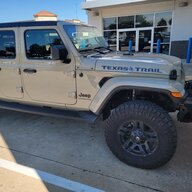
2022 Jeep Gladiator Texas Trail
I'm guessing the transmission is "tuned" for different parameters on the Max-Tow mine holds 4 or 5 up to and past 45 mph. Holding and runs up past 3000 before shifts. I'd like to see if anyone else with a Max-Tow has noticed the same.
That's nuts. Mine is the exact opposite. The one consistent thing about this transmission is the inconsistency. I make weekly trips between Dallas and Waco. Gas mileage runs an average between 13.5 and 19 per trip unless I'm manually shifting the whole time. Going down a slight incline at 70 the damn thing won't shift into 8th gear unless I shift it. Not all the time, but often enough.

35s on 3.73, so I get I'm not always gonna enjoy 8th gear. Any kind of an incline and it downshifts. I'm ok with that. When it jumps all the way to 5th... that's a problem. 10 times as bad with cruise control. I've given up on it.
 

Scrubb84

Well-Known Member
First Name
Adam
Joined
Aug 22, 2019
Threads
6
Messages
308
Reaction score
279
Location
Saranac Lake, NY
Vehicle(s)
2020 JTR
That's nuts. Mine is the exact opposite. The one consistent thing about this transmission is the inconsistency. I make weekly trips between Dallas and Waco. Gas mileage runs an average between 13.5 and 19 per trip unless I'm manually shifting the whole time. Going down a slight incline at 70 the damn thing won't shift into 8th gear unless I shift it. Not all the time, but often enough.

35s on 3.73, so I get I'm not always gonna enjoy 8th gear. Any kind of an incline and it downshifts. I'm ok with that. When it jumps all the way to 5th... that's a problem. 10 times as bad with cruise control. I've given up on it.
Yup, regardless of how u drive, it is a shit-show. I wish a 5th grader was on the engineering/design teams. Things would have been a whole lot better all the way around, not just the transmission.
 
First Name
Brian
Joined
Aug 28, 2020
Threads
3
Messages
21
Reaction score
8
Location
VA
Vehicle(s)
loaner
Occupation
IT guy
I ran 89 for a few tanks while on vacation and everything seemed fine for about a week. The rattle has re-appeared.... considering bumping up to 91 or 93 on the next fill-up.

Also, I thought this was tied to heat and humidity but that theory seems to be out the window as well.
 

Blade1668

Well-Known Member
First Name
Darrell
Joined
Jan 7, 2020
Threads
12
Messages
3,263
Reaction score
3,148
Location
N. AL.
Vehicle(s)
90XJ, 91XJ, 91MJ, 05 LJ, 20 JT
Build Thread
Link
Vehicle Showcase
1
That's nuts. Mine is the exact opposite. The one consistent thing about this transmission is the inconsistency. I make weekly trips between Dallas and Waco. Gas mileage runs an average between 13.5 and 19 per trip unless I'm manually shifting the whole time. Going down a slight incline at 70 the damn thing won't shift into 8th gear unless I shift it. Not all the time, but often enough.

35s on 3.73, so I get I'm not always gonna enjoy 8th gear. Any kind of an incline and it downshifts. I'm ok with that. When it jumps all the way to 5th... that's a problem. 10 times as bad with cruise control. I've given up on it.
If I'm reading your post correctly you don't have a Max-Tow via reading 3:73 gearing. With that I've got a Sport S "Max-Tow" with 4:11 gearing.
 

Sponsored

Jeepin' John

Well-Known Member
First Name
John
Joined
May 6, 2020
Threads
9
Messages
373
Reaction score
936
Location
Raleigh, NC
Vehicle(s)
'20 JT Sport S
Occupation
Structural Engineer
Referring to low speed pre-ignition, my conspiracy theory is that it has become a new problem due to using 0w-20 weight oil. The oil is thin enough to get into the cylinder in larger quantities, to the point that it is affecting combustion and causing knock

High engine compression would make more PCV line pressure right? And thinner oil would flow through it easier, and even overcome a good catch can. Might be why i'm seeing some oil still make it though my mishimoto at the intake manifold clean line.

And if you're combining PCV oil in the cylinder as well as the oil coming by the piston rings in a larger amount into the cylinder, you've got a good amount of oil that is being compressed in a high compression engine with the fuel. Seems like that could be causing the low-speed pre-ignition.

that's my uneducated theory - could be totally wrong, just thinking out loud for the guys who know more about this stuff

i think running 89, 91, or 93 is a bandaid for this specific problem, and that a catch can reduces but doesn't eliminate the problem. And that it's not necessarily related to engine intake temp (i still get it on mild days with a mopar intake)

thoughts guys?
 

Scrubb84

Well-Known Member
First Name
Adam
Joined
Aug 22, 2019
Threads
6
Messages
308
Reaction score
279
Location
Saranac Lake, NY
Vehicle(s)
2020 JTR
Referring to low speed pre-ignition, my conspiracy theory is that it has become a new problem due to using 0w-20 weight oil. The oil is thin enough to get into the cylinder in larger quantities, to the point that it is affecting combustion and causing knock

High engine compression would make more PCV line pressure right? And thinner oil would flow through it easier, and even overcome a good catch can. Might be why i'm seeing some oil still make it though my mishimoto at the intake manifold clean line.

And if you're combining PCV oil in the cylinder as well as the oil coming by the piston rings in a larger amount into the cylinder, you've got a good amount of oil that is being compressed in a high compression engine with the fuel. Seems like that could be causing the low-speed pre-ignition.

that's my uneducated theory - could be totally wrong, just thinking out loud for the guys who know more about this stuff

i think running 89, 91, or 93 is a bandaid for this specific problem, and that a catch can reduces but doesn't eliminate the problem. And that it's not necessarily related to engine intake temp (i still get it on mild days with a mopar intake)

thoughts guys?
I know a guy who recently tried 5W-20 with absolutely zero change with the detonation/rattle. I bet he would be willing to try something even thicker if I ask him too. LMK
 

Jeepin' John

Well-Known Member
First Name
John
Joined
May 6, 2020
Threads
9
Messages
373
Reaction score
936
Location
Raleigh, NC
Vehicle(s)
'20 JT Sport S
Occupation
Structural Engineer
I know a guy who recently tried 5W-20 with absolutely zero change with the detonation/rattle. I bet he would be willing to try something even thicker if I ask him too. LMK
the 5 wouldn't make a change at operating temp, the 20 would still result in the same problem at operating temp. If trying something thicker for science, 0w-30 would probably be it.

I'm not recommending -anyone else- run a different weight than recommended by the manufacturer. I'm contemplating being a lab mouse, and trying 0w-30 in mine, but not decided yet.

I know the engineers are smart and know what they're doing, but i also know they're put between a rock and a hard place designing these engines. If you told them, let's forget about fuel economy and that you just need these engines to last just 100k miles, and i want you to design a pentastar that gets lower fuel economy, can run on 87, 89, or 91, can run any weight oil, but has to last 300k miles. What would they recommend for oil weight and fuel then? Genuinely curious, not trying to prove any specific point as far as octane or engine weight - i'd love to know what they would recommend if their design criteria changed to maximize reliability and zero knock
 

DAVECS1

Well-Known Member
First Name
David
Joined
Jan 24, 2020
Threads
56
Messages
1,861
Reaction score
2,538
Location
Peoria, IL
Vehicle(s)
2020 Gladiator Sport S Max Tow
I think the Cam tuning is bogus, buuuuuuutttt, with that said I would be concerned about it, changing oil weights. The engine was probably tuned using 20w. I think your theory is a sound one. On the same tomen there is no shortage of phazers being changed out of these engines.
 

ShadowsPapa

Well-Known Member
First Name
Bill
Joined
Oct 12, 2019
Threads
247
Messages
40,440
Reaction score
53,853
Location
Runnells, Iowa
Vehicle(s)
'25 JTMX, '23 JLU 4xe, '82 SX4, '73 Javelin
Occupation
Retired auto mechanic, frmr gov't ntwrk security admin
Vehicle Showcase
3
Referring to low speed pre-ignition, my conspiracy theory is that it has become a new problem due to using 0w-20 weight oil. The oil is thin enough to get into the cylinder in larger quantities, to the point that it is affecting combustion and causing knock

High engine compression would make more PCV line pressure right? And thinner oil would flow through it easier, and even overcome a good catch can. Might be why i'm seeing some oil still make it though my mishimoto at the intake manifold clean line.

And if you're combining PCV oil in the cylinder as well as the oil coming by the piston rings in a larger amount into the cylinder, you've got a good amount of oil that is being compressed in a high compression engine with the fuel. Seems like that could be causing the low-speed pre-ignition.

that's my uneducated theory - could be totally wrong, just thinking out loud for the guys who know more about this stuff

i think running 89, 91, or 93 is a bandaid for this specific problem, and that a catch can reduces but doesn't eliminate the problem. And that it's not necessarily related to engine intake temp (i still get it on mild days with a mopar intake)

thoughts guys?
Oil in the chamber leads to detonation. Preignition is different but all over the web i see them switched around and some even using the made-up word "predetonation" - a merger of the two issues that doesnt exist.
Detonation is after the spark.
Preignition is when the charge ignites before the spark...
thus PRE plus IGNITION meaning before ignition (by spark)
 

Sponsored

Jeepin' John

Well-Known Member
First Name
John
Joined
May 6, 2020
Threads
9
Messages
373
Reaction score
936
Location
Raleigh, NC
Vehicle(s)
'20 JT Sport S
Occupation
Structural Engineer
Whatever they want to call it, all of the LSPI tech articles i've read talk about trying to fix it with oil formulations. So to me, that's the hint that it's related to oil in the combustion chamber. So why is there so much oil in the combustion chamber to the level that causes knock?

My theory is it's the thin 0w-20 weight oil. My idea of the solution is keeping as much oil out of the combustion chamber as possible. I might try a more "normal" 5w-30 oil and see if the knock goes away. It would probably be a pretty quick result. If i'm still getting LSPI after say, 1,000 miles, i'll drain it out and put 0w-20 back in and say i tried. If LSPI goes away, that's a good result i think for engine longevity
 

DAVECS1

Well-Known Member
First Name
David
Joined
Jan 24, 2020
Threads
56
Messages
1,861
Reaction score
2,538
Location
Peoria, IL
Vehicle(s)
2020 Gladiator Sport S Max Tow
So the only issue I see with that theory, is it may fix the combustion chamber issue, but then the cam timing will be off causing a similar knock issue.
 

Scrubb84

Well-Known Member
First Name
Adam
Joined
Aug 22, 2019
Threads
6
Messages
308
Reaction score
279
Location
Saranac Lake, NY
Vehicle(s)
2020 JTR
So the only issue I see with that theory, is it may fix the combustion chamber issue, but then the cam timing will be off causing a similar knock issue.
are you saying the cam timing is the definite problem?
replace cam phasers?
 

ShadowsPapa

Well-Known Member
First Name
Bill
Joined
Oct 12, 2019
Threads
247
Messages
40,440
Reaction score
53,853
Location
Runnells, Iowa
Vehicle(s)
'25 JTMX, '23 JLU 4xe, '82 SX4, '73 Javelin
Occupation
Retired auto mechanic, frmr gov't ntwrk security admin
Vehicle Showcase
3
How about looking at this in the grand scheme of things -
Why do most of them not do it at all, or if they do, it's a minor thing and of no concern?
Mine doesn't - and I've hauled a load or two heavier than my truck should hauled, and I live in a very hilly area. Every single time I come back home, I have to brake to slow and make a left turn onto a road that goes up a 4+ percent hill about 1/4 mile long, I'm going up that hill at lower RPM (1200-1600 depending on gear) and accelerating up the hill. No ping. Our area is all hills, from 3 to 5 percent on a lot of them, elevation varies wildly, speeds vary, mostly winding county blacktops.
I was towing 4900-5000 pounds home last night and had to take off from the stop signs and make the hills - no ping. Unloaded - no ping.
We've never heard a ping out of my wife's multiple Grand Cherokees with 3.6

I've talked to others who own these trucks (local folks) - no ping.
So why some and not all or even most?

Yes, it's well known that oil in the combustion chamber can exacerbate or even cause the ping of detonation. And it's not a theory with me that it can cause or make it worse. I've studied it for years building performance engines, not to mention my training as a tech - no one has to convince me that oil in the chamber can be a problem. When you see engines lost twice to severe detonation, you learn as much as you can about it.


0w20 vs 5w30 - the 0 vs 5 is cold weather. So that 5 won't matter once it's warmed up.
The 20 vs 30 - not a whole lot of difference in the grand scheme of things.
Once an oil is warmed up, the 0w and the 5w will be basically the same.
So you really are making it a tad more viscous when cold (0 vs 5) so that difference disappears.
You are basically switching from 20 to 30 if you ignore the cold startup part (the "W" part)

In short, once warmed up, there's little difference - but since the phasers and other parts rely on specific pressures and flows............. I guess you'll find out.

Sometimes I wonder if people are hearing something that's really a concern, or just not experienced enough with engines over a period of many years to know that a short bit under certain conditions isn't enough to get excited about. If mine even did ping for say a brief second while under low RPM load on a hill, or after a corner and it lasted maybe a second - I'd move on.
If it was more frequent or longer - that's a different animal.
 

Scrubb84

Well-Known Member
First Name
Adam
Joined
Aug 22, 2019
Threads
6
Messages
308
Reaction score
279
Location
Saranac Lake, NY
Vehicle(s)
2020 JTR
How about looking at this in the grand scheme of things -
Why do most of them not do it at all, or if they do, it's a minor thing and of no concern?
Mine doesn't - and I've hauled a load or two heavier than my truck should hauled, and I live in a very hilly area. Every single time I come back home, I have to brake to slow and make a left turn onto a road that goes up a 4+ percent hill about 1/4 mile long, I'm going up that hill at lower RPM (1200-1600 depending on gear) and accelerating up the hill. No ping. Our area is all hills, from 3 to 5 percent on a lot of them, elevation varies wildly, speeds vary, mostly winding county blacktops.
I was towing 4900-5000 pounds home last night and had to take off from the stop signs and make the hills - no ping. Unloaded - no ping.
We've never heard a ping out of my wife's multiple Grand Cherokees with 3.6

I've talked to others who own these trucks (local folks) - no ping.
So why some and not all or even most?

Yes, it's well known that oil in the combustion chamber can exacerbate or even cause the ping of detonation. And it's not a theory with me that it can cause or make it worse. I've studied it for years building performance engines, not to mention my training as a tech - no one has to convince me that oil in the chamber can be a problem. When you see engines lost twice to severe detonation, you learn as much as you can about it.


0w20 vs 5w30 - the 0 vs 5 is cold weather. So that 5 won't matter once it's warmed up.
The 20 vs 30 - not a whole lot of difference in the grand scheme of things.
Once an oil is warmed up, the 0w and the 5w will be basically the same.
So you really are making it a tad more viscous when cold (0 vs 5) so that difference disappears.
You are basically switching from 20 to 30 if you ignore the cold startup part (the "W" part)

In short, once warmed up, there's little difference - but since the phasers and other parts rely on specific pressures and flows............. I guess you'll find out.

Sometimes I wonder if people are hearing something that's really a concern, or just not experienced enough with engines over a period of many years to know that a short bit under certain conditions isn't enough to get excited about. If mine even did ping for say a brief second while under low RPM load on a hill, or after a corner and it lasted maybe a second - I'd move on.
If it was more frequent or longer - that's a different animal.
The quick ping that most experience is not quick on mine. It can go for 1/4 mile straight if the conditions are just right. And it sounds like a bad throw out bearing. Problem is I have an 8spd auto.
Sponsored


Top