
Sponsored

Soft brake pedal on my Gladiator Rubicon

ShadowsPapa

Well-Known Member
First Name
Bill
Joined
Oct 12, 2019
Threads
247
Messages
40,440
Reaction score
53,853
Location
Runnells, Iowa
Vehicle(s)
'25 JTMX, '23 JLU 4xe, '82 SX4, '73 Javelin
Occupation
Retired auto mechanic, frmr gov't ntwrk security admin
Vehicle Showcase
3
My guess is low brake booster pressure.
Diesels don't create vacuum like a gas engine, so boost comes from a hydraulic or electric booster.
Low booster vacuum is reason for a hard pedal, difficult to push, not a soft pdeal.

Mine was weak from the time I bought it dec of 21 I double tap the brake to bring it up . I told them this but they never looked at it during first year of nitemare issues . It’s still this way too. It really should be a recall like other said
Recall? For what? The brakes work fine. My Silverado was always where it went down farther on the first push compared to subsequent pedal presses. Yet it braked fine, hauled, towed, never a problem. Just a different feel from others.
I wonder if many are trying to compare to other vehicles - and that shouldn't be the case.
I've owned two of these and yes, the pedal is different, but it's more akin to a graduated application of the brakes, not faulty brakes. It'll stop 5,000 pounds just fine. I've had to "hit the brakes!" more than once, and it's never failed. It's a lot like my Chevy was. My ford always had a solid pedal, it was just different, not better. In fact, the rear-only ABS was a joke and just plain deadly! Most F250 owers disabled that garbage system it was so bad. (there was never a recall)
There's nothing to recall here. The brakes work. They are just more like Chevy than certain other brands. They stop and stop fine (otherwise I'd have been calling DNR a couple of times to get deer removed from the road (and my JT would be in the shop for repairs). I've had people on the highway slam on brakes because they weren't paying attention and I had to do similar (but wasn't following so close). Been in mountains in traffic jams in extreme traffic - never a braking. Pike's Peak- never any issue.
Different, but not faulty.
Sponsored

 

MudderNuker

Well-Known Member
First Name
Jose
Joined
May 20, 2023
Threads
19
Messages
614
Reaction score
753
Vehicle(s)
'21 JTR
Occupation
Retired@52
My '21 Willy's feels the same but it stops really well once you press beyond half way. My '92 YJ when I bought it, I didn't feel safe going over 30 MPH. That is how bad the brakes were. Years of no maintenance will do that. I replaced everything, disks, drums, pads and bands and now it stops nicely. If I recall correctly, my 2012 JKU felt the same as the JT.
 

Rusty PW

Well-Known Member
First Name
Russ
Joined
Jan 10, 2022
Threads
37
Messages
11,320
Reaction score
30,200
Location
Fayette Nam, Pennsyltucky
Website
www.youtube.com
Vehicle(s)
'22 JTRD, '11 370Z Nismo, '07 Honda VFR
Build Thread
Link
Occupation
Muff Diver
Low booster vacuum is reason for a hard pedal, difficult to push, not a soft pdeal.


Recall? For what? The brakes work fine. My Silverado was always where it went down farther on the first push compared to subsequent pedal presses. Yet it braked fine, hauled, towed, never a problem. Just a different feel from others.
I wonder if many are trying to compare to other vehicles - and that shouldn't be the case.
I've owned two of these and yes, the pedal is different, but it's more akin to a graduated application of the brakes, not faulty brakes. It'll stop 5,000 pounds just fine. I've had to "hit the brakes!" more than once, and it's never failed. It's a lot like my Chevy was. My ford always had a solid pedal, it was just different, not better. In fact, the rear-only ABS was a joke and just plain deadly! Most F250 owers disabled that garbage system it was so bad. (there was never a recall)
There's nothing to recall here. The brakes work. They are just more like Chevy than certain other brands. They stop and stop fine (otherwise I'd have been calling DNR a couple of times to get deer removed from the road (and my JT would be in the shop for repairs). I've had people on the highway slam on brakes because they weren't paying attention and I had to do similar (but wasn't following so close). Been in mountains in traffic jams in extreme traffic - never a braking. Pike's Peak- never any issue.
Different, but not faulty.
Had rear anti lock brakes on my 08 Power Wagon. They were OK for the most part. Unless you were hard on the brake pedal and hit a bump. That would unload the rear axle and the pedal would go to the floor. You had to do a quick second pump of the pedal to get it to come back up.
 

ShadowsPapa

Well-Known Member
First Name
Bill
Joined
Oct 12, 2019
Threads
247
Messages
40,440
Reaction score
53,853
Location
Runnells, Iowa
Vehicle(s)
'25 JTMX, '23 JLU 4xe, '82 SX4, '73 Javelin
Occupation
Retired auto mechanic, frmr gov't ntwrk security admin
Vehicle Showcase
3
Had rear anti lock brakes on my 08 Power Wagon. They were OK for the most part. Unless you were hard on the brake pedal and hit a bump. That would unload the rear axle and the pedal would go to the floor. You had to do a quick second pump of the pedal to get it to come back up.
Wow, that's weird.

One other thing that hasn't been talked about - these have a very different brake pedal, pedal sensing and with 4 wheel disk brakes, there's no residual pressure valves to hold pressure in the calipers like there was with drum brakes. So as the wheels turn, the normal imperfections in the rotors push or nudge the brake pads back a bit. First pump removes all play, second will be higher, maybe more firm, because the pads are again against the rotors until a few more rotations move the pads back again.
These also detect how hard you are pressing the brakes for various reasons, including the much-hated and maligned infamous ESS (and traction and stability control, and I've noticed it pays attention to how hard I brake for a split second when going down a hill. Do it just right and it seems to downshift and apply engine braking to keep me from speeding up going down a good hill. Don't hit the brakes firmly enough, it won't do it.
 

IzzyO

Well-Known Member
First Name
Jay
Joined
Mar 25, 2022
Threads
4
Messages
59
Reaction score
25
Location
Utah
Vehicle(s)
21' Jeep Gladiator Rubicon
I've experienced this soft brake pedal as well. The problem really came about and was noticeable after an incident where I hit some ice and the ABS engaged. After trying the normal bleeding of brakes & checking the components of the brake system the only thing that ended up fixing it was to bleed the brakes with the ABS active. I'm not sure why the ABS engaging would cause there to be air in the brake lines or maybe it was there already. All I know is that it is now fixed after bleeding the brakes with the ABS active.
 

Sponsored

PuddleJumper

Well-Known Member
First Name
Cortlund
Joined
Jan 17, 2024
Threads
68
Messages
2,540
Reaction score
3,373
Location
Alexandria, Virginia
Vehicle(s)
23' JTM, 22' JTR, 22' F56S,
Build Thread
Link
Occupation
STACK Infrastructure Critical Operations Technician
Vehicle Showcase
1
Hi, I'm starting a new thread on this after unsuccessfully searching for mention of this problem. Basically the brakes on my truck work fine and are pretty similar to other trucks I've owned, including my previous Gladiator. However the brake pedal on my new truck has a distinctly soft or mushy feel that I don't remember being on the 2020 Gladiator I had. The new one is a diesel so it's heavier in the front, both were Rubicons, and it's unrelated to any wheel or tire changes (same on stock wheels/tires). The brake pedal feel is like what one gets with air in the lines, or a leaking caliper, or a bad master cylinder, or worn out rubber brake lines. There's no fluid loss anywhere, so that rules out an actual leak, but I just don't have enough experience with Jeeps to know if this is typical or not typical. Again, there's no lack of actual stopping power, just this soft pedal that doesn't feel good. I used to race cars and the feeling is similar to when we would overheat the brakes and boil the fluid or cook the pads, which of course hasn't happened with my new truck. I'm totally capable of changing parts or bleeding the system, I just don't know where to start. Any helpful advice or insight would be greatly appreciated!
i got a 23' JTM, it felt mushy when i got it and i assumed they were all like that. I got a Tazer JL and now it seems adaptive? like if your ginger with it, it almost feels like you got pump it but still somehow has plenty of stopping power. its very disconnecting. However if you fucking get on it quick and hard, its immeadiately firm with minimal travel before it bites. IDK whats going on but its like its electronically progressive/smart now i guess.
 

ecidiego

Well-Known Member
First Name
Chris
Joined
Nov 3, 2021
Threads
62
Messages
3,625
Reaction score
5,580
Location
San Diego
Vehicle(s)
2021 Gladiator Mojave
Occupation
IT
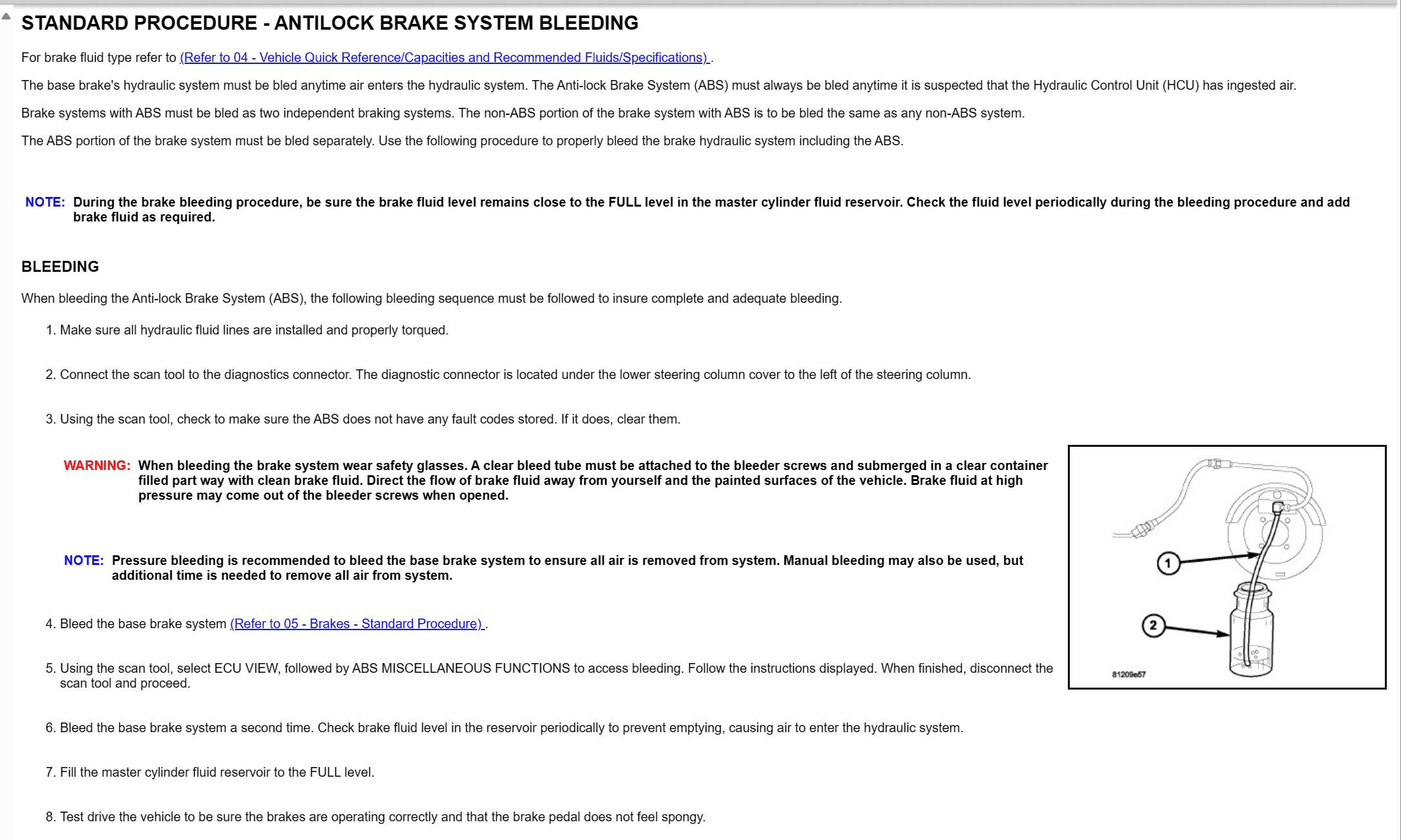
Changing brake fluid this weekend - sounds like I first do a normal fluid change and bleed.... then bleed one more time using AlfaOBD to trigger the "ABS Brake Bleed" function?
 

Toyfrog

Well-Known Member
First Name
James
Joined
Sep 4, 2020
Threads
8
Messages
603
Reaction score
697
Location
Houston
Vehicle(s)
2021 Mojave
Changing brake fluid this weekend - sounds like I first do a normal fluid change and bleed.... then bleed one more time using AlfaOBD to trigger the "ABS Brake Bleed" function?
Took mine to the dealership for the third time for this. They said they couldn’t find anything wrong even though the tech said if you push the brake and let off and push it again that it firms up. I told them that if it sat for a few days, that sometimes the brake pedal would be like a rock on startup. He said that’s normal sometimes. ?
 

ecidiego

Well-Known Member
First Name
Chris
Joined
Nov 3, 2021
Threads
62
Messages
3,625
Reaction score
5,580
Location
San Diego
Vehicle(s)
2021 Gladiator Mojave
Occupation
IT
Opened the service USB since I am doing this today, figured I'd post the bleed page straight from it. If you bleed ABS they want you to do another "regular" bleed after:

Jeep Gladiator Soft brake pedal on my Gladiator Rubicon 1709996867698
 

Desert_Gladiator

Well-Known Member
Joined
Jan 9, 2024
Threads
4
Messages
53
Reaction score
71
Location
Mojave Desert
Vehicle(s)
2023 JTRD
Just to add my experiences to this thread, as I found this thread when trying to look for advice on working through similar issues posted here, and also this thread has some conflicting information/experiences from other owners that were probably provided with bad service/information by dealers.

I have a '23 JTRD. I installed a lift that required changing some extended brake lines. After doing the lift, I did a thorough standard bleed as I've always done on any other vehicle.

Ever since installing the lift, my brake pedal had felt mushy, though it did not seem to reduce available clamping power -- I could still lock the brakes up, though with the pedal nearly to the floor. Also the first pump of the pedal would require pressing the pedal much further than subsequent pumps. I started a habit of a short false pump on the brake pedal to get better engagement/pedal feedback. I finally had enough with the situation when running Rocky Gap -- I felt I had very little control when dropping off boulders in the rock garden as it was very difficult to precisely modulate the pedal.

I was confident that I'd bled the brakes properly, but this thread was my first introduction to the "ABS Pump Bleed". I also read a lot of the diesel-specific comments and wondered if this was just the nature of my truck, and also started second-guessing myself on whether the issue had been present before the lift install, etc. I decided it would be worth the effort to attempt to sort out the issue. So, I picked up a JSCAN license and did the following:

1. Another Standard Bleed. - No change/Improvement
2. ABS Pump Bleed procedure using JSCAN - If anything, made the issue WORSE!
2. Yet another standard bleed - OMG! Problem Sorted!!!

My brake pedal feels so much better now with perfectly positive engagement at the first tap, starts right at the top of the stroke, and doesn't fall to the floor with continuous pressure. So - this is not something ecodiesel owners need to live with - it appears simply that proper brake bleeding in this vehicle is more difficult than others I have experience with and a standard bleed likely won't resolve issues with air in the lines/components. Also, make sure the follow the ENTIRE procedure posted by ecidiego (post #41) - It may seem like an excessive amount of brake bleeding, but my issue didn't resolve until another round of normal brake bleeding after doing the ABS bleed procedure.
 

Sponsored

gravely

Well-Known Member
First Name
Jeremy
Joined
Jan 4, 2025
Threads
6
Messages
68
Reaction score
50
Location
Indy
Vehicle(s)
2022 willy gladiator
Occupation
Automotive technology
My two door anniversary 2021 felt soft and not responsive. Always thought it was just the underpowered brakes do to weight. My willys gladly feel much better and surprising responsive
 

ShadowsPapa

Well-Known Member
First Name
Bill
Joined
Oct 12, 2019
Threads
247
Messages
40,440
Reaction score
53,853
Location
Runnells, Iowa
Vehicle(s)
'25 JTMX, '23 JLU 4xe, '82 SX4, '73 Javelin
Occupation
Retired auto mechanic, frmr gov't ntwrk security admin
Vehicle Showcase
3
Always thought it was just the underpowered brakes do to weight.
No such thing as far as impacting the feel of the pedal. Brakes can't be "under-powered" other than having not enough boost, simply making the pedal harder to push. If they were undersized for the weight of the vehicle, the brakes would still feel firm and fine - but your stopping distance would be increased.
that is the only difference between brakes too small for the load/weight and brakes that are sized perfectly for the weight - the amount of time it takes to stop.
Undersized brakes may also be prone to fading as they get hot - but it won't really impact how the pedal feels - soft or firm.

"soft pedal" really is rather subjective - does it mean mushy, as if there's air in the system or does it mean that the pedal goes down farther than expected.
Every truck I've owned with disk brakes (truck will have larger rotors and larger fluid capacity in the calipers - so it matters) has had a pedal that is lower the first push, but comes up right away on the second push.
That is typically caused by the rotors being imperfect - a slight amount of runout, and, wheel bearing play. Disk brakes don't self-retract. They rely on the tiny bit of rotor runout or imperfection, coupled with a bit of give in the wheel bearings to literally push the pads back from the rotors. They'll still drag, but not push hard.
Large calipers means that you need a lot of fluid moved back into the caliper to push the pads back against the rotor - the first push fills them and moves the pads back to the rotor, the second push applies the pads firmly against the caliper. So a bit of difference between the first push and the second is not unexpected in large capacity disk brakes - and the larger they are, the more noticeable the difference may be.
 

Minty JL

Well-Known Member
First Name
Jeremy
Joined
May 15, 2019
Threads
25
Messages
4,793
Reaction score
7,612
Location
Ft Meade, MD - AOR
Vehicle(s)
23 JTM - 19 JLUR - 22 Compass LTD - 04 355 ZQ8
Occupation
USA(R), DoD - MD TM lead - Field Operations
American Power Brakes offers a upgraded booster for like $1300. They take a OEM booster and modify it some how. Advertising 35% better braking.

There videos on YT about it, the install looks rather straight forward
 

gravely

Well-Known Member
First Name
Jeremy
Joined
Jan 4, 2025
Threads
6
Messages
68
Reaction score
50
Location
Indy
Vehicle(s)
2022 willy gladiator
Occupation
Automotive technology
No such thing as far as impacting the feel of the pedal. Brakes can't be "under-powered" other than having not enough boost, simply making the pedal harder to push. If they were undersized for the weight of the vehicle, the brakes would still feel firm and fine - but your stopping distance would be increased.
that is the only difference between brakes too small for the load/weight and brakes that are sized perfectly for the weight - the amount of time it takes to stop.
Undersized brakes may also be prone to fading as they get hot - but it won't really impact how the pedal feels - soft or firm.

"soft pedal" really is rather subjective - does it mean mushy, as if there's air in the system or does it mean that the pedal goes down farther than expected.
Every truck I've owned with disk brakes (truck will have larger rotors and larger fluid capacity in the calipers - so it matters) has had a pedal that is lower the first push, but comes up right away on the second push.
That is typically caused by the rotors being imperfect - a slight amount of runout, and, wheel bearing play. Disk brakes don't self-retract. They rely on the tiny bit of rotor runout or imperfection, coupled with a bit of give in the wheel bearings to literally push the pads back from the rotors. They'll still drag, but not push hard.
Large calipers means that you need a lot of fluid moved back into the caliper to push the pads back against the rotor - the first push fills them and moves the pads back to the rotor, the second push applies the pads firmly against the caliper. So a bit of difference between the first push and the second is not unexpected in large capacity disk brakes - and the larger they are, the more noticeable the difference may be.
Well lets say not so mushy or like there was air in it, just definitely lacking in the braking for as light as it was. The gladiators that I have test drove and now own is night and day. I'm not sure if they are just bigger or larger booster, but definitely different.
 
Last edited:

Stan H

Well-Known Member
First Name
Stanley
Joined
Oct 26, 2022
Threads
10
Messages
5,475
Reaction score
5,456
Location
WV
Vehicle(s)
Gladiator Rubicon 2021
Occupation
Safety Consultant
No such thing as far as impacting the feel of the pedal. Brakes can't be "under-powered" other than having not enough boost, simply making the pedal harder to push. If they were undersized for the weight of the vehicle, the brakes would still feel firm and fine - but your stopping distance would be increased.
that is the only difference between brakes too small for the load/weight and brakes that are sized perfectly for the weight - the amount of time it takes to stop.
Undersized brakes may also be prone to fading as they get hot - but it won't really impact how the pedal feels - soft or firm.

"soft pedal" really is rather subjective - does it mean mushy, as if there's air in the system or does it mean that the pedal goes down farther than expected.
Every truck I've owned with disk brakes (truck will have larger rotors and larger fluid capacity in the calipers - so it matters) has had a pedal that is lower the first push, but comes up right away on the second push.
That is typically caused by the rotors being imperfect - a slight amount of runout, and, wheel bearing play. Disk brakes don't self-retract. They rely on the tiny bit of rotor runout or imperfection, coupled with a bit of give in the wheel bearings to literally push the pads back from the rotors. They'll still drag, but not push hard.
Large calipers means that you need a lot of fluid moved back into the caliper to push the pads back against the rotor - the first push fills them and moves the pads back to the rotor, the second push applies the pads firmly against the caliper. So a bit of difference between the first push and the second is not unexpected in large capacity disk brakes - and the larger they are, the more noticeable the difference may be.
When I experienced this it was rhe bottom caliper slider rusted badly. Removed the caliper attachment braket from the axle and had to beat the sliders out . Then got 2 new ones and brake pads. BAM lots of stopping power.
P.S. both bottom ones each side were like that.
Sponsored


Top