
Flanders
Well-Known Member
- Thread starter
- #1
Noco does not disclose any useful details of their charging algorithms. This puffery is why I don't own a Noco charger.
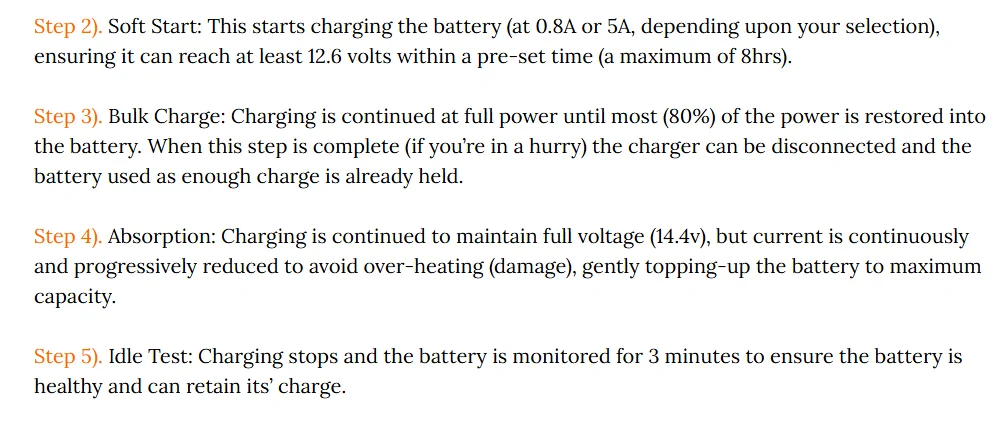
This is a constant-current charger. It has 6 charging currents. Each current has a voltage cutoff. When the voltage rises to the cutoff, it drops to the next lower current.
Once it finishes at its lowest charging current it shuts off. The top green light on the charge meter goes solid. No current flows in this dormant state. The battery voltage slowly falls to 12.875V, at which point the charging cycle starts again at the lowest current. The green light pulses until it reaches its voltage limit and goes dormant again. This cycle repeats indefinitely.
These measurements were taken in AGM mode. The voltages for higher currents are not accurate because the NG10 has temperature compensation and it warmed up noticeably as it charged at high currents and cooled during the low/no current stages.
At startup, the NG10 tests currents for 14.5s each, starting with 1.39A and increasing until it sees a sharp rise in voltage. It starts charging about two levels below that. If it gets to its max current without voltage spiking then it stays with that.
The charger undoubtedly uses other factors to determine transitions between currents. Time limits, for one. But that's the general shape of it. Let's see it in action.
The JT sat for 2 days. I turned on the headlights for 8 minutes, waited an hour for it to go into its deepest sleep state and plugged in the NG10. The first 100 seconds shows the startup sequence.

This was actually the start of a 2000-second capture.
I barely caught the next step down, to 0.32A at 14.75V.
It took another 5000s at 0.32A to finish, at 15.05V.
That voltage dip around 900s is some system in the Jeep waking up. This happens every 12 hours. The Noco didn't react.
The indicator light went solid green and nothing happened for about 12 hours. The charger is off. Eventually the battery fell to 12.875V. I only caught the start of the first re-up.
The next re-up came a couple of hours later. Charging lasted about 16 minutes.
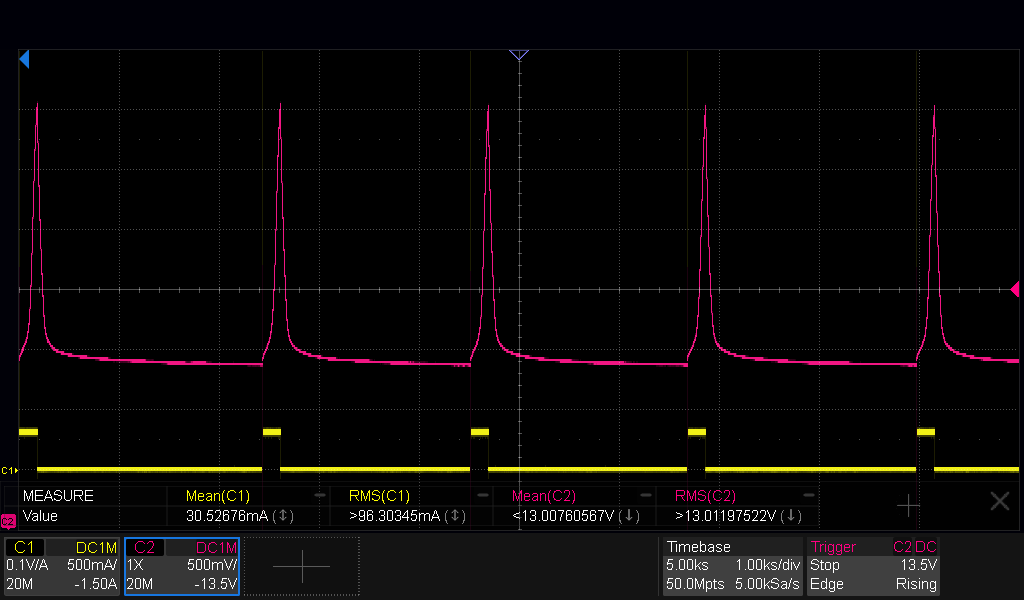
Subsequent re-ups all have the same shape, but they get shorter and more frequent. It takes less time at 0.32A to get to 15.05V, and it remains above 12.875V for a shorter time.
After two days of this, the re-ups are happening every 45 minutes and lasting only about 3 minutes.
On the third day I disconnected the Noco and finished charging with a power supply. It didn't take any charge to speak of. The NG10 got it done.
Apparently, I have a lot more to say about the Genius 10.
Edit: I tried again later in this thread to get the Noco Genius 10 to charge a normally discharged Jeep at higher current than its 0.32A minimum, this time with no shunt resistor. Same result. The battery would have happily accepted 3.3A at 13.5V for awhile, but the Noco only charged at 0.32A.
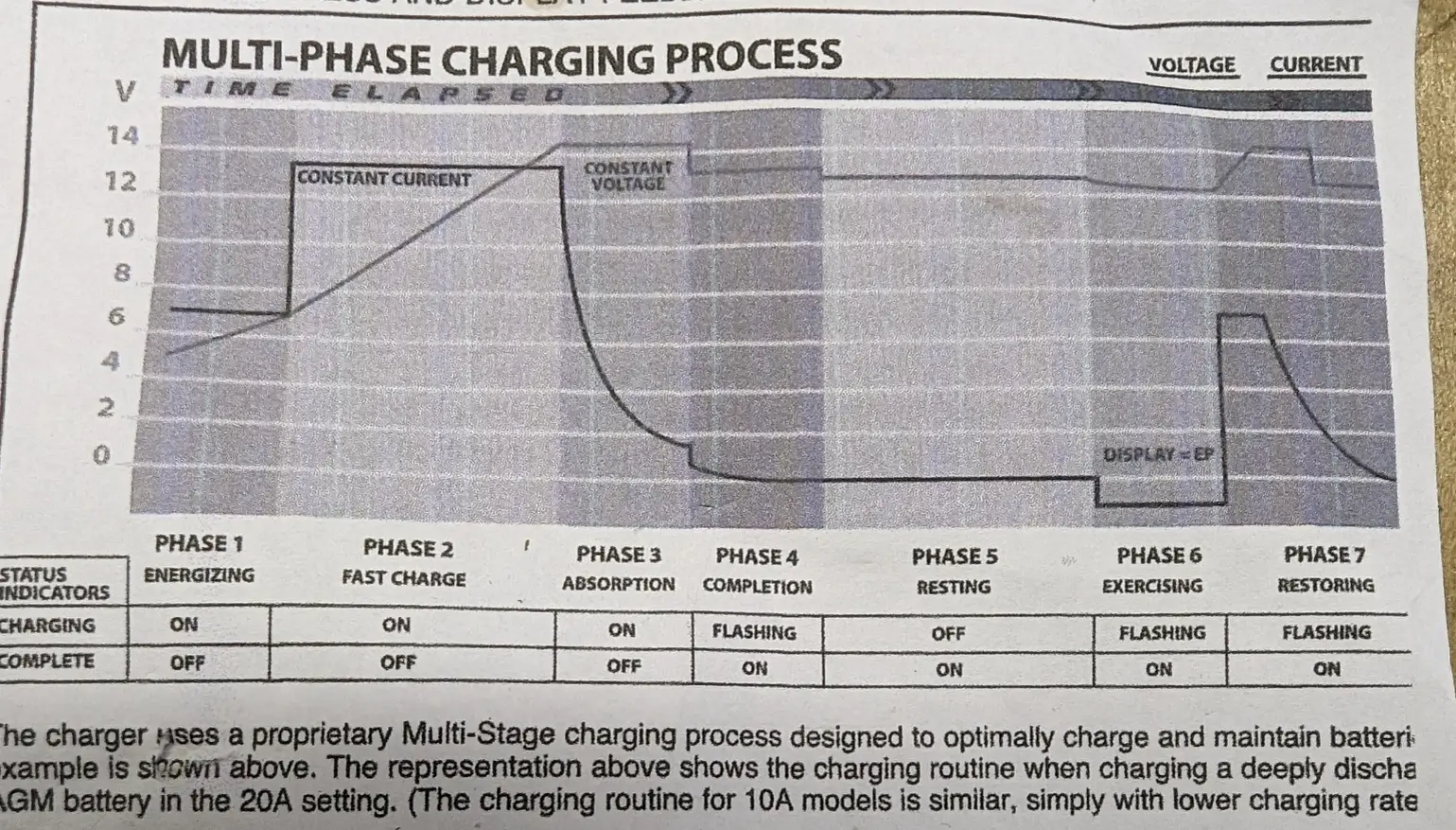
Yet I have in hand a Genius 10 and I can't deny its pleasing heft. Let us prepare to grapple with the ineffable itself, and see if we may not eff it after all.the charger utilizes multilayered charging profiles to fully recapture capacity and optimize the specific gravity of the battery for increased run time and performance
This is a constant-current charger. It has 6 charging currents. Each current has a voltage cutoff. When the voltage rises to the cutoff, it drops to the next lower current.
Once it finishes at its lowest charging current it shuts off. The top green light on the charge meter goes solid. No current flows in this dormant state. The battery voltage slowly falls to 12.875V, at which point the charging cycle starts again at the lowest current. The green light pulses until it reaches its voltage limit and goes dormant again. This cycle repeats indefinitely.
Current (A) | Cutoff (V) (50-55F) |
|---|---|
9.66 | ? |
7.20 | ? |
4.78 | 14.60 |
3.32 | 14.68 |
1.39 | 14.75 |
0.32 | 15.05 |
0 | 12.875 |
These measurements were taken in AGM mode. The voltages for higher currents are not accurate because the NG10 has temperature compensation and it warmed up noticeably as it charged at high currents and cooled during the low/no current stages.
At startup, the NG10 tests currents for 14.5s each, starting with 1.39A and increasing until it sees a sharp rise in voltage. It starts charging about two levels below that. If it gets to its max current without voltage spiking then it stays with that.
The charger undoubtedly uses other factors to determine transitions between currents. Time limits, for one. But that's the general shape of it. Let's see it in action.
The JT sat for 2 days. I turned on the headlights for 8 minutes, waited an hour for it to go into its deepest sleep state and plugged in the NG10. The first 100 seconds shows the startup sequence.
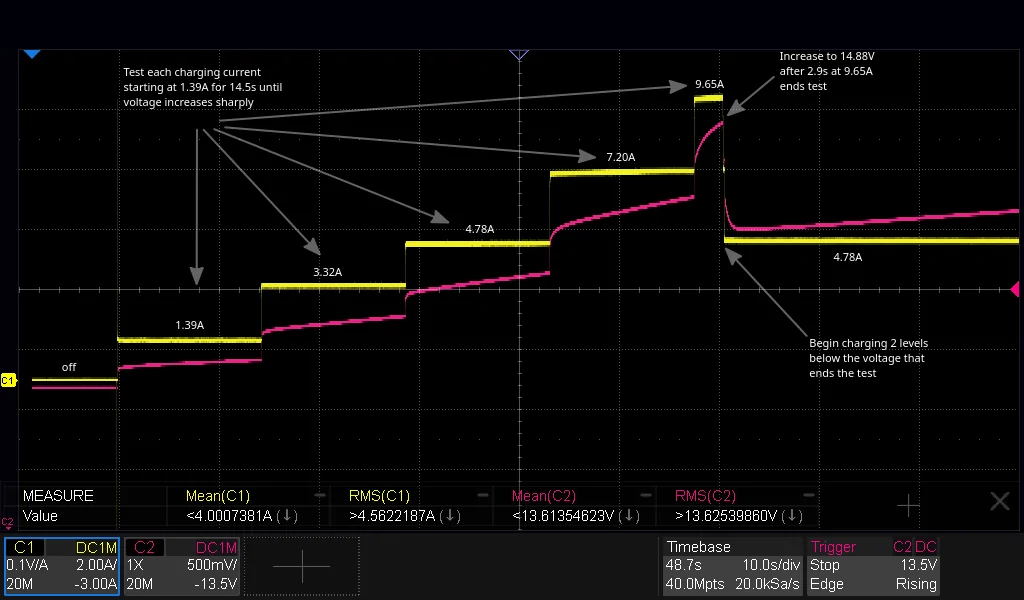
This was actually the start of a 2000-second capture.
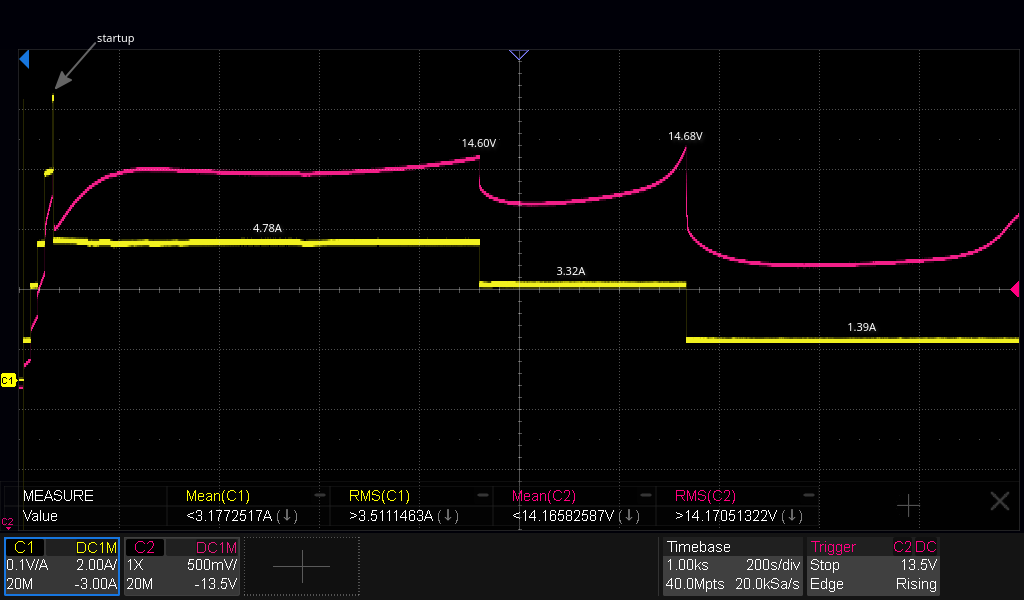
I barely caught the next step down, to 0.32A at 14.75V.
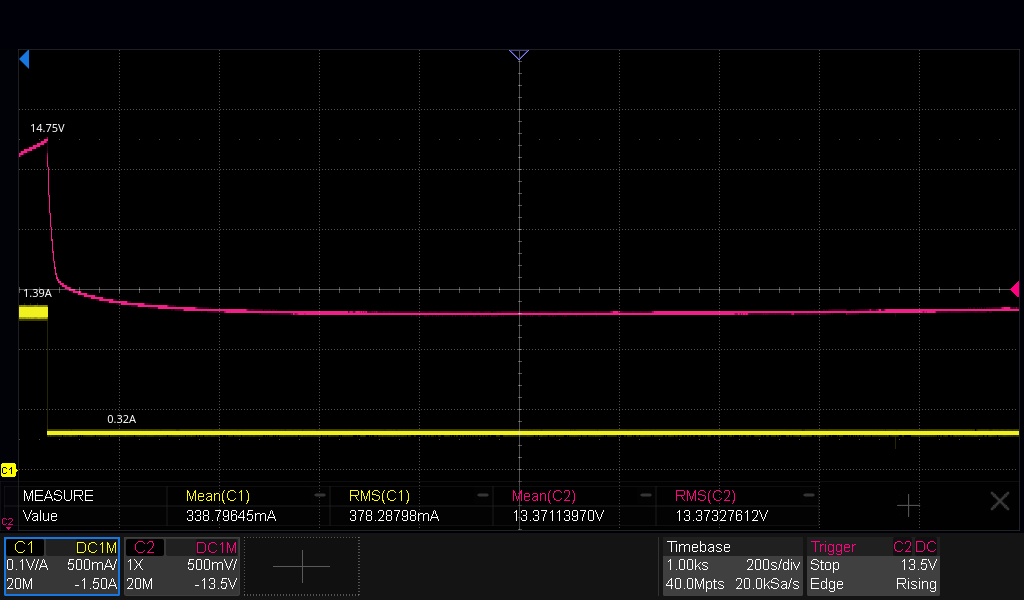
It took another 5000s at 0.32A to finish, at 15.05V.
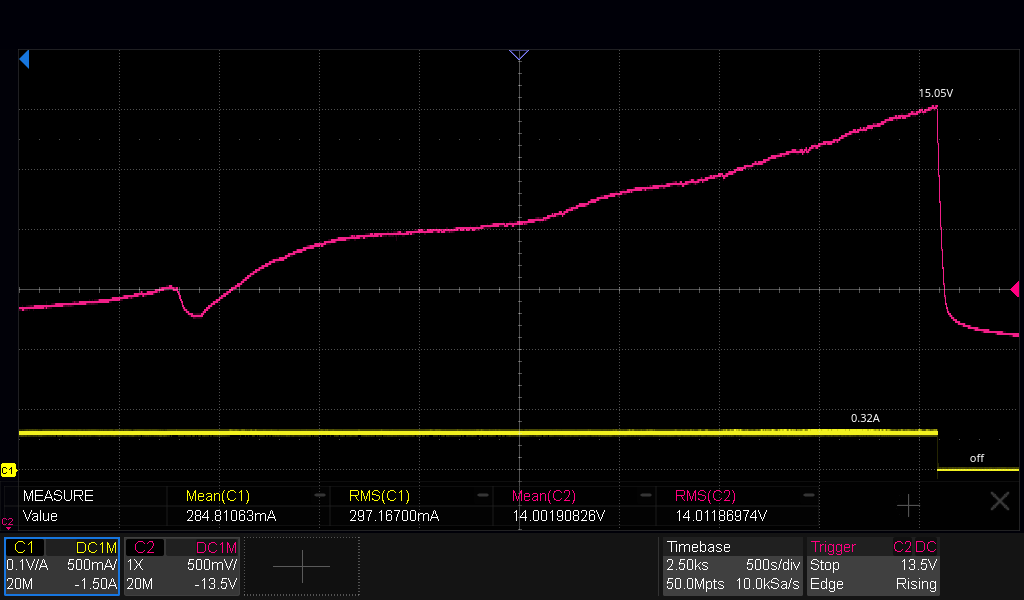
That voltage dip around 900s is some system in the Jeep waking up. This happens every 12 hours. The Noco didn't react.
The indicator light went solid green and nothing happened for about 12 hours. The charger is off. Eventually the battery fell to 12.875V. I only caught the start of the first re-up.
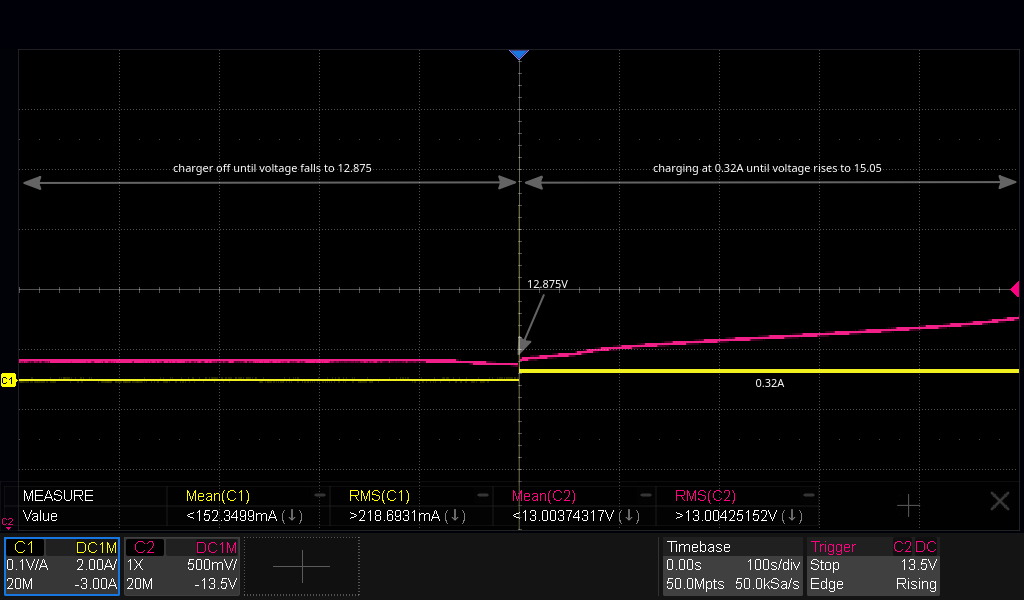
The next re-up came a couple of hours later. Charging lasted about 16 minutes.
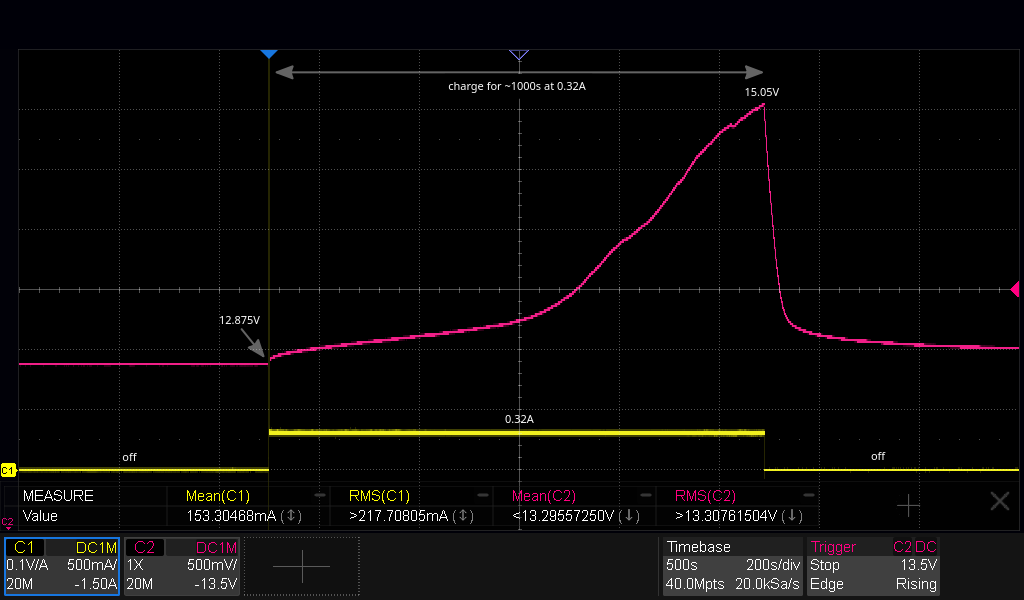
Subsequent re-ups all have the same shape, but they get shorter and more frequent. It takes less time at 0.32A to get to 15.05V, and it remains above 12.875V for a shorter time.
After two days of this, the re-ups are happening every 45 minutes and lasting only about 3 minutes.
On the third day I disconnected the Noco and finished charging with a power supply. It didn't take any charge to speak of. The NG10 got it done.
Apparently, I have a lot more to say about the Genius 10.
- Regulation is excellent. I never saw any oscillation.
- Power supply mode works up to 10A, at least. It's about 13.85V open circuit and 13.25V with 10A load. The difference can be attributed to voltage drop over the permanently attached wires. It won't enter power supply mode while connected to a battery, but you can put it in power supply mode and then connect it to a battery to float charge. It would be best to bring the battery up to 13.8V before connecting to avoid arcing.
- Turning on the headlights when it was re-upping at 0.32A caused it to transition to max current. I only had a DC clamp meter on it, but it looked like a regular charge cycle.
- The voltage goes higher than I would like, 15.05V at 50-55F. I also observed 14.64V at ~95F and 14.75-14.80V at ~85F. One end of the charger gets hotter than the other so the temperatures involve some guesswork. The OEM battery has a sticker:

I'm not crazy about a maintainer that pulls my battery up to 15V about 30 times a day.
- I took me several tries to get NG10 to show its range. In my normal use case, a vehicle that's been sitting a week or so, it immediately settles on its lowest current. It takes a long time to charge 2-3Ah at 0.32A. The battery would accept the next higher current, 1.39A, for 30 minutes at least, but the NG10 settles on one level lower. The trick to getting greater charge acceptance was a recent discharge of the battery, i.e., by turning on the headlights shortly before charging. Same discharge in Ah as from sitting a week, but fresh.
- The NG10 has no float stage. It turns off completely until the battery falls below 12.875V at 50-55F. The voltage threshold does not appear to be temperature-compensated.
- The minimum current, 320mA, is higher than I would like. It's typical for charge acceptance of a lead acid battery that's sat awhile to fall below 300mA at 13.8V float, and continue falling slowly to 50mA over several days. The NG10 is going to need a lot of re-up cycles and a lot of time above 14.5V to do what a float charger can, if it can do it at all.
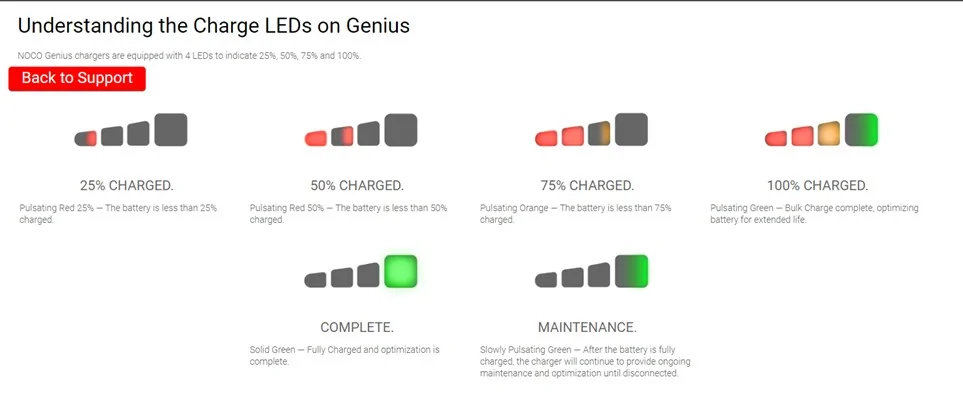
- The 4-LED meter doesn't give useful information about the battery's SoC. It's pure fiction as far as I can tell. All of my batteries were above 95% SoC but the NG10 progressed from 25% as if it were doing a really great job charging at 0.32A.
- One thing appears to be true, in AGM mode at least: When the bottom 3 LEDs are off and the top green is lit solid, that means the charger's most recent activity was charging at 0.32A until the battery came up to temperature-compensated 14.8V, and now it's off and waiting for the battery to fall below 12.875V.
- The 1A version would probably be a better fit for me; I don't need a 10A charger to output 0.32A. I expect the 1A version has a lower minimum current and would probably charge my batteries at 1A for awhile. Noco doesn't disclose those details.

Edit: I tried again later in this thread to get the Noco Genius 10 to charge a normally discharged Jeep at higher current than its 0.32A minimum, this time with no shunt resistor. Same result. The battery would have happily accepted 3.3A at 13.5V for awhile, but the Noco only charged at 0.32A.
Sponsored
Last edited: