Sponsored

Jeep wouldn't start this Morning

jebiruph

Well-Known Member
First Name
Jerry
Joined
Dec 9, 2018
Threads
15
Messages
806
Reaction score
730
Location
IA
Vehicle(s)
2018 Wrangler JL 2024 Grand Cherokee L WL 2020 Gladiator JT
They aren't bypassing anything. That's the confusion. They are jumping crank battery to electronics.
Since the batteries are in parallel, the crank battery actually is connected to N1 at all times as long as the PCR is closed.
Your main battery at 12 volts means it's dead or near dead - not enough to start the vehicle.
The cables are large enough the voltage drop would be minimal.
The explanations floating around are flawed.
The one and only way an aux battery could act this way is with an internal short. It's not that common and those who "need" to jump N1 to N2 have some other issues going on but are convinced of what they believe so there's no fixing that.

Read my discussions on batteries, voltages and other fun Jeep electrics.
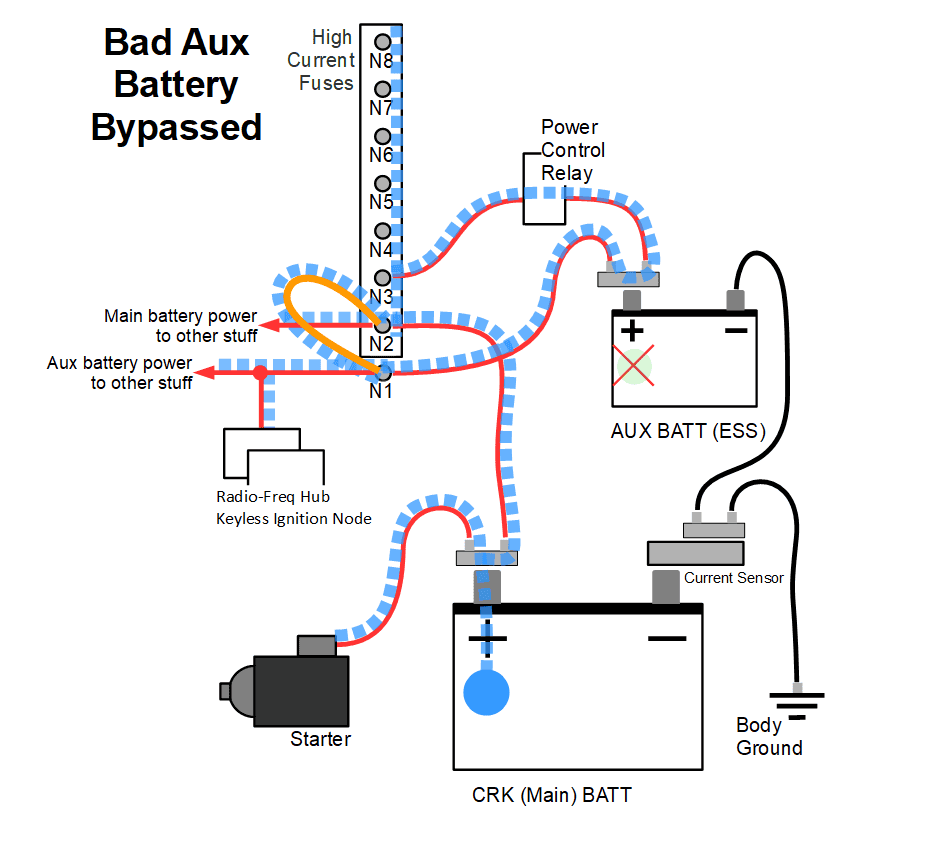
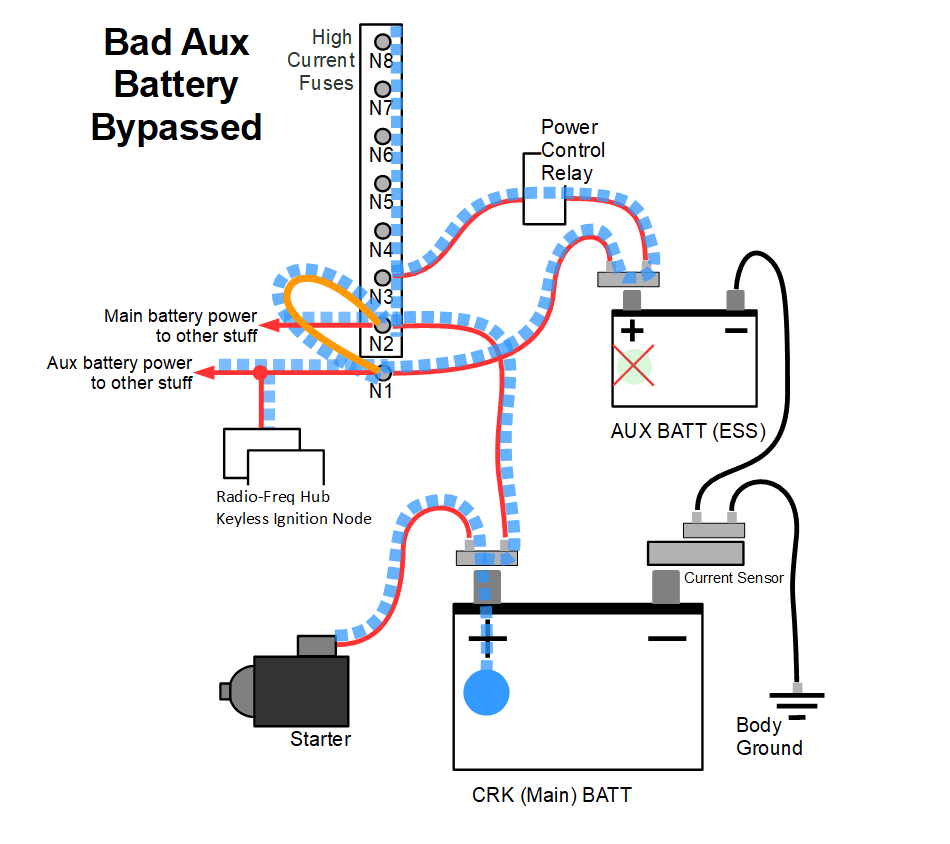
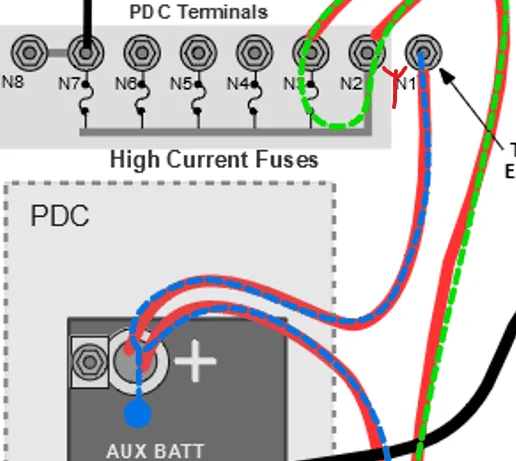
Well, given that the main battery connects to N2 which connects to N3 through the ESS fuse, then through the PCR to the aux battery and finally to N1, the jumper connected to N1 to N2 does bypass the aux battery and all the related components.

As far as the illustrated aux battery behavior not being common, I agree. But at the time I was having to investigate the system behavior by physically disconnecting the aux battery, so that's what's behind the way it is explained. Where were you in 2018? I could have used the help.
Sponsored

 

ShadowsPapa

Well-Known Member
First Name
Bill
Joined
Oct 12, 2019
Threads
247
Messages
40,461
Reaction score
53,903
Location
Runnells, Iowa
Vehicle(s)
'25 JTMX, '23 JLU 4xe, '82 SX4, '73 Javelin
Occupation
Retired auto mechanic, frmr gov't ntwrk security admin
Vehicle Showcase
3
Well, given that the main battery connects to N2 which connects to N3 through the ESS fuse, then through the PCR to the aux battery and finally to N1, the jumper connected to N1 to N2 does bypass the aux battery and all the related components.

As far as the illustrated aux battery behavior not being common, I agree. But at the time I was having to investigate the system behavior by physically disconnecting the aux battery, so that's what's behind the way it is explained. Where were you in 2018, I could have used the help.
The aux battery is still connected, though. It's still there.
The cable between batteries is large enough to leave extremely minimal voltage drop between the two. The jumper between N2 and N1 doesn't take the battery out of the equation. It's still connected, can still draw power.

With a jumper between 1 and 2, the aux battery is still connected directly to N1 - not bypassed at all. If it's "shorted" it's still going to pull things down - just that now it has a direct path to the main battery to suck power down. All that's bypassed is the PCR.
Jeep Gladiator Jeep wouldn't start this Morning 1668744986289


My bet with at least some of these is that if a person doing the jumping made the connection, kept the RPM up on the vehicle doing the jumping via jscan or tazer and waited a minute or two, it would start with no other interaction.
The load from the electronics is minimal, the cable is large enough to handle a lot of amperage for charging so there won't be much voltage drop - fractions of a volt.
If the aux battery was truly shorted it would create quite a spark when you jumped N1 and N2 IF the cables were small enough to create a large voltage drop.
If I ever take mine apart, I'll measure the resistance of the PCR circuit and try to calculate a voltage drop.
People seem to want to put on jumper cables and push that button instantly, then complain when it won't start. Always give it a minute at least.
 
OP
OP
Jeeperjamie

Jeeperjamie

Well-Known Member
First Name
Jamie
Joined
Feb 12, 2020
Threads
135
Messages
4,754
Reaction score
5,412
Location
Kannapolis nc
Vehicle(s)
2020 jeep gladiator
Occupation
Weyerhaeuser
Vehicle Showcase
1
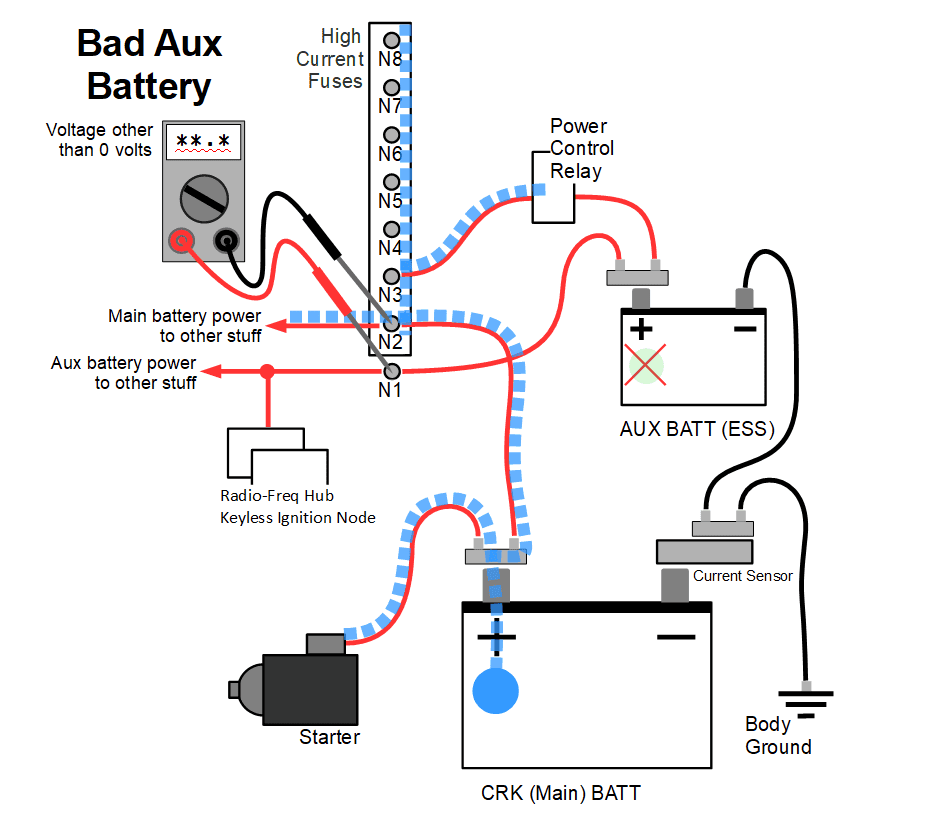
my main battery reads 12 volts on volt meter and the baby battery appears to be dead. This is from the JL Forum and is a common problem with this Jeep JT and JL forum with the start stop.

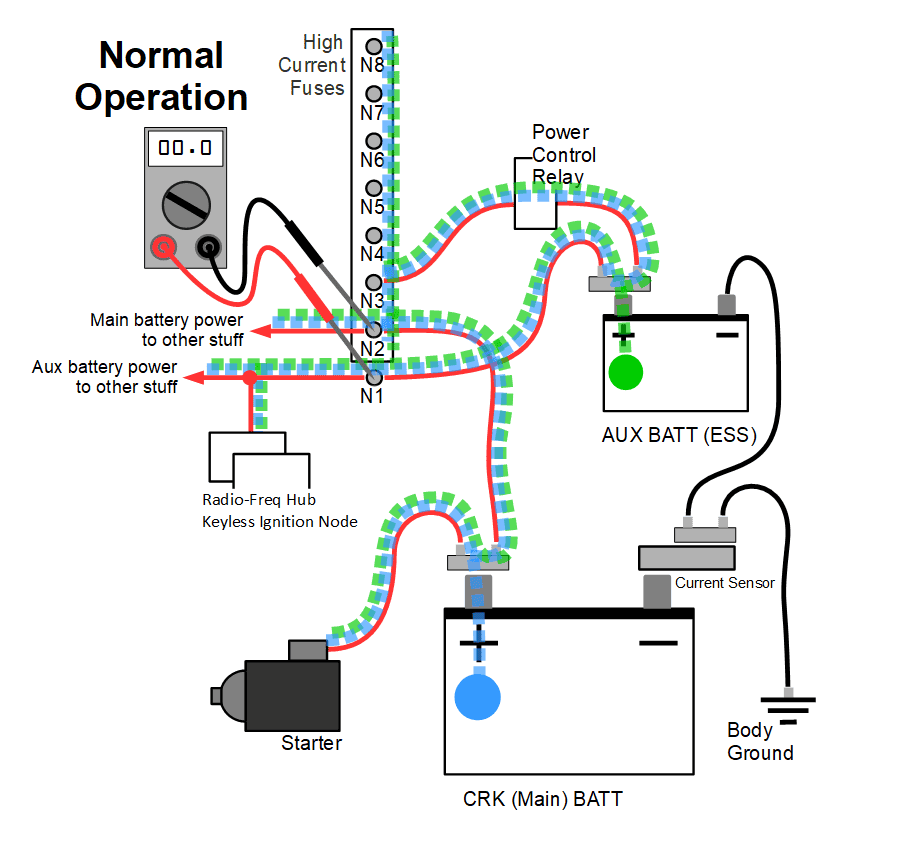
“Here's the battery voltages on a working system, the PCR is connecting the batteries in parallel, both batteries providing power to everything. Normal operation is verified with 0 volts between N1 and N2.”


1668734111836.png


“Bypassing is accomplished by jumping N1 to N2. This diagram illustrates the jumper getting power back to the critical electronics.”

1668734377067.png


“Bypassing is accomplished by jumping N1 to N2. This diagram illustrates the jumper getting power back to the critical electronics.”


1668734242433.png


my problem is definitely the baby battery and it goes bye bye tomorrow. ?

https://www.jlwranglerforums.com/forum/threads/jumperless-aux-battery-bypass.95945/

1668734179554.png
My large battery was reading 12 volts as well on the meter and at AutoZone when I took it there. I assumed small battery was the issue. Dealership hooked the machine they had up to it and it came back that there was a dead cell in the large battery that was killing the smaller battery. I have no idea how the system works but I went by what they said. They replaced my large battery and that was 6500 miles ago and all has been good. Ess hadn't been working for probably 6 weeks before the whole jeep died and wouldn't crank. I drove about 50 miles and the small battery must of got charged enough to kick on the ESS and since then everything has been working great.

I've spoke to numerous JL and JT owners who assumed small battery, replaced small battery and then ended up having to replace the large battery as well. That's the only drawback to deleting or not using the ESS is normally that will stop working first and when happens it's more than likely just a matter a time before your stranded. Every person I have talked to that's had a pretty much similar issue it's been the large battery and about half of those people didn't use the ESS or have turned if off.

Straight from my guy at the dealership who I've known for maybe 18yrs and I trust , he said a lot of guys test the battery at the house, go to AutoZone and get a ok on the large battery and come in and say they need a small battery. He said almost everytime they put the machine on it that it comes back with a large battery issue. I'm not 100 positive that's your issue but I'm jus saying you may want to get that large battery checked by more that just a meter.
 

ShadowsPapa

Well-Known Member
First Name
Bill
Joined
Oct 12, 2019
Threads
247
Messages
40,461
Reaction score
53,903
Location
Runnells, Iowa
Vehicle(s)
'25 JTMX, '23 JLU 4xe, '82 SX4, '73 Javelin
Occupation
Retired auto mechanic, frmr gov't ntwrk security admin
Vehicle Showcase
3
My large battery was reading 12 volts as well on the meter and at AutoZone when I took it there. I assumed small battery was the issue. Dealership hooked the machine they had up to it and it came back that there was a dead cell in the large battery that was killing the smaller battery. I have no idea how the system works but I went by what they said. They replaced my large battery and that was 6500 miles ago and all has been good. Ess hadn't been working for probably 6 weeks before the whole jeep died and wouldn't crank. I drove about 50 miles and the small battery must of got charged enough to kick on the ESS and since then everything has been working great.

I've spoke to numerous JL and JT owners who assumed small battery, replaced small battery and then ended up having to replace the large battery as well. That's the only drawback to deleting or not using the ESS is normally that will stop working first and when happens it's more than likely just a matter a time before your stranded. Every person I have talked to that's had a pretty much similar issue it's been the large battery and about half of those people didn't use the ESS or have turned if off.

Straight from my guy at the dealership who I've known for maybe 18yrs and I trust , he said a lot of guys test the battery at the house, go to AutoZone and get a ok on the large battery and come in and say they need a small battery. He said almost everytime they put the machine on it that it comes back with a large battery issue. I'm not 100 positive that's your issue but I'm jus saying you may want to get that large battery checked by more that just a meter.
Isn't that interesting - all of the assuming out there, and too often - wrong.

I'm just wondering when people say "my battery read 12 volts" do they mean 12 volts, or is it 12.7, or 12.4 or similar?
I ask because 12 volts is trouble. At 12 volts, the battery is all but dead and unlikely to handle any sort of load. 12.0 volts may be 20 to 40% capacity and if your meter is off by say a tenth of a volt or so, it's likely on the low side. Think of the people working at a parts store - they get a job, the other guys say here, take this, toss it on, push a button and read the screen. That's their training and the end of their "expertise" on batteries. And yet in college, you spend an entire quarter on batteries, charging systems and starting systems and you leave with books 2" thick on the topic. Then you get a job in a shop and the boss says how about some more training and you go to Omaha where GM has classes on advanced charging systems and they spend a couple of hours just on batteries. (granted that was years ago - but show me a parts store hack that's been to any training)

The problem with internet experts is that someone does some assuming - maybe they were told something, or got lucky once and something worked, or they had one case of something and they post it and another guy sees that and to him, untrained, it makes sense so he reposts it and suddenly it's fact by virtue of being posted 10 times.
They don't know how things work, so there's a lot of guessing. Then they find and trace wires and again, some assuming. Oh, that battery is farther away so it's going to not do this or that - ignoring the fact that with the right size wires, the voltage is the same along the whole path.
Too dang many myths out there that get going and take on a life of their own.
The draw of the electronics matters - if the load is below the capability of the wires between the aux battery and the load itself, then there's no appreciable voltage drop and all of the speculation out there is bunk.

Autozone, O'Reilly's, NAPA, whatever, should, as my mother used to say "keep their grubby mitts off of" these as far as testing.
Unless they pull the aux battery ground off the IBS, then fully charge the crank battery, they can't possibly test shxx.
The testing the dealers must do to warrant a battery is quite a process - and they must use specified equipment brand and models. There's a process - if the voltage of said battery is below a certain point, if the state of charge (SoC) is below a certain point, they must charge the battery to a certain point before testing.
I'd have to refresh my memory, but I seem to recall the process FCA describes covers at least 2 to 3 pages for battery testing.
To just drive in and throw a hand-held tester on these is a complete joke.

There's just so much wrong with so much of the stuff that's out there, it's hard to know where to start. It happens when untrained people believe they are seeing something - but without complete understanding.
It's why they thought for thousands of years the earth was flat, I guess.
 
OP
OP
Jeeperjamie

Jeeperjamie

Well-Known Member
First Name
Jamie
Joined
Feb 12, 2020
Threads
135
Messages
4,754
Reaction score
5,412
Location
Kannapolis nc
Vehicle(s)
2020 jeep gladiator
Occupation
Weyerhaeuser
Vehicle Showcase
1
Isn't that interesting - all of the assuming out there, and too often - wrong.

I'm just wondering when people say "my battery read 12 volts" do they mean 12 volts, or is it 12.7, or 12.4 or similar?
I ask because 12 volts is trouble. At 12 volts, the battery is all but dead and unlikely to handle any sort of load. 12.0 volts may be 20 to 40% capacity and if your meter is off by say a tenth of a volt or so, it's likely on the low side. Think of the people working at a parts store - they get a job, the other guys say here, take this, toss it on, push a button and read the screen. That's their training and the end of their "expertise" on batteries. And yet in college, you spend an entire quarter on batteries, charging systems and starting systems and you leave with books 2" thick on the topic. Then you get a job in a shop and the boss says how about some more training and you go to Omaha where GM has classes on advanced charging systems and they spend a couple of hours just on batteries. (granted that was years ago - but show me a parts store hack that's been to any training)

The problem with internet experts is that someone does some assuming - maybe they were told something, or got lucky once and something worked, or they had one case of something and they post it and another guy sees that and to him, untrained, it makes sense so he reposts it and suddenly it's fact by virtue of being posted 10 times.
They don't know how things work, so there's a lot of guessing. Then they find and trace wires and again, some assuming. Oh, that battery is farther away so it's going to not do this or that - ignoring the fact that with the right size wires, the voltage is the same along the whole path.
Too dang many myths out there that get going and take on a life of their own.
The draw of the electronics matters - if the load is below the capability of the wires between the aux battery and the load itself, then there's no appreciable voltage drop and all of the speculation out there is bunk.

Autozone, O'Reilly's, NAPA, whatever, should, as my mother used to say "keep their grubby mitts off of" these as far as testing.
Unless they pull the aux battery ground off the IBS, then fully charge the crank battery, they can't possibly test shxx.
The testing the dealers must do to warrant a battery is quite a process - and they must use specified equipment brand and models. There's a process - if the voltage of said battery is below a certain point, if the state of charge (SoC) is below a certain point, they must charge the battery to a certain point before testing.
I'd have to refresh my memory, but I seem to recall the process FCA describes covers at least 2 to 3 pages for battery testing.
To just drive in and throw a hand-held tester on these is a complete joke.

There's just so much wrong with so much of the stuff that's out there, it's hard to know where to start. It happens when untrained people believe they are seeing something - but without complete understanding.
It's why they thought for thousands of years the earth was flat, I guess.
Yep, I agree 100%. If I had listened to some on here or went with what I assumed as weIl, I would have replaced my smaller battery for no reason and would of ended up stranded again with a dead new small battery. People give dealerships a hard time over fees and stuff and I'm not saying there aren't bad ones out there. Hendricks has always done me right and they charge a $86 diagnostic fee to tell you what's wrong with your vehicle. I know some will say that's crazy to charge that for a battery to be diagnosed as bad but they take the charge out of the total charge if they do the work and replace the battery. Seems fair to me, they have to pay a tech to do the work and imagine how much time and money they would be out if they did everyone for free,even on a battery and then you decide to buy the batteries and do the work yourself. $86 seems like a fair price for piece of mind, Just sayin'
 

Sponsored

XJADDICTION

Banned
Banned
Joined
Dec 16, 2017
Threads
11
Messages
821
Reaction score
1,669
Location
TN
Vehicle(s)
2020 JT SS Max Tow, 2005 WK Hemi, 2013 Mustang GT
Occupation
Surgical CSFA
Wow shadows papa… ? that’s a lot of wind

I’m going to delete the small battery and replace the large battery because I do not want to guess one is good and the other is not. I definitely do not want to do the job twice or get stranded because I didn’t do the complete job.

I hate the start stop BS.
 
Last edited:

jebiruph

Well-Known Member
First Name
Jerry
Joined
Dec 9, 2018
Threads
15
Messages
806
Reaction score
730
Location
IA
Vehicle(s)
2018 Wrangler JL 2024 Grand Cherokee L WL 2020 Gladiator JT
The aux battery is still connected, though. It's still there.
The cable between batteries is large enough to leave extremely minimal voltage drop between the two. The jumper between N2 and N1 doesn't take the battery out of the equation. It's still connected, can still draw power.

With a jumper between 1 and 2, the aux battery is still connected directly to N1 - not bypassed at all. If it's "shorted" it's still going to pull things down - just that now it has a direct path to the main battery to suck power down. All that's bypassed is the PCR.
1668744986289.png


My bet with at least some of these is that if a person doing the jumping made the connection, kept the RPM up on the vehicle doing the jumping via jscan or tazer and waited a minute or two, it would start with no other interaction.
The load from the electronics is minimal, the cable is large enough to handle a lot of amperage for charging so there won't be much voltage drop - fractions of a volt.
If the aux battery was truly shorted it would create quite a spark when you jumped N1 and N2 IF the cables were small enough to create a large voltage drop.
If I ever take mine apart, I'll measure the resistance of the PCR circuit and try to calculate a voltage drop.
People seem to want to put on jumper cables and push that button instantly, then complain when it won't start. Always give it a minute at least.
The bypass jumper doesn't eliminate the aux battery by itself, but it bypasses the aux battery which allows the aux battery to be disconnected without turning on the error light.
 

talljeeper

Well-Known Member
Joined
Mar 21, 2019
Threads
15
Messages
84
Reaction score
74
Location
Seattle
Vehicle(s)
79 J-20 97 TJ 2012 JKU 2020 JT/LE
Where can I find a jumper? My battery(s) are exhibiting failure and these threads are freaking exhausting. I saw the Lite Brite video with the socket jump. I have a good jump box. If I become stranded how can I use the jump box with or without a jumper without damaging component? Looking for real world experience and not being scolded for asking the question.
 

Mr._Bill

Well-Known Member
First Name
Bill
Joined
Jul 22, 2019
Threads
38
Messages
6,649
Reaction score
7,750
Location
North Las Vegas, NV
Vehicle(s)
2023 Gladiator High Altitude - 2013 Nissan Leaf SV
Vehicle Showcase
1
Where can I find a jumper? My battery(s) are exhibiting failure and these threads are freaking exhausting. I saw the Lite Brite video with the socket jump. I have a good jump box. If I become stranded how can I use the jump box with or without a jumper without damaging component? Looking for real world experience and not being scolded for asking the question.
If the batteries are showing signs of failure, then replace them before it becomes a problem.

The jump box works just like it would on any other vehicle. Connect it to the terminals on the primary battery.

The only thing you really have to watch for is making sure there is no short to ground from the positive battery cables or connections.
 

ShadowsPapa

Well-Known Member
First Name
Bill
Joined
Oct 12, 2019
Threads
247
Messages
40,461
Reaction score
53,903
Location
Runnells, Iowa
Vehicle(s)
'25 JTMX, '23 JLU 4xe, '82 SX4, '73 Javelin
Occupation
Retired auto mechanic, frmr gov't ntwrk security admin
Vehicle Showcase
3
Where can I find a jumper? My battery(s) are exhibiting failure and these threads are freaking exhausting. I saw the Lite Brite video with the socket jump. I have a good jump box. If I become stranded how can I use the jump box with or without a jumper without damaging component? Looking for real world experience and not being scolded for asking the question.
Just jump start it. Forget the "jumper". It's not necessary except in extreme uncommon situations.
I've started Jeeps with both batteries DEAD with a set of jumper cables.

Tip - charge the batteries and get them tested by a dealer - not a parts store. Those people don't know squat most of the time. If either are weak, just replace them. Don't tempt fate or get yourself PO'd by putting off what you believe you see coming.

Anyway - if using another vehicle, connect jumper cables, let the donor vehicle idle for a minute or two after things are connected, THEN try to start the dead one.
If using a jump pack - do similar - connect, don't get in a big-@$$ hurry, then try to start it.
You won't damage anything. I have no idea where the idea that you'd damage something comes from by simple basic jump starting like we've done for decades.

No magic here - jump it like you would any other vehicle out there.

And that's real world experience - not to mention years of working on electric systems.

You can't do damage by jump starting IF you use the cables or jump pack correctly.
 
OP
OP
Jeeperjamie

Jeeperjamie

Well-Known Member
First Name
Jamie
Joined
Feb 12, 2020
Threads
135
Messages
4,754
Reaction score
5,412
Location
Kannapolis nc
Vehicle(s)
2020 jeep gladiator
Occupation
Weyerhaeuser
Vehicle Showcase
1
Just jump start it. Forget the "jumper". It's not necessary except in extreme uncommon situations.
I've started Jeeps with both batteries DEAD with a set of jumper cables.

Tip - charge the batteries and get them tested by a dealer - not a parts store. Those people don't know squat most of the time. If either are weak, just replace them. Don't tempt fate or get yourself PO'd by putting off what you believe you see coming.

Anyway - if using another vehicle, connect jumper cables, let the donor vehicle idle for a minute or two after things are connected, THEN try to start the dead one.
If using a jump pack - do similar - connect, don't get in a big-@$$ hurry, then try to start it.
You won't damage anything. I have no idea where the idea that you'd damage something comes from by simple basic jump starting like we've done for decades.

No magic here - jump it like you would any other vehicle out there.

And that's real world experience - not to mention years of working on electric systems.

You can't do damage by jump starting IF you use the cables or jump pack correctly.
This, Jumper cables and then get the batteries tested at the dealership. That's what I did with mine and found out the right issue and replaced the right battery.
I've never had a issue using jumper cables. I just leave the vehicle running that doing the jumping off.
Sponsored


Top