Sponsored

Drive Shaft Phasing

JTenn

Well-Known Member
First Name
Jason
Joined
Feb 21, 2022
Threads
46
Messages
820
Reaction score
1,597
Location
Middle Tennessee
Vehicle(s)
20 JT Overland, 21 JT Willys
Occupation
Mechanical Engineer
I know the front and rear driveshafts are weighted for balance and must be correctly oriented. Does anyone know if they are phased to the differentials or trans/t-case? Or is it to eachother? If it is to the diff's I'm not sure how to know the orientation when I install the f/r axles. Just gathering info before the axle swap.
Sponsored


 

Charles 236

Well-Known Member
First Name
Charles
Joined
Feb 13, 2022
Threads
0
Messages
607
Reaction score
1,228
Location
Greenville, SC
Vehicle(s)
Jeep Gladiator Overland
Occupation
Jeep technician
Typically, driveshafts are matched to the differential yoke or flange. A small paint mark is usually used on the end of the driveshaft and on the yoke or flange. I can't remember if the marks on the flange or yoke and driveshaft on the highest point of runout or the lowest, but the idea is to match the lowest point to the highest so that they cancel each other out. Also, driveshafts are not phased to the transfer case. Hope this helps.
 

JTDay

Well-Known Member
First Name
Josh
Joined
Sep 19, 2021
Threads
14
Messages
358
Reaction score
422
Location
Georgia
Vehicle(s)
2022 Sport S
Occupation
EHS
Do our driveshafts even have a slip yoke?
 

ShadowsPapa

Well-Known Member
First Name
Bill
Joined
Oct 12, 2019
Threads
247
Messages
40,442
Reaction score
53,858
Location
Runnells, Iowa
Vehicle(s)
'25 JTMX, '23 JLU 4xe, '82 SX4, '73 Javelin
Occupation
Retired auto mechanic, frmr gov't ntwrk security admin
Vehicle Showcase
3
I know the front and rear driveshafts are weighted for balance and must be correctly oriented. Does anyone know if they are phased to the differentials or trans/t-case? Or is it to eachother? If it is to the diff's I'm not sure how to know the orientation when I install the f/r axles. Just gathering info before the axle swap.
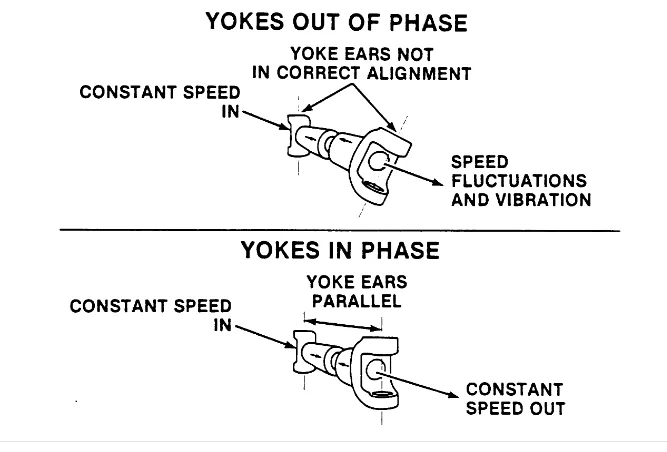
You only "phase" drive shafts with 2 cross type joints - one at each end.

Otherwise shafts are balanced out of the vehicle, without the differential yoke, etc.

CV joints don't need to be phased.

Jeep Gladiator Drive Shaft Phasing 1677632581222


Jeep Gladiator Drive Shaft Phasing 1677632545709
 
OP
OP
JTenn

JTenn

Well-Known Member
First Name
Jason
Joined
Feb 21, 2022
Threads
46
Messages
820
Reaction score
1,597
Location
Middle Tennessee
Vehicle(s)
20 JT Overland, 21 JT Willys
Occupation
Mechanical Engineer
Typically, driveshafts are matched to the differential yoke or flange. A small paint mark is usually used on the end of the driveshaft and on the yoke or flange. I can't remember if the marks on the flange or yoke and driveshaft on the highest point of runout or the lowest, but the idea is to match the lowest point to the highest so that they cancel each other out. Also, driveshafts are not phased to the transfer case. Hope this helps.
Thanks. The back story is I'm about to swap Rubicon axles into my Willys. Therefore my current drive shaft is not and never has been mated to either f/r diff that will be going in. However, in the purchase the guy threw in both f/r drive shafts that were originally mounted to those diff's. Not sure if it matters which DS's I use. To @ShadowsPapa point, they are all balanced outside of and independent of the vehicle. Now how to figure out if the bolt circles on the yoke hub and diff hubs are lined up in any particular way. Thanks everyone.
 

Sponsored

Rusty PW

Well-Known Member
First Name
Russ
Joined
Jan 10, 2022
Threads
37
Messages
11,335
Reaction score
30,231
Location
Fayette Nam, Pennsyltucky
Website
www.youtube.com
Vehicle(s)
'22 JTRD, '11 370Z Nismo, '07 Honda VFR
Build Thread
Link
Occupation
Muff Diver
You only "phase" drive shafts with 2 cross type joints - one at each end.

Otherwise shafts are balanced out of the vehicle, without the differential yoke, etc.

CV joints don't need to be phased.

1677632581222.png


1677632545709.png
Beat me to it. ?
 

ShadowsPapa

Well-Known Member
First Name
Bill
Joined
Oct 12, 2019
Threads
247
Messages
40,442
Reaction score
53,858
Location
Runnells, Iowa
Vehicle(s)
'25 JTMX, '23 JLU 4xe, '82 SX4, '73 Javelin
Occupation
Retired auto mechanic, frmr gov't ntwrk security admin
Vehicle Showcase
3
Beat me to it. ?
And that's not easy! LOL.

I'm sure you've done this in your sleep.
For me - it was shortening driveshafts, that sort of thing, when doing transmission swaps. (and diagnosing vibrations, etc.)
 

Hootbro

Well-Known Member
First Name
Don
Joined
Apr 13, 2019
Threads
57
Messages
10,176
Reaction score
19,942
Location
Delaware
Vehicle(s)
2025 Gladiator Sport
Attached is the Tech Authority procedure on driveshaft removal and install. It mentions only marking the flanges and reinstalling back in the same spot.
 

Attachments

Last edited:
OP
OP
JTenn

JTenn

Well-Known Member
First Name
Jason
Joined
Feb 21, 2022
Threads
46
Messages
820
Reaction score
1,597
Location
Middle Tennessee
Vehicle(s)
20 JT Overland, 21 JT Willys
Occupation
Mechanical Engineer
Attached is the Tech Authority procedure on driveshaft removal and install. It only mentions only marking the flanges and reinstalling back in the same spot.
Perfect!! Thanks
 

ShadowsPapa

Well-Known Member
First Name
Bill
Joined
Oct 12, 2019
Threads
247
Messages
40,442
Reaction score
53,858
Location
Runnells, Iowa
Vehicle(s)
'25 JTMX, '23 JLU 4xe, '82 SX4, '73 Javelin
Occupation
Retired auto mechanic, frmr gov't ntwrk security admin
Vehicle Showcase
3
Attached is the Tech Authority procedure on driveshaft removal and install. It only mentions only marking the flanges and reinstalling back in the same spot.
I've always done that if removal was for something like seal replacement, u-joint replacement, etc. because I figured what the heck - it had no problem before in that position, put it back. I do that for my wheels, too, if putting them back on the same axle - no vibration when I started, then put it back in the same position.

I seem to recall that the bolts on some of these flanges were spaced just a bit differently meaning if you didn't put it back in the same place, one of them won't go back in. But that was a long time back so I could be recalling that incorrectly.

I guess over the years, experience and paranoia have taught me - mark, put it back the same way. Not that it will break or perform poorly, it's just so easy to do.
I keep silver, black and yellow markers and paint pens and an engraving tool on the shelf next to my work bench.

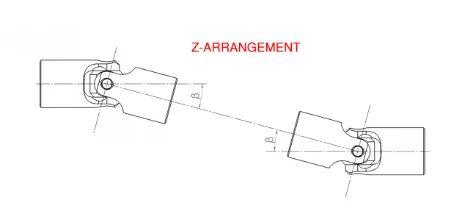
Just a word to those making bigger, or "radical" changes - on a shaft with a single cross type u-joint on one end, and maybe a CV on the other end - there is no phasing, HOWEVER, that cross type u-joint needs to run pretty straight. If you perform a lift or change control arms on the rear or whatever, and you have a shaft with a single cross joint - make sure to line things up so that cross joint is running straight.
Conventional u-joints like that change rotational speed of the shaft or device they drive as they rotate if they are not perfectly straight, and the larger the angle, the more you note the change.
If there is a cross type joint at each end of the same shaft, phase is critical as is watching the angles of each and try to match them up to keep the rotational differences to a minimum.
The one image I posted sort of shows that. It may mean a pinion angle change is in order.
CV joints have a larger operating angle, and no speed changes.
 

Sponsored

OP
OP
JTenn

JTenn

Well-Known Member
First Name
Jason
Joined
Feb 21, 2022
Threads
46
Messages
820
Reaction score
1,597
Location
Middle Tennessee
Vehicle(s)
20 JT Overland, 21 JT Willys
Occupation
Mechanical Engineer
I've always done that if removal was for something like seal replacement, u-joint replacement, etc. because I figured what the heck - it had no problem before in that position, put it back. I do that for my wheels, too, if putting them back on the same axle - no vibration when I started, then put it back in the same position.

I seem to recall that the bolts on some of these flanges were spaced just a bit differently meaning if you didn't put it back in the same place, one of them won't go back in. But that was a long time back so I could be recalling that incorrectly.

I guess over the years, experience and paranoia have taught me - mark, put it back the same way. Not that it will break or perform poorly, it's just so easy to do.
I keep silver, black and yellow markers and paint pens and an engraving tool on the shelf next to my work bench.

Just a word to those making bigger, or "radical" changes - on a shaft with a single cross type u-joint on one end, and maybe a CV on the other end - there is no phasing, HOWEVER, that cross type u-joint needs to run pretty straight. If you perform a lift or change control arms on the rear or whatever, and you have a shaft with a single cross joint - make sure to line things up so that cross joint is running straight.
Conventional u-joints like that change rotational speed of the shaft or device they drive as they rotate if they are not perfectly straight, and the larger the angle, the more you note the change.
If there is a cross type joint at each end of the same shaft, phase is critical as is watching the angles of each and try to match them up to keep the rotational differences to a minimum.
The one image I posted sort of shows that. It may mean a pinion angle change is in order.
CV joints have a larger operating angle, and no speed changes.
Couldn't agree more. I am also a paint marker warrior. I'll check the bolt pattern of the flange. I would be surprised if it's not clocked in a way that forces one way assembly.
 

ShadowsPapa

Well-Known Member
First Name
Bill
Joined
Oct 12, 2019
Threads
247
Messages
40,442
Reaction score
53,858
Location
Runnells, Iowa
Vehicle(s)
'25 JTMX, '23 JLU 4xe, '82 SX4, '73 Javelin
Occupation
Retired auto mechanic, frmr gov't ntwrk security admin
Vehicle Showcase
3
Couldn't agree more. I am also a paint marker warrior. I'll check the bolt pattern of the flange. I would be surprised if it's not clocked in a way that forces one way assembly.
I'd be interested in seeing if my memory is right, so if you find the spacing isn't even all the way around, let us know.

Keep up the smart work.
 

jac04

Well-Known Member
First Name
Jeff
Joined
Apr 20, 2021
Threads
27
Messages
1,545
Reaction score
2,246
Location
CT
Vehicle(s)
2021 Mojave, 2014 JKRX SWB
There is a V95 recall for the rear driveshaft on some 2020 Gladiators. In this recall, there are instructions for installing a new rear driveshaft. There is no requirement to install the shaft in any particular orientation to the differential input or the transfer case output.

The bolt pattern is symmetrical

https://static.oemdtc.com/Recall/19V636/RCRIT-19V636-3067.pdf
 
OP
OP
JTenn

JTenn

Well-Known Member
First Name
Jason
Joined
Feb 21, 2022
Threads
46
Messages
820
Reaction score
1,597
Location
Middle Tennessee
Vehicle(s)
20 JT Overland, 21 JT Willys
Occupation
Mechanical Engineer

ShadowsPapa

Well-Known Member
First Name
Bill
Joined
Oct 12, 2019
Threads
247
Messages
40,442
Reaction score
53,858
Location
Runnells, Iowa
Vehicle(s)
'25 JTMX, '23 JLU 4xe, '82 SX4, '73 Javelin
Occupation
Retired auto mechanic, frmr gov't ntwrk security admin
Vehicle Showcase
3
There is a V95 recall for the rear driveshaft on some 2020 Gladiators. In this recall, there are instructions for installing a new rear driveshaft. There is no requirement to install the shaft in any particular orientation to the differential input or the transfer case output.

The bolt pattern is symmetrical

https://static.oemdtc.com/Recall/19V636/RCRIT-19V636-3067.pdf
They wouldn't put that in a recall document anyway, especially if it's "keyed" by spacing one bolt differently. Some things are assumed, or they refer to another set of instructions.
If it will only fit one way, the tech will discover that during installation, it will be unsaid.
If it goes on in any orientation, then there's no problem.

They are also talking a new replacement shaft - not a used one being put back.

I could refer to axle hubs in the 1970s where a used hub must go back on the axle in the same orientation, but a new one - doesn't matter.
Sponsored


Top