Sponsored

Aftermarket front driveshaft noise

JeepOfTheseus

Well-Known Member
Joined
May 26, 2021
Threads
56
Messages
1,042
Reaction score
1,870
Location
Bay Area
Vehicle(s)
Jeep Gladiator
Unfortunately, when you try and adjust pinion angle. You change the caster too.
I guess what I don’t get is…surely there are guys with larger lifts and/or running driveshafts with u-joints. Assuming you’re supposed to keep the pinion angle straight for that setup, how do you do that without the bottom spring seat being severely off-angle?
Sponsored


Rusty PW

Well-Known Member
First Name
Russ
Joined
Jan 10, 2022
Threads
37
Messages
11,370
Reaction score
30,340
Location
Fayette Nam, Pennsyltucky
Website
www.youtube.com
Vehicle(s)
'22 JTRD, '11 370Z Nismo, '07 Honda VFR
Build Thread
Link
Occupation
Muff Diver
I guess what I don’t get is…surely there are guys with larger lifts and/or running driveshafts with u-joints. Assuming you’re supposed to keep the pinion angle straight for that setup, how do you do that without the bottom spring seat being severely off-angle?
Good question.

I'm at 4" lift. Planning on going with a Woods driveshaft. They use a double cardan at the transfer case and a 1350 at the diff. What does your driveshaft have?
 

ShadowsPapa

Well-Known Member
First Name
Bill
Joined
Oct 12, 2019
Threads
247
Messages
40,445
Reaction score
53,878
Location
Runnells, Iowa
Vehicle(s)
'25 JTMX, '23 JLU 4xe, '82 SX4, '73 Javelin
Occupation
Retired auto mechanic, frmr gov't ntwrk security admin
Vehicle Showcase
3
I guess what I don’t get is…surely there are guys with larger lifts and/or running driveshafts with u-joints. Assuming you’re supposed to keep the pinion angle straight for that setup, how do you do that without the bottom spring seat being severely off-angle?
CV joints don't need to run straight. You can run them at an angle I think up to something like 30 degrees? Maybe it's 37, can't recall now

A shaft with 2 CV joints - one on each end, doesn't have to have equal but opposite angles on each end.

A shaft with 2 cross type joints, one at each end, can only run at so much of an angle, and the angle at each end must be equal but opposite.
Ideally, the operating angles on each end of the driveshaft should be equal to or within 1 degree of each other, have a 3* degree maximum operating angle and have at least 1/2 of a degree continuous operating angle. With 0 angle at all, the cross type will wear badly because the needles never turn and eventually pound into the cross instead of rolling on it.

A shaft with a CV at one end and a cross joint at the other - try to keep the cross joint nearly straight, 1/2 degree good, don't go much or you'll have vibrations, the CV joint won't matter, you can go quite an angle on the CV end.
 

JeepOfTheseus

Well-Known Member
Joined
May 26, 2021
Threads
56
Messages
1,042
Reaction score
1,870
Location
Bay Area
Vehicle(s)
Jeep Gladiator
Good question.

I'm at 4" lift. Planning on going with a Woods driveshaft. They use a double cardan at the transfer case and a 1350 at the diff. What does your driveshaft have?
CV joints don't need to run straight. You can run them at an angle I think up to something like 30 degrees? Maybe it's 37, can't recall now

A shaft with 2 CV joints - one on each end, doesn't have to have equal but opposite angles on each end.

A shaft with 2 cross type joints, one at each end, can only run at so much of an angle, and the angle at each end must be equal but opposite.
Ideally, the operating angles on each end of the driveshaft should be equal to or within 1 degree of each other, have a 3* degree maximum operating angle and have at least 1/2 of a degree continuous operating angle. With 0 angle at all, the cross type will wear badly because the needles never turn and eventually pound into the cross instead of rolling on it.

A shaft with a CV at one end and a cross joint at the other - try to keep the cross joint nearly straight, 1/2 degree good, don't go much or you'll have vibrations, the CV joint won't matter, you can go quite an angle on the CV end.
I'm running Adam's 1350 Front and Rear. Their kit swaps the rear diff yoke and front/rear transfer case yokes, so you end up with a u-joint at the front and rear diffs, and double cardan at both ends of the t-case.

Their site/pics say to run at a straight angle, but when I called Adam's, the guy said I can run a couple degrees off if need be.

For me, it's not so much as a "vibration", but a buzzing...which I guess is a very high speed vibration. I can't feel it in the steering wheel (i.e. it's not shaking), but I can feel a buzzing in my butt (yea, yea, talk to my proctologist). I can see it in the side mirrors as well.

I guess I could stay under 70mph, but I live in California - we either go 10 over or 10 under.
 

UNlimited65

Active Member
Joined
Aug 3, 2021
Threads
12
Messages
32
Reaction score
5
Location
Doylestown, PA
Vehicle(s)
Gladiator Rubicon
You may have to adjust pinion angle now that you changed the driveshaft. I’m battling this with my Adam’s 1350 driveshafts. After initial install I was getting a lot of drone/buzzing and vibration above ~68mph. Adjust the rear uppers so that the pinion angle was straight with the driveshaft, which got me to about 72mph before the vibration, but led to very bowed springs. Brought it slightly back to where it was for now till I figure how how you can achieve that angle without horribly off angled springs.

Interestingly, as a result of swapping my front axle shafts, I decided I will do a FAD delete. While I wait for the kit, I’m running in 4H Auto, which seems to balance the vibration out a bit. It’s only bad from 75-80mph, and then it just switches to a bad drone but little vibration.
I had the EXACT SAME issue with my Adam's 1350 ... did the upper control arm adjustment and it solved the issue.
 

Sponsored

ShadowsPapa

Well-Known Member
First Name
Bill
Joined
Oct 12, 2019
Threads
247
Messages
40,445
Reaction score
53,878
Location
Runnells, Iowa
Vehicle(s)
'25 JTMX, '23 JLU 4xe, '82 SX4, '73 Javelin
Occupation
Retired auto mechanic, frmr gov't ntwrk security admin
Vehicle Showcase
3
I had the EXACT SAME issue with my Adam's 1350 ... did the upper control arm adjustment and it solved the issue.
But what did you end up with for caster?
Changing the pinion angle by adjusting the control arms also changes the caster.
For every degree you move the pinion upward, you reduce caster by the same.

I'm running Adam's 1350 Front and Rear. Their kit swaps the rear diff yoke and front/rear transfer case yokes, so you end up with a u-joint at the front and rear diffs, and double cardan at both ends of the t-case.

Their site/pics say to run at a straight angle, but when I called Adam's, the guy said I can run a couple degrees off if need be.

For me, it's not so much as a "vibration", but a buzzing...which I guess is a very high speed vibration. I can't feel it in the steering wheel (i.e. it's not shaking), but I can feel a buzzing in my butt (yea, yea, talk to my proctologist). I can see it in the side mirrors as well.

I guess I could stay under 70mph, but I live in California - we either go 10 over or 10 under.


The info I posted on the various types of joints is a fact you can't get around no matter what.

You need to keep the plain cardan or cross type joint as straight as possible, depending on driveshaft RPM (you need to figure that out using tire size, road speed and gear ratio of the differentials) you will be limited to 2, maybe 3 degrees. She'll vibrate badly and since the driveshaft spins faster than the axles, it will be a high speed vibration.

The double can be at a pretty good angle, but the individual joints in the double still should not be run beyond the ability of a single joint - there's still rules because it's still cardan or cross type joints there. It's just that they can double what a single joint can take, and they take the RPM changes out of the equation by using 2 - the second one in phase cancels the RPM changes of the first joint smoothing out the fluctuations.

In short - if you have a single at one end, a double at the other, that single must be run very close to straight. A couple of degrees is pushing it, in my experiences with other drive shafts.
32 degrees is the max of a double cardan joint - 22 is normal operating max.
MAX for a single cardan joint, which these have at one end, is about 3 degrees - 5500 RPM driveshaft speed.
So do not run that single joint far off straight, depending on your gear ratio, tire sizes and so on - figure your driveshaft RPM - that helps determine the maximum angle you can run that single joint.
 

JeepOfTheseus

Well-Known Member
Joined
May 26, 2021
Threads
56
Messages
1,042
Reaction score
1,870
Location
Bay Area
Vehicle(s)
Jeep Gladiator
But what did you end up with for caster?
Changing the pinion angle by adjusting the control arms also changes the caster.
For every degree you move the pinion upward, you reduce caster by the same.
Surprised I can't find anything more about this. Basically, I think I/we need these: https://www.synergymfg.com/synergy-jeep-jk-rear-coil-wedges.html

It's a pretty simple design, so I wonder if it would work for the JT. Only downside is it's fixed at 10 degrees, but honestly I feel I need close to that. One other thing that concerns me is I don't see how it actually safely seats in there, seems like it's just a smooth surface that it could slide off of. I will chat with them tomorrow.
 
OP
OP
Troop

Troop

Well-Known Member
First Name
Cam
Joined
Nov 1, 2019
Threads
6
Messages
60
Reaction score
45
Location
Ontario, Canada
Vehicle(s)
2020 Jeep Gladiator Launch Edition Rubicon
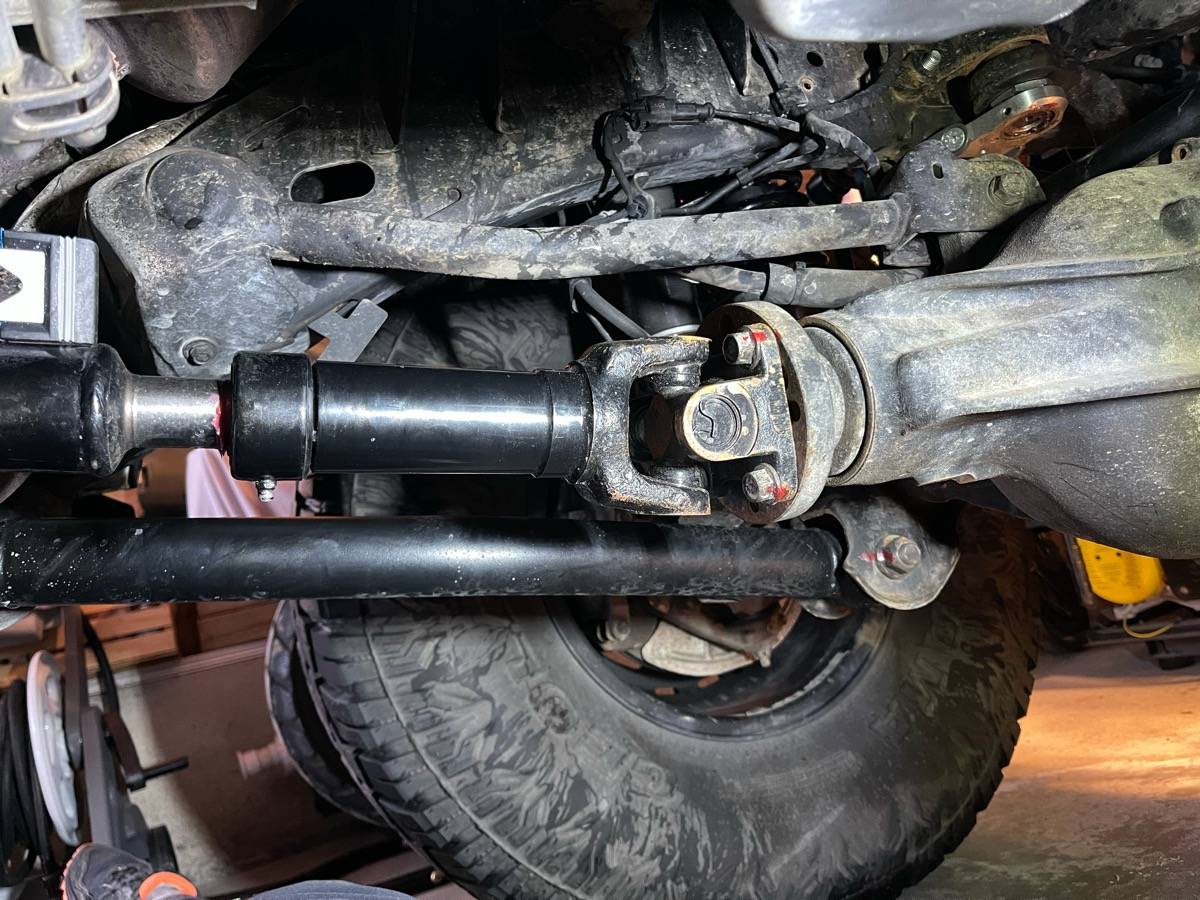
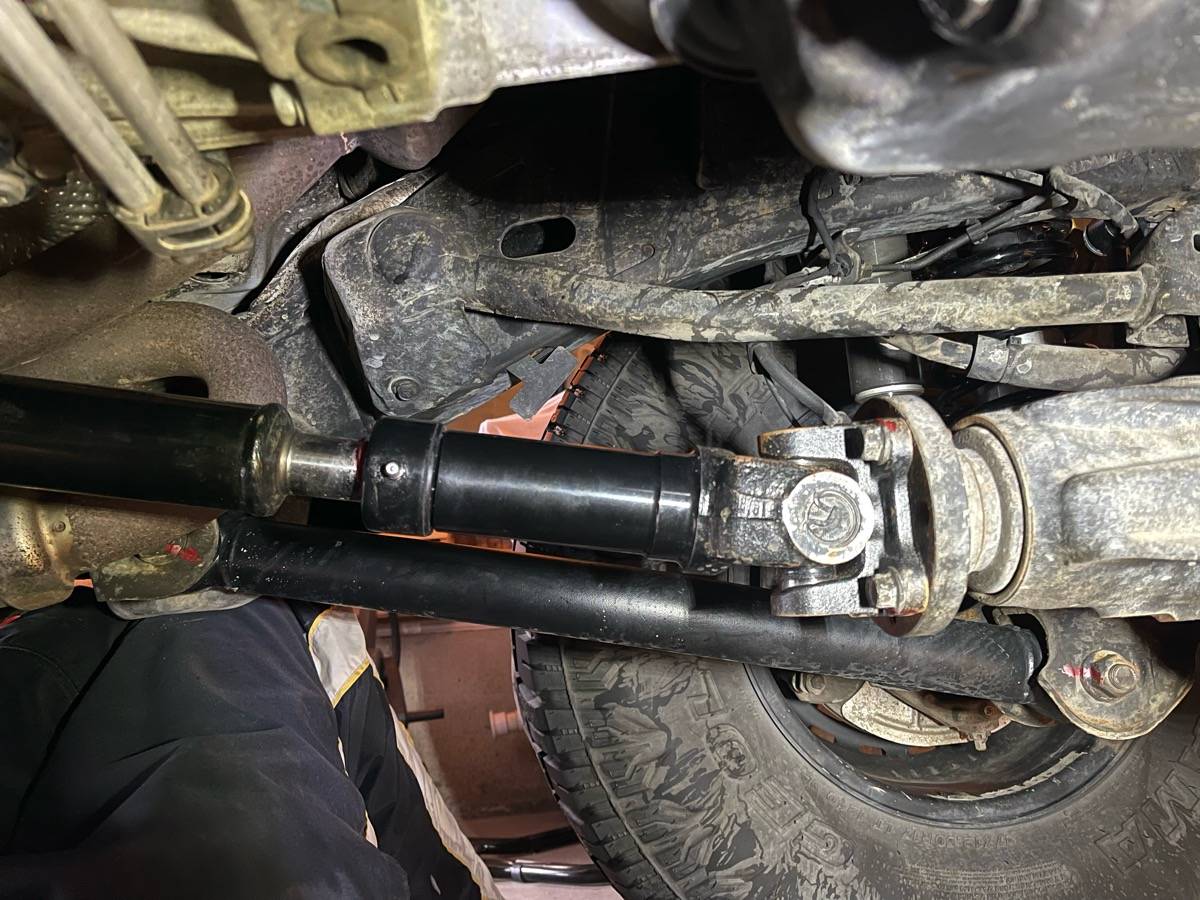
I've checked all the bolt torques and confirmed the driveshaft doesn't wiggle or feel loose when turning by hand. All the u-joints seem good, but I'm wondering if the angle is too much for them and if that might be causing the noise?

Jeep Gladiator Aftermarket front driveshaft noise IMG_6009.JPG
Jeep Gladiator Aftermarket front driveshaft noise IMG_6010.JPG
 

JTGuy

Well-Known Member
First Name
Pascual
Joined
Jul 23, 2023
Threads
57
Messages
1,745
Reaction score
1,675
Location
San Dimas CA
Vehicle(s)
20022 Jeep Gladiator
Occupation
Manager
yep, it's a pain, had the problem with my 14 JKUR with 4 inch lift. You can adjust pinion angle with the lower CAs but eventually have no caster and possibly DW or bad steering. Manual locking free spin hubs will give you freedom to adjust more but not available on our D44s. Need a custom front diff. How about a custom DS with high angle Rzappa at each end? With the CAD the front diff only spins in 4x4 mode. Good luck, I love my little 2 inch lift.
 

Sponsored

JeepOfTheseus

Well-Known Member
Joined
May 26, 2021
Threads
56
Messages
1,042
Reaction score
1,870
Location
Bay Area
Vehicle(s)
Jeep Gladiator
I've checked all the bolt torques and confirmed the driveshaft doesn't wiggle or feel loose when turning by hand. All the u-joints seem good, but I'm wondering if the angle is too much for them and if that might be causing the noise?

IMG_6009.JPG
IMG_6010.JPG
Assuming you have a double cardan at the transfer case, my understanding of these configurations is that the pinion angle needs to be straight or no more than 1-2* off center to the driveshaft. And therein lies the issue: how can you get it straight without drastically changing the caster.

I'm wondering if this is getting into custom territory where the spring seat needs to be cut off and re-centered back onto the axle.
 

ShadowsPapa

Well-Known Member
First Name
Bill
Joined
Oct 12, 2019
Threads
247
Messages
40,445
Reaction score
53,878
Location
Runnells, Iowa
Vehicle(s)
'25 JTMX, '23 JLU 4xe, '82 SX4, '73 Javelin
Occupation
Retired auto mechanic, frmr gov't ntwrk security admin
Vehicle Showcase
3
I've checked all the bolt torques and confirmed the driveshaft doesn't wiggle or feel loose when turning by hand. All the u-joints seem good, but I'm wondering if the angle is too much for them and if that might be causing the noise?

IMG_6009.JPG
IMG_6010.JPG
Without a corresponding joint in phase sitting at an equal but opposite number of degrees, that's a problem for a single cross type joint.

Assuming you have a double cardan at the transfer case, my understanding of these configurations is that the pinion angle needs to be straight or no more than 1-2* off center to the driveshaft. And therein lies the issue: how can you get it straight without drastically changing the caster.

I'm wondering if this is getting into custom territory where the spring seat needs to be cut off and re-centered back onto the axle.
Yes. It's really a dumb design, sorry, it just is. You can't run over a degree or so of angle on a single joint.
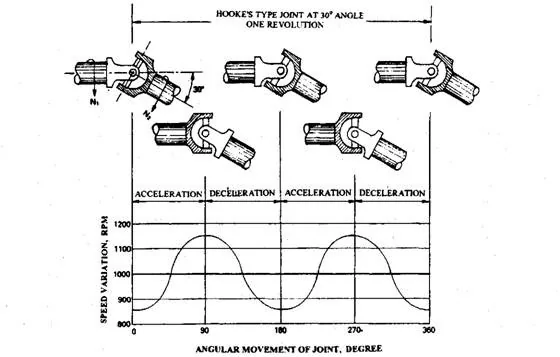
Here's the reason for that -

Jeep Gladiator Aftermarket front driveshaft noise ujoint-image0023


There's an RPM change for each partial rotation. If you don't counter that on the other end, then you will have stresses and vibrations as the shaft keeps changing speed - and whatever is connected to it tries to as well.

I can't believe anyone sells a shaft that would put a single joint at any sort of angle.
Maybe ok for the rear, but to have to change CASTER to get that joint lined up?

It's a serios enough issue there's tons of talk and videos on the topic.
It was one of the things we were taught in diagnosing vibrations and so on. There's fair mention of it in all of the TSMs I have over the years.

They need to change their design - double where the angle is sharpest, and put the single where it can run almost straight.
 

Lunentucker

Well-Known Member
Joined
Apr 24, 2022
Threads
247
Messages
5,873
Reaction score
15,379
Location
Virginia
Vehicle(s)
2021 Jeep Gladiator Mojave
Occupation
People Work?
I seemed to get a slight similar noise when I experimented with going all the way on my geo brackets. I only heard it when I engaged 4 Hi at higher speeds.
I assumed I went too far on the caster and adversely affected the pinion angle, so I moved it back to the middle hole (recommended for my lift), and it's been great ever since.
I'm betting you would have had the same noise with the stock shaft, and the lift is what's made the difference.


JeepOfTheseus

Well-Known Member
Joined
May 26, 2021
Threads
56
Messages
1,042
Reaction score
1,870
Location
Bay Area
Vehicle(s)
Jeep Gladiator
Without a corresponding joint in phase sitting at an equal but opposite number of degrees, that's a problem for a single cross type joint.

Yes. It's really a dumb design, sorry, it just is. You can't run over a degree or so of angle on a single joint.
Here's the reason for that -

ujoint-image0023.jpg


There's an RPM change for each partial rotation. If you don't counter that on the other end, then you will have stresses and vibrations as the shaft keeps changing speed - and whatever is connected to it tries to as well.
And just so I know, this doesn't apply if there is a single cross-type at one end and CV at the other? Because isn't that what the OEM front is doing?
 

ShadowsPapa

Well-Known Member
First Name
Bill
Joined
Oct 12, 2019
Threads
247
Messages
40,445
Reaction score
53,878
Location
Runnells, Iowa
Vehicle(s)
'25 JTMX, '23 JLU 4xe, '82 SX4, '73 Javelin
Occupation
Retired auto mechanic, frmr gov't ntwrk security admin
Vehicle Showcase
3
And just so I know, this doesn't apply if there is a single cross-type at one end and CV at the other? Because isn't that what the OEM front is doing?
Yes, it applies. But without a massive lift, as long as the cross joint isn't at too much of an angle, there's not a whole lot of speed change. It increases with angle. So when you change caster and add a big lift, you toss that joint into a larger angle and introduce problems.
OEM isn't running much angle at stock height.

Here is what happens -
When the cross or cardan type joint is at an angle, there is a cyclic RPM change of the shaft on the other side of the joint.
The RPM change increases with the amount of angle on the joint.
So if the output shaft of a transmission or transfer case is spinning 1000 RPM just for an example, the shaft on the other side of the joint spins anywhere from 850 to 1150 RPM, like the chart shows.
So the shaft speeds up and slows down, speeds up and slows down, as that single joint turns at an angle - the more angle, the more RPM change there is.
To cancel that, you put a single joint on the other end running the same angle to the negative and that cancels the RPM change perfectly so that although the shaft between the joint changes RPM, the transmission output and the differential pinion spin at a constant RPM.
With just ONE such joint, you have the driven item trying to change speed up and down, up and down.
the double-cardan joint takes care of that because it's two joints in one - only the piece between the two joints changes RPM.

This explains and shows what I mean - imagine your front pinion being driven like that because of that too extreme angle on a single cross joint!! This is exactly what would happen.


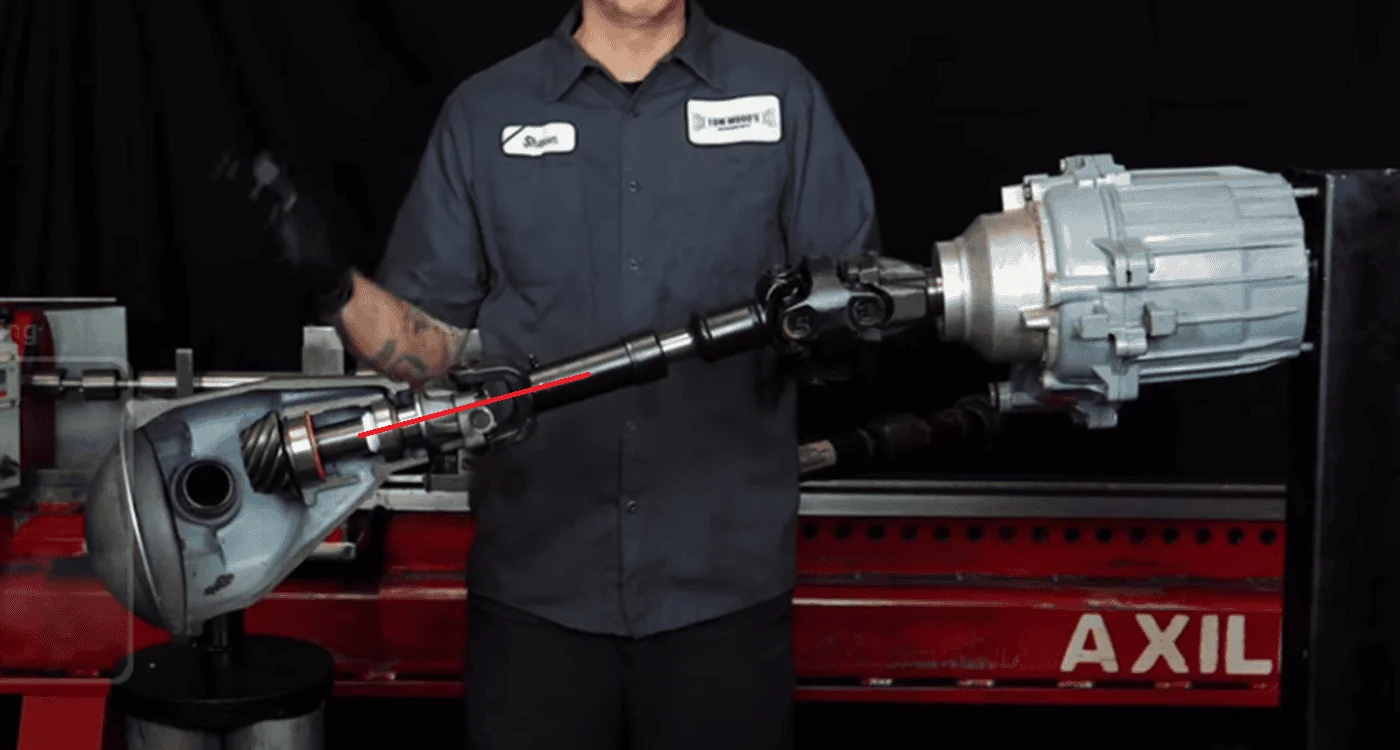
From the other video posted before - look at how straight that single cross joint is!
The double joint is taking the greater angle.
This shaft is going to work fine - the double is angled, the single is straight..
This is how shafts like this should be installed. NOT so the single joint is angled and the double is nearly straight.
(this would be for the rear axle - the front would need this reversed if the angle is at the front axle)

Jeep Gladiator Aftermarket front driveshaft noise Screenshot 2024-01-12 214941
Sponsored

 
Last edited:


Top