Sponsored

Are the batteries really isolated during ESS stops?

OP
OP
Flanders

Flanders

Well-Known Member
Joined
Dec 2, 2023
Threads
11
Messages
152
Reaction score
121
Location
Dyer, NV
Vehicle(s)
2023 JT
Is this the same math that has 250 amps going through a 150 amp fuse?
It is indeed. It's common to exceed a fuse's rating for short periods.

The engineers put a 150A fuse on the 200CCA AUX battery, with nothing to limit current.

The Fluke 87V uses 440mA and 11A Bussmann fast-acting fuses (datasheet). Fluke's user manual says:

For the 440mA circuit,
600 mA for 18 hr maximum.
For the 11A circuit,
>10 A to 20 A for 30 seconds maximum, 5 minutes off.

Jeep Gladiator Are the batteries really isolated during ESS stops? wrong-all-the-time-the-simpsons-0
Sponsored


ShadowsPapa

Well-Known Member
First Name
Bill
Joined
Oct 12, 2019
Threads
247
Messages
40,442
Reaction score
53,859
Location
Runnells, Iowa
Vehicle(s)
'25 JTMX, '23 JLU 4xe, '82 SX4, '73 Javelin
Occupation
Retired auto mechanic, frmr gov't ntwrk security admin
Vehicle Showcase
3
For years the reason given for adding the aux battery was to provide additional power for the ESS restart. This made sense because at the time the Cherokee had the original single battery ESS system and Cherokees were getting stranded at intersections when the single battery crossed the failure threshold during an ESS event and were unable to power an ESS restart.
And for years that reasoning was forum posts, people trying to explain what they didn't understand and so on. There was nothing at all scientific behind it.

Hot starts are a whole heck of a lot easier, and a lot less draw, than cold starts.
Check the draw of a starter cranking a cold engine and starting it vs. one that's warmed up and ready to go.
I'd suggest that with the Cherokees, there was something else going on. (and was the number REALLY that large, or was it amplified because of forum posts repeating the same cherokees stranded at intersections)

The wisdom of the internet is so often wrong - and today, using AI for the answer is even worse.
The bit about thermostat opening temperature - most Wrangler forum posts I've found say it opens at 203 degrees. Do a Google search and it responds "203 degrees" and it references Wrangler forum posts. So as far as the internet is concerned, it's 203 degrees - but that's incorrect.
The stock/factory/correct replacement stat opens at 195 (opening temperature is JUST STARTING TO OPEN, not full open temp)
People take a bit of info they've read, especially if they've read it more than one time in more than one place and suddenly it's the fact to go by.
So I suggest what was said about this on the internet, in forums and so on, was simply people guessing and trying to explain things, grabbing a couple of incidents from the web, and trying to combine them to explain it all.

If it was battery capacity, Jeep could save a lot of money using one, larger, higher capacity battery and watching the voltage and shutting down ESS stops if it senses a certain SoC/voltage.
Installing 1 battery is cheaper.

If a vehicle ever needed extra capacity for a start, it's during a cold start.

As far as the accuracy of the factory documentation, it can be invalidated with a related firmware update. Like with the manual transmission recall that updated the firmware to monitor drive train slippage, estimate clutch temperature and invoke limp mode accordingly. That's not going to in 2020 factory documentation. So for the factory documentation my thought is to trust, but verify.
Not a great comparison because an update isn't going to totally change how this system functions. The clutch, I get why they are doing that. But to modify how this works with an update? Apples and Oranges.
 

ShadowsPapa

Well-Known Member
First Name
Bill
Joined
Oct 12, 2019
Threads
247
Messages
40,442
Reaction score
53,859
Location
Runnells, Iowa
Vehicle(s)
'25 JTMX, '23 JLU 4xe, '82 SX4, '73 Javelin
Occupation
Retired auto mechanic, frmr gov't ntwrk security admin
Vehicle Showcase
3
It is indeed. It's common to exceed a fuse's rating for short periods.

The engineers put a 150A fuse on the 200CCA AUX battery, with nothing to limit current.

The Fluke 87V uses 440mA and 11A Bussmann fast-acting fuses (datasheet). Fluke's user manual says:

For the 440mA circuit,


For the 11A circuit,


wrong-all-the-time-the-simpsons-0.webp
My snow plow can draw up to 400 amps in the cold weather, fully loading the hydraulic pump on a lift or tilt. It has a 200 amp fuse. The cables can handle the 400 amps for a short time, they are beefy. Apparently the 200 amps fuse handles it, too, as I can watch my truck's system voltage drop like a rock when lifting or tilting the blade.
 

Andy29847

Well-Known Member
First Name
Andy
Joined
Oct 25, 2020
Threads
14
Messages
552
Reaction score
934
Location
South Carolina
Vehicle(s)
2020 Wrangler Rubicon, 2020 Gladiator Rubicon
Occupation
Retired
Not to discourage new life in this old thread, but what are you guys hoping to discover?

I measured the resistance between N1 and N2 at less than 3 milliohms in post 136.

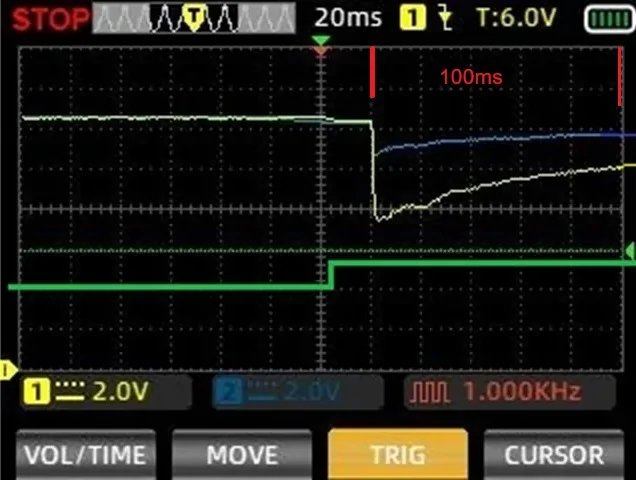
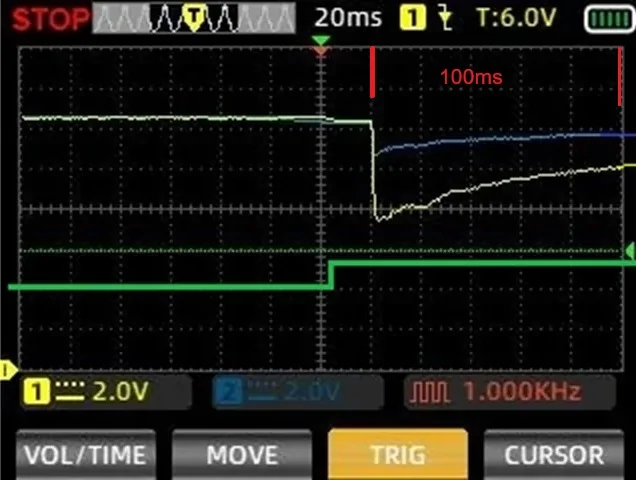
The trace of an ESS restart shows a sizeable voltage drop from N1 to N2, more than 2V for 100ms.

If the PCR is conducting, it's carrying more than 2V / 3 milliohms = 667A for 100ms from the AUX side to the MAIN side and the starter.

Where do you suppose that current comes from? Detroit?

I'm curious about what happens on an ESS stop/start.

Does the aux battery carry the cab electronics for the stop or just for the start?

When are the batteries separated and then combined?

Regarding your calculations, you are seeing current flow between N1 and N2 in the 100ms period pictured below. My thoughts are that the N1 and N2 are separated here.

Jeep Gladiator Are the batteries really isolated during ESS stops? ess restart 1
 

Andy29847

Well-Known Member
First Name
Andy
Joined
Oct 25, 2020
Threads
14
Messages
552
Reaction score
934
Location
South Carolina
Vehicle(s)
2020 Wrangler Rubicon, 2020 Gladiator Rubicon
Occupation
Retired
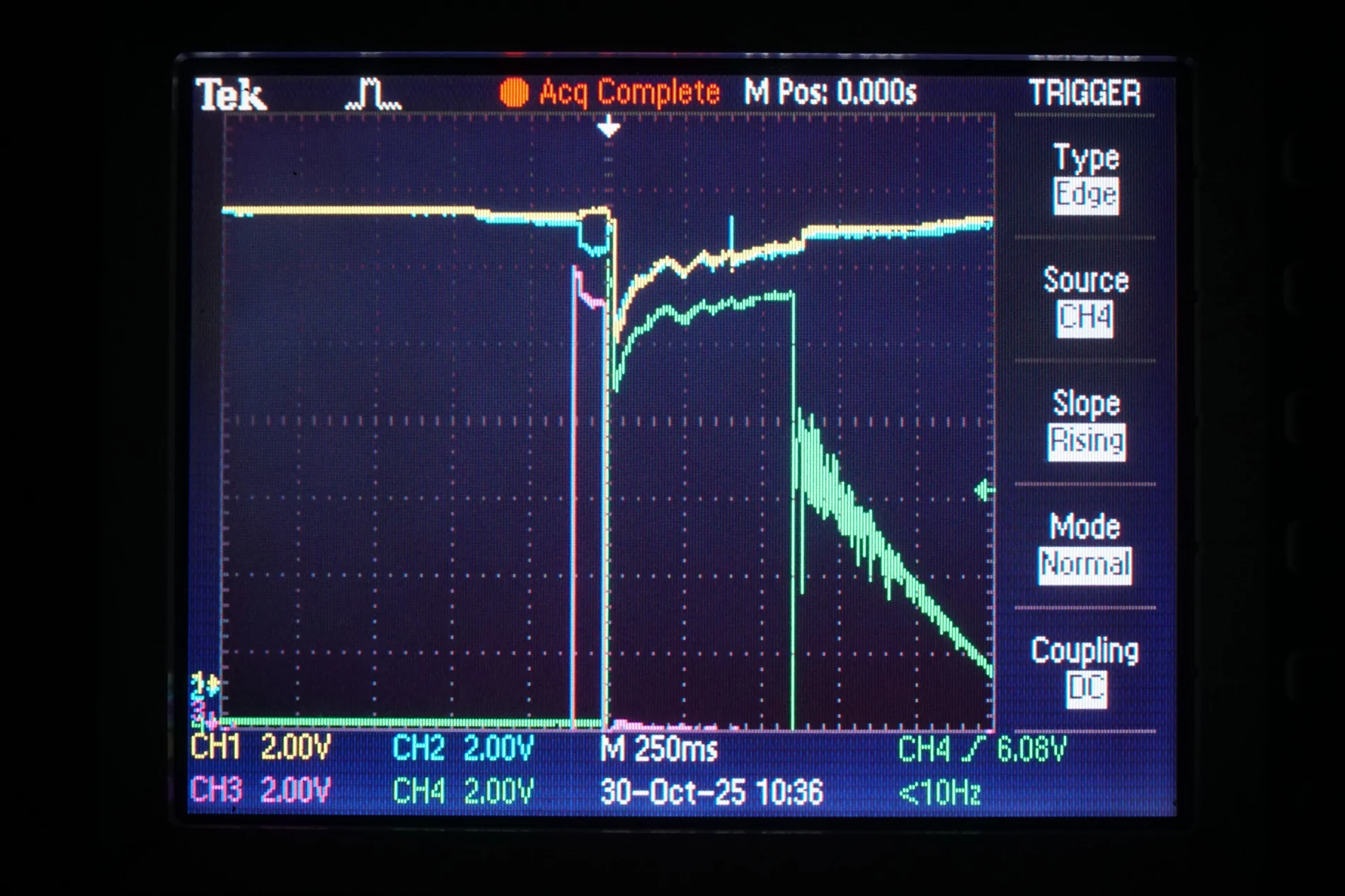
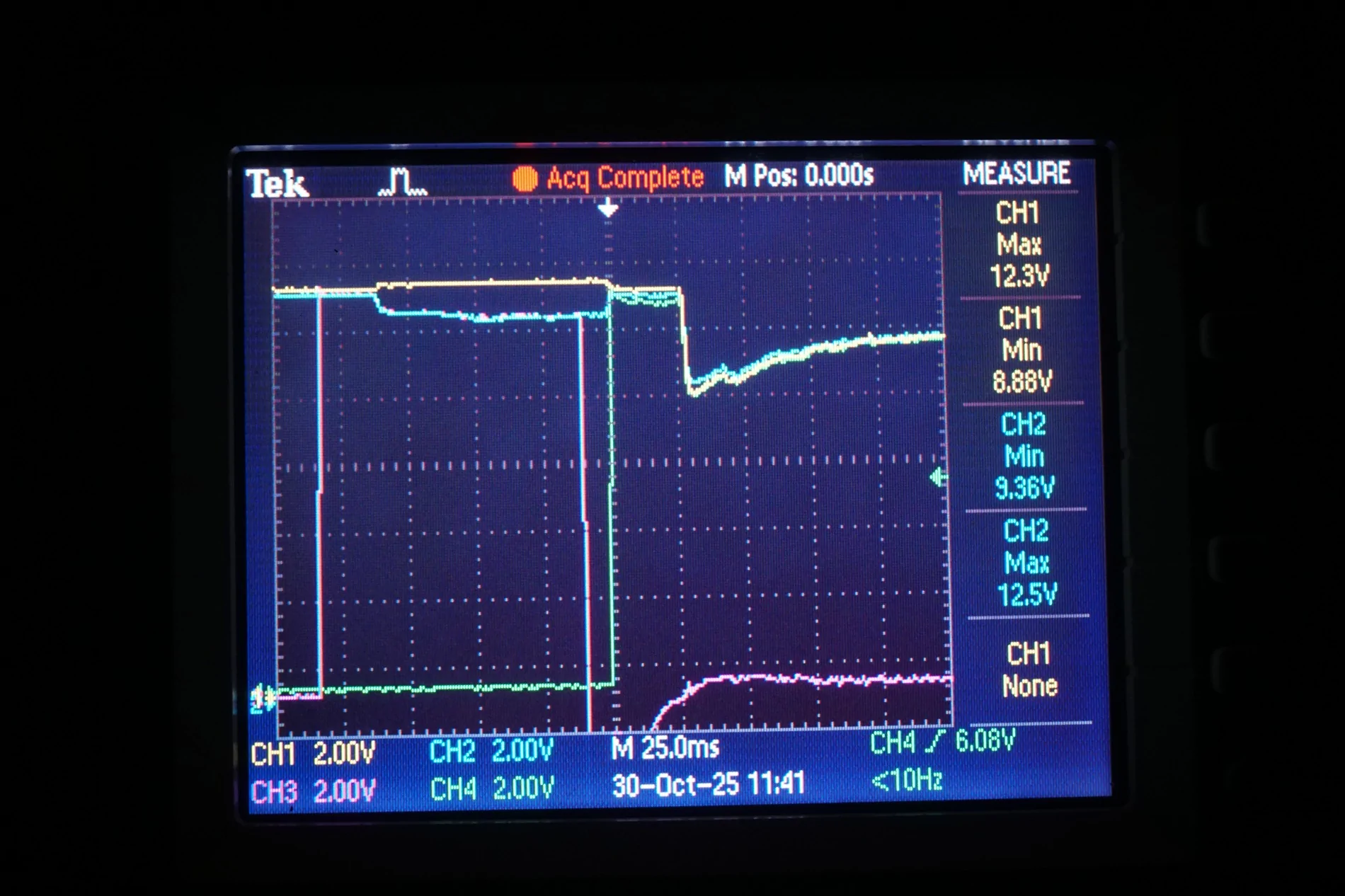
Now I have a good trigger. See all the ringing in the green trace.
DSC05457.webp

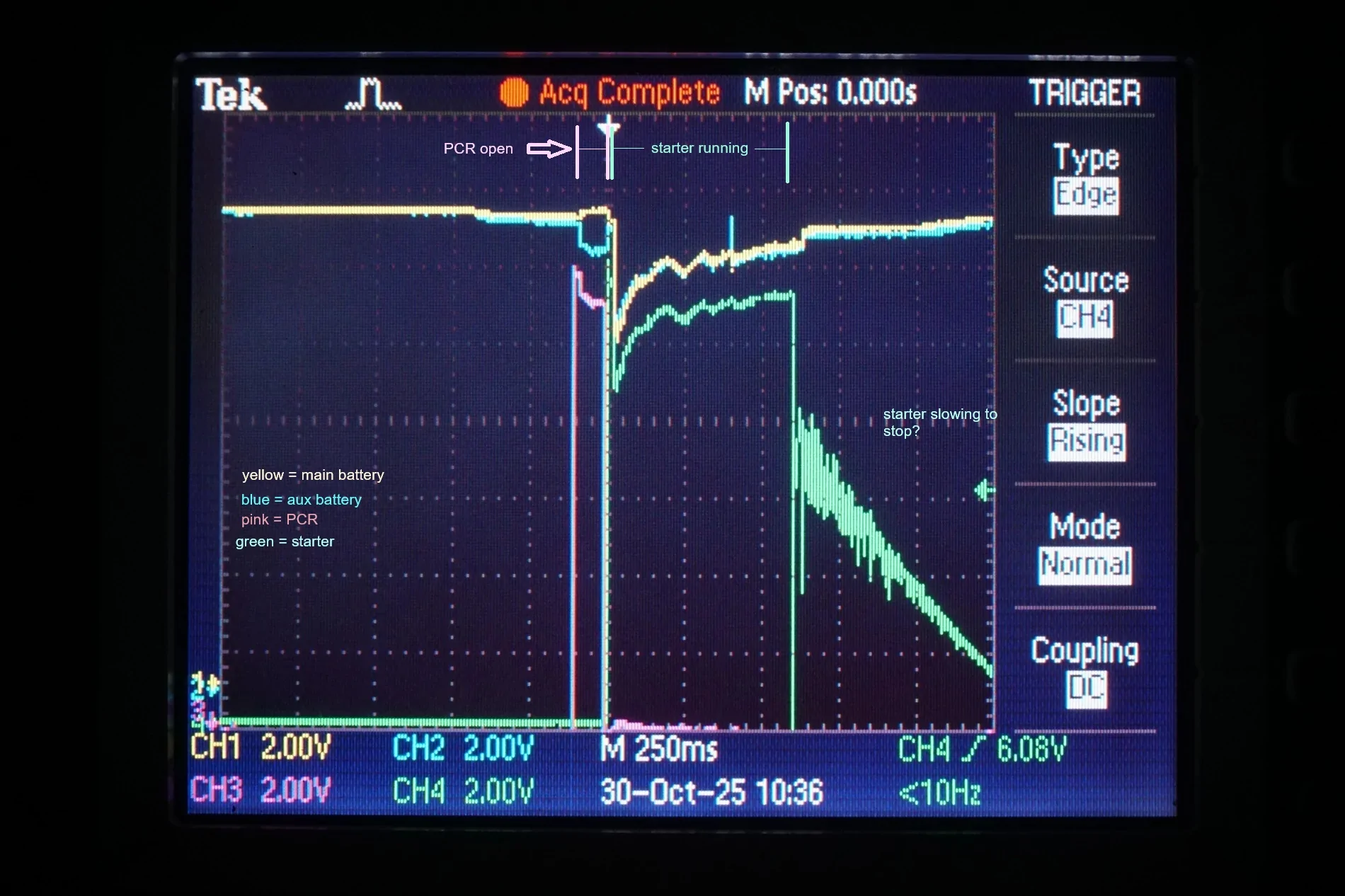
I believe that this is a cold start. Thanks for putting everything together. I put some labels on your photo. Let me know if I got something wrong. I'll fix it.

Jeep Gladiator Are the batteries really isolated during ESS stops? cold restart
 

Sponsored

ShadowsPapa

Well-Known Member
First Name
Bill
Joined
Oct 12, 2019
Threads
247
Messages
40,442
Reaction score
53,859
Location
Runnells, Iowa
Vehicle(s)
'25 JTMX, '23 JLU 4xe, '82 SX4, '73 Javelin
Occupation
Retired auto mechanic, frmr gov't ntwrk security admin
Vehicle Showcase
3
I'm curious about what happens on an ESS stop/start.

Does the aux battery carry the cab electronics for the stop or just for the start?

When are the batteries separated and then combined?

The batteries are connected during the ESS stop. We've proven that. Both carry the load of the stopped vehicle. They are not separated at any time during the stop itself - not until the restart sequence is initiated.

The batteries only disconnect for the first milliseconds of the starter engagement.

It's documented and I've shown they are connected during the stop. Further, the schematic show that if they were disconnected during the stop, there would be no reason at all for the voltage of the crank battery to drop, and yet it drops exactly the same as the aux battery voltage drops.

It's that simple.
 

sharpsicle

Well-Known Member
Joined
Apr 29, 2021
Threads
22
Messages
2,765
Reaction score
6,255
Location
Tampa, FL / Milwaukee, WI
Vehicle(s)
2020 Gladiator Overland, 2002 VTX1800
Does the aux battery carry the cab electronics for the stop or just for the start?
Just the restart. The issue it is mitigating is voltage drop during starter engagement.

When are the batteries separated and then combined?
Combined at all times except for the moment of starter engagement during an ESS restart (and the initial startup test on a cold start, obviously).

Feels like I could just copy and paste this over and over, we're literally talking in circles with everyone here.

"I see the documentation, but I don't trust the documentation. I also see a oscilloscope image showing the documentation is accurate, but I don't believe it is being interpreted correctly. I also see wiring diagrams that support both the documentation and the oscilloscope interpretation, but I still need to verify how it works. I must continue to create new questions until I convince everyone else they're wrong."

Someone needs to explain how this thought process hasn't ended yet.
 

Andy29847

Well-Known Member
First Name
Andy
Joined
Oct 25, 2020
Threads
14
Messages
552
Reaction score
934
Location
South Carolina
Vehicle(s)
2020 Wrangler Rubicon, 2020 Gladiator Rubicon
Occupation
Retired
The batteries are connected during the ESS stop. We've proven that. Both carry the load of the stopped vehicle. They are not separated at any time during the stop itself - not until the restart sequence is initiated.

The batteries only disconnect for the first milliseconds of the starter engagement.

It's documented and I've shown they are connected during the stop. Further, the schematic show that if they were disconnected during the stop, there would be no reason at all for the voltage of the crank battery to drop, and yet it drops exactly the same as the aux battery voltage drops.

It's that simple.

There is a lot of info regarding several subjects in this thread. I'm struggling to finalize conclusions, and I may be missing somethings. The mystery that currently remains for me is the actions during an ESS stop/start. As far as I know, we only have one trace for that circumstance. That trace shows a difference in voltage between N1 and N2 after the start is initiated. The 2 traces do not get back together on the test. Logically, the PCR is open.

Jeep Gladiator Are the batteries really isolated during ESS stops? ess restart 1
 

ShadowsPapa

Well-Known Member
First Name
Bill
Joined
Oct 12, 2019
Threads
247
Messages
40,442
Reaction score
53,859
Location
Runnells, Iowa
Vehicle(s)
'25 JTMX, '23 JLU 4xe, '82 SX4, '73 Javelin
Occupation
Retired auto mechanic, frmr gov't ntwrk security admin
Vehicle Showcase
3
That trace shows a difference in voltage between N1 and N2 after the start is initiated. The 2 traces do not get back together on the test. Logically, the PCR is open.
That shows a difference after the start because yes, the PCR opens at the moment the start is initiated.
Main handles the starter, aux handles the electronics, then it reconnects.
But until the start is initiated, the two batteries are connected.

I used volt meters connected to my main and to N1 and found the voltage to be the same the entirety of the time the engine was stopped for an ESS stop.
It would only be the same if the batteries were connected while the engine was off - there's nothing connected to the main itself except through the PCR.
 

Andy29847

Well-Known Member
First Name
Andy
Joined
Oct 25, 2020
Threads
14
Messages
552
Reaction score
934
Location
South Carolina
Vehicle(s)
2020 Wrangler Rubicon, 2020 Gladiator Rubicon
Occupation
Retired
That shows a difference after the start because yes, the PCR opens at the moment the start is initiated.
Main handles the starter, aux handles the electronics, then it reconnects.
But until the start is initiated, the two batteries are connected.

I used volt meters connected to my main and to N1 and found the voltage to be the same the entirety of the time the engine was stopped for an ESS stop.
It would only be the same if the batteries were connected while the engine was off - there's nothing connected to the main itself except through the PCR.

On the cold start trace, the lines merge after the PCR is closed. The lines are not merging on the ESS start trace.
 

Sponsored

J Sierra

Well-Known Member
First Name
James
Joined
Dec 29, 2020
Threads
9
Messages
157
Reaction score
192
Location
Tucson AZ
Vehicle(s)
2020 Jeep gladiator
Occupation
retired
Vehicle Showcase
1
This is a rough number starter current is 360 A. This is from a clamp on amp meter.
 

ShadowsPapa

Well-Known Member
First Name
Bill
Joined
Oct 12, 2019
Threads
247
Messages
40,442
Reaction score
53,859
Location
Runnells, Iowa
Vehicle(s)
'25 JTMX, '23 JLU 4xe, '82 SX4, '73 Javelin
Occupation
Retired auto mechanic, frmr gov't ntwrk security admin
Vehicle Showcase
3
The lines are not merging on the ESS start trace.
He needs a new check on the ESS stop/start events. There's hardly any time shown there.
The PCR opens at first starter initialization, and then closes after - and it's going to take some time for the lines to merge - it's not showing the full sequence up to the point of the engine firing and running.


On the cold start trace, the lines merge after the PCR is closed. The lines are not merging on the ESS start trace.
They are going to merge fast because it only opens for a moment before cranking, so there's nothing taken out of either battery - PCR opens for voltage check, then closes, then starter engages.
There's really nothing to merge as there would be little difference unless one battery wasn't really healthy. If both were at 12.6, the PCR opens, check made, PCR closes, unless one battery is weak, they are going to merge again pretty quickly.
But with the start sequence, there's two different loads applied to the two batteries, it will take more to equalize again
 

J Sierra

Well-Known Member
First Name
James
Joined
Dec 29, 2020
Threads
9
Messages
157
Reaction score
192
Location
Tucson AZ
Vehicle(s)
2020 Jeep gladiator
Occupation
retired
Vehicle Showcase
1
This is before I moved the PCR and starter traces down a bit.
Jeep Gladiator Are the batteries really isolated during ESS stops? DSC05461
 

Andy29847

Well-Known Member
First Name
Andy
Joined
Oct 25, 2020
Threads
14
Messages
552
Reaction score
934
Location
South Carolina
Vehicle(s)
2020 Wrangler Rubicon, 2020 Gladiator Rubicon
Occupation
Retired
He needs a new check on the ESS stop/start events. There's hardly any time shown there.
The PCR opens at first starter initialization, and then closes after - and it's going to take some time for the lines to merge - it's not showing the full sequence up to the point of the engine firing and running.


They are going to merge fast because it only opens for a moment before cranking, so there's nothing taken out of either battery - PCR opens for voltage check, then closes, then starter engages.
There's really nothing to merge as there would be little difference unless one battery wasn't really healthy. If both were at 12.6, the PCR opens, check made, PCR closes, unless one battery is weak, they are going to merge again pretty quickly.
But with the start sequence, there's two different loads applied to the two batteries, it will take more to equalize again

Your last 2 posts have said the same thing. I feel like you are not understanding what I am asking about. Let me try again: On all the cold start traces, N1 and N2 merge together immediately after the PCR closes. On the one ESS stop/Start trace that we have, the N1 and N2 lines do not merge while the test is running. My logic from the info at hand is that the PCR separated N1 and N2 for the ESS start. Then the PCR remains open for an undetermined period of time. I'd guess that it stays open until N1 and N2 are almost the same (volts). I'd also guess this happens fairly fast because the aux battery is discharging on the cab load and the main battery is charging from the alternator. This is all just supposition from an idle mind. As it stands, we don't seem to KNOW.
 

Andy29847

Well-Known Member
First Name
Andy
Joined
Oct 25, 2020
Threads
14
Messages
552
Reaction score
934
Location
South Carolina
Vehicle(s)
2020 Wrangler Rubicon, 2020 Gladiator Rubicon
Occupation
Retired
This is before I moved the PCR and starter traces down a bit.
DSC05461.webp

Thanks for the info you are providing. I'd like to point out that the traces look different from photo to photo because the scale setti9ng of the meter is changing.
Sponsored


Top