
ShadowsPapa
Well-Known Member
- First Name
- Bill
- Joined
- Oct 12, 2019
- Threads
- 247
- Messages
- 40,442
- Reaction score
- 53,860
- Location
- Runnells, Iowa
- Vehicle(s)
- '25 JTMX, '23 JLU 4xe, '82 SX4, '73 Javelin
- Occupation
- Retired auto mechanic, frmr gov't ntwrk security admin
- Vehicle Showcase
- 3
No, you don't want oil to "condition" seals or make them swell at all.
Sorry, I strongly disagree on that.
That's for old, hard seals. New seals are supple enough. You don't need or want swelling. If you soften them too much with such things they actually "grab" the shaft and wear faster and get hotter.
I've been dealing with axles and seals since I was in my mid-teens, cars and trucks of all sorts, including the big power company boom trucks, and including 1910s stuff. A good seal needs nothing at all but a good lubricant like any other moving part. Why the hell would you want to soften an already flexible seal that's being forced against the shaft with some real pressure?
This isn't a case of lube not "conditioning" seals. That I will bet on. Only the companies selling lubricating products will throw that out at customers. The last thing you want is anything that makes seals softer unless they are aged and hard.
Now if these SEALS have a problem that's different, but a good seal will last well over 100,000 miles with any good lube, and not need conditioning. The reason they eventually start leaking is age (they get hard) and/or wear.
I've replaced axle seals and rebuilt transmissions after someone put "seal fixing products" in them.
There's already tension on the seal against the shaft - you don't want more (read up on seal design and engineering) A standard lip type seal actually will hold back at least 7psi as it sits right out of the box and as pressure builds, the lip is pressed harder against the shaft, increasing the seal's sealing power.
The damn oil companies try to sell product by convincing them they need "Seal conditioning" and that's just marketing bunk. I will never put anything that claims to soften seals or condition them in a vehicle that is A - under warranty, or B - fewer than about 100,000 miles (and I want to stretch some life out of it).
Seals don't need conditioning. We've gotten by many decades with ordinary plain hypoid lube without solvents and "seal conditioners". Why would it be "needed" now? To sell fancy oils, convincing the unsuspecting public that it's what they need.
As a guy who has made his living fixing leaks, rebuilding axles, transmissions and engines, and putting lube and fluids back in, keep that stuff away from my vehicles if it claims to soften seals or "condition" them.
Here's another reason that's not the issue - only the right seal. Think about it - ONLY the right. That's a lube issue?
Why not the 2020? You think they changed hypoid lube to something without solvents to soften seals?
The why not the front?
Why not the left?
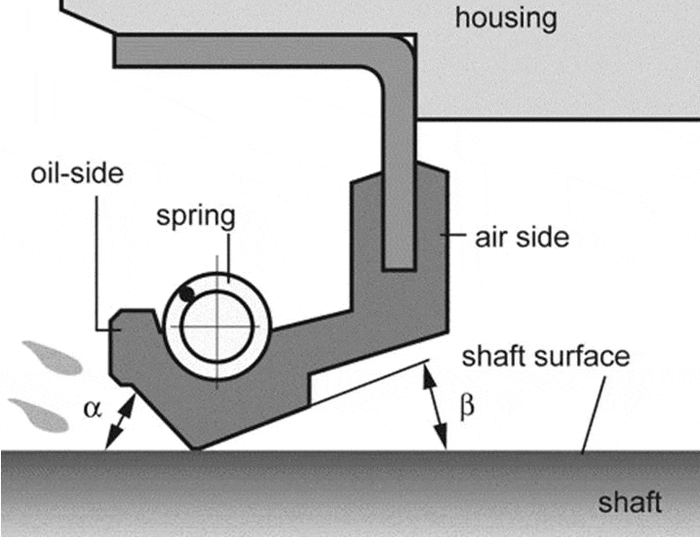
You have a sharp seal edge against the shaft surface, in most cases it's being forced against that shaft with a spring ring. Any internal pressures force the sealing lip against the shaft even harder. If you soften the seal, you flatten that sealing lip and make it LESS effective, you don't want more surface against the axle, that reduces the sealing force. You want a thin lip of rubber against the shaft - that means the pressure is higher on that thin lip for a better seal - otherwise the seal's sealing surface would be flat, not sharp.
(my college prof would be in full defense mode right now regarding seal conditioners. We were warned in no uncertain terms - only as a last resort on an already leaking seal - as a band-aid. )


Sorry, I strongly disagree on that.
That's for old, hard seals. New seals are supple enough. You don't need or want swelling. If you soften them too much with such things they actually "grab" the shaft and wear faster and get hotter.
I've been dealing with axles and seals since I was in my mid-teens, cars and trucks of all sorts, including the big power company boom trucks, and including 1910s stuff. A good seal needs nothing at all but a good lubricant like any other moving part. Why the hell would you want to soften an already flexible seal that's being forced against the shaft with some real pressure?
This isn't a case of lube not "conditioning" seals. That I will bet on. Only the companies selling lubricating products will throw that out at customers. The last thing you want is anything that makes seals softer unless they are aged and hard.
Now if these SEALS have a problem that's different, but a good seal will last well over 100,000 miles with any good lube, and not need conditioning. The reason they eventually start leaking is age (they get hard) and/or wear.
I've replaced axle seals and rebuilt transmissions after someone put "seal fixing products" in them.
There's already tension on the seal against the shaft - you don't want more (read up on seal design and engineering) A standard lip type seal actually will hold back at least 7psi as it sits right out of the box and as pressure builds, the lip is pressed harder against the shaft, increasing the seal's sealing power.
The damn oil companies try to sell product by convincing them they need "Seal conditioning" and that's just marketing bunk. I will never put anything that claims to soften seals or condition them in a vehicle that is A - under warranty, or B - fewer than about 100,000 miles (and I want to stretch some life out of it).
Seals don't need conditioning. We've gotten by many decades with ordinary plain hypoid lube without solvents and "seal conditioners". Why would it be "needed" now? To sell fancy oils, convincing the unsuspecting public that it's what they need.
As a guy who has made his living fixing leaks, rebuilding axles, transmissions and engines, and putting lube and fluids back in, keep that stuff away from my vehicles if it claims to soften seals or "condition" them.
Here's another reason that's not the issue - only the right seal. Think about it - ONLY the right. That's a lube issue?
Why not the 2020? You think they changed hypoid lube to something without solvents to soften seals?
The why not the front?
Why not the left?
You have a sharp seal edge against the shaft surface, in most cases it's being forced against that shaft with a spring ring. Any internal pressures force the sealing lip against the shaft even harder. If you soften the seal, you flatten that sealing lip and make it LESS effective, you don't want more surface against the axle, that reduces the sealing force. You want a thin lip of rubber against the shaft - that means the pressure is higher on that thin lip for a better seal - otherwise the seal's sealing surface would be flat, not sharp.
(my college prof would be in full defense mode right now regarding seal conditioners. We were warned in no uncertain terms - only as a last resort on an already leaking seal - as a band-aid. )
Sponsored