
Sponsored

Another Cam bites the dust...

ShadowsPapa

Well-Known Member
First Name
Bill
Joined
Oct 12, 2019
Threads
247
Messages
40,442
Reaction score
53,858
Location
Runnells, Iowa
Vehicle(s)
'25 JTMX, '23 JLU 4xe, '82 SX4, '73 Javelin
Occupation
Retired auto mechanic, frmr gov't ntwrk security admin
Vehicle Showcase
3
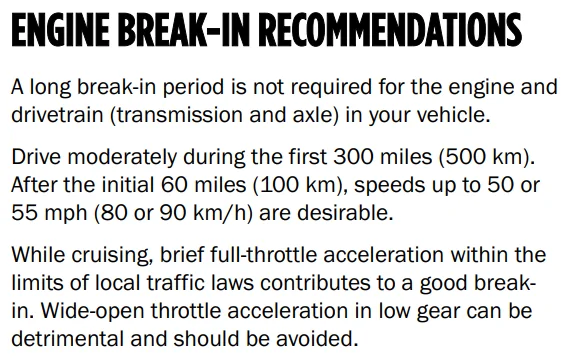
Break in? Did the dealer tell you that? While the internet swears up and down about break in period an everything. I've never found any supporting documentation from the FCA about it. Even in my owners manual the page tabbed for break in, is a blank page. And considering the DANA gear set in these have a coating ( burnished according to ShadowPapas) that also allows them to be run with no break in. I'm not saying to not do a break in. But i have 23' that i got at 0 miles odo. I now have 57k and I left the dealership smoking the rear tires. From my 19.8 NOBO camper, my boat, countless car hauls, u-hauls, over every surface, grade and trail. I haven't even ever gotten a check engine light. I'm gonna have to say that cam was fucked before you did anything.
Jeep Gladiator Another Cam bites the dust... 1754315376298-y4


noted and noted. Did you follow break in? if so did it seem adequate or overkill?
What they say has to be tempered with REALITY. Around here, it's a mix of roads, highways and speeds. "Up to" 50 might get you in trouble. But they are talking not so much the engine as the drivetrain itself - differential gears and such. The engine should be driven with a wide mix of speeds and moderate loads. Don't take it into the mountains with a 7,000 pound trailer in the first 100 miles. But their bit about "full throttle acceleration" is spot-on and right out of the books dating back years for RING break-in. And just 3 or 4 times of heavy acceleration from 20 to say 55 - not letting the transmission kick down, heavy load but no lugging - that seats the rings. After that (takes maybe 10 minutes) rings are fine - just drive it.
Ford has said it's broken in at the factory and "no further break-in is necessary" in some of their older owners manuals.

I am careful with it the first 50-100 miles - no mashing it hard, no high RPM without a load on it and so on, but I do the heavy acceleration to force high combustion pressures in the first miles to ensure rings are forced out to wear in fast. That's over with in minutes.

You want some heavy acceleration loads right away for rings, you want to watch the loads for the ring and pinion, but it all works out fine, there's no real contradiction to any of it.

His professional advise was.. New production engines don’t come with a special, break ins oil anymore. However, there is ALWAYS some material in the engine that needs to be flushed out to prevent excessive scaring on the various mating surfaces. The first oil change should be done between 1000 and 2000 miles
It's been a very very long time since there was any "break-in oil" put in from the factory. Last time was probably before half the members here were born.
I try to go 2-3K on the first and no more.
And that includes the engines I build myself.
I put in what I'm going to run, make the first change interval short (ring wear-in materials, other things that need to be flushed out) and go from there. Nothing special.
Sponsored

 

ShadowsPapa

Well-Known Member
First Name
Bill
Joined
Oct 12, 2019
Threads
247
Messages
40,442
Reaction score
53,858
Location
Runnells, Iowa
Vehicle(s)
'25 JTMX, '23 JLU 4xe, '82 SX4, '73 Javelin
Occupation
Retired auto mechanic, frmr gov't ntwrk security admin
Vehicle Showcase
3
The cam issue is a defective part issue from a random (as of now) selection of Jeeps. I don't believe it has anything to do with driving behavior, gas, oil, or longevity.
That's about the best "guess" we can make at this point.
It's not oil, not gas, driving may make iffy cams go sooner, but it won't make a good cam go if it wasn't going to.
My wife tends to drive for mpg and keeps loads and RPM lower, but then that will cause the high lift to kick in anyway........ so she's not necessarily using that less compared to some people.
I let it do what it needs to do - and in our case, going up the steep ramps onto the highways, you can't go from 10 mph to 70 mph on that short ramp without some real RPM to get there. Just not possible. Then some of the highways have a mile of grade once you get there, so you are still in 6th gear at 65 for a while - the RPM hovering 3,000 or so. You just can't NOT do it. I'd challenge anyone to bring their Jeep here, drive our neighborhood, access our highways, drive I80 east with any sort of load, and keep the RPM below 3,000.
IMO, after all of these decades of driving, maintaining, and working on cars and trucks for hundreds of other people, I believe "variety is what makes 'em last" far more than "keep the RPM low". (if you always drive with low RPM, after many miles, there is often a small ridge that forms at the top of the cylinder wall where the rings don't travel. Hit some high RPM with a ring ridge there and suddenly you are forcing that piston to travel maybe just a tiny bit farther due to clearances being removed and rod stretch and bang, you've busted the top ring)
 

ShadowsPapa

Well-Known Member
First Name
Bill
Joined
Oct 12, 2019
Threads
247
Messages
40,442
Reaction score
53,858
Location
Runnells, Iowa
Vehicle(s)
'25 JTMX, '23 JLU 4xe, '82 SX4, '73 Javelin
Occupation
Retired auto mechanic, frmr gov't ntwrk security admin
Vehicle Showcase
3
I'm 95% sure when brands mention "matching," it's an inflated marketing term. The cam profile is "matched" to fit "this" head. With manufacturing tolerances vastly (?) superior to decades past, cams and heads are like having 2 dozen pairs of the same socks. It doesn't matter which sock goes with another.
You know that in some cases teams swap cams like we swap underwear or socks.
I still want to know "what is to match". I challenge someone to show exactly what about a cam is matched to a head, and why.
They can't show it because the cam profile is the cam profile. If the lift and duration as compared to the base circle is all correct, it's in specs. Bearing surfaces - the journals - same thing. If it's in the spec range, it's good to go.
When building an engine, especially a cam in block design (say a SBC V8) if you deck the block, shave the head, swap out different rockers, that sort of thing, then you have to check your lifter preload because now you have changed things from the factory numbers, but that's still not matching the cam to anything. In that case you have adjustable push rods and set the lifter preload to spec using that test push rod, then you take it out, measure it, and order push rods to match that length.
I had to shim the pedestals on my roller rockers to get the rocker tip to hit the valve stems correctly, get the correct push rod length and that sort of thing, but if the cam were to go south, I can simply order another with those specs and slide it in and move on.

Ah, but you know all of this stuff..........


They'd have an impossible time proving that one.
Literally impossible. There just isn't any way to prove you "followed the book" or didn't. There may be clues about "abuse", but break-in? No way.
 

montechie

Well-Known Member
First Name
Wes
Joined
Nov 26, 2021
Threads
4
Messages
303
Reaction score
574
Location
Bozeman, MT, USA
Vehicle(s)
2005 LJ Rubicon, 2022 JT Rubicon
Occupation
Writer of code, designer of things
So much for thinking Jeep turned a corner on this issue.
Ugh, this is exactly how I feel. Was just thinking of trading my '22 (1 cam fix @33K) in for a '25, the TSB and discounts had given me confidence.
 

KevinM60

Well-Known Member
First Name
Kevin
Joined
Jun 7, 2023
Threads
9
Messages
1,076
Reaction score
1,874
Location
Southern Cal
Vehicle(s)
2023 Gladiator Mojave
Occupation
CAD/CAM
Literally impossible. There just isn't any way to prove you "followed the book" or didn't. There may be clues about "abuse", but break-in? No way
that was why I chose the word “impossible “ instead of “hard time “.
There’s no way they could ever prove that and would be stupid to try.
 

Sponsored

MPMB

Well-Known Member
First Name
Michael
Joined
Apr 30, 2021
Threads
12
Messages
1,820
Reaction score
2,716
Location
Utah
Vehicle(s)
'21 JTR - SG
Occupation
Check your inbox.
Ah, but you know all of this stuff..........
I know enough to be dangerous.

We cracked a valve once, right across the diameter of the face - not even a 1/8" gap on either side of the valve. Ran around town looking for a replacement, ran into an engine shop and he looked at it, dug through his milk crate of valves, and tossed us one. "It'll work." It wasn't the same width, but it was close enough. Back to the track, stuffed the valve in, slapped the head on, bolted everything back together and fired it up. Finished 5th.

Yes, there are "tolerances" but there's also "it'll work." :like::LOL:
 

Lunentucker

Well-Known Member
Joined
Apr 24, 2022
Threads
246
Messages
5,868
Reaction score
15,357
Location
Virginia
Vehicle(s)
2021 Jeep Gladiator Mojave
Occupation
People Work?
Has the fact that it's always the passenger side been addressed at all?

So many things discussed here as I skimmed through.
At the end of the day it comes down to this.
1. It's clearly a common problem.
2. Jumping through hoops like babied break in periods, not changing oil brands, oil additives, etc. and so on isn't the fix. This is an inherent issue with poor design, poor manufacturing, or both.
 

DylanM

Well-Known Member
First Name
Dylan
Joined
Sep 1, 2023
Threads
1
Messages
1,022
Reaction score
2,552
Location
Texas
Vehicle(s)
'21 JTRD
Occupation
USAF Retired
Has the fact that it's always the passenger side been addressed at all?

So many things discussed here as I skimmed through.
At the end of the day it comes down to this.
1. It's clearly a common problem.
2. Jumping through hoops like babied break in periods, not changing oil brands, oil additives, etc. and so on isn't the fix. This is an inherent issue with poor design, poor manufacturing, or both.
That's the point that seems to get skipped over in the posts positing that the cause is a simple materials or finishing issue with the camshafts and/or rockers -- why is the problem so much more prevalent on the right cylinder head?
 

OldButStillJeeping

Well-Known Member
First Name
Eric
Joined
Apr 20, 2021
Threads
14
Messages
517
Reaction score
932
Location
Northwest Wisconsin
Vehicle(s)
2021 JTM, '92 Jeep YJ, 2017 F250 4WD, 1996 RAM D150 4x4, 2006 Jeep Liberty 4x4
Occupation
Tree farmer now. Retired first responder.
I know enough to be dangerous.

We cracked a valve once, right across the diameter of the face - not even a 1/8" gap on either side of the valve. Ran around town looking for a replacement, ran into an engine shop and he looked at it, dug through his milk crate of valves, and tossed us one. "It'll work." It wasn't the same width, but it was close enough. Back to the track, stuffed the valve in, slapped the head on, bolted everything back together and fired it up. Finished 5th.

Yes, there are "tolerances" but there's also "it'll work." :like::LOL:
You guys know way more than I.

I swapped cams back in the day as well.

But more recently I worked a bit for a high end car shop. The tenure techs said no way would they swap a cam without the head as well. It all has to do with matching the bearing faces to high tolerance. As well as other valve train tolerancd match.

Can't have a sloppy cam in an engine turning 7 to 8,000 RPM constant. I took that too mean most reputable modern engines are built to higher tolerance.

I expected the same from a modern 3.6 because Mercedes owned Jeep for awile. Some good things came from that merger for Jeep.

My mistake.
 

Sponsored

Zachanadandy

Well-Known Member
First Name
Zach
Joined
Oct 17, 2023
Threads
4
Messages
2,992
Reaction score
4,735
Location
Patterson, ca
Vehicle(s)
2023 gladiator Mojave
Occupation
Electrical foreman
that was why I chose the word “impossible “ instead of “hard time “.
There’s no way they could ever prove that and would be stupid to try.
And even when they remember to print that page in the manual it clearly says "recommendations". Not following a suggestion couldn't void a warranty even if they could prove it. If you payed video of smokey burnouts leaving the dealer. Doesn't matter. It's a recommendation. Not a mandate. Certainly not a mandate that would void the warranty if not followed.
 

KevinM60

Well-Known Member
First Name
Kevin
Joined
Jun 7, 2023
Threads
9
Messages
1,076
Reaction score
1,874
Location
Southern Cal
Vehicle(s)
2023 Gladiator Mojave
Occupation
CAD/CAM
You guys know way more than I.

I swapped cams back in the day as well.

But more recently I worked a bit for a high end car shop. The tenure techs said no way would they swap a cam without the head as well. It all has to do with matching the bearing faces to high tolerance. As well as other valve train tolerancd match.

Can't have a sloppy cam in an engine turning 7 to 8,000 RPM constant. I took that too mean most reputable modern engines are built to higher tolerance.

I expected the same from a modern 3.6 because Mercedes owned Jeep for awile. Some good things came from that merger for Jeep.

My mistake.
I think you stated it correctly with the high rpm engines needing a better close tolerance match on the cam bearing compared to a lower general rpm of the 3.6L pentastar.
When I’ve had cylinders rebored I sent the pistons and rings along and they honed the cylinder to match.
 

ShadowsPapa

Well-Known Member
First Name
Bill
Joined
Oct 12, 2019
Threads
247
Messages
40,442
Reaction score
53,858
Location
Runnells, Iowa
Vehicle(s)
'25 JTMX, '23 JLU 4xe, '82 SX4, '73 Javelin
Occupation
Retired auto mechanic, frmr gov't ntwrk security admin
Vehicle Showcase
3
You guys know way more than I.

I swapped cams back in the day as well.

But more recently I worked a bit for a high end car shop. The tenure techs said no way would they swap a cam without the head as well. It all has to do with matching the bearing faces to high tolerance. As well as other valve train tolerancd match.

Can't have a sloppy cam in an engine turning 7 to 8,000 RPM constant. I took that too mean most reputable modern engines are built to higher tolerance.

I expected the same from a modern 3.6 because Mercedes owned Jeep for awile. Some good things came from that merger for Jeep.

My mistake.
There is literally nothing to match. Journal clearances. And it has nothing to do with who owned who or what.
The journal clearances have a range, and being at either edge of the range will have zip to do with cam life or operation. Nothing.
I wonder if sometimes techs do things becaus because that's what they are told, that is what the factory says, or some other reason - even if there is really no sound logic or science behind it.
If the journal fit is snug, as long as it's in specs, it means little.
If it's on the looser side but in specs, it only means potentially shorter cam bearing area life - maybe, but generally not because there's so much control over the oil system. The pressure is regulated. So if the journals weep out a tad more oil than a tighter fit - no biggy, you just get more volume through but the system still all gets the same oil it should, the same amounts and pressures.

My challenge to them would be to put one of those heads on my bench and check the cam bearing area/journal clearances. Check cam runout.
Now, swap cam only, and then tell me if it's out of spec, or why it's not going to work. Show me the proof it's "necessary" instead of "that's what we're supposed to do".
I have all of the tools here for measuring - inside and outside micrometers of all sizes 0 to 5", a pair of stands used to check for balance and runout, dial indicators from Kent-Moore and Starrette, plastigauge in various sizes uses to check clearances on shafts with removable bearing caps and more.
 
OP
OP
Lochsa

Lochsa

Well-Known Member
Joined
Jan 11, 2025
Threads
4
Messages
69
Reaction score
116
Location
Sacramento, CA
Vehicle(s)
2024 Jeep Gladiator Rubicon X
Occupation
Retired
That's the point that seems to get skipped over in the posts positing that the cause is a simple materials or finishing issue with the camshafts and/or rockers -- why is the problem so much more prevalent on the right cylinder head?
I agree, this seems to be a common problem. Why so many cases where the failure occurs on the intake cam, right back, on cylinder number one? At least that is what I find in my research. At 7900 miles, it is difficult to blame owner behavior, oil, break-in etc. If this was just a materials problem, I would expect failures to be spread throughout the valve train, both intake and exhaust. Something is off.
 

ShadowsPapa

Well-Known Member
First Name
Bill
Joined
Oct 12, 2019
Threads
247
Messages
40,442
Reaction score
53,858
Location
Runnells, Iowa
Vehicle(s)
'25 JTMX, '23 JLU 4xe, '82 SX4, '73 Javelin
Occupation
Retired auto mechanic, frmr gov't ntwrk security admin
Vehicle Showcase
3
I think you stated it correctly with the high rpm engines needing a better close tolerance match on the cam bearing compared to a lower general rpm of the 3.6L pentastar.
When I’ve had cylinders rebored I sent the pistons and rings along and they honed the cylinder to match.
The cylinder finish surface is related to the ring type
The size is related to the individual pistons, but on most engines, it's all still in clearance specs if they hone to the specifed size and finish.
Rings are filed for the proper gap once installed. I have the ring grinders and a board setup for when I do engines - the board has pegs numbered 1 through 8.
I take a piston ring set, start with cylinder 1 and file the ends of the ring until I get the proper gap, sneaking up on it, of course. I do that for the 2 upper rings and both oil ring rails, then hang those rings on peg 1 and move to the next cylinder and set of rings.
When using custom pistons, such as the hyper type, they run hotter so there are different ring end gap specs for those or you'll bind and break the rings when you get it hot and under a load.
You finish hone for the ring type and material.
You gap the rings for the cylinder size and piston type.

In my case, I've simply told the machine shop (if I didn't do it myself) to finish hone for xyz rings and whatever type and size piston I was using on that build.

I think you stated it correctly with the high rpm engines needing a better close tolerance match on the cam bearing compared to a lower general rpm of the 3.6L pentastar.
You have to get WAY up there in RPM and even then, not really. High RPM high performance engines doing 7,000 or so RPM - they swap cams without issue.
For being really picky, I have a cam bearing hone that will hone a perfectly straight path through the bearings and to the size needed.
If there are no cam bearings - if it just rides on the aluminum head, then you might have some wear there - and can't just replace cam bearings to compensate like a V8. OHC engines running just on the head aluminum with no special bearing, they might be talking WEAR on head, not a "custom pair".
Sponsored


Top