Sponsored

Question first oil change.

BKDinTexas

Member
First Name
Ben
Joined
Feb 23, 2021
Threads
1
Messages
18
Reaction score
48
Location
Texas
Vehicle(s)
2021 Gladiator Rubicon
Occupation
Engineer Specialist
My EcoDiesel is about 3,500 miles right now I have a drive from California to Tennessee coming up this weekend. Originally I wanted to get the oil change done before the long drive but it seems all the dealers have no appointments available. Just wanted some opinions if you guys think everything will be good if I waited till I got there to have to oil changed. I plan to top it up before I leave with Motul (2051) 8100 X-Clean 5W-40 Synthetic. My home is right next to gupton motors which has had great reviews on here so I figured I can just get the change there. Sorry for the pretty basic questions this is my first diesel.
I have always changed the oil on a new vehicle at 1200 to 1500 miles. I figure whatever bits and pieces are knocked off by then and a oil and filter change will start everything clean and fresh. I changed my first oil at 1500 on my Gladiator. I am getting my second change today with 24% oil life left and 7700 on the odo. This included a week of very hard trail driving in Colorado. So you should be fine on your trip as far as oil life. But I would change it soon after.
Sponsored


ShadowsPapa

Well-Known Member
First Name
Bill
Joined
Oct 12, 2019
Threads
247
Messages
40,442
Reaction score
53,860
Location
Runnells, Iowa
Vehicle(s)
'25 JTMX, '23 JLU 4xe, '82 SX4, '73 Javelin
Occupation
Retired auto mechanic, frmr gov't ntwrk security admin
Vehicle Showcase
3
I have charts for breaking in diesel engines vs. gasoline auto engines. Granted, it's before the days of the "eco-diesel" and the modern technology, but it's amazing to see how long they want the things run - and I don't mean idling either. 4 times longer than gas. 1 phase of the steps to do a dyno break-in is 15 minutes on gas, 60 on diesel.
All tech info I has also matches what WXman says about small diesel engines and oil consumption the first few thou miles. I think their number are lower (more like 3,000 miles) but then those were days when engine RPMs were higher than today when cruising down a highway, too.
 

ShadowsPapa

Well-Known Member
First Name
Bill
Joined
Oct 12, 2019
Threads
247
Messages
40,442
Reaction score
53,860
Location
Runnells, Iowa
Vehicle(s)
'25 JTMX, '23 JLU 4xe, '82 SX4, '73 Javelin
Occupation
Retired auto mechanic, frmr gov't ntwrk security admin
Vehicle Showcase
3
"Unusual accuracy"? LOL.

IMO, first oil changes are to clean out any misc production debris and shouldn't be delayed too long.

In racing, our engine builder would give us the engine, we'd stick it in the car, run it, clean the filters, and race it. After a race we'd change it. Then race it 3-4 more races before changing it again. And we'd still be finding bits of blue silicone and cork.
Please don't shoot the messenger, LOL. That's Ford's words. I just posted it :angel:

Ugh - you wouldn't find pieces of silicone, etc. in mine because I use is SPARINGLY. It doesn't "squeeze out". No big chunks to break loose and plug things. I apply it sparingly, I spread it with my finger if I don't have a spreader handy.
I could never stand seeing parts of gaskets or silicone or other sealers in engines or coming out with the oil. Drove me nuts. I don't use much silicone any more - closest things I use are "Right Stuff" or anaerobic sealers. Silicone is bad mojo IMO around coolant. It just doesn't hold up.
 

MrZappo

Well-Known Member
First Name
Tom
Joined
Aug 9, 2020
Threads
13
Messages
780
Reaction score
1,872
Location
Granger, Indiana
Vehicle(s)
Gladiator Mojave
Occupation
Computer Consultant
Not needed. I believe engineers and my experiences over 4 decades (and college training) before such sites SELLING OIL.
I will never, I have never, used break-in oil. When companies that make engines put in the same oil that they recommend you use, that says something. When people like me build engines and put in the same oil I'll be using later and hundreds of us do just that, it should say "break-in oils are over-hyped".

I believe engineers, Perfect Circle, Ford and SAE engineers before I believe a site selling oil.
I know what Perfect Circle (MAKER OF RINGS and other parts) says, I have quotes from Ford and others.
Here's what an SAE member says after testing oils -

10. BREAK-IN OILS – DO WE REALLY NEED THEM?

First, a little background info so that we are all on the same page. The independent and unbiased Engineering testing I perform at a REPRESENTATIVE OPERATIONAL TEMPERATURE, to establish motor oil wear protection capability, is a dynamic friction test under load, similar to how an engine dyno test is a dynamic HP/Torque test under load. Both tests show how their subjects truly perform in the real world, no matter what brand names are involved, no matter what outrageous claims may have been made, and no matter what their spec sheets may say.

The fact is, motor oil wear protection capability is determined by the base oil and its additive package “as a whole”, with the emphasis on the additive package, which is what contains the extreme pressure anti-wear components, and NOT merely by how much zinc is present. The use of zinc as the primary extreme pressure anti-wear component is outdated technology. Modern extreme pressure anti-wear components are equal to or better than zinc, which is why many modern low zinc oils outperform many traditional high zinc oils.

...........................
They are typically high zinc lovers who just can’t accept the fact that what they’ve always believed about the need for high zinc oils, is only an Old Wives Tale MYTH. So, they get upset and go out of their way trying to undermine anything that goes against what they have been brainwashed to believe about high zinc oils. But, emotion does not determine how good any particular oil is. Factual Engineering tests have proven over and over again that zinc levels alone DO NOT determine an oil’s wear protection capability. The naysayers cannot back-up anything they say, but I back-up everything I say with hard Engineering test data that exactly matches real world experience.


*****

Now, on with Break-In Oil information.

.
So-called Break-In oils are typically hyped by claiming they provide for quick ring seating while providing extra wear protection for other parts. Of course no oil can be formulated to “allow” the wear of only certain parts, AND to “prevent” the wear of other parts, at the same time. It has to be formulated for one or the other, which we will see below.

.
When impossible Marketing claims like that are made, it is only to sell product, no matter what the truth really is. Many would call that blatant false advertising, which motor oils are famous for. The absolute best oils and the absolute worst oils all make the same claim about how great they are. Until my wear protection capability test data became available, buyers had no way of knowing which oils actually live up to those claims and which ones don’t. Because we now know that looking at the zinc level alone, is absolutely worthless, and tells you nothing about an oil’s wear protection capability.
Let’s take a look at component quantities of several Break-In Oils, from the Lab Tests performed by ALS Tribology in Sparks, Nevada.

Lucas 30 wt Break-In Oil, conventional
zinc = 4483 ppm
phos = 3660 ppm
moly = 3 ppm
total detergent/dispersant/anti-deposit build-up/anti-sludge = 1104 ppm
TBN = 5.9
This oil has by far, the highest level of zinc/phos I have ever come across. It has way more than twice the amount of zinc that begins to CAUSE wear/damage. Because of that, the extremely low level of TBN, and the extremely low level of detergent, this oil should be used for only a very short time, as a Break-In oil would suggest.

Comp Cams 10W30 Break-In Oil, conventional
zinc = 3004 ppm
phos = 2613 ppm
moly = 180 ppm
total detergent/dispersant/anti-deposit build-up/anti-sludge = 4234 ppm
TBN = 14.7
This oil also has by far, way too much zinc/phos. It has way more than enough zinc to begin causing wear/damage, rather than prevent it. Because of that, this oil also should be used for only a very short time, as a Break-In oil would suggest.

Edelbrock 30 wt Break-In Oil, conventional
zinc = 1545 ppm
phos = 1465 ppm
moly = 4 ppm
total detergent/dispersant/anti-deposit build-up/anti-sludge = 3452 ppm
TBN = 10.6
This oil is manufactured for Edelbrock by Torco.

.
Royal Purple 10W30 Break-In Oil, conventional
zinc = 1170 ppm
phos = 1039 ppm
moly = 0 ppm
total detergent/dispersant/anti-deposit build-up/anti-sludge = 3184 ppm
TBN = 9.8

As you can see above, there is absolutely no consistency at all, between the Break-In oils that were fomulated by these various Oil Companies. These oils are all over the place and bouncing off the walls. We see zinc from 1170 ppm to 4483 ppm. We see phos from 1039 ppm to 3660 ppm. We see detergent levels from 1104 ppm to 4234 ppm. And we see TBN values from 5.9 to 14.7. WOW!!! These oils couldn’t be much more different, and yet they are all aimed at the EXACT SAME Break-In oil market. It makes you wonder if these Oil Companies have any idea what they are doing, and if they even test these oils to see what they can really do.

So, let’s take a look at the wear protection these oils and several other Break-In oils, actually provide, and see how they rank just among themselves, according to their “Load Carrying Capacity/Film Strength” psi value. This data will tell us once and for all, what the Oil Companies would not, and that is, whether the oils are formulated to “allow” wear or “prevent” wear.

.
The Wear Protection reference categories are:

• Over 105,000 psi = INCREDIBLE wear protection

• 90,000 to 105,000 psi = OUTSTANDING wear protection

• 75,000 to 90,000 psi = GOOD wear protection

• 60,000 to 75,000 psi = MODEST wear protection

• Below 60,000 psi = UNDESIRABLE wear protection

The higher the psi , the better the Wear Protection

1. 30wt Amsoil Break-In Oil conventional = 78,192 psi
zinc = 2051 ppm
phos = 1917 ppm
moly = 0 ppm

.
2. 30wt Edelbrock Break-In Oil conventional = 69,160 psi
zinc = 1545 ppm
phos = 1465 ppm
moly = 4 ppm

.
3. Royal Purple 10W30 Break-In Oil, conventional = 62,931 psi
zinc = 1170 ppm
phos = 1039 ppm
moly = 0 ppm

.
4. Crane Cams 10W40 Break-In Oil, conventional = 62,603 psi
zinc = TBD, but bottle claims high zinc formula
phos = TBD
moly = TBD

.
5. 30wt Brad Penn, Penn Grade 1, Break-In Oil, conventional = 56,020 psi
zinc = TBD, but the bottle claims high zinc
phos = TBD
moly = TBD

.
6. 10W30 Comp Cams Break-In Oil, conventional = 51,749 psi
zinc = 3004 ppm
phos = 2613 ppm
moly = 180 ppm

.
7. 15W50 Joe Gibbs Driven BR Break-In oil, conventional = 51,299 psi
NOTE: Total Seal also sells this Break-In Oil with their label on it.
zinc = TBD
phos = TBD
moly = TBD

.
8. 30wt Lucas Break-In Oil, conventional = 49,455 psi
zinc = 4483 ppm
phos = 3660 ppm
moly = 3 ppm

.
9. 5W30 Joe Gibbs Driven BR30 Break-In Oil, conventional = 47,483 psi
NOTE: Total Seal also sells this Break-In Oil with their label on it.
zinc = TBD
phos = TBD
moly = TBD

.
Anyone who has followed my previous oil tests, knows that the wear protection capability psi values provided by most of these Break-In oils is quite low overall. Only the Amsoil made it into the GOOD WEAR PROTECTION category (75,000 to 90,000 psi). Edelbrock, Royal Purple and Crane Cams oils made it into the MODEST WEAR PROTECTION category (60,000 to 75,000 psi), while the Brad Penn, Comp Cams, Lucas and both Joe Gibbs Break-In oils managed only the UNDESIRABLE PROTECTION category (below 60,000 psi).

In comparison, the highest ranking oil (with no aftermarket additives) on my Wear Protection Ranking List, is 5W30 Motul 300V Ester Core 4T Racing Oil, synthetic = 112,464 psi, with a zinc level of 1724 ppm. That oil provides FAR GREATER wear protection capability than even the top ranked Amsoil Break-In oil here. And it provides nearly 2 1/2 times as much wear protection as the lowest ranked Joe Gibbs Break-In oil here.

So, now we finally know that because of their low wear protection capabilities, these Break-In oils are formulated only to allow wear, and are NOT formulated to provide a high level of wear protection. Of course it was impossible for them to be capable of both things at the same time, in spite of their advertising claims. And without the type of dynamic wear testing performed here, we would have never known what these Break-In oils were truly formulated for.

Every oil test I’ve performed, showed that the level of zinc has nothing to do with an oil’s wear protection capability, nor its ranking against other oils. And we’ve seen it yet again here, that high zinc levels do NOT always provide better wear protection. In fact, the ULTRA HIGH zinc Lucas Break-In oil, ended up in next to last place in wear protection capability for this group of Break-In oils.

And no one can complain that my test equipment and test procedure do not allow high zinc oils to perform at their highest level. Because here are some high zinc (over 1100 ppm) conventional, semi-synthetic, and full synthetic oils that I’ve tested previously. And they all produced test results of at least 90,000 psi, which put them all in the “INCREDIBLE or OUTSTANDING WEAR PROTECTION” categories.

.
5W30 Motul 300V Ester Core 4T Racing Oil, synthetic = 112,464 psi
zinc = 1724 ppm
phosphorus = 1547 ppm
moly = 481 ppm

.
10W30 Lucas Racing Only, full synthetic = 106,505 psi
zinc = 2642 ppm
phos = 3489 ppm
moly = 1764 ppm

.
5W30 Joe Gibbs Driven LS30 Performance Motor Oil, synthetic = 104,487 psi
zinc = 1610 ppm
phosphorus = 1496 ppm
moly = 0 ppm

.
10W30 Valvoline NSL (Not Street Legal) Conventional Racing Oil = 103,846 psi
zinc = 1669 ppm
phos = 1518 ppm
moly = 784 ppm

.
10W30 Valvoline VR1 Conventional Racing Oil (silver bottle) = 103,505 psi
zinc = 1472 ppm
phos = 1544 ppm
moly = 3 ppm

.
10W30 Valvoline VR1 Synthetic Racing Oil, API SL (black bottle) = 101,139 psi
zinc = 1180 ppm
phos = 1112 ppm
moly = 162 ppm

.
30 wt Red Line Race Oil, full synthetic = 96,470 psi
zinc = 2207 ppm
phos = 2052 ppm
moly = 1235 ppm

.
10W30 Amsoil Z-Rod Oil, full synthetic = 95,360 psi
zinc = 1431 ppm
phos = 1441 ppm
moly = 52 ppm

.
10W30 Quaker State Defy, API SL (semi-synthetic) = 90,226 psi
zinc = 1221 ppm
phos = 955 ppm
moly = 99 ppm

As you’ve seen above in the poor performing high zinc break-in oils and immediately above in the excellent performing high zinc non-break-in oils, the zinc levels completely overlap among all those poor performing and excellent performing oils. So, that is absolute proof once and for all, that you simply CANNOT predict an oil’s wear protection capability based on its zinc level alone.

.
Now the brainwashed high zinc believers have ironclad data to show them that everything they have always believed about only needing to look at zinc levels, is total nonsense. Zinc levels alone are completely worthless. Only film strength/load carrying capability from dynamic wear testing under load, can tell us which oils provide good wear protection and which oils don’t. If the high zinc believers don’t grasp the value of this information, then they will never be able to select the best possible oil for their needs.

.
A fair number of people have been able to get away with using these poor performing Break-In oils in high performance flat tappet engines without a problem. But, they typically were only able to do that with these oils by following elaborate and worrisome break-in procedures. Those break-in procedures typically include removal of the inner valve springs, to reduce the pressure between the lobes and lifters. They also typically follow the routine of keeping the engine at around 2,500 rpm for 20 minutes, etc, etc. Everything they do as part of their elaborate and nerve wracking break-in procedure, is only a crutch to prevent wiping lobes because these break-in oils provide such poor wear protection. But, if high ranking oils were selected instead, and used for Break-In, people wouldn’t have to go through all that, because NO elaborate break-in procedures would be required with those far superior high ranking oils.

.
People think they have to go through all this break-in agony, because they assume parts quality isn’t that high, even when using parts from reputable Industry leading companies. They never even consider for a moment that their beloved high zinc oils are to blame. But, as you can see above, these break-in oils show that they put flat tappet engines at serious risk of failure, because of their poor wear protection capability, even though they have high zinc levels. People typically believe they are getting sufficient wear protection because of all that zinc, from what the bottles and/or websites claim. But, now we know that the hype about great wear protection was nothing more than false advertising snake oil. These oils are formulated only to allow wear, by having low wear protection capability, in spite of their high zinc levels.

.
And that is precisely why there are still so many flat tappet wiped lobe engine failures at break-in and shortly thereafter. When people use these poor performing break-in oils, in flat tappet engines, they are simply playing Russian Roulette with their engines. They may be OK, or they may suffer engine failure. It’s extremely iffy, because the margin of safety is about zero with these oils. But, it does NOT have to be that way if a highly ranked oil is chosen instead.

.
It’s a similar situation where a fair number of people have managed to get away with using low zinc oils with aftermarket zinc additives added into those oils, for breaking-in high performance flat tappet engines. Some people were able to squeak by with this type of oil concoction that also provides only minimal wear protection capability. But, quite a few people have experienced wiped lobe engine failure doing this. These people also “thought” they were getting outstanding wear protection, from what those zinc additive bottles and/or websites claimed. But, Engineering test data has proven over and over again, that simply having high zinc levels, is no guarantee of having sufficient wear protection.

.
I tested the zinc additives “ZDDPlus” which added a whopping 1848 ppm zinc when added at the recommended quantity, and “Edelbrock Zinc Additive” which added 573 ppm zinc when added at the recommended quantity. Each zinc additive was tested in two full synthetic oils and one conventional oil. And in EVERYONE of the six test oils, the wear protection capability DROPPED SIGNIFICANTLY.

.
The “ZDDPlus” caused a drop of about 25% on average, and the “Edelbrock Zinc Additive” caused a drop of about 34% on average. The oils with the “ZDDPlus” ended up having a “Load carrying capacity/Film strength” of only 58,855 psi on average. And the oils with the “Edelbrock Zinc Additive” ended up having a “Load carrying capacity/Film strength” of only 51,930 psi on average. That puts them into the UNDESIRABLE PROTECTION category (below 60,000 psi). So, the wear protection capability of these oil concoctions, was right in the exact same range as most of the Break-In oils tested here. Oil Companies have typically said to NEVER add anything to motor oil, because doing that will ruin an oil’s carefully balanced additive package and its resulting chemical properties. And they were absolutely correct, because that is precisely what the test data showed.

.
It’s also a similar situation where a fair number of people have managed to get away with using Diesel oils for breaking-in high performance flat tappet engines. They were able to squeak by with Diesel oil even though these oils also provide only minimal wear protection capability, which puts their engines at a substantial risk of failure. These folks “thought” they were getting outstanding wear protection. But, I tested 13 different popular conventional and synthetic Diesel oils, including the “OLD” Rotella, and they had a “Load carrying capacity/Film strength” of only 72,408 psi on average, putting them in the MODEST PROTECTION category (60,000 to 75,000 psi). This wear protection capability puts them right at the upper range of the Break-In oils tested here.

.
To summarize, most of the Break-In oils, the low zinc oils with aftermarket zinc added to them, and the Diesel oils, provided about the same level of modest to undesirable wear protection in gasoline engines. And that makes most of them a risky proposition for use as Break-In oils.

.
This points out that all the effort, including elaborate break-in procedures, that people go through with these motor oils, in order to prevent wiped lobes in High Performance flat tappet engines, is misguided because these oils DO NOT provide the best wear protection in the first place. There are far better motor oil choices readily available.

.
Many people probably have a gut feeling that whatever Break-In oil they use, should not be overly protective against wear, so that components can break-in quickly. That’s why you often hear people say to break-in an engine with conventional oil, then later switch to synthetic, even though they aren’t aware that an oil being conventional or synthetic does not determine its wear protection capability.

.
But, then the flat tappet guys often want to have max protection against wear to avoid wiped lobes. So, they will then often choose conventional oil with high levels of zinc, “falsely believing” that will help increase the oil’s wear protection. But, as mentioned many times before, “wear testing” and “lab testing” have ALWAYS shown that the level of zinc does NOT determine an oil’s wear protection capability. No more than the level of gas in your tank determines how much HP your engine makes.

.
We’ve only looked at the “lower end” of the spectrum of Break-In oils, which are formulated to allow break-in wear. But, since things just aren’t that simple, let’s also take a look at the “upper” end of the spectrum of Break-In oils. Consider the following facts.

.
Countless thousands of brand new Performance cars have come off the production line, factory filled with full synthetic motor oil. We’ve seen this for years in both domestic and import Performance Cars. Perhaps the most commonly known is the full synthetic 5W30 Mobil 1 that comes in High Performance GM vehicles. Also the Ford GT Sports Car of a few years back, as well as Ford’s Supercharged Shelby GT500 Mustangs, came factory filled with full synthetic 5W50 Motorcraft oil.

.
That full synthetic 5W30 Mobil 1, API SN oil ranks in the top 10% of all the oils I’ve tested, with a “Load carrying capacity/Film strength” value of 105,875 psi. And the full synthetic 5W50 Motorcraft, API SN oil also ranks in the top 10% of all the oils I’ve tested, with a “Load carrying capacity/Film strength” value of 103,517 psi. With the extremely impressive wear protection capability provided by these oils, if any oils would interfere with ring seal and proper break-in wear overall, these oils would be the ones to do it. But, that is simply not a problem, and of course these vehicles all come with a normal factory warranty.

CONCLUSION:

We know that countless High Performance factory engines, both 2 valve and 4 valve, have nicely broken-in for many, many years with NO ring sealing problems what so ever, using various oils with high wear protection capability. In addition to that, using oils with excellent wear protection capability, has worked perfectly fine for breaking-in in traditional High Performance flat tappet engines, and have proven that NO elaborate break-in procedures are required at all. You can simply fire the engine and drive the car with no drama and no worries. Try doing that with the poor performing high zinc Break-In oils.

.
So, why would anyone ever believe that you need so-called Break-In Oils with poor their wear protection capability, when these oils are simply NOT needed for ring seal (properly built engines will seal/seat their rings almost immediately no matter what oil is used), and they put High Performance flat tappet engines at serious risk of wiped lobe engine failure? Plus, they require elaborate break-in procedures if there is any hope at all of getting away with using these poor performing oils. Bottom Line: So-called Break-In oils are simply not necessary and can also put flat tappet engines at serious risk.

.
If you insist on providing these short answers devoid of sufficient breadth and lacking in detail, I dont know how I can continue to take you seriously ...
 

ShadowsPapa

Well-Known Member
First Name
Bill
Joined
Oct 12, 2019
Threads
247
Messages
40,442
Reaction score
53,860
Location
Runnells, Iowa
Vehicle(s)
'25 JTMX, '23 JLU 4xe, '82 SX4, '73 Javelin
Occupation
Retired auto mechanic, frmr gov't ntwrk security admin
Vehicle Showcase
3
If you insist on providing these short answers devoid of sufficient breadth and lacking in detail, I dont know how I can continue to take you seriously ...
Funny thing - people will believe what they see if it matches their own thinking - but when confronted with other information, nope, you are wrong. I'm finding that even with proof, evidence, engineering data, test data, naw, you are still wrong.

I loved a "Debate" years ago on the AMC forum about throttle pressures vs. governor pressures. A guy came in contradicting everyone saying no, this is how it works. I showed him my college book pages - with "Courtesy Ford Motor Company" or "courtesy General Motors" right with the charts - nope, I was still wrong (even though I rebuilt automatic transmissions and repaired them myself)
I finally got him to prove his beliefs. He pointed to a web site where a guy had done a driveway overhaul of his AMX transmission - and it worked, and that guy put up a bunch of bogus information about transmission pressures. All of it wrong. Yet that other guy swore because the info was on a web site and posted by a guy who posted pictures of his transmission rebuild in the driveway, he knew better.
Ford, GM, Chrysler, they were wrong.
I think the guy was blowing a gasket and getting really nasty because he was proven wrong in public.
 

Sponsored

MrZappo

Well-Known Member
First Name
Tom
Joined
Aug 9, 2020
Threads
13
Messages
780
Reaction score
1,872
Location
Granger, Indiana
Vehicle(s)
Gladiator Mojave
Occupation
Computer Consultant
Funny thing - people will believe what they see if it matches their own thinking - but when confronted with other information, nope, you are wrong. I'm finding that even with proof, evidence, engineering data, test data, naw, you are still wrong.

I loved a "Debate" years ago on the AMC forum about throttle pressures vs. governor pressures. A guy came in contradicting everyone saying no, this is how it works. I showed him my college book pages - with "Courtesy Ford Motor Company" or "courtesy General Motors" right with the charts - nope, I was still wrong (even though I rebuilt automatic transmissions and repaired them myself)
I finally got him to prove his beliefs. He pointed to a web site where a guy had done a driveway overhaul of his AMX transmission - and it worked, and that guy put up a bunch of bogus information about transmission pressures. All of it wrong. Yet that other guy swore because the info was on a web site and posted by a guy who posted pictures of his transmission rebuild in the driveway, he knew better.
Ford, GM, Chrysler, they were wrong.
I think the guy was blowing a gasket and getting really nasty because he was proven wrong in public.
I get it ...

For me, its Amsoil every 1000 miles with filter changes every 500 ... You cant be too careful plus I saw it in an issue of cosmo once I think ...

You shall never convince me sir ...
 

ShadowsPapa

Well-Known Member
First Name
Bill
Joined
Oct 12, 2019
Threads
247
Messages
40,442
Reaction score
53,860
Location
Runnells, Iowa
Vehicle(s)
'25 JTMX, '23 JLU 4xe, '82 SX4, '73 Javelin
Occupation
Retired auto mechanic, frmr gov't ntwrk security admin
Vehicle Showcase
3
I get it ...

For me, its Amsoil every 1000 miles with filter changes every 500 ... You cant be too careful plus I saw it in an issue of cosmo once I think ...

You shall never convince me sir ...
At least you didn't read it in teen vogue LOL
 

just_another_guy

Well-Known Member
Joined
Jan 1, 2021
Threads
8
Messages
327
Reaction score
471
Location
Indiana
Vehicle(s)
Gladiator
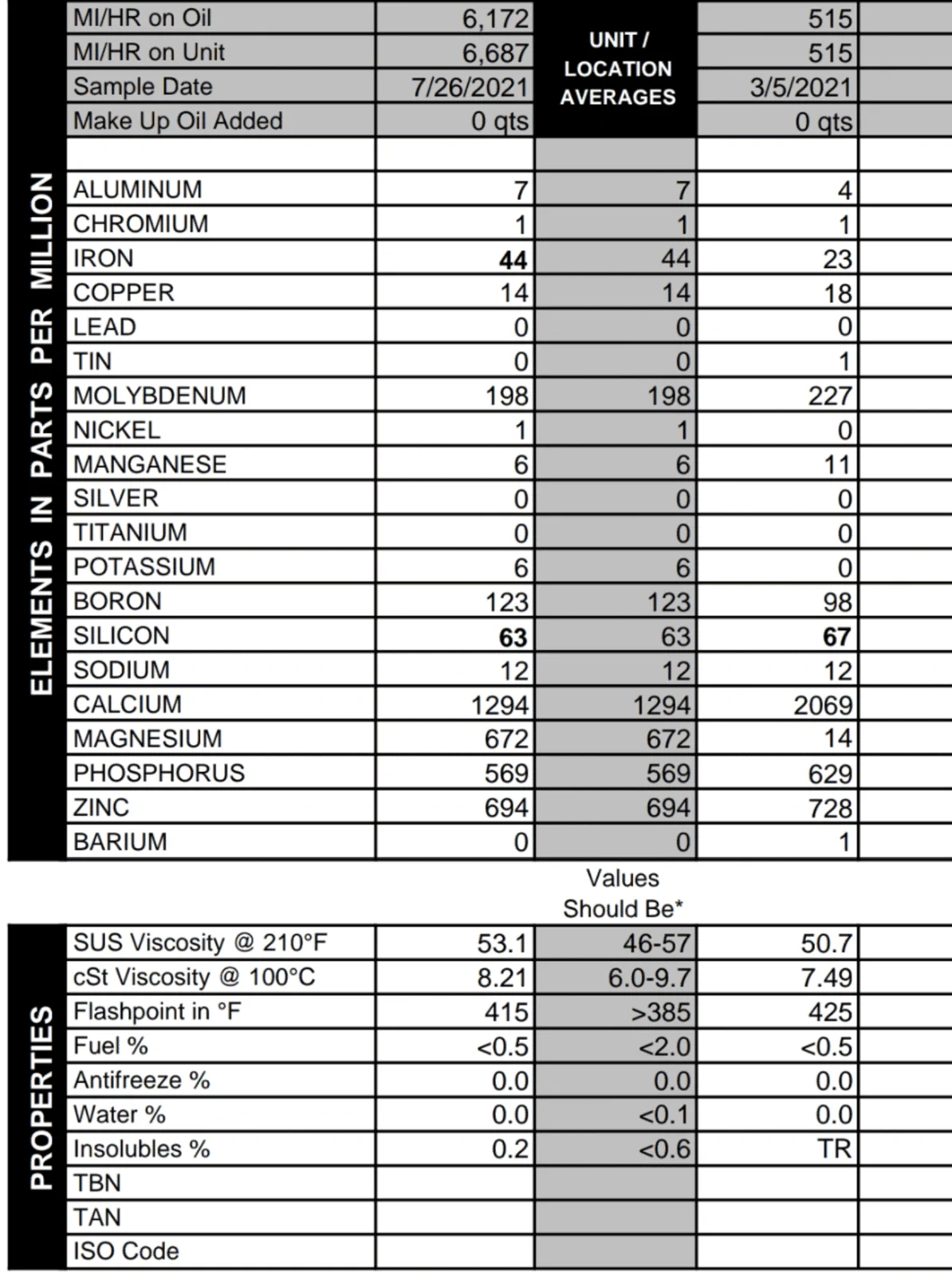
I changed my oil at 500mi and again at 6700mi and had the samples analyzed at blackstone to see how the engine is breaking in.

Jeep Gladiator Question first oil change. Screenshot_20210810-130942


Wear was definitely accelerated in the first 500mi, but the levels aren't alarming in either report. It's worth mentioning that there was no towing in the first 500mi and the truck is pulling something behind it about half the time after that.

I also cut the filters open on both of these oil changes and have found a surprising amount of debris in them both times (first was significantly worse than the second). It mostly consisted of yellow paint particles and small specks of aluminum. If nothing else, I would suggest changing the filter on a brand new motor within the first 500mi since it's such an easy job.
 

Chestnut

Well-Known Member
First Name
Andrew
Joined
Jul 15, 2021
Threads
1
Messages
183
Reaction score
234
Location
Minneapolis
Vehicle(s)
2013 WRX, 2017 Forester XT, 2021 JTO
Occupation
Civil Engineer
Umm wow information overload.... Awesome post I appreciate it.

I did my first oil change on my Subaru at 500 miles and again at 2,000 miles. Despite a lot of oil burn conversations surrounding the boxer engine the level on my engine doesn't burn much if any between changes. I also get better than average fuel mileage. I've seen 30-32 on full highway driving tanks this is calculated not computer mileage.

Right or wrong my mentailty has always been sooner rather than later. An extra oil changer here or there is a lot cheaper than a new engine, excessive oil burn, or other issues that may arise.
 

Sponsored

MPMB

Well-Known Member
First Name
Michael
Joined
Apr 30, 2021
Threads
12
Messages
1,820
Reaction score
2,716
Location
Utah
Vehicle(s)
'21 JTR - SG
Occupation
Check your inbox.
Please don't shoot the messenger, LOL. That's Ford's words. I just posted it :angel:

Ugh - you wouldn't find pieces of silicone, etc. in mine because I use is SPARINGLY. It doesn't "squeeze out". No big chunks to break loose and plug things. I apply it sparingly, I spread it with my finger if I don't have a spreader handy.
I could never stand seeing parts of gaskets or silicone or other sealers in engines or coming out with the oil. Drove me nuts. I don't use much silicone any more - closest things I use are "Right Stuff" or anaerobic sealers. Silicone is bad mojo IMO around coolant. It just doesn't hold up.
;) ?

Obviously we have experiences with different beasts. :LOL:

Budget necessities of the era. $10 of RTV silicone for a season or $30/pop for gasket sets for each rebuild. 3 or 4 rebuilds a season; that's the cost of a new race tire.

I got pretty good at sealing the headers, never had a blowout.
 

MPMB

Well-Known Member
First Name
Michael
Joined
Apr 30, 2021
Threads
12
Messages
1,820
Reaction score
2,716
Location
Utah
Vehicle(s)
'21 JTR - SG
Occupation
Check your inbox.
Q: If you installed a dry sump system (2gal tank), which would give you almost 3X the amount of oil, could you go at least 3X between oil changes?

Nevermind the "why" or arguments on added weight. Theoretically, would it be possible?
 

just_another_guy

Well-Known Member
Joined
Jan 1, 2021
Threads
8
Messages
327
Reaction score
471
Location
Indiana
Vehicle(s)
Gladiator
Q: If you installed a dry sump system (2gal tank), which would give you almost 3X the amount of oil, could you go at least 3X between oil changes?

Nevermind the "why" or arguments on added weight. Theoretically, would it be possible?
Yes, with the caveats that your filter will last that long and most manufacturers recommend you change your oil every 12mo regardless of mileage
 

ShadowsPapa

Well-Known Member
First Name
Bill
Joined
Oct 12, 2019
Threads
247
Messages
40,442
Reaction score
53,860
Location
Runnells, Iowa
Vehicle(s)
'25 JTMX, '23 JLU 4xe, '82 SX4, '73 Javelin
Occupation
Retired auto mechanic, frmr gov't ntwrk security admin
Vehicle Showcase
3
;) ?

Obviously we have experiences with different beasts. :LOL:

Budget necessities of the era. $10 of RTV silicone for a season or $30/pop for gasket sets for each rebuild. 3 or 4 rebuilds a season; that's the cost of a new race tire.

I got pretty good at sealing the headers, never had a blowout.
I've not had headers leak -not until I lose a bolt or one gets loose. Embarrassing as heck was heading out of town with a girl who later ended up being my first wife. Headed out to the country roads. Just turned onto an almost never traveled old country road (a bit bumpy) and dropped a side pipe. Well, there goes the evening. I found some old fence wire in the ditch, wrapped it around the end of the pipe and she drove my car back home while I leaned out the door and held the pipe up off the road.

30 bucks for a gasket set? That's pretty cheap.
Intake gasket for my engines - 45 bucks, plus the rest of the set.

Yes, with the caveats that your filter will last that long and most manufacturers recommend you change your oil every 12mo regardless of mileage
Yup - every year regardless of miles. That's due to the sludges and acids that built up. I have 2 oil pans up on a shelf that have small holes in them - eaten from the inside by the acid in the oil. Obviously the owner of those engines didn't drive them much and changed oil even less.
I don't like the crud sitting in there so it gets changed. If driven right to avoid moisture and acids shouldn't be a problem, but I'd rather change the oil than see etched parts like I've seen over the years.

I also cut the filters open on both of these oil changes and have found a surprising amount of debris in them both times (first was significantly worse than the second). It mostly consisted of yellow paint particles and small specks of aluminum.
The yellow likely from inspection marks. I bought a NOS (new old stock) Jeep engine from Edelbrock years ago. They obtained it to use on their dyno as part of a performance manifold project that never saw the light of day. There sat that brand new engine under one of their work benches. An employee friend put it up for sale - highest offer buys is. I didn't have hardly any money but offered 200 bucks. After a week the guy said it was mine. Got it home and took the pan off as I was going to use it in a rare Eagle I had here - and had to swap on the Eagle specific pan and oil pickup screen. The rods were each marked with painted inspection marks. So were some of the other internal parts. I have photos somewhere as I thought - how many people have seen the inside of a never installed in a vehicle engine.
There was also some casting flashing.
Since by the time you tear an engine down few if any inspection marks remain one must figure with the heat, oil, and other conditions in the crank case, those marks make their way into the oil (and filter)
I ended up selling the car and selling the engine to a guy who was restoring a Jeep. He got a brand new complete engine for a grand - the exhaust still had the original shipping tag on it.
 

Chestnut

Well-Known Member
First Name
Andrew
Joined
Jul 15, 2021
Threads
1
Messages
183
Reaction score
234
Location
Minneapolis
Vehicle(s)
2013 WRX, 2017 Forester XT, 2021 JTO
Occupation
Civil Engineer
Obviously the owner of those engines didn't drive them much and changed oil even less.
Is there something an owner of a vehicle they drive little can do to make sure their engine and internal parts stay in good condition? I only get about 3k miles on my subaru a year and it's almost always in 500 mile increments.
Sponsored


Top