Sponsored

Rough idle when partially warmed up.

punchingbag

Well-Known Member
First Name
Travis
Joined
Aug 18, 2025
Threads
7
Messages
110
Reaction score
223
Location
Houston, TX
Vehicle(s)
24 JTMT, 99 F150 Lightning, 24 Santa Fe
Build Thread
Link
Occupation
IT for Class A Office Buildings
Howdy, folks.

First-time Jeep owner here. Joined the family Monday with a used 2024 JTMT with ~5400 miles.

Noticed a rough idle when cold Tuesday morning. (sat overnight). Took it to the dealer Wednesday, and they weren't even interested in hardly looking at it. I bought their "injector cleaner" service just to create a record of my concern and to create an initial relationship with the dealer. Their recommendation is that it has likely sat for some time. Run the injector cleaner, put a few tanks of premium in it, and drive it for a couple of months. "it should clear up".

One thread I have since read on these forums seems to describe my issue exactly. The consensus from that thread was to try to pull diag logs on it while it is doing it because if it was a "fuel" issue, it would do it the entire time it was running.

My symptoms
1. On cold start no rough idle
2. About 60-90 seconds in, the rough idle starts. It is worse with a/c on but doesn't go away completely with a/c off.
3. Feels like a single surge or miss every couple of seconds. With a/c on it is 2 or 3 surges at a time
4. The tach needle doesn't move at all during the rough idle. Even the lightest touch on the gas stops the behavior instantly. When letting off, it comes back.
5. The issue also goes away when fully warmed up.

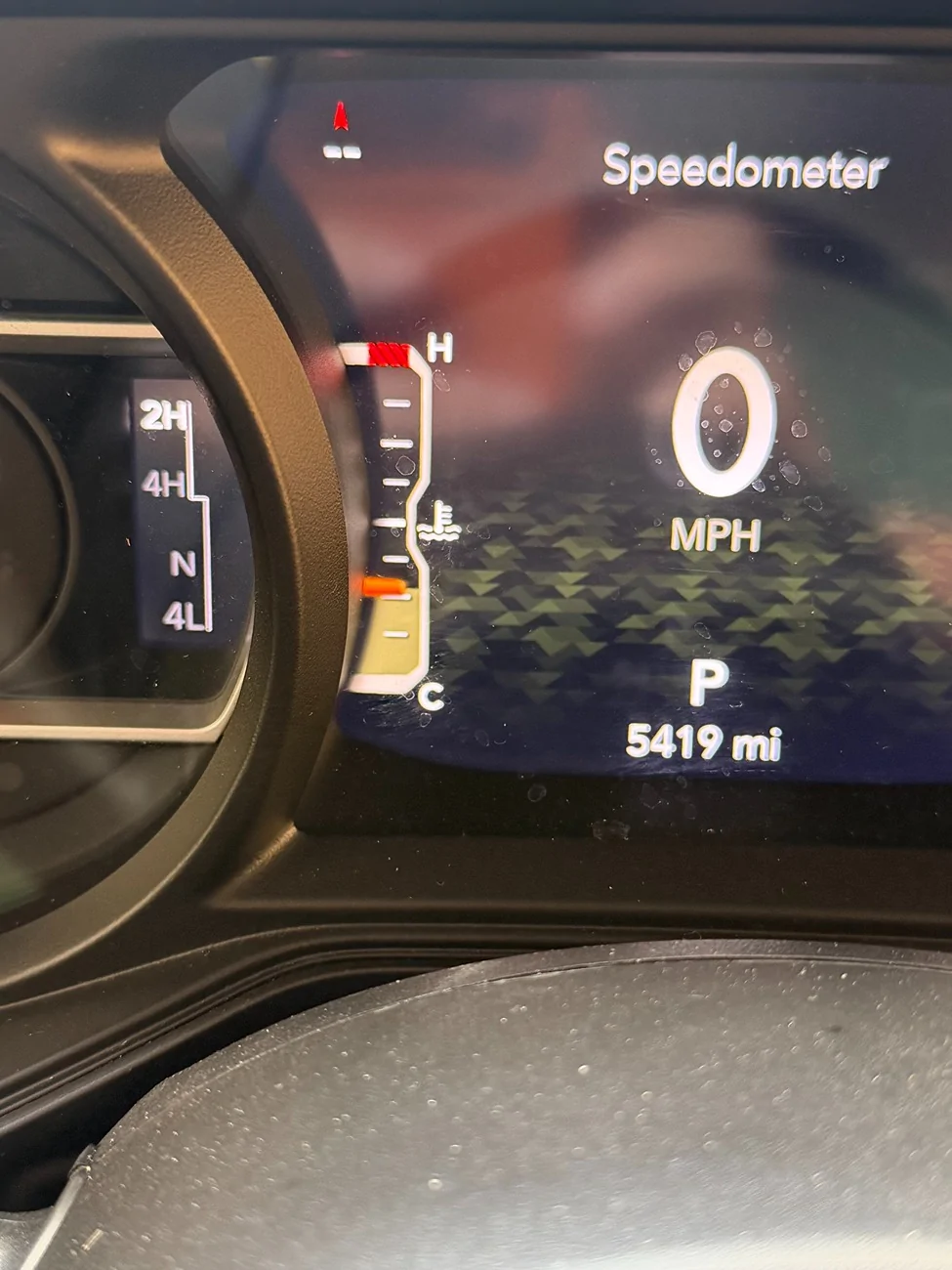
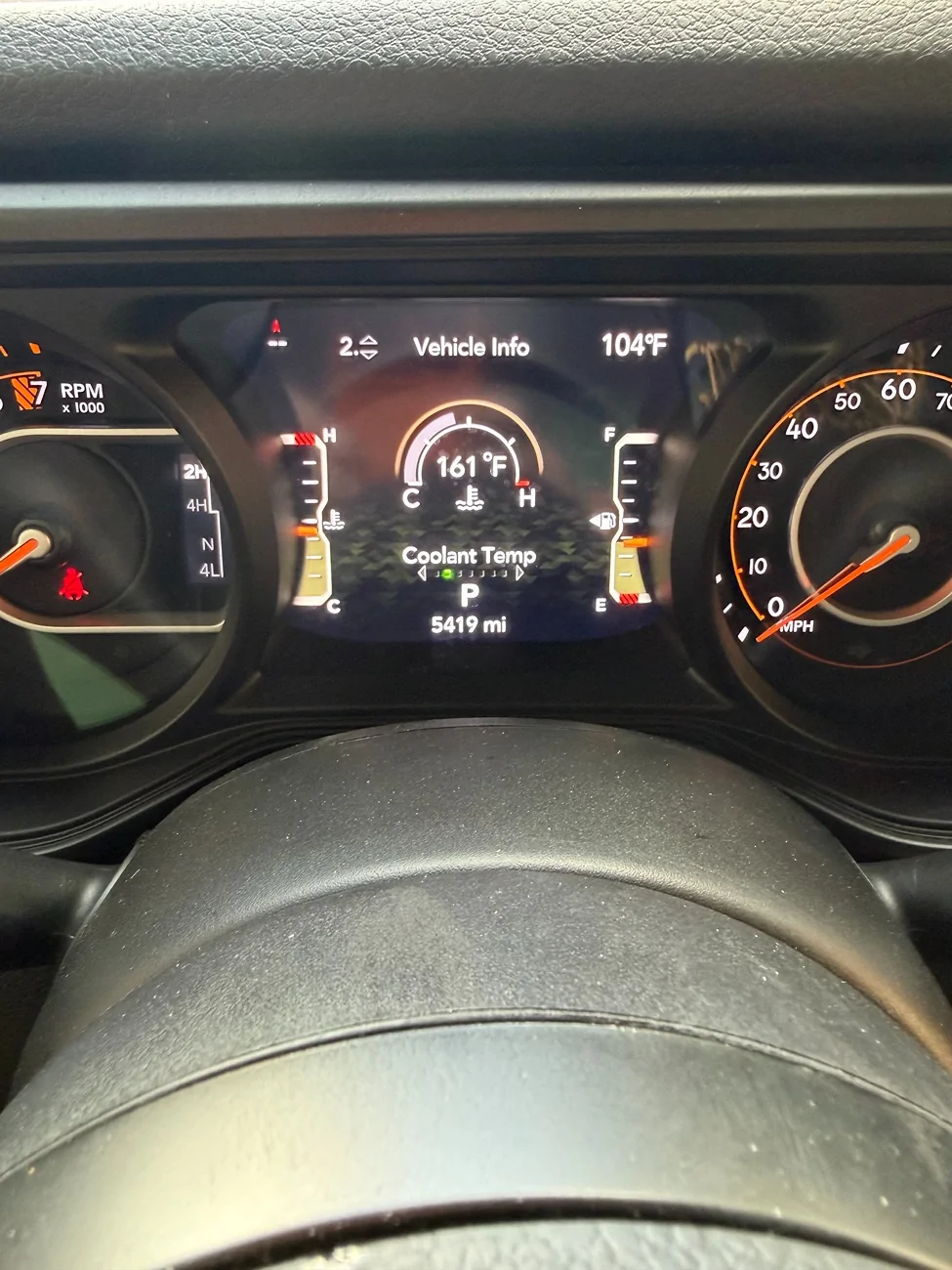
The pictures below show the temp when the roughness starts and when it goes away.

Any thoughts from the experienced Jeep guys would be much appreciated.

Thank you, Kindly
-Travis

Jeep Gladiator Rough idle when partially warmed up. IMG_0424
Jeep Gladiator Rough idle when partially warmed up. IMG_0430
Sponsored

 
OP
OP
punchingbag

punchingbag

Well-Known Member
First Name
Travis
Joined
Aug 18, 2025
Threads
7
Messages
110
Reaction score
223
Location
Houston, TX
Vehicle(s)
24 JTMT, 99 F150 Lightning, 24 Santa Fe
Build Thread
Link
Occupation
IT for Class A Office Buildings
Forgot to mention. For my benefit, I am sending an oil sample to Blackstone for analysis to get a baseline for the engine.
 

bmpcamry09

Rock Sponsor (Level 1)
Joined
Feb 28, 2026
Threads
11
Messages
242
Reaction score
387
Location
IL
Vehicle(s)
25 JL
There is nothing wrong with your Jeep at all. And a fuel system cleaning service with 5000 mile was a waste of money.

These have a very aggressive variable cam and spark timing mapping when the engine is warming up, this is done on purpose to heat up the catalytic converter and engine as fast as possible and will often manifest as "rough" running. The engine will advance the intake cam and retard the exhaust cam from their base position to create a mild EGR effect and recycle hotter air through the combustion process during warm up. This is why these engines warm up so quickly. What your describing is common and nothing to worry about, a significant rough running or misfire even will cause a check engine light.
 
OP
OP
punchingbag

punchingbag

Well-Known Member
First Name
Travis
Joined
Aug 18, 2025
Threads
7
Messages
110
Reaction score
223
Location
Houston, TX
Vehicle(s)
24 JTMT, 99 F150 Lightning, 24 Santa Fe
Build Thread
Link
Occupation
IT for Class A Office Buildings
Thank you for the great information. This helps me a lot as I start to learn what sounds/feels normal on this first Jeep.

The first thing I noticed was how fast it warmed up. I was like, "Damn, OK then" lol.
 

bmpcamry09

Rock Sponsor (Level 1)
Joined
Feb 28, 2026
Threads
11
Messages
242
Reaction score
387
Location
IL
Vehicle(s)
25 JL
Thank you for the great information. This helps me a lot as I start to learn what sounds/feels normal on this first Jeep.

The first thing I noticed was how fast it warmed up. I was like, "Damn, OK then" lol.
Yep! The 2.0 in the Wrangler is even more noticeable. It sounds like a misfiring farm tractor until it’s warmed up for the same reason.
 

Sponsored

bmpcamry09

Rock Sponsor (Level 1)
Joined
Feb 28, 2026
Threads
11
Messages
242
Reaction score
387
Location
IL
Vehicle(s)
25 JL
Thank you for this post. I have wondered same thing about my gladiator it runs great jut has the same exact symptom. Finally an explanation that makes total sense.
No problem! I tune these almost daily and I can pinpoint and explain in painful detail nearly every unique trait of this engine. I’ve got probably 1000+ hours into these calibrations both in stock form and in supercharged form and still learn some new stuff every now and then. Feel free to reach out of you have any questions!
 

WilldWilly

Well-Known Member
First Name
Billy
Joined
Jun 6, 2024
Threads
12
Messages
493
Reaction score
1,105
Location
New Hampshire
Vehicle(s)
2025 Gladiator High Tide, 1994 Impala SS
Occupation
Machinist
I agree this is normal. I will say that with your truck's age, and mileage, if it sits a lot, I would keep the tank full, and treat the gas with Stabil 360.
 

ChrisNLA

Well-Known Member
First Name
Chris
Joined
Jun 7, 2022
Threads
23
Messages
3,444
Reaction score
6,665
Location
Louisiana
Vehicle(s)
2022 JT Sport Max Tow
Build Thread
Link
Can confirm. Mine feels like that sometimes, but engine runs great.
 

Slingblade72

New Member
First Name
Steven
Joined
Apr 21, 2018
Threads
1
Messages
4
Reaction score
1
Location
League city texas
Vehicle(s)
2016 jeep wrangler unlimited sport
I agree this is normal. I will say that with your truck's age, and mileage, if it sits a lot, I would keep the tank full, and treat the gas with Stabil 360.
Question. I just posted earlier today about similar symptoms. Mine started about 5 months ago. Didn't ever do it before. Seems to be more abundant now compared to then. Still through this whole period it has never caused any codes or check engine light.
 

WilldWilly

Well-Known Member
First Name
Billy
Joined
Jun 6, 2024
Threads
12
Messages
493
Reaction score
1,105
Location
New Hampshire
Vehicle(s)
2025 Gladiator High Tide, 1994 Impala SS
Occupation
Machinist
Question. I just posted earlier today about similar symptoms. Mine started about 5 months ago. Didn't ever do it before. Seems to be more abundant now compared to then. Still through this whole period it has never caused any codes or check engine light.
Year? 3.6? Still under factory Warranty?
Ethenol gas is just horrible stuff for everyday use. Whatever excuses the industry uses to justify it, it starts to break down and attract moisture within two weeks. Even when vehicles are designed to handle it now, it can still do havoc on the fuel system.

Without a stabilizer your gas will be junk within a few months.

I drive my 94 Impala SS a couple times a month during the summer, so it sits a lot. I use a high-grade gas with a mid to high octane. I keep the tank treated with Stabil 360 at all times with no problems. Keeping the tank halfway to full rather than waiting till it gets down to near empty means less air is in the tank, and therefore less absorption of moisture will take place.

While Ethanol is a great Octane booster, it has a downside if your vehicle sits for any period of time


1. Reduced Fuel Economy
  • Lower Energy Density: Ethanol contains roughly 35% less energy per gallon than pure gasoline.
  • Decreased Mileage: Because of this lower energy content, burning E10 results in a 3% to 5% drop in fuel economy compared to pure gasoline, meaning you will get fewer miles per gallon

2. Moisture Absorption and Fuel Spoilage
  • Hydrophilic Nature: Ethanol is hygroscopic, meaning it naturally attracts and bonds with moisture from the air.
  • Phase Separation: If E10 sits unused for extended periods (typically longer than 3 to 4 weeks), the absorbed water and ethanol will separate from the gasoline and sink to the bottom of the tank. This creates a corrosive, gooey mixture that can clog fuel pumps, filters, and injectors

3. Damage to Small and Seasonal Engines
  • Small Engine Vulnerability: Equipment like lawnmowers, chainsaws, weed eaters, and boats are highly susceptible to ethanol damage.
  • Gumming Up: Because these tools are used seasonally and store fuel for long periods, they frequently suffer from phase separation, leading to tough starts, fouled carburetors, and a reduced engine lifespan.

4. Corrosion of Fuel System Components
  • Material Degradation: Ethanol is a strong solvent and is highly corrosive to certain metals, plastics, and rubbers.
  • Older Vehicle Risks: Vehicles built before the early 2000s and vintage machinery often use older formulations of rubber fuel lines, seals, and gaskets. E10 can cause these components to dry out, swell, shrink, or crack, potentially creating dangerous fuel leaks.
Sponsored


Top