Sponsored

Tire volume calculations

OP
OP

Darel

Well-Known Member
First Name
Darel
Joined
Apr 29, 2020
Threads
51
Messages
393
Reaction score
299
Location
Mountain Top, PA
Vehicle(s)
'21 JT Rubi Sarge Green; '08 JK
Occupation
Military
I think @ParatusExpeditions wins this round. Kudos for putting all that math and effort into it. I ran some quick theoretical numbers on a mole calculator I found online and I think what I came up with matches your numbers pretty close - something like 2x 5-gal air tanks would have about 10-ish moles of air at 125 psi, but four tires of that size (volume based on a YouTube vid of a guy reviewing a 10.6 cfm compressor with a stopwatch) came out to something like 129 moles. And your calc, which is undoubtedly more accurate, is in that ballpark. Not worth it. I'll just carry a compressor. Thank you very much!

Also excellent point on that "force" required as the differential pressures get closer.
Sponsored
 

bleda2002

Well-Known Member
Joined
May 11, 2021
Threads
24
Messages
2,746
Reaction score
4,489
Location
34655
Vehicle(s)
2021 JTR Firecracker Red
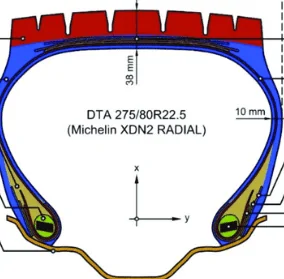
Since the rim has a drop, is it not part of that cylinder? Or is it small enough you are discounting it?
A xxx size tire on one rim will also be either a larger volume, or smaller, depending on the width rim it's installed on.


1699327009902.png
I was discounting it, since we really just need to see if it was even close to working.

Kudos to the guy that did all the math btw, was neat to see it all actually worked out!
 

jav_eee

Well-Known Member
Joined
Mar 10, 2023
Threads
35
Messages
1,084
Reaction score
1,075
Location
Texas
Vehicle(s)
2021 Gladiator Rubicon
10# CO2 tank for the win!
 

Badunit

Well-Known Member
Joined
Jan 31, 2023
Threads
20
Messages
817
Reaction score
1,346
Location
USA
Vehicle(s)
2023 JT Rubicon, 1997 TJ
Unless I misunderstood the previous calculations, one thing left out was that you cannot evacuate the tank. It is part of the final volume (4 tires + tank). It is the correct amount needed from a pump but not when using a tank.

Here is part of a calculation I did last night then deleted:

P1 = Pressure of the tank
V1 = Volume of the tank
P2 = Initial pressure of a tire (17psi)
V2 = Volume of a 35" tire. 30-40 gal ea (using same units as the tank)
There are 4 tires to pump up
Pfinal = the pressure of tank & tires after equalization

Pfinal = (P1*V1 + 4*P2*V2)/(V1+4*V2)

5 gal tank @ 125psi -> Pfinal = (125*5 + 4*17*30)/(5+4*30) = 21 psi
10 gal tank @ 150psi -> Pfinal = (150*10+4*17*30)/(10+4*30) = 27psi
20 gal tank @ 150psi -> Pfinal = (150*20 + 4*17*30)/(20+ 4*30) = 36psi

These are for sure not reliable numbers and may not even be close (I don't know what the actual tire volume is) but I think they give a general idea of what you would get from a tank, assuming I did it right.

A few scuba tanks at 3000psi would be more efficient due to their smaller volume. and higher pressure.
 
Last edited:

Stuntman Mike

Well-Known Member
First Name
Joerg
Joined
Sep 9, 2023
Threads
6
Messages
526
Reaction score
1,046
Location
Essen, Germany
Vehicle(s)
2022 JTOD, 2005 TJ 4.0, 1989 XJ 4.0, 2004 XK8
Occupation
Rotating Equipment Consultant
A few scuba tanks at 3000psi would be more efficient due to their smaller volume. and higher pressure.
That would be a smart solution but I am quite sure that Darel is not able to refill the scuba tank with his compressor. ;)
 

Sponsored

ParatusExpeditions

Well-Known Member
Joined
Mar 18, 2022
Threads
10
Messages
442
Reaction score
378
Location
CA
Vehicle(s)
22 JT Rubicon EcoDiesel
one thing left out was that you cannot evacuate the tank
The tank pressure is always higher than the tire in this model, it equalizes out so no need for a pump. That’s the same principle used with power tanks except the gas is even more compressed. They have those this two stage mechanism that reduces the pressure to something in the 125-250 PSI depending on which one someone would get. One just need to have enough at the start in the tank such as it can equalize to at least the target pressure.

Having more is luxury directly translating in inflation speed as the closer we get to equalizing pressure the slower it inflate.

Now, thinking about it, what you’re saying makes sense to me but I’ve based my calculations on a difference of mol of air needed to go from P1 to P2 at given temperature setting etc. So that is independent of the source (pump vs tank). Then this is used to calculate a volume at a given pressure (I chose 150PSI because that's what my compressor could put said tank at) effectively making a theoretical tank that carries enough mol of air to inflate said tire from P1 to P2. However, from what you're saying I think instead of calculating the difference in mol between P1 and P2 for the tank air quantity, we should take n2 (quantity air for the target pressure) directly since n1 (quantity of air at start pressure) would always stay in the tank when they form a single volume. Correct?

That is an easy tweak to do. It will result in a bigger tank size needed to store those extra mol of air. Making this solution less likely to be viable. Last I checked the 30Gal tank is large, somewhat heavy and on my diesel no way of attaching it to the car.
 

ParatusExpeditions

Well-Known Member
Joined
Mar 18, 2022
Threads
10
Messages
442
Reaction score
378
Location
CA
Vehicle(s)
22 JT Rubicon EcoDiesel
That would be a smart solution but I am quite sure that Darel is not able to refill the scuba tank with his compressor. ;)
Correct, any tank size can be reduced if the pressure increases adequately. But last I checked the scuba shop compressors are large, gas-powered, and expensive. Powertank or DIY a Co2 tank and getting it refilled will go a long way before breaking even with the shop compressor ?
 

Freems

Well-Known Member
First Name
Mike
Joined
Mar 13, 2023
Threads
10
Messages
871
Reaction score
1,192
Location
Boise Idaho
Vehicle(s)
2020 Gladiator Sport 2022 Bronco Sport
Occupation
Retired
Powertank.com

a ten pound tank fills 42 each 35” tires on a single fill of CO2 and cost about $13.50 to fill. It’s portable, it will run air tools on the trail, it will operate air lockers with a manifold and the tank is pressure rated, so it’s safe. No pumps, no electric connection, quit over thinking it, and stop doing math, your making my head hurt.
 

ParatusExpeditions

Well-Known Member
Joined
Mar 18, 2022
Threads
10
Messages
442
Reaction score
378
Location
CA
Vehicle(s)
22 JT Rubicon EcoDiesel
The onboard tank solution can work with a way smaller bottle if someone can find a belt-driven compressor that can push more than 150PSI and more importantly fit in our engine compartment ?. This would be similar to have An infitine powertank. Larger LMTV vehicles uses those belt driven compressor for their CTIS systems on way larger tires with no issues.
 

biplaneguy

Well-Known Member
First Name
Dana
Joined
Oct 28, 2023
Threads
15
Messages
217
Reaction score
266
Location
CT
Vehicle(s)
2023 Gladiator Sport
Occupation
Engineer
Must be some scientists here, to talk of moles. In engineering we just use "standard cubic feet" (or any other volume units), which is the volume a mass of air would fill at at standard atmospheric pressure ( psi).

The precise dimensions of the tire probably don't matter, you can get close enough with an approximation. I assumed a torus with a 32" OD and 12.5" cross section, which gives 7097 cubic inches, or 4.1 cubic feet (CF).

38 psig (gauge) is 52.7 psia (absolute), so multiplying 4.1*52.7/14.7 means we have 14.7 SCF at 38 psig, and similarly, 8.8 SCF at 17 psig. So you need to add 5.9 SCF to raise the pressure from 17 to 38, or 23.6 SCF for four tires.

1 gallon is 0.13 cubic feet, so a 10 gallon tank at 100 psig holds 10.1 SCF. And you can't use all of that, since the tank can only fill the tire to 38 psi when the pressure in the tank itself is greater than 38 psi, meaning only 6.5 SCF is available... so a 10 gallon tank at 100 psi could just barely fill one tire from 17 to 38 psi, and it'd be pretty slow at the end.

Very rough assumptions, but we agree within an order of magnitude, that a 10 gallon tank at 100 psi won't cut it.

On my CJ5 I had a York compressor from an AMC Eagle air conditioner, it worked great. Had two small tanks (maybe 1/2 gallon total) just to buffer it and provide a reserve for the air horns.
 

Sponsored

mrmo

Well-Known Member
First Name
Mrmo
Joined
Jan 26, 2021
Threads
56
Messages
863
Reaction score
544
Location
East Tn
Vehicle(s)
2022 Gladiator
Occupation
nuke
TWO 5 gal tanks??? I gotta see this one....
 
OP
OP

Darel

Well-Known Member
First Name
Darel
Joined
Apr 29, 2020
Threads
51
Messages
393
Reaction score
299
Location
Mountain Top, PA
Vehicle(s)
'21 JT Rubi Sarge Green; '08 JK
Occupation
Military
Must be some scientists here, to talk of moles. In engineering we just use "standard cubic feet" (or any other volume units), which is the volume a mass of air would fill at at standard atmospheric pressure ( psi).

The precise dimensions of the tire probably don't matter, you can get close enough with an approximation. I assumed a torus with a 32" OD and 12.5" cross section, which gives 7097 cubic inches, or 4.1 cubic feet (CF).

38 psig (gauge) is 52.7 psia (absolute), so multiplying 4.1*52.7/14.7 means we have 14.7 SCF at 38 psig, and similarly, 8.8 SCF at 17 psig. So you need to add 5.9 SCF to raise the pressure from 17 to 38, or 23.6 SCF for four tires.

1 gallon is 0.13 cubic feet, so a 10 gallon tank at 100 psig holds 10.1 SCF. And you can't use all of that, since the tank can only fill the tire to 38 psi when the pressure in the tank itself is greater than 38 psi, meaning only 6.5 SCF is available... so a 10 gallon tank at 100 psi could just barely fill one tire from 17 to 38 psi, and it'd be pretty slow at the end.

Very rough assumptions, but we agree within an order of magnitude, that a 10 gallon tank at 100 psi won't cut it.

On my CJ5 I had a York compressor from an AMC Eagle air conditioner, it worked great. Had two small tanks (maybe 1/2 gallon total) just to buffer it and provide a reserve for the air horns.
I had a York from a FSJ woody wagon (supposedly the biggest version of York you could get) on my TJ and it worked great. I had a 2.5 gal air tank off an old bus on the Jeep, and another external made out of a propane tank and I could sandblast with it.

Good luck finding space on our Jeeps for a belt-driven compressor.....
Sponsored


Top