
Sponsored

Transmission fluid or not!

ShadowsPapa

Well-Known Member
First Name
Bill
Joined
Oct 12, 2019
Threads
247
Messages
40,440
Reaction score
53,853
Location
Runnells, Iowa
Vehicle(s)
'25 JTMX, '23 JLU 4xe, '82 SX4, '73 Javelin
Occupation
Retired auto mechanic, frmr gov't ntwrk security admin
Vehicle Showcase
3
Varnish formation is an interesting science in ATF (well, engine oil, too) - there's a whole lot to it, including not only oxidation but moisture and acid levels, and molecules floating around that eventually cling to surfaces, causing an endless loop. Once a tiny layer forms, that layer actually prompts more to form, and the more it forms, the more it prompts more formation.

Here's a snippet of an article that suggests what I've seen and known for years - you short-trippers are killing not only your engine, but your other vehicle equipment - differentials (yes, they can even varnish) transmissions and more -


--------------------------------------------------------
Varnish is a wide-ranging term encompassing various types of deposits in oil systems. Some types are hard and tenacious, others sticky, and still others soft and thick, commonly referred to as sludge. What they have in common is they typically originate from the breakdown or degradation of the oil in the system. Varnish usually forms and sticks in areas that are either very hot or very cool and stagnant.

Measuring or detecting varnish is a challenge. Every equipment operator should have an oil analysis program to check for contaminants in the oil. However, oil analysis only measures the precursors of varnish. MPC testing (Membrand Patch Colorimetry) is an indicator the oil may be breaking down, a measure of the potential for varnish but not of the varnish itself. Varnish does not appear in the oil, but on the metal surfaces with which the oil comes in contact. The only way to know you have varnish is to see it on a surface or to experience its effect. For example, a sticky valve is a likely indicator of the presence of varnish.

Varnish is triggered in various ways. In general, the cycle of varnish starts with something that upsets the stability of the lubricant, usually a thermal event such as excessive heat. This causes the oil to start degrading and impurities to start forming. For a long time, those impurities stay dissolved in the oil and don’t cause any harm. As more and more accumulate, however, they begin to stick together, forming insoluble, suspended submicron particles. Ultimately, these particles become polar, or electrically attracted to metal surfaces. When they start sticking to those surfaces, they become varnish.

Cross-contamination of oils with incompatible additives can also trigger the varnish cycle. If an operator introduces a new oil with a different additive formulation from the existing oil, the additives can react with each other, which upsets the lubricant and starts the process of degradation that ultimately leads to varnish.

Often the process is reversible, depending on the oil temperature. The hotter the oil, the better it can hold varnish in solution. If the system is allowed to cool, or the oil becomes stagnant, as often happens when equipment is shut off for a few days or a weekend, the risk is greater that varnish will stick to surfaces.

---------------------------------------------------
Sponsored
 
OP
OP
DanJT

DanJT

Well-Known Member
First Name
Dan
Joined
Sep 19, 2024
Threads
33
Messages
702
Reaction score
1,063
Location
Tn
Vehicle(s)
2020 Gladiator Rubicon
Occupation
Retired
I believe my transmission fluid (manual) was supposed to be changed around 30K but my dealer forgot to do it and i was relying on them. We just noticed and changed it at 50K. Was worrying about this but it sounds like most everyone is getting by OK changing at longer intervals.
That's what I keep hearing on the Manny trans, 30K.
 

g2020

Well-Known Member
First Name
David
Joined
Oct 30, 2024
Threads
22
Messages
214
Reaction score
272
Location
Texas USA
Vehicle(s)
2020 Jeep Gladiator Sport
I believe my transmission fluid (manual) was supposed to be changed around 30K but my dealer forgot to do it and i was relying on them. We just noticed and changed it at 50K. Was worrying about this but it sounds like most everyone is getting by OK changing at longer intervals.
Post #40 provides a basic understanding of ATF for automatic transmission, as well as some coverage of the manual transmission. As DanJT said, 30K miles / 3 years is the severe service interval for a manual transmission. It also happens to be the only specific service interval, for either transmission, published in the owner's manual. This is where ZF guidance on the automatic transmission kicks in.
 

Stan H

Well-Known Member
First Name
Stanley
Joined
Oct 26, 2022
Threads
10
Messages
5,475
Reaction score
5,456
Location
WV
Vehicle(s)
Gladiator Rubicon 2021
Occupation
Safety Consultant
Post #40 provides a basic understanding of ATF for automatic transmission, as well as some coverage of the manual transmission. As DanJT said, 30K miles / 3 years is the severe service interval for a manual transmission. It also happens to be the only specific service interval, for either transmission, published in the owner's manual. This is where ZF guidance on the automatic transmission kicks in.
Which makes it completely irrational and irresponsible of FCA to literally throw us to the wolves on the "lifetime" bull crap. Last time I had my ATF changed pan dropped etc. The guy said why it's lifetime. I said cause ZF says so and He looked at me like I just spit out the directions to shangri la . I thought for a second He was going to says Shhhhhh not so loud dont want anyone else to hear that.
 
OP
OP
DanJT

DanJT

Well-Known Member
First Name
Dan
Joined
Sep 19, 2024
Threads
33
Messages
702
Reaction score
1,063
Location
Tn
Vehicle(s)
2020 Gladiator Rubicon
Occupation
Retired
Tranny pan is in and as I pulled the plug to check the fluid while warm I already have a light colored/dark fluid. But.. I have a drain plug so 1,000 miles or so it's fluid change time again...
 

Sponsored

ShadowsPapa

Well-Known Member
First Name
Bill
Joined
Oct 12, 2019
Threads
247
Messages
40,440
Reaction score
53,853
Location
Runnells, Iowa
Vehicle(s)
'25 JTMX, '23 JLU 4xe, '82 SX4, '73 Javelin
Occupation
Retired auto mechanic, frmr gov't ntwrk security admin
Vehicle Showcase
3
Which makes it completely irrational and irresponsible of FCA to literally throw us to the wolves on the "lifetime" bull crap. Last time I had my ATF changed pan dropped etc. The guy said why it's lifetime. I said cause ZF says so and He looked at me like I just spit out the directions to shangri la . I thought for a second He was going to says Shhhhhh not so loud dont want anyone else to hear that.
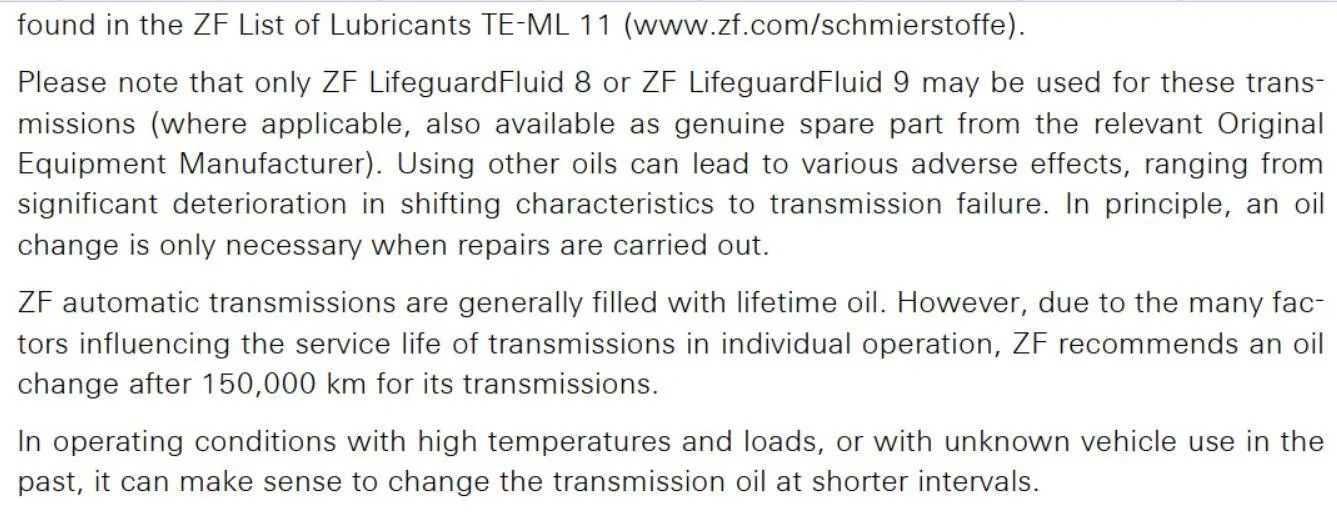
FCA isn't throwing anyone to the wolves. ZF themselves states the following -

Jeep Gladiator Transmission fluid or not! Screenshot 2025-05-11 101222


These aren't your 1970 TF727s with open vents and dipstick tubes and old-generation fluids in their infancy.

Obviously owners can have it changed, or change it themselves every 5K if it makes them feel better about it.
Me - I have no reason, see no reason, in experience, have nothing indicating I'm going to cause any trouble going 50K or more - even 60K.
Is it necessary? No.
If it makes you feel good - go for it.
But none of the fear mongering that you are breaking things if you don't do at least every 30-40K.
Do what makes you feel good.
 

g2020

Well-Known Member
First Name
David
Joined
Oct 30, 2024
Threads
22
Messages
214
Reaction score
272
Location
Texas USA
Vehicle(s)
2020 Jeep Gladiator Sport
Which makes it completely irrational and irresponsible of FCA to literally throw us to the wolves on the "lifetime" bull crap. Last time I had my ATF changed pan dropped etc. The guy said why it's lifetime. I said cause ZF says so and He looked at me like I just spit out the directions to shangri la . I thought for a second He was going to says Shhhhhh not so loud dont want anyone else to hear that.
Note: This is a list of grievances for next Festivus. It is not guidance. For basic guidance on ATF for the automatic transmission (and some on the manual transmission), see post #40.

Why, might you ask, is there a SEVERE service interval (30k mi / 3 yrs) for the manny tranny in the OM, but not a NORMAL service interval? Instead of doubling the SEVERE service interval like a NORMAL person, they say that ATF in the manual transmission (for NORMAL driving), too, is "for the life of the vehicle".

Score: Lifetime 3, Specific Interval 1
Lifetime: Auto SEVERE, Auto NORMAL, Manny NORMAL
Specific Interval: Manny SEVERE

Selective reading: On the first page of the ZF LifeguardFluid 9 PDS, ZF says "lifetime oil" and then "150,000 km" (93,000 mi) in the same paragraph. Why did Stellantis/FCA/Jeep stop reading after "lifetime oil"?

Dealer transmission service: When a transmission service is performed at a dealer, the warranty is for 24 months. Why doesn't the special dispensation on lifetime ATF carry over to a transmission service?

It seems obvious that these gaps are related to environmental standards, but they could have done much better on the guidance front.
 

Maximus Gladius

Well-Known Member
First Name
Kevin
Joined
Jan 30, 2021
Threads
74
Messages
2,901
Reaction score
3,692
Location
Calgary, AB, Canada
Vehicle(s)
2021 JTR, 2023 JTR
I have the lab doing an oxidation test on my transmission oil. They keep the old sample for 3 months so, since my transmission oil was pan dropped early April, they can pull my sample bottle and run this new test. They only needed me to bring in fresh oil to compare, so I ran that over to them.

I went in the back and met with the lab technician and he gave me the 15 min run down on the “markers” they look for with regard to varnish BUT….if the oil is a full synthetic, the synthetic spike is too high and wide to be able to find varnish markers. IF the oil is a semi-synthetic, chances are much greater to find varnish markers. He will tell me later today what he finds the Mopar 8/9 speed is. I told him I’ve seen where this oil has been called both semi and full synthetic.

IF he’s able to read the markers, then the data collected today will be compared with the next two oxidation tests and from there, can then draw a trend line with “time” and “distance” to determine when varnish is critical.

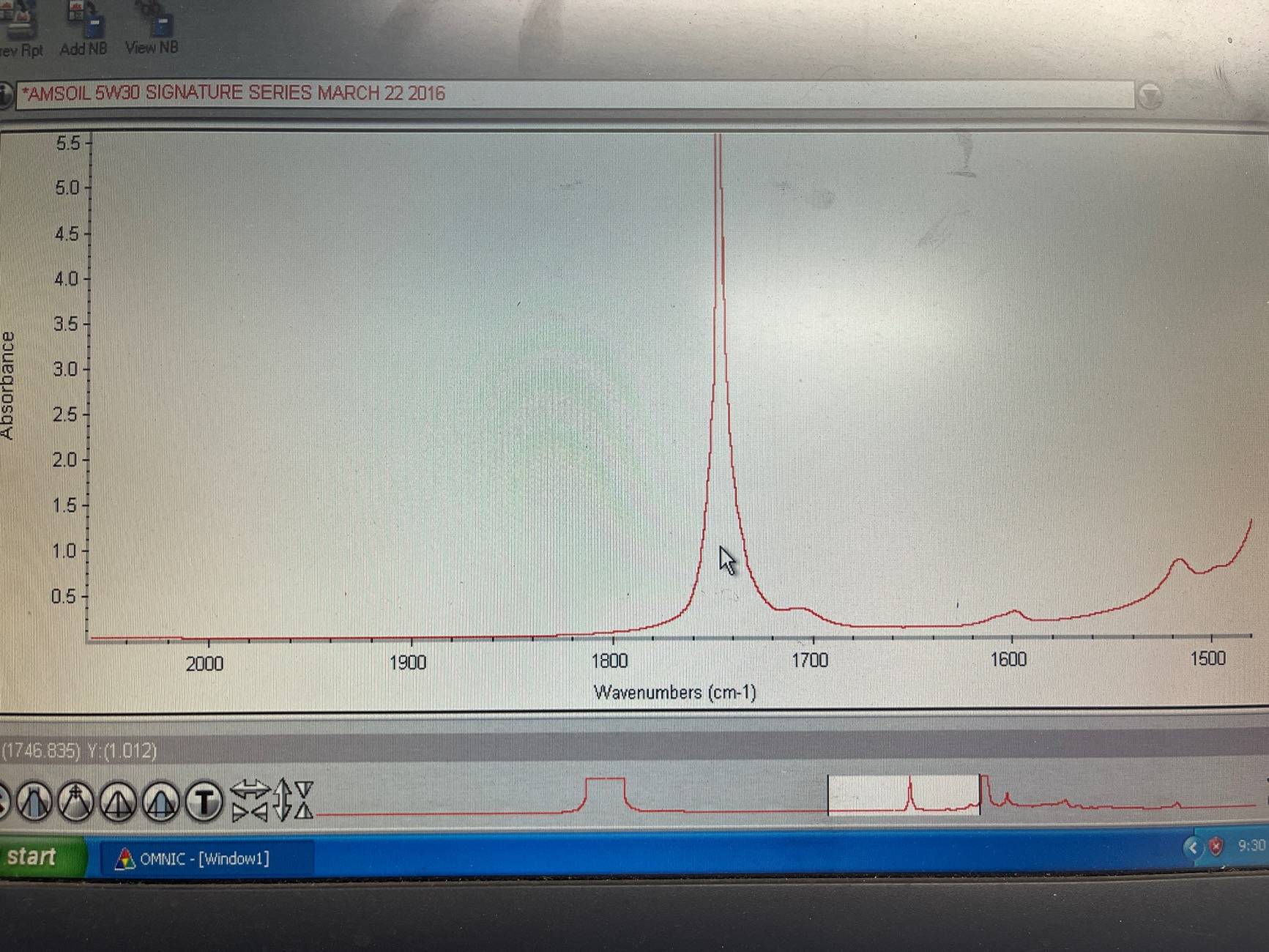
This testing goes beyond the typical generic test documenting wear metals and additives. My own pan drops are yearly, so in all fairness, a trend line can be made in 2 years.
The lab tech called me today to say the “synthetic spike” in the Mopar 8/9 speed ATF isn’t as prevalent as AMSOIL’s ATF (making comparisons) so varnish markers can be detected but I only have 20k kms (12k miles) on this sample and as of now, there is no detectable varnish markers.

As I mentioned earlier, he asked me if the Mopar 8/9 was a full synthetic or semi? I have read from ZF sources in their docs that it’s been called both so I didn’t know.

He showed me from his computer files what a “synthetic spike” looks like in a full synthetic like AMSOIL’s and I’ve attached the screen shot for you all to see what he’s talking about. He said it’s essential to understand the chemistry of synthetics when checking for varnish markers and he tried very hard to speak more “dumbed down” so I could try and grasp what it all means in a brief 15 minute explanation.

If in their oxidation tests today, if the “synthetic spike” is like that of AMSOIL’s ATF, it will be impossible to detect varnish markers. If the spike is less than AMSOIL’s ATF, it supports the notion that MOPAR 8/9 speed ATF is semi-synthetic and varnish markers can be detected.

I asked him, because AMSOIL’s spike is so tall (see photo attached) and it’s impossible for this lab to detect varnish markers, can one drive hundreds of thousands of kms and not have varnish markers present? He said correct, but there are many other factors that cause the oil to need changing like contamination, moisture and wear metals etc. Lifetime oil can not be effective for a lifetime.

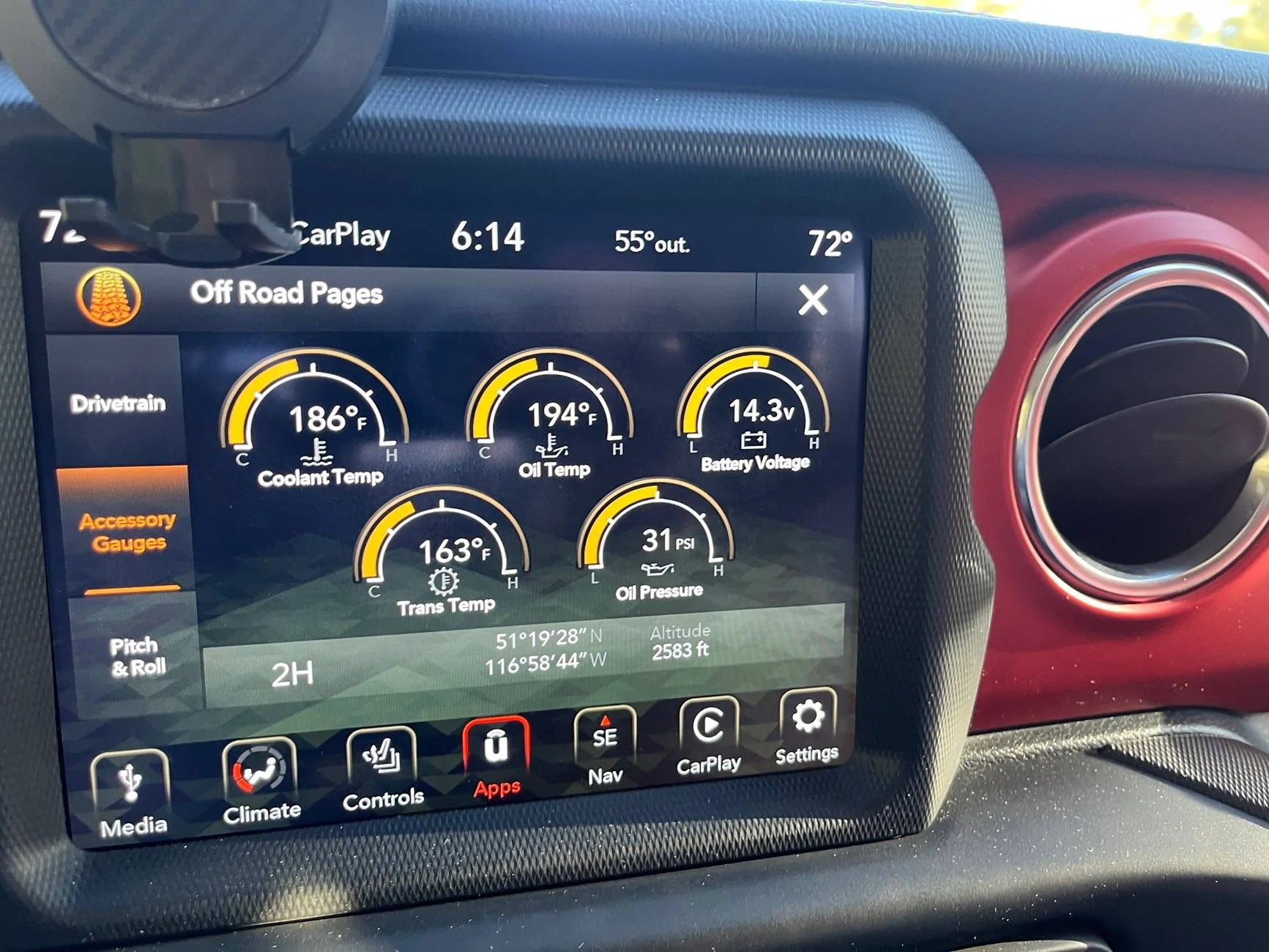
The tech called me at the end of the day (I love taking a sample to them in the morning and getting results the same day, I’m spoiled!) and said that the “synthetic spike” is not like AMSOIL’s spike. It’s much smaller in size, he says, and it is possible to detect varnish markers BUT he is unable to see anything right now because there’s not enough milage on the oil. I only have 20k kms (12k miles). Not only is there no varnish data to detect but because this is my 4th pan drop in 40 something k kms, the oil is super clean, and my transmission temps are lower than everyone else’s that have run theirs out to 50k + miles. (See attached photo, I’ve changed it to F from Celsius)

I noticed my temps dropped after the second pan drop, then dropped further on the 3rd pan drop and then dropped again on the 4th. I wanted to see if doing pan drops and keeping the oil clean was directly related to the cooler temps, my speculation and experiment “appears” to be working. I’ve also decided to stay with Mopar 8/9 to keep the chemistry the same.

Jeep Gladiator Transmission fluid or not! IMG_4272


Jeep Gladiator Transmission fluid or not! IMG_4299
 

ShadowsPapa

Well-Known Member
First Name
Bill
Joined
Oct 12, 2019
Threads
247
Messages
40,440
Reaction score
53,853
Location
Runnells, Iowa
Vehicle(s)
'25 JTMX, '23 JLU 4xe, '82 SX4, '73 Javelin
Occupation
Retired auto mechanic, frmr gov't ntwrk security admin
Vehicle Showcase
3
Don't get hooked on varnish - it's not as prevalent a thing as it was in the past. In fact, it's been a long time since I've seen a truly "varnished" transmission, and that was an old-school unit using pre-modern fluids.

I have to run mine pretty hard to get transmission temperatures up - I really only get concerned towing in our hills where it wasn't to "hunt" - and I force it into manual mode and things tame right down again.
A day in the 80s it takes forever for the transmission to really warm up unless running it hard.

If I was driving in 55 degree temps, it would take a good 30 minutes at speed in the highway in some hills to see transmission temperatures to get to coolant temps.

ZF Lifeguard 8/9 fluid is a full synthetic.
(in fact another member posted the explanation over a year ago)

Basically, it's due to rules in Germany in how things are labeled (and the fact there's more than one way to make a "synthetic" lube)
MOPAR is the same thing - so both the MOPAR 8/9 and ZF Lifeguard 8/9 fluids are synthetic, not blends, but full synthetic.
Labeling rules in Germany confuse things.


Jeep Gladiator Transmission fluid or not! 1747108343393-3r


Only ZF or MOPAR fluids for my transmission.
I won't risk mixing chemistries.

Also beware of open bottles, or fluids sitting around for a while.
 

Hootbro

Well-Known Member
First Name
Don
Joined
Apr 13, 2019
Threads
57
Messages
10,172
Reaction score
19,936
Location
Delaware
Vehicle(s)
2025 Gladiator Sport
As I mentioned earlier, he asked me if the Mopar 8/9 was a full synthetic or semi? I have read from ZF sources in their docs that it’s been called both so I didn’t know.
The MOPAR 8/9 Speed fluid is re-bottled ZF Lifeguard 9 fluid and is a full synthetic. Stand alone ZF Lifeguard 8 fluid is a semi-synthetic.
 

Sponsored

ShadowsPapa

Well-Known Member
First Name
Bill
Joined
Oct 12, 2019
Threads
247
Messages
40,440
Reaction score
53,853
Location
Runnells, Iowa
Vehicle(s)
'25 JTMX, '23 JLU 4xe, '82 SX4, '73 Javelin
Occupation
Retired auto mechanic, frmr gov't ntwrk security admin
Vehicle Showcase
3
The MOPAR 8/9 Speed fluid is re-bottled ZF Lifeguard 9 fluid and is a full synthetic. Stand alone ZF Lifeguard 8 fluid is a semi-synthetic.
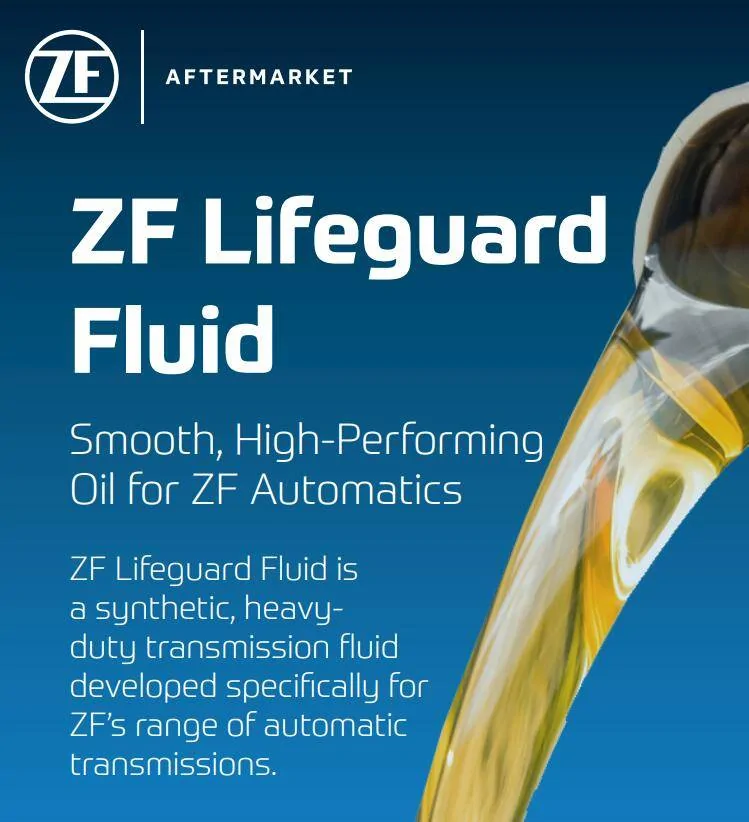
Yet ZF's own PDF says "Lifeguard is synthetic".
 

Maximus Gladius

Well-Known Member
First Name
Kevin
Joined
Jan 30, 2021
Threads
74
Messages
2,901
Reaction score
3,692
Location
Calgary, AB, Canada
Vehicle(s)
2021 JTR, 2023 JTR
I stand corrected on the synthetic spike photo I posted above. I thought the tech showed me the graph sample of AMSOIL’s ATF but it’s of AMSOIL 5/30 SS (read the very top of that photo). What he was talking about was the “spike” in full synthetic that doesn’t allow for varnish markers to be detected and this was one such example.

When he called me at the end of the day, he said Mopar has a spike but it’s much smaller and markers can be read but I had to have a lot more milage on it for them to run another test. He said AMSOIL’s sample he showed me is definitely a full synthetic but when I asked about the difference in the spike height of Mopar as being a full synthetic also, he couldn’t tell me. It required more testing beyond what I asked him to do but because he couldn’t see any varnish markers, it was too early and he didn’t charge me. To have the graph showing all the spikes (and there’s lots of them I would have no clue what I’d be looking at) costs $100 cad. I just took his word the “synthetic spike” was smaller.

I remember back in the 80’s, in high school, my dad had a lot of dealings with this same lab and I remember discussions, back then with his business partner, about “full synthetic” and different oil manufacturers claiming it but when the testing was done, they were as low as 10% “full synthetic”.

The temperature photo I posted above was a trip to BC I took with the wife last weekend to pick up a kayak for her. It was approximately 2000 kms return trip and we took the south route there and came the north route back. South was fairly flat, avoiding the mountain passes but coming back the north route with the kayak, we had several mountain passes to climb starting at 1600 ft elevation and reached heights in our trip of over 5400 ft.

The transmission temps never went above 182F (I’m speaking US’n to make it easy for y’all) and settled back down to the 160’s when cooled down. I’ve never seen this before is all I’m saying.

I do have a friend that lives in my community, just down the road with a 21 gladiator rubicon with just over 80k kms that I’ve talked to him about having the lab look at an oil sample before he does his first service on it…. Wouldn’t that be a good test to see. ?
 

Hootbro

Well-Known Member
First Name
Don
Joined
Apr 13, 2019
Threads
57
Messages
10,172
Reaction score
19,936
Location
Delaware
Vehicle(s)
2025 Gladiator Sport
Yet ZF's own PDF says "Lifeguard is synthetic".
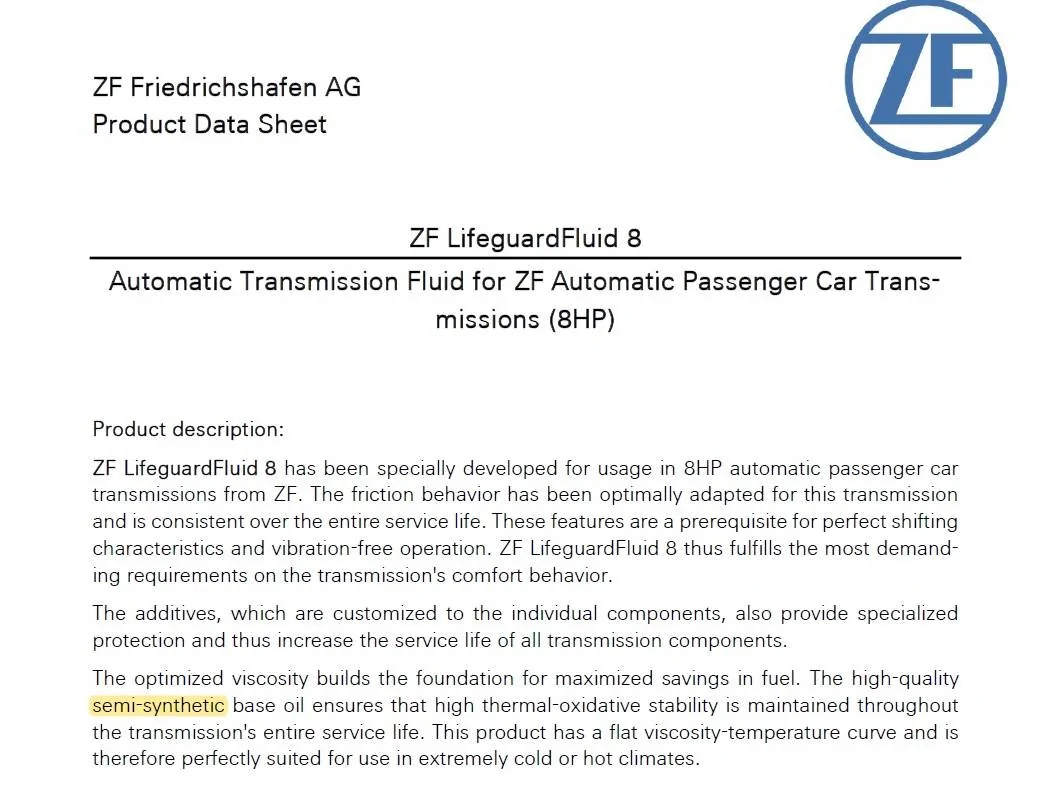
This says it is a semi synthetic 🤷‍♂️

Might be a difference in how Germany defines "Synthetic". They do not allow Group III base oils to be defined as full synthetic unless they are from Group IV base oils. Group III base oils in some instances can be defines as "Synthetic" in the USA market.

Jeep Gladiator Transmission fluid or not! ZFHP8
 

Attachments

ShadowsPapa

Well-Known Member
First Name
Bill
Joined
Oct 12, 2019
Threads
247
Messages
40,440
Reaction score
53,853
Location
Runnells, Iowa
Vehicle(s)
'25 JTMX, '23 JLU 4xe, '82 SX4, '73 Javelin
Occupation
Retired auto mechanic, frmr gov't ntwrk security admin
Vehicle Showcase
3
This says it is a semi synthetic 🤷‍♂️

Might be a difference in how Germany defines "Synthetic". They do not allow Group III base oils to be defined as full synthetic unless they are from Group IV base oils. Group III base oils in some instances can be defines as "Synthetic" in the USA market.

ZFHP8.jpg
It is a difference in how the base is defined. For our purposes, it's synthetic like other USA products sold. For Germany, they aren't allowed to say that on the bottle due to the grp 3 base.
It's made through synthesis technology, which means that it was based on grp 3 but "massaged" into synthetic performance through chemistry.
It will maintain it's viscosity and other performances like others.

It's still the only thing I'll use, especially since you are always mixing fluids on any service you do. Unless you do a complete tear-down, it's dry, the lines are flushed out and there's not a trace of other fluids - it's a case of "I will not mix".
Funny, people brag about 20K, 30K and other similar fluid changes -saying 'it's worth it to spend that bit of money" but will buy a cheaper oil on the other hand. Huh?
Makes little sense to me. "you need to change it frequently, but can use cheaper fluid". Hmmmmm.
If I'm so concerned about how you MUST change the fluid more frequently, I'd use a the fluid ZF says to use - why try to save a few bucks by using cheaper fluid?

I'll go to the best doctor money can buy - but refuse to take his advice and use the meds he recommends, I'll use OTC instead.
 

Hootbro

Well-Known Member
First Name
Don
Joined
Apr 13, 2019
Threads
57
Messages
10,172
Reaction score
19,936
Location
Delaware
Vehicle(s)
2025 Gladiator Sport
It is a difference in how the base is defined. For our purposes, it's synthetic like other USA products sold. For Germany, they aren't allowed to say that on the bottle due to the grp 3 base.
It's made through synthesis technology, which means that it was based on grp 3 but "massaged" into synthetic performance through chemistry.
It will maintain it's viscosity and other performances like others.

It's still the only thing I'll use, especially since you are always mixing fluids on any service you do. Unless you do a complete tear-down, it's dry, the lines are flushed out and there's not a trace of other fluids - it's a case of "I will not mix".
Funny, people brag about 20K, 30K and other similar fluid changes -saying 'it's worth it to spend that bit of money" but will buy a cheaper oil on the other hand. Huh?
Makes little sense to me. "you need to change it frequently, but can use cheaper fluid". Hmmmmm.
If I'm so concerned about how you MUST change the fluid more frequently, I'd use a the fluid ZF says to use - why try to save a few bucks by using cheaper fluid?

I'll go to the best doctor money can buy - but refuse to take his advice and use the meds he recommends, I'll use OTC instead.
We cheat, it is still a semi synthetic.
Sponsored


Top