Sponsored

Winch wiring to battery with IBS (Smart battery) sensor

RougeShot12er

Well-Known Member
Joined
Nov 15, 2024
Threads
1
Messages
88
Reaction score
198
Location
Melbourne, FL
Website
www.instagram.com
Vehicle(s)
2021 JT Rubicon
Hey guys,
Getting ready to install a winch tomorrow.
Trying to figure out connection to the battery terminal with the IBS sensor. Does the factory connect to the battery before or after the sensor? How did you hook yours up? Does anyone know the sensor amperage rating? If you hooked to the terminal side of the sensor, have you had any issues with providing a ground bypass of your sensor through the winch? Should I just buy an Anderson connector and remove the winch circuit completely when not in use? Very little info about this online, but I know tons of people run winches on JLs and JTs. Even the mopar winch install inscriptions don’t cover it. Also, pictures are always appreciated.

Thanks!
Sponsored

 

Lost1wing

Well-Known Member
First Name
Tim
Joined
Dec 22, 2020
Threads
24
Messages
2,611
Reaction score
2,867
Location
West Georgia
Vehicle(s)
2020 Jeep Gladiator Rubicon
Occupation
Retired AMT
Above the sensor. My negative is connected to the fender ground, same stud as the main negative cable. You can attach your negative winch cable to the plate above the IBS. Do not connect to the main battery post directly (below the IBS).
 

Lost1wing

Well-Known Member
First Name
Tim
Joined
Dec 22, 2020
Threads
24
Messages
2,611
Reaction score
2,867
Location
West Georgia
Vehicle(s)
2020 Jeep Gladiator Rubicon
Occupation
Retired AMT
You can read through some post here on that subject as far as disconnects, cutoff switches and fuses. You will have to make up your own mind on how to do it.

I have a 400 amp fuse at the main positive. From there I have the positive connected to a 400amp continuous duty solenoid. The control circuit is in the cab. The purpose of this is to remove the direct dc power from the front of the Jeep when not in use.

Other use a manual cutoff switch instead of the solenoid. I have this setup on another vehicle. I still use a 400 amp fuse at the battery connection.

Another connection like you mentioned is the Anderson plug disconnect. That is fine too, as long as the connector or cables are not in a pinch area in case of a collision.

Another type of connection that "I" would not recommend, would be to connect directly from the positive post on the battery to the winch. I know you will see this diagram everywhere, but it is just a reference. When connecting like this on a trailer or some other utility setup, it is perfect. Warn Industries recommends a disconnect for an extra layer of protection, they even sell a solenoid kit, even though they show the cables connected directly to the battery.
 

Zachanadandy

Well-Known Member
First Name
Zach
Joined
Oct 17, 2023
Threads
4
Messages
3,023
Reaction score
4,783
Location
Patterson, ca
Vehicle(s)
2023 gladiator Mojave
Occupation
Electrical foreman
Warn Industries recommends a disconnect for an extra layer of protection, they even sell a solenoid kit, even though they show the cables connected directly to the battery.
Where does warn recommend a disconnect? Not in any of their install manuals I could find? Not shown in any of their wiring diagrams? Even the power interrupter kit everyone takes as Warn recommending it be used for front mounted winches is listed on the rear mounted winch accessories page of their catalog. In that application it makes a lot of sense as the winch isn't permanently installed so there's no point in having hot wires just hanging back there. Again, I'm not arguing that you can't add it on a front mounted winch, but every rig in Warns parking lot that I saw when I was there years ago had the winch wired straight to the battery.
 

Lost1wing

Well-Known Member
First Name
Tim
Joined
Dec 22, 2020
Threads
24
Messages
2,611
Reaction score
2,867
Location
West Georgia
Vehicle(s)
2020 Jeep Gladiator Rubicon
Occupation
Retired AMT
Where does warn recommend a disconnect? Not in any of their install manuals I could find? Not shown in any of their wiring diagrams? Even the power interrupter kit everyone takes as Warn recommending it be used for front mounted winches is listed on the rear mounted winch accessories page of their catalog. In that application it makes a lot of sense as the winch isn't permanently installed so there's no point in having hot wires just hanging back there. Again, I'm not arguing that you can't add it on a front mounted winch, but every rig in Warns parking lot that I saw when I was there years ago had the winch wired straight to the battery.
It is a note on the solenoid item itself. Just look up power interrupter kit at Warn international.
 

Sponsored

Lost1wing

Well-Known Member
First Name
Tim
Joined
Dec 22, 2020
Threads
24
Messages
2,611
Reaction score
2,867
Location
West Georgia
Vehicle(s)
2020 Jeep Gladiator Rubicon
Occupation
Retired AMT
Where does warn recommend a disconnect? Not in any of their install manuals I could find? Not shown in any of their wiring diagrams? Even the power interrupter kit everyone takes as Warn recommending it be used for front mounted winches is listed on the rear mounted winch accessories page of their catalog. In that application it makes a lot of sense as the winch isn't permanently installed so there's no point in having hot wires just hanging back there. Again, I'm not arguing that you can't add it on a front mounted winch, but every rig in Warns parking lot that I saw when I was there years ago had the winch wired straight to the battery.
I have a new 2023 vehicle with a Warn m8 hooked directly from the factory. It doesn't make it right in my opinion. I think they do it that way to save money. I haven't had any issues with the extra connections. I made brackets to hold my solenoids, fuses and breaker to keep them secure.
 

ShadowsPapa

Well-Known Member
First Name
Bill
Joined
Oct 12, 2019
Threads
247
Messages
40,465
Reaction score
53,924
Location
Runnells, Iowa
Vehicle(s)
'25 JTMX, '23 JLU 4xe, '82 SX4, '73 Javelin
Occupation
Retired auto mechanic, frmr gov't ntwrk security admin
Vehicle Showcase
3
........ years ago.... factory installs............. isn't it possible it's a cost cutting thing? There's also a lot of calculations done in a whole lot of other 4x4 forums where they suggest that some of the wiring with Warn winches should actually be larger. A lot of folks have done a lot of math and several places call it "keeping costs low on an already very expensive winch".
parts + labor = $$

Anyway, ALL loads should be connected to the top of the IBS like already said here.

The IBS can handle a heck of a load, no problem at all. It's only a 1 ohm resistance.

(EDIT: - just read where one version of the Bosch IBS will handle 1500 amps. If your winch is pulling that much, you best call for a ride home as you'll need to replace a lot of cables, batteries and an alternator)

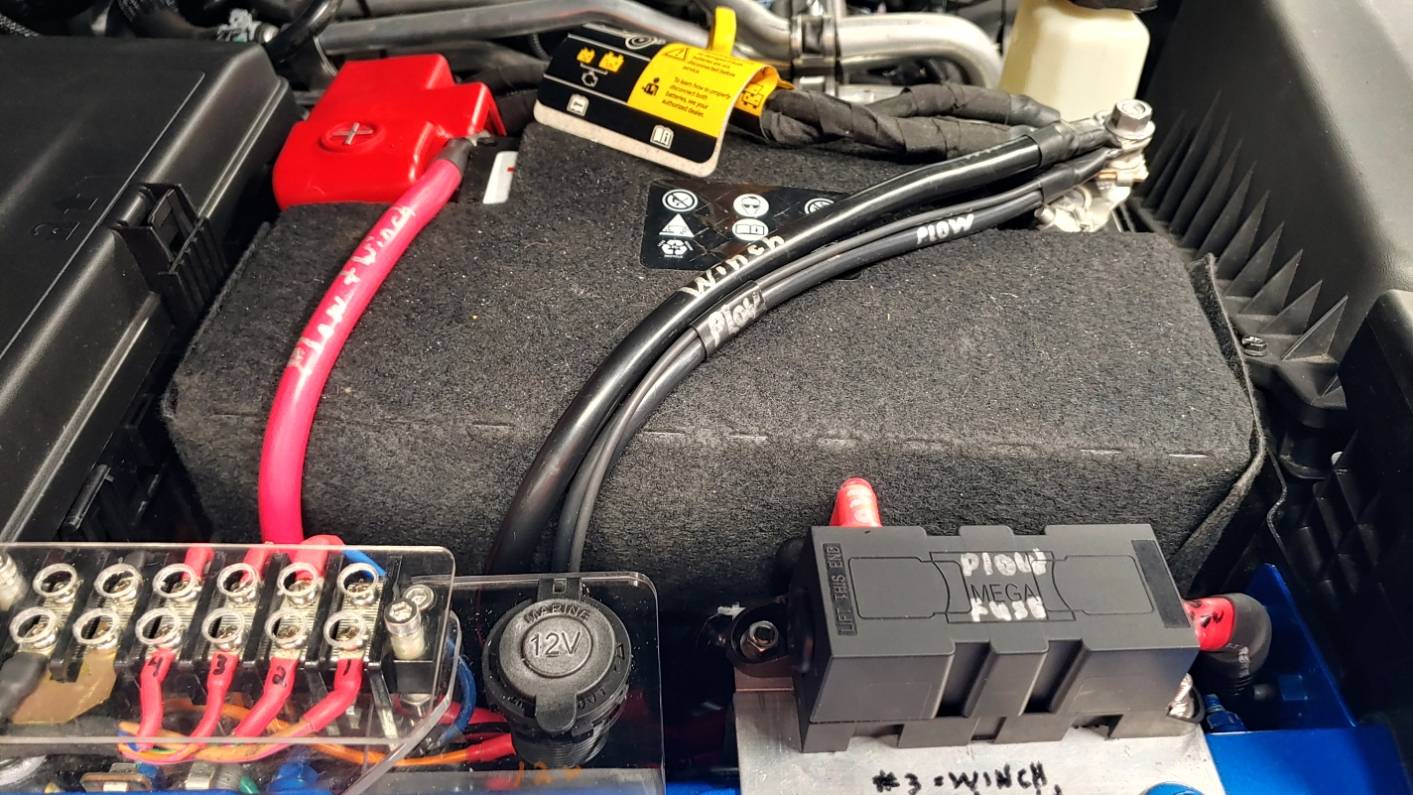
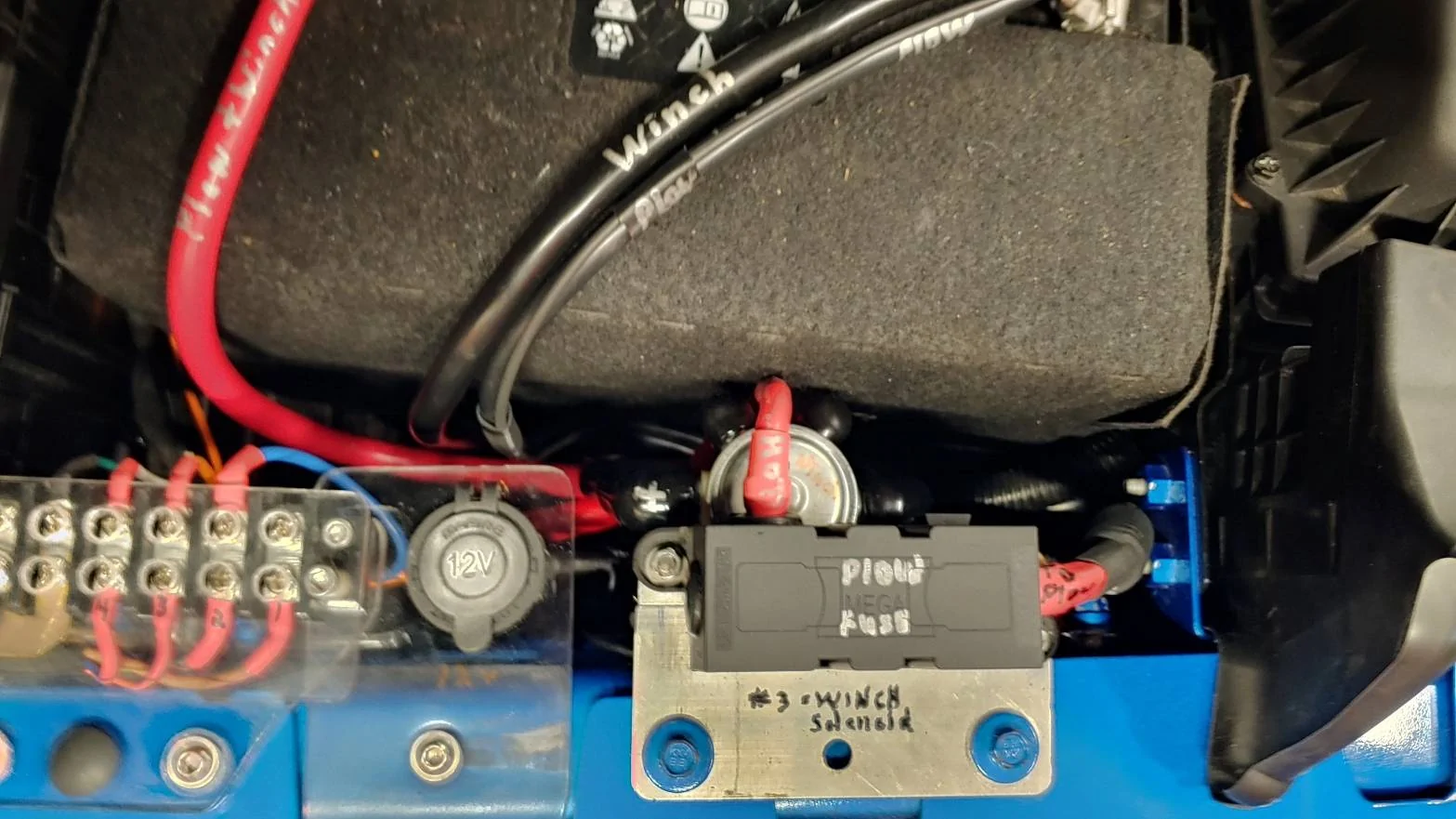
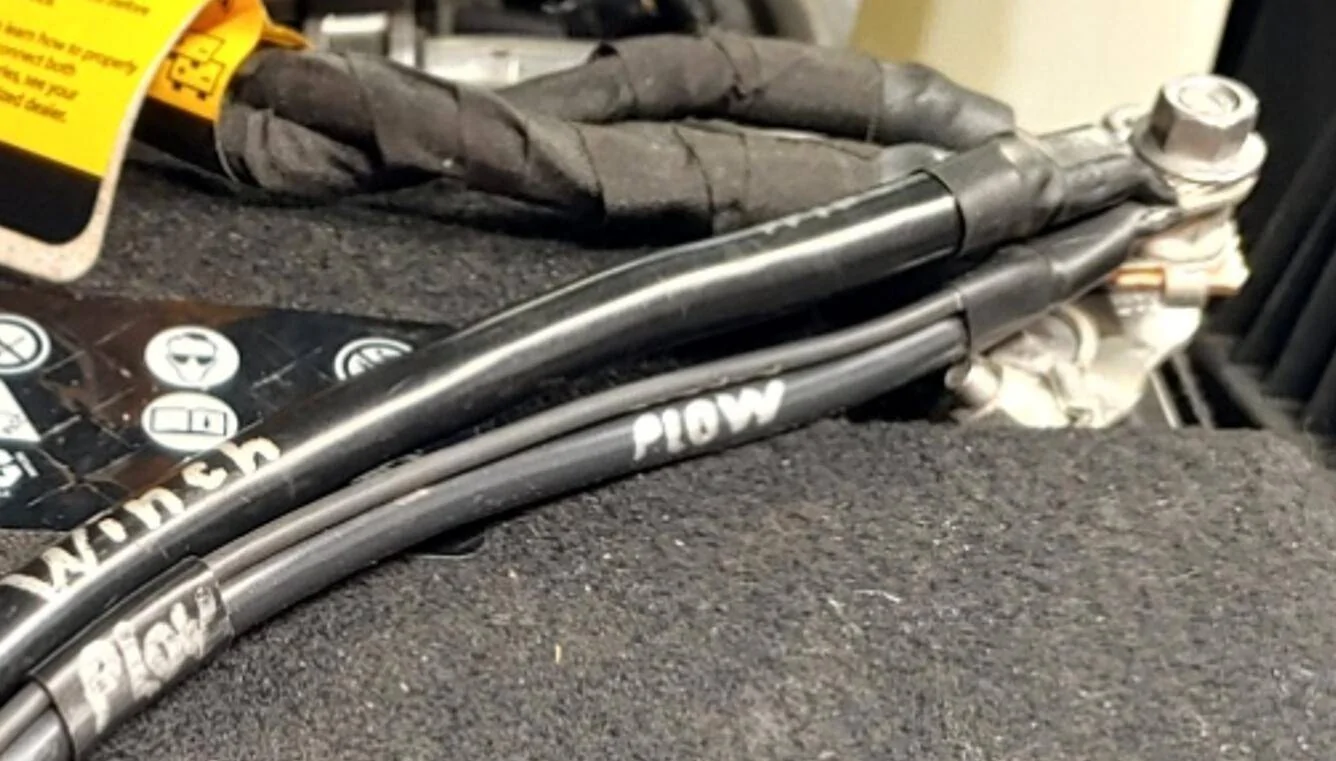
I run a snow plow (negative cable marked plow) and my winch to the same stud on the IBS.
The winch disconnect is under the snow plow fuse holder.

Western insists on using a fuse on their plows, and they supply said fuse and holder.

Pictures? You got it ->

Jeep Gladiator Winch wiring to battery with IBS (Smart battery) sensor 20221109_160609_HDR


Jeep Gladiator Winch wiring to battery with IBS (Smart battery) sensor 20221109_160554_HDR


Jeep Gladiator Winch wiring to battery with IBS (Smart battery) sensor 1732040468263-9c
 
Last edited:

Zachanadandy

Well-Known Member
First Name
Zach
Joined
Oct 17, 2023
Threads
4
Messages
3,023
Reaction score
4,783
Location
Patterson, ca
Vehicle(s)
2023 gladiator Mojave
Occupation
Electrical foreman
I have a new 2023 vehicle with a Warn m8 hooked directly from the factory. It doesn't make it right in my opinion. I think they do it that way to save money. I haven't had any issues with the extra connections. I made brackets to hold my solenoids, fuses and breaker to keep them secure.
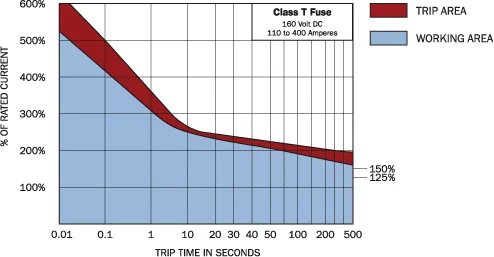
Just because some prefer a different way doesn't make the factory/manufacturer recommended/ vast majority of winch installs over the last 50+ years way necessarily wrong either. Run it however you're comfortable. Not to beat a dead horse, but here's the time delay chart from bluesea for their DC class t fuses. Note that it will flow 200% for 50 seconds. Your battery won't put out more than 800A in a dead short bolted fault. Your 400A fuse is literally useless and will never trip. Even if the fault exists beyond that 50 seconds, your battery has discharged enough by then that you're under the 150% limit and it will keep cooking for a full 500 seconds. This is why no manufacturers recommend fusing winches and it has nothing to do with cost savings.
Jeep Gladiator Winch wiring to battery with IBS (Smart battery) sensor ClassT_Fus
 
Last edited:

Blade1668

Well-Known Member
First Name
Darrell
Joined
Jan 7, 2020
Threads
12
Messages
3,273
Reaction score
3,160
Location
N. AL.
Vehicle(s)
90XJ, 91XJ, 91MJ, 05 LJ, 20 JT
Build Thread
Link
Vehicle Showcase
1
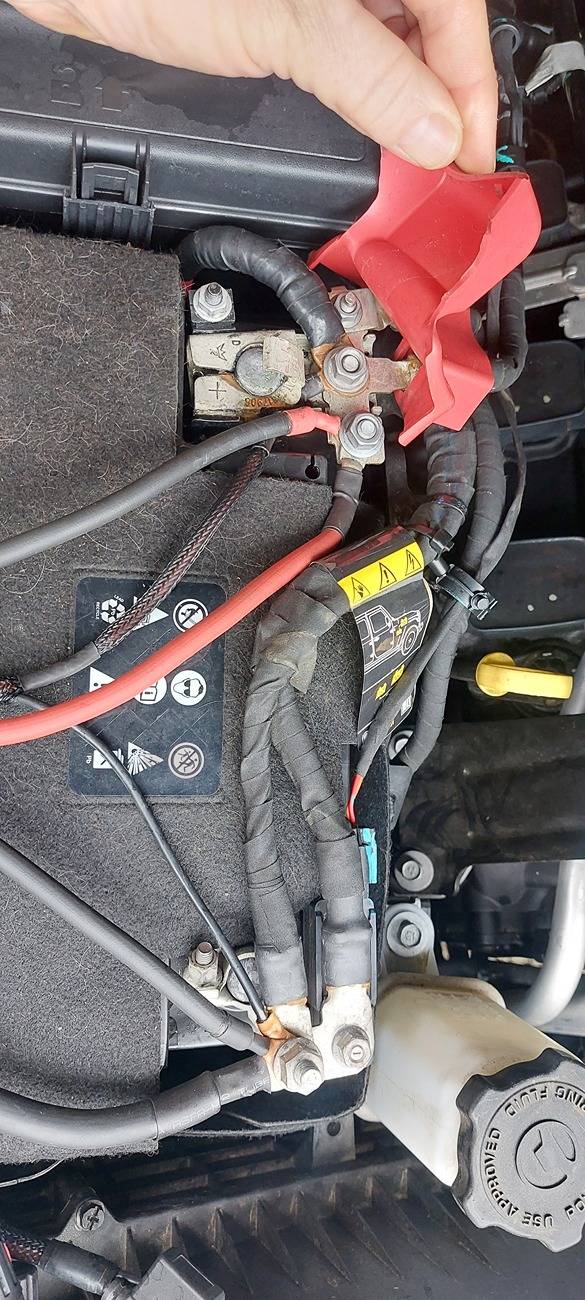
No drawn-out reply... but a photo. ;)
Right way seems to be, I've not had any problems with it yet.
Jeep Gladiator Winch wiring to battery with IBS (Smart battery) sensor 20241119_143937

Top wire in photo feeds winch though a relay. Thick one on bottom of photo is ground cable.
 

Sponsored

Lost1wing

Well-Known Member
First Name
Tim
Joined
Dec 22, 2020
Threads
24
Messages
2,611
Reaction score
2,867
Location
West Georgia
Vehicle(s)
2020 Jeep Gladiator Rubicon
Occupation
Retired AMT
Just because some prefer a different way doesn't make the factory/manufacturer recommended/ vast majority of winch installs over the last 50+ years way necessarily wrong either. Run it however you're comfortable. Not to beat a dead horse, but here's the time delay chart from bluesea for their DC class t fuses. Note that it will flow 200% for 50 seconds. Your battery won't put out more than 800A in a dead short bolted fault. Your 400A fuse is literally useless and will never trip. Even if the fault exists beyond that 50 seconds, your battery has discharged enough by then that you're under the 150% limit and it will keep cooking for a full 500 seconds. This is why no manufacturers recommend fusing winches and it has nothing to do with cost savings.
ClassT_Fuse.webp
Not using a class t fuse.
Just because some prefer a different way doesn't make the factory/manufacturer recommended/ vast majority of winch installs over the last 50+ years way necessarily wrong either. Run it however you're comfortable. Not to beat a dead horse, but here's the time delay chart from bluesea for their DC class t fuses. Note that it will flow 200% for 50 seconds. Your battery won't put out more than 800A in a dead short bolted fault. Your 400A fuse is literally useless and will never trip. Even if the fault exists beyond that 50 seconds, your battery has discharged enough by then that you're under the 150% limit and it will keep cooking for a full 500 seconds. This is why no manufacturers recommend fusing winches and it has nothing to do with cost savings.
ClassT_Fuse.jpg
Wrong fuse type and voltage. Look at ANL fuses. Looks more like 10 second blow rate.
 

Zachanadandy

Well-Known Member
First Name
Zach
Joined
Oct 17, 2023
Threads
4
Messages
3,023
Reaction score
4,783
Location
Patterson, ca
Vehicle(s)
2023 gladiator Mojave
Occupation
Electrical foreman
Not using a class t fuse.

Wrong fuse type and voltage. Look at ANL fuses. Looks more like 10 second blow rate.
The curve for the ANL fuse is better, but I'm still willing to bet that A. If it flows full CCA for 10 seconds it's already started whatever fire you were trying to prevent B. After 10 seconds of full CCA your battery output has probably dropped below 600A which is the 150% point where even the ANL will not blow for 500 seconds. I've seen a bunch of people running 400A+ fuses, have any of you had them actually blow and protect anything? They still seem functionally useless looking at the trip graphs. Any fuse big enough to allow a full amp pull without tripping seems big enough to allow the battery to fully discharge without tripping?
 

Lost1wing

Well-Known Member
First Name
Tim
Joined
Dec 22, 2020
Threads
24
Messages
2,611
Reaction score
2,867
Location
West Georgia
Vehicle(s)
2020 Jeep Gladiator Rubicon
Occupation
Retired AMT
The curve for the ANL fuse is better, but I'm still willing to bet that A. If it flows full CCA for 10 seconds it's already started whatever fire you were trying to prevent B. After 10 seconds of full CCA your battery output has probably dropped below 600A which is the 150% point where even the ANL will not blow for 500 seconds. I've seen a bunch of people running 400A+ fuses, have any of you had them actually blow and protect anything? They still seem functionally useless looking at the trip graphs. Any fuse big enough to allow a full amp pull without tripping seems big enough to allow the battery to fully discharge without tripping?
I had a 300 amp fuse at first, and it would blow about 20 seconds into a hard pull. I need to look at the chart for the 300 amp. Still have no idea of the amp draw, just that I didn't bog the winch down to a stop . I put the 400 in to be able to use the 396 amp but more to kill the power up front in case of an accident. The solenoid keeps the power away but you never know what could flip the switch on. Automakers on certain vehicles mark the wire harness alerting firefighters where to cut to remove power. I have it on my Duramax, but that is for dual batteries, my guess.
 

Vtur

Well-Known Member
First Name
Le
Joined
Mar 6, 2021
Threads
11
Messages
1,948
Reaction score
2,304
Location
Norcal
Vehicle(s)
JTOD
Occupation
Electrical Foreman
Just because some prefer a different way doesn't make the factory/manufacturer recommended/ vast majority of winch installs over the last 50+ years way necessarily wrong either. Run it however you're comfortable. Not to beat a dead horse, but here's the time delay chart from bluesea for their DC class t fuses. Note that it will flow 200% for 50 seconds. Your battery won't put out more than 800A in a dead short bolted fault. Your 400A fuse is literally useless and will never trip. Even if the fault exists beyond that 50 seconds, your battery has discharged enough by then that you're under the 150% limit and it will keep cooking for a full 500 seconds. This is why no manufacturers recommend fusing winches and it has nothing to do with cost savings.
ClassT_Fuse.jpg
There's a different between a short circuit and an overcurrent protection. The blow time rating chart above is meant for overcurrent protection for slow-blow type fuses. Electric motors are usually protected by slow-blow fuse type due to various loads. Example is an ARB compressor didn't used standard type A fuse for that reason as it's considered as fast-acting. A short circuit will blow any fuse instantly, like in a case of a front end accident.
Sponsored


Top