
Sponsored
OP
OP
Wolf Island Diver

Wolf Island Diver

Well-Known Member
Joined
Apr 14, 2021
Threads
26
Messages
1,128
Reaction score
2,477
Location
Virginia
Vehicle(s)
2021 JT Rubicon EcoDiesel
Occupation
Software Engineer
Update:

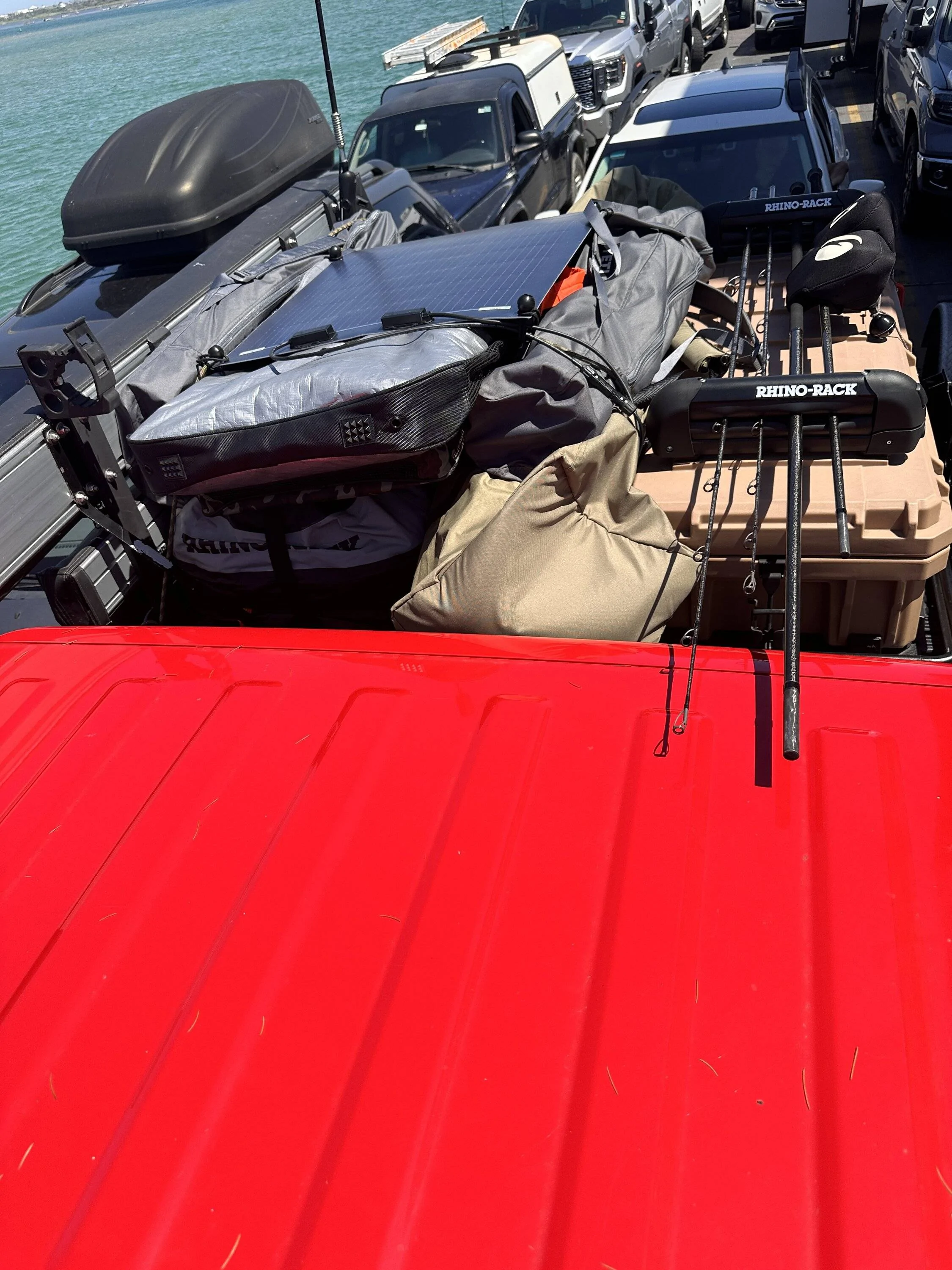
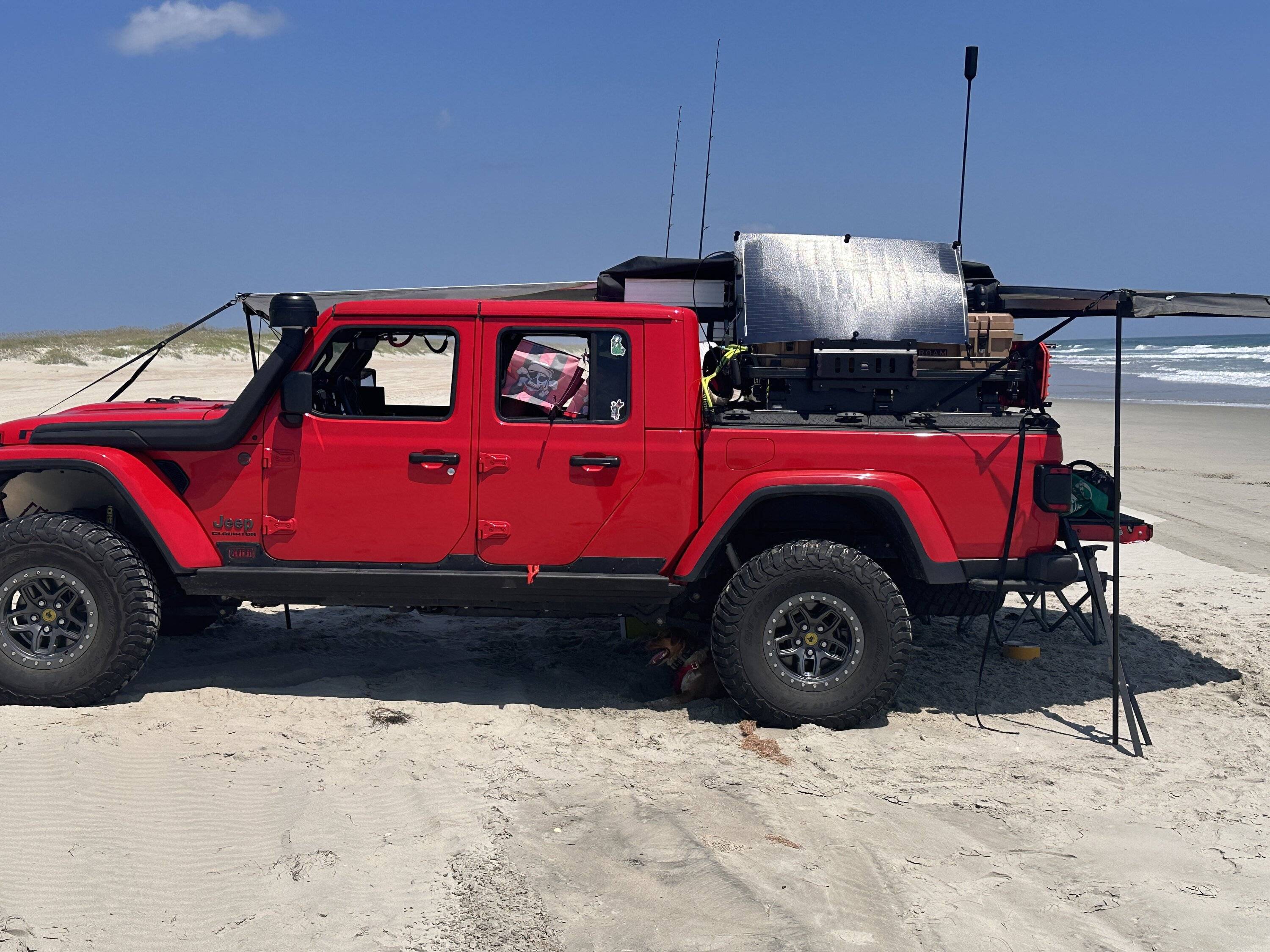
I spent Friday - Monday in OI. I ended up ditching the use of my 2 100w panels and just used this 100w flexible Renogy one thrown up on the roof, strapped to my gear or propped up on the rack. It was around 86 degrees during the day, so the fridge ran a lot. Running the fridge, awning lights and charging various things, the battery never dropped below 80% so just stopped thinking about power at all.
Jeep Gladiator Renogy LiFePO House (Dual) Battery Install IMG_1983
Jeep Gladiator Renogy LiFePO House (Dual) Battery Install IMG_2021
Sponsored

 
OP
OP
Wolf Island Diver

Wolf Island Diver

Well-Known Member
Joined
Apr 14, 2021
Threads
26
Messages
1,128
Reaction score
2,477
Location
Virginia
Vehicle(s)
2021 JT Rubicon EcoDiesel
Occupation
Software Engineer
Update:

Without a little effort to position the solar panel I can’t keep the fridge running at my house for more than about 5 days. Keep in mind this is locked in the bed of the truck where it’s warm. When camping this is actually far less of an issue because I usually have better sun and I’ve got additional solar panels, etc. This is just parking the truck at my house and putting in zero effort to position the panel. I don’t really need to keep the fridge running but the option would be nice.

The DCC50S will charge the house battery if it detects a signal from the ignition wire indicating that the truck is running. I’m curious if I can simply tie this into the positive of my shore power wire I previously installed. So when the NOCO is plugged in, it will charge the starting battery and activate the DCC50S to start receiving power from the starting battery. The other option is to install a switch under the cowl and run two small wires back to the positive and negative busbars. I think that’s unnecessary.

There's a lot of confusion about what the ignition sensor wire on the Renogy does. Traditional alternators always put out power when the truck is running. So-called smart alternators put out varying power. The ignition sensor wire simply attaches to any power source in the truck that’s only supplied power when the truck is running as a more reliable indicator than the alternator output. By connecting the hot wire coming in from the shore power port it will accomplish the same thing. The NOCO puts out 10A. The ignition sensor wire from the Renogy isn’t gonna pull more than that so I should be good. I’d do this today but there’s a lightning storm outside so it’s probably not a good idea to do electrical work. If anyone thinks this shore power hack doesn’t make sense, let me know what you think.


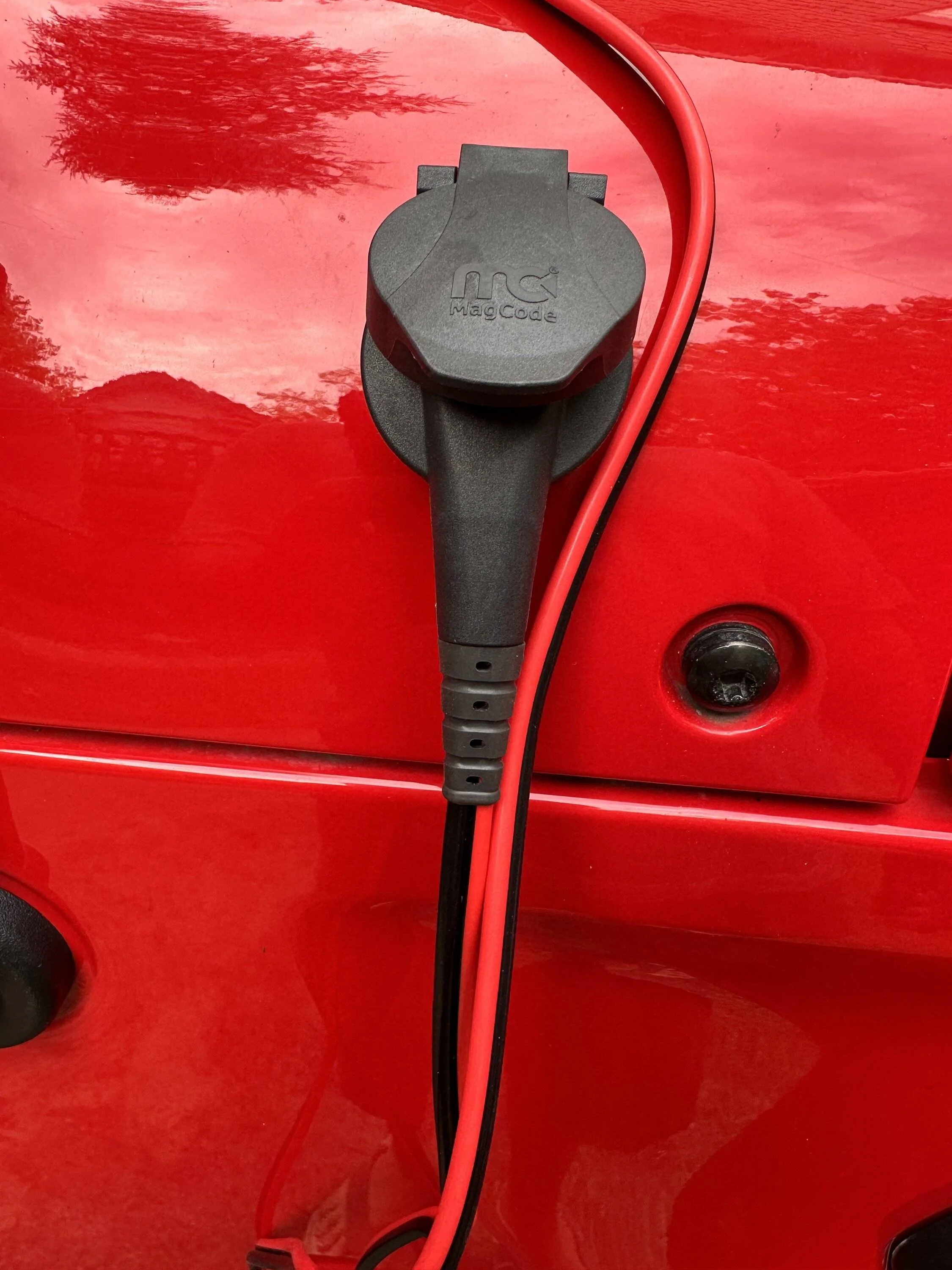
My MagCode plug for the NOCO Genius charger. This is wired to the starting battery. I really like this NOCO stuff and my tender can even revive some old batteries.
Jeep Gladiator Renogy LiFePO House (Dual) Battery Install IMG_1762


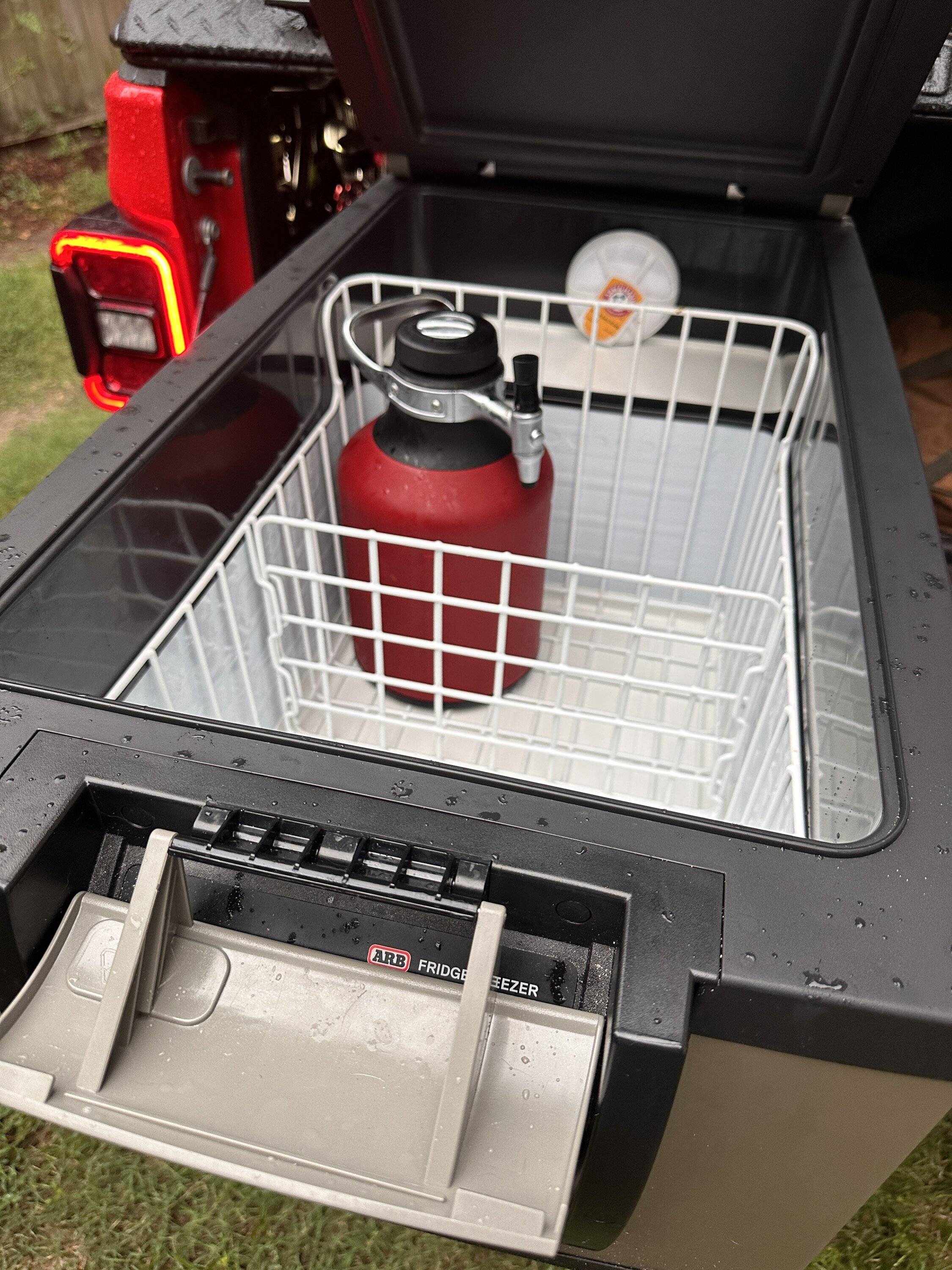
Something else occurred to me. With this permanent fridge, I can step up my tailgating and professional beer drinking game. I’ve had a 128 OZ GrowlerWerks Ukeg Go for a couple of years. During Covid I couldn’t get it filled so I sort of forgot about it. Then it hit me today that I had this. Around Hampton Roads everyone and his brother has a brewery and we’ve actually got a few great ones. I’m going to start using this again but it would be really nice to be able to take this places like when I go fishing or after a mountain bike ride, and of course down at the beach. So I went out in the rain to see if it fits in the ARB.


Great Success!! If driving around with a refrigerated keg in my truck is wrong, I don’t want to be right. Obviously I’ll drink responsibly and not while driving or to the point oh ?eight Virginia standard before driving. I may have to get a roof top tent after all just in case.
Jeep Gladiator Renogy LiFePO House (Dual) Battery Install IMG_2168
 

mx5red

Well-Known Member
First Name
Paul
Joined
May 7, 2020
Threads
28
Messages
1,495
Reaction score
2,228
Location
San Diego
Vehicle(s)
2020 Firecracker JTR; 2020 DGC JLUR
Build Thread
Link
Update:

Without a little effort to position the solar panel I can’t keep the fridge running at my house for more than about 5 days. Keep in mind this is locked in the bed of the truck where it’s warm. When camping this is actually far less of an issue because I usually have better sun and I’ve got additional solar panels, etc. This is just parking the truck at my house and putting in zero effort to position the panel. I don’t really need to keep the fridge running but the option would be nice.

The DCC50S will charge the house battery if it detects a signal from the ignition wire indicating that the truck is running. I’m curious if I can simply tie this into the positive of my shore power wire I previously installed. So when the NOCO is plugged in, it will charge the starting battery and activate the DCC50S to start receiving power from the starting battery. The other option is to install a switch under the cowl and run two small wires back to the positive and negative busbars. I think that’s unnecessary.

There's a lot of confusion about what the ignition sensor wire on the Renogy does. Traditional alternators always put out power when the truck is running. So-called smart alternators put out varying power. The ignition sensor wire simply attaches to any power source in the truck that’s only supplied power when the truck is running as a more reliable indicator than the alternator output. By connecting the hot wire coming in from the shore power port it will accomplish the same thing. The NOCO puts out 10A. The ignition sensor wire from the Renogy isn’t gonna pull more than that so I should be good. I’d do this today but there’s a lightning storm outside so it’s probably not a good idea to do electrical work. If anyone thinks this shore power hack doesn’t make sense, let me know what you think.


My MagCode plug for the NOCO Genius charger. This is wired to the starting battery. I really like this NOCO stuff and my tender can even revive some old batteries.
IMG_1762.jpeg


Something else occurred to me. With this permanent fridge, I can step up my tailgating and professional beer drinking game. I’ve had a 128 OZ GrowlerWerks Ukeg Go for a couple of years. During Covid I couldn’t get it filled so I sort of forgot about it. Then it hit me today that I had this. Around Hampton Roads everyone and his brother has a brewery and we’ve actually got a few great ones. I’m going to start using this again but it would be really nice to be able to take this places like when I go fishing or after a mountain bike ride, and of course down at the beach. So I went out in the rain to see if it fits in the ARB.


Great Success!! If driving around with a refrigerated keg in my truck is wrong, I don’t want to be right. Obviously I’ll drink responsibly and not while driving or to the point oh ?eight Virginia standard before driving. I may have to get a roof top tent after all just in case.
IMG_2168.jpeg
I’d consider putting some block foam or something to keep the keg from bashing around and breaking the tap.
 
OP
OP
Wolf Island Diver

Wolf Island Diver

Well-Known Member
Joined
Apr 14, 2021
Threads
26
Messages
1,128
Reaction score
2,477
Location
Virginia
Vehicle(s)
2021 JT Rubicon EcoDiesel
Occupation
Software Engineer
I’d consider putting some block foam or something to keep the keg from bashing around and breaking the tap.
Oh yeah, that was just my lid test. For sure I need some foam spacers, unless I just start filling the fridge, carrying around big thi…..??………….?….things of meat. Like burgers. And steaks……and bags of shrimp………..and PORK BUTTS…………………? a and a portable grill…….or maybe a portable tailgate PELLET SMOKEEER!! I could drive around from place to place always ready at a moment notice to grill out and drink beer.

Busch Gardens parking lot and cheap as hell?
No problem. To hell with the “New France” “smokehouse,” I’m smoking a 1/2 pork shoulder right next to the Italy tram station.

I64 at the bridge tunnel backed up?
No problem. let’s make some fajitas

Parked on the street in Washington DC after seeing a Cluch AND Fugazi concert?
No f’ing problem. Let’s make some smash burgers.

Ocracoke Island Ferry down to one ship.
No problem.
let’s grill 500 hot dogs.
 

mx5red

Well-Known Member
First Name
Paul
Joined
May 7, 2020
Threads
28
Messages
1,495
Reaction score
2,228
Location
San Diego
Vehicle(s)
2020 Firecracker JTR; 2020 DGC JLUR
Build Thread
Link
Oh yeah, that was just my lid test. For sure I need some foam spacers, unless I just start filling the fridge, carrying around big thi…..??………….?….things of meat. Like burgers. And steaks……and bags of shrimp………..and PORK BUTTS…………………? a and a portable grill…….or maybe a portable tailgate PELLET SMOKEEER!! I could drive around from place to place always ready at a moment notice to grill out and drink beer.

Busch Gardens parking lot and cheap as hell?
No problem. To hell with the “New France” “smokehouse,” I’m smoking a 1/2 pork shoulder right next to the Italy tram station.

I64 at the bridge tunnel backed up?
No problem. let’s make some fajitas

Parked on the street in Washington DC after seeing a Cluch AND Fugazi concert?
No f’ing problem. Let’s make some smash burgers.

Ocracoke Island Ferry down to one ship.
No problem.
let’s grill 500 hot dogs.
It’s like you’re inside my brain?
Jeep Gladiator Renogy LiFePO House (Dual) Battery Install IMG_4659
 

Sponsored

HereWeGo

Well-Known Member
First Name
Kenny
Joined
Jul 28, 2022
Threads
40
Messages
181
Reaction score
198
Location
Fort Walton Beach FL
Vehicle(s)
2021 Jeep Gladiator Rubicon
@Wolf Island Diver
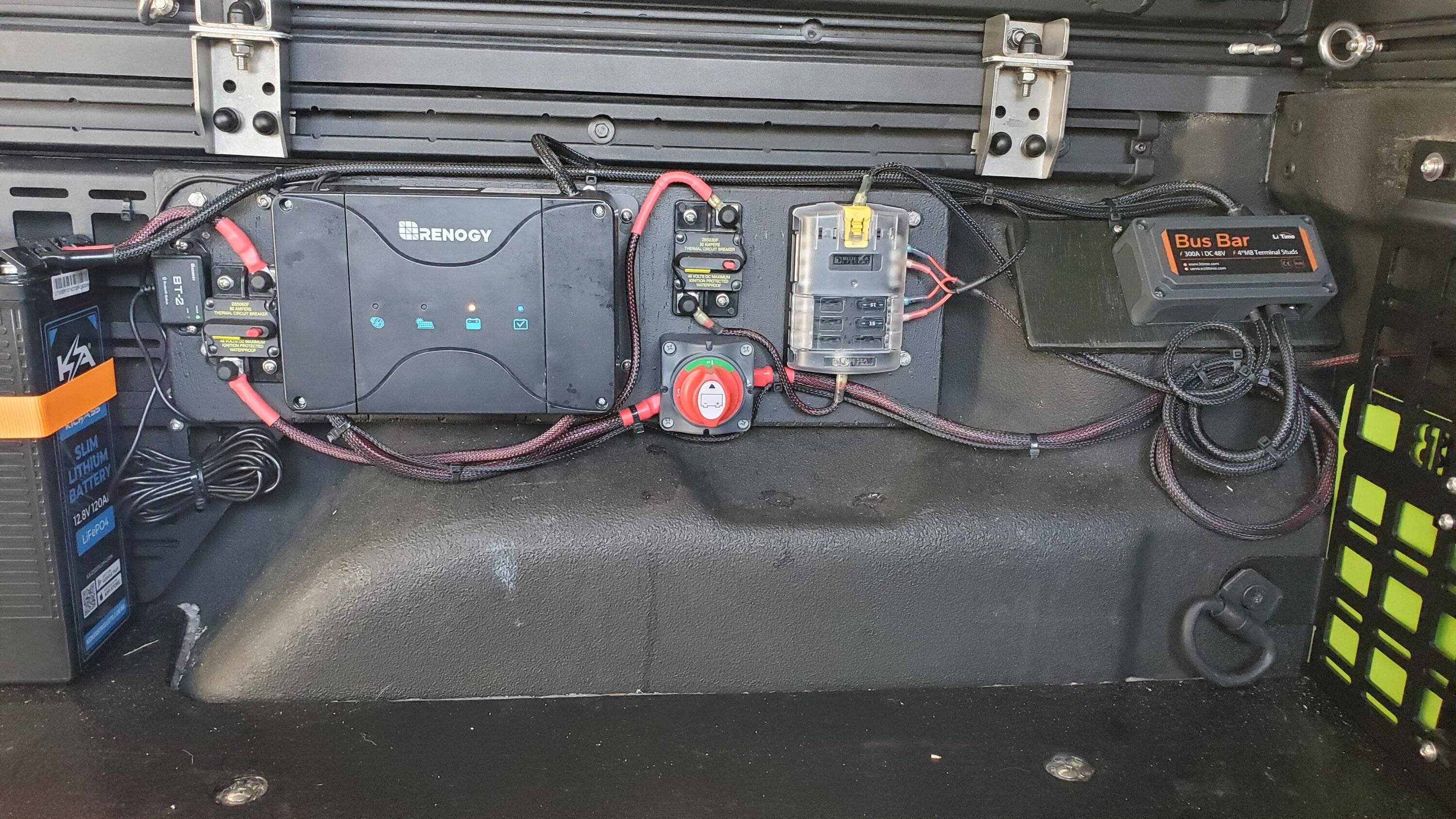
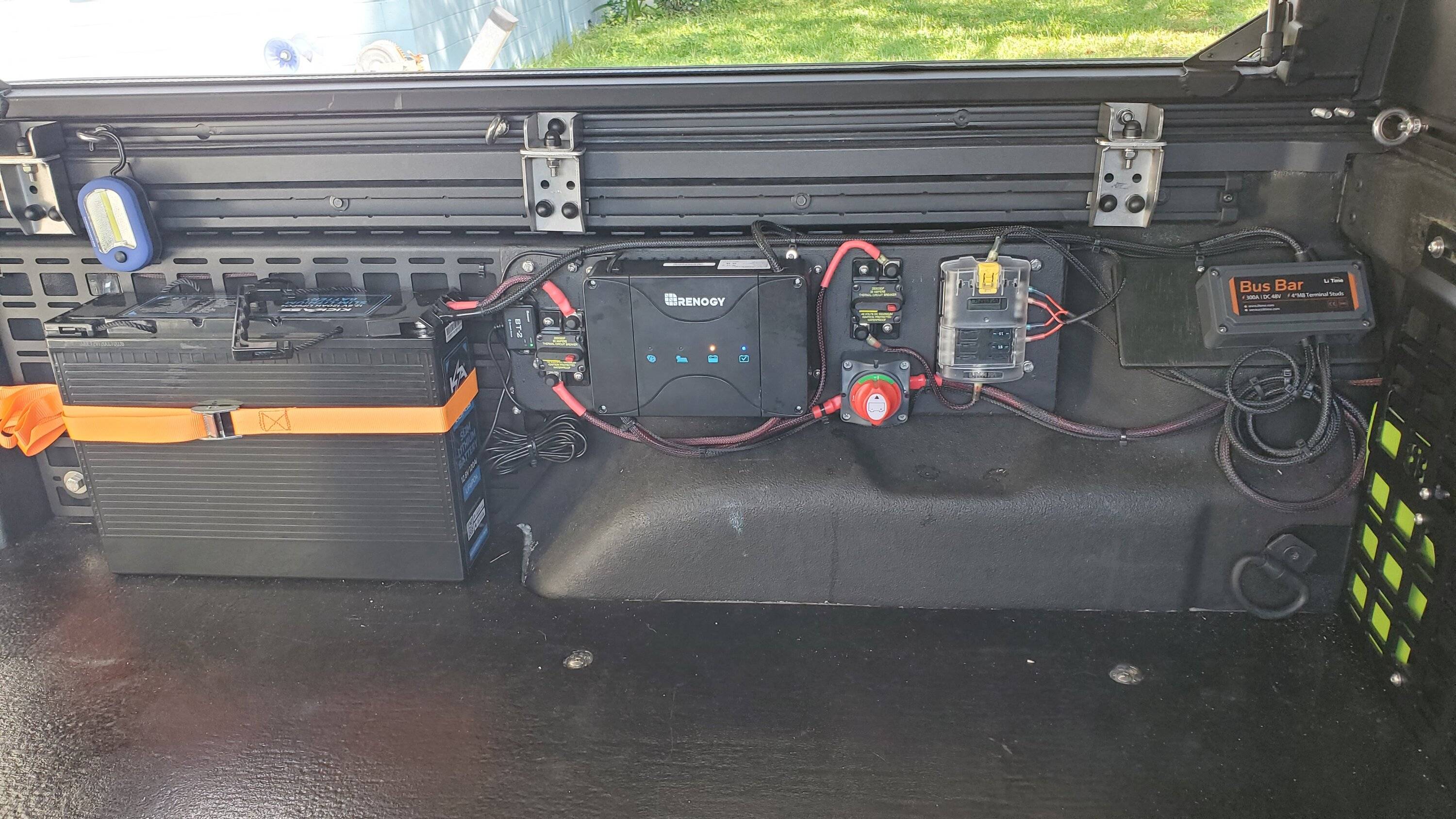
I used your layout as a basis for my own design. I bolted a piece of 1/2" plywood to the 813 molle panel so I could just screw the components to the wood. Have the Renogy DCC50, breaker from the house battery, breaker to the distribution panel, on/off switch for the starter battery, ANL fuse under the hood on a fab'd mounting plate, the buss bar is grounded to the chassis under the spare tire (which is a factory ground point). I wanted that KA Slim battery so it tucks in behind the wheel well. Now I have the entire width of the bed to use for the fridge and a slide. Thanks for the great ideas!!

Jeep Gladiator Renogy LiFePO House (Dual) Battery Install 20230911_101808


Jeep Gladiator Renogy LiFePO House (Dual) Battery Install 20230911_101830
 
OP
OP
Wolf Island Diver

Wolf Island Diver

Well-Known Member
Joined
Apr 14, 2021
Threads
26
Messages
1,128
Reaction score
2,477
Location
Virginia
Vehicle(s)
2021 JT Rubicon EcoDiesel
Occupation
Software Engineer
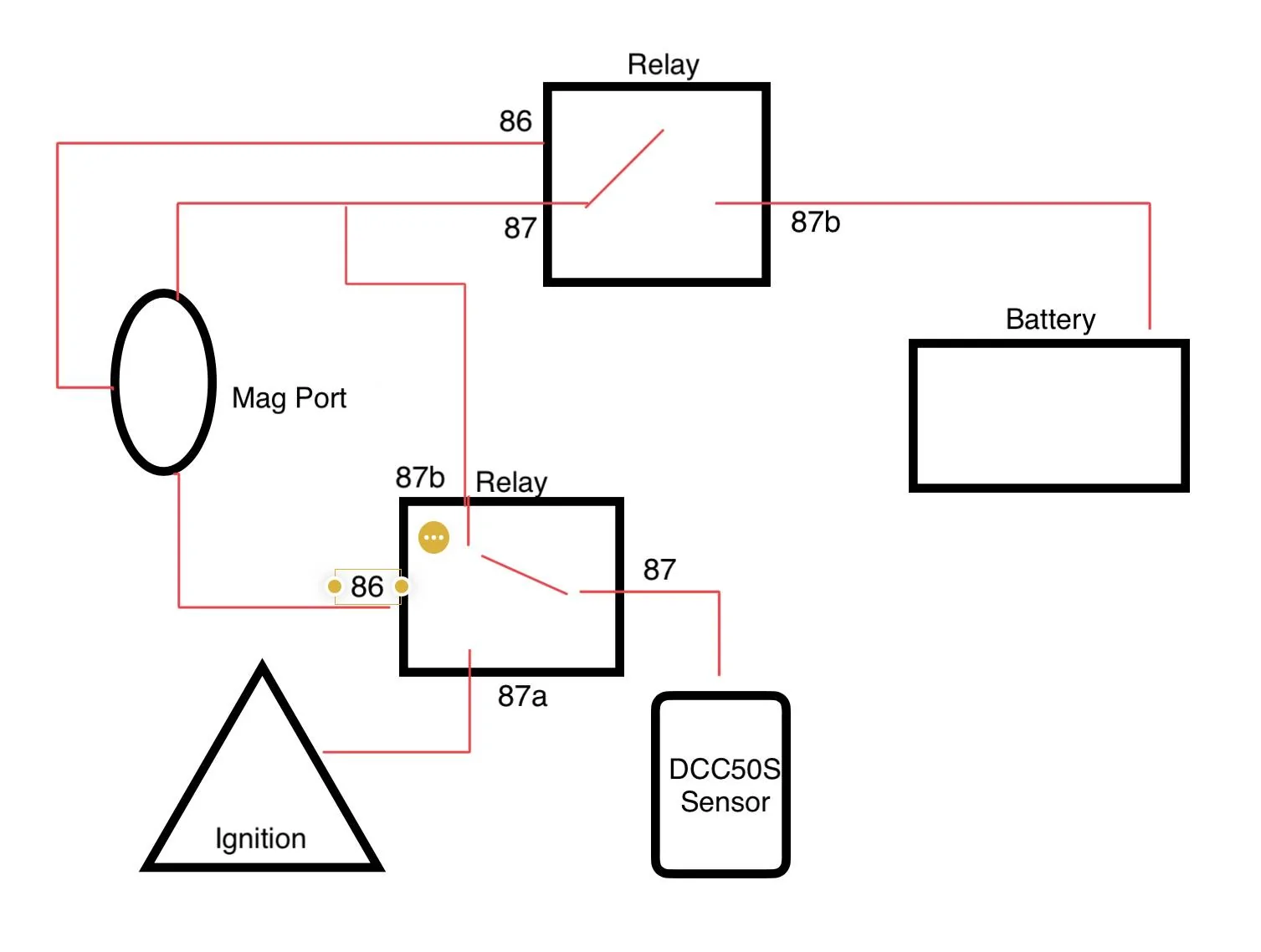
I was thinking I could just wire the DCC50S alternator sensor wire to the MagCode port and when I plug in my Noco10 it would trigger the DCC50S to begin charging. That way one single “shore power” plug will charge both batteries. The problem is that the starting battery is wired to this port. The DCC50S would immediately see voltage from the battery and start working, draining the starting battery.

The way the “smart” alternator sensor work is as follows:

Normally with a conventional battery you will see a consistent ~14V at the battery when the vehicle is running. The DCC50S is designed to come on when it detects this voltage at its input with no sensor required. Smart alternators only charge the battery at certain times designed to reduce the load on the engine and save fuel. Therefore the voltage will frequently be under this threshold when the vehicle is running. The sensor wire connected to an ignition source simply lets the DCC50S know the engine is running more reliably on vehicles with these alternators.

All the sensor needs is voltage. Plugging it into something that’s also plugged into the battery like the MagCode port will do this which means that it will start draining the battery if the NOCO isn’t plugged in. So I either need to add a switch that allows me to choose between using the ignition source to trigger the DCC50S or voltage from a charger plugged into the MagCode and not just the battery. The simple solution is just a 3 way switch under the hood. But this means that I then have to open the hood. I’m going to try this with relays instead so it’s all automatic. 1 relay to keep the battery isolated from the MagCode, actuated by voltage from the charger and one relay to switch between the ignition source and the charger for the DCC50S sensor. It’s 2 $9 5 pin Bosch relays (the battery isolator only uses 4 pins). It’s a little hackish for the battery isolation because the positive from the MagCode will both activate the relay but also serve as the power input. Normally this would negate the need for a relay, but in this case it’s working as a battery isolator. I don’t think this should cause issues unless theres a magnetic flux issue. For the relay for the sensor it’s working as a changeover relay with a NO and NC pin.

Now it’s important to note a few things. This is all low amperage. The NOCO tops out at 10a which is way less than the typical 30A rating on these relays. The connection between the DCC50S power input and the battery will not flow through these relays. This is just to provide voltage to the sensor. The other important thing is that this isn’t true shore power. The NOCO is a charger. If I run a lot loads on the house battery and the DCC50S is allowed to pull from the starting battery it’s going to drain it if the only thing supplying power is a 10A charger. This is for when both batteries are charged and I simply want to keep them both topped off, or if I’m running a small load like my ARB fridge. I already have this set up in reverse with the DCC50S trickle charging the starting battery with solar when the house battery is topped off and it’s sunny.

Here’s my crappy diagram showing only positive. It seems complicated but it’s a little bit of wire and $18 in relays.

Jeep Gladiator Renogy LiFePO House (Dual) Battery Install IMG_0032


Here’s the big caveat to all of this:

NOCO among other sources recommends against charging a battery while simultaneously apply a load to it. The reason is primarily decreasing the longevity of the battery. The other is heat. But there’s a lot of nuance here. We frequently charge batteries that are under load. Dual battery systems with DCCS chargers do this all the time by design. We do it with laptops and cell phones. We do it with lead acid batteries. Personally I think running a heavy load on the starting battery while charging, for example allowing the DCC50S to charge a depleted lithium while the starting battery is being charged via the NOCO would be a bad idea. I only intend to use this for float charging. I may not even be able to get away with keeping the fridge running although that uses very little power. I’m also going to have monitor heat. I don’t think using this set up as a maintainer for two charged batteries is likely to result in damage to the starting battery but this is an experiment. It’s not the appropriate solution to charge the dead or depleted lithium off the back of the starting battery. In that case the NOCO should be directly connected to the Lithium.

That last option is also a possibility. I could simply run wires to the lithium house battery from the MagCode port and add a 3 way switch to allow the NOCO to directly charge that battery or the starting battery but not both. I’d have to make sure the NOCO was switch to the proper mode for whatever battery it was connected to.
 
OP
OP
Wolf Island Diver

Wolf Island Diver

Well-Known Member
Joined
Apr 14, 2021
Threads
26
Messages
1,128
Reaction score
2,477
Location
Virginia
Vehicle(s)
2021 JT Rubicon EcoDiesel
Occupation
Software Engineer
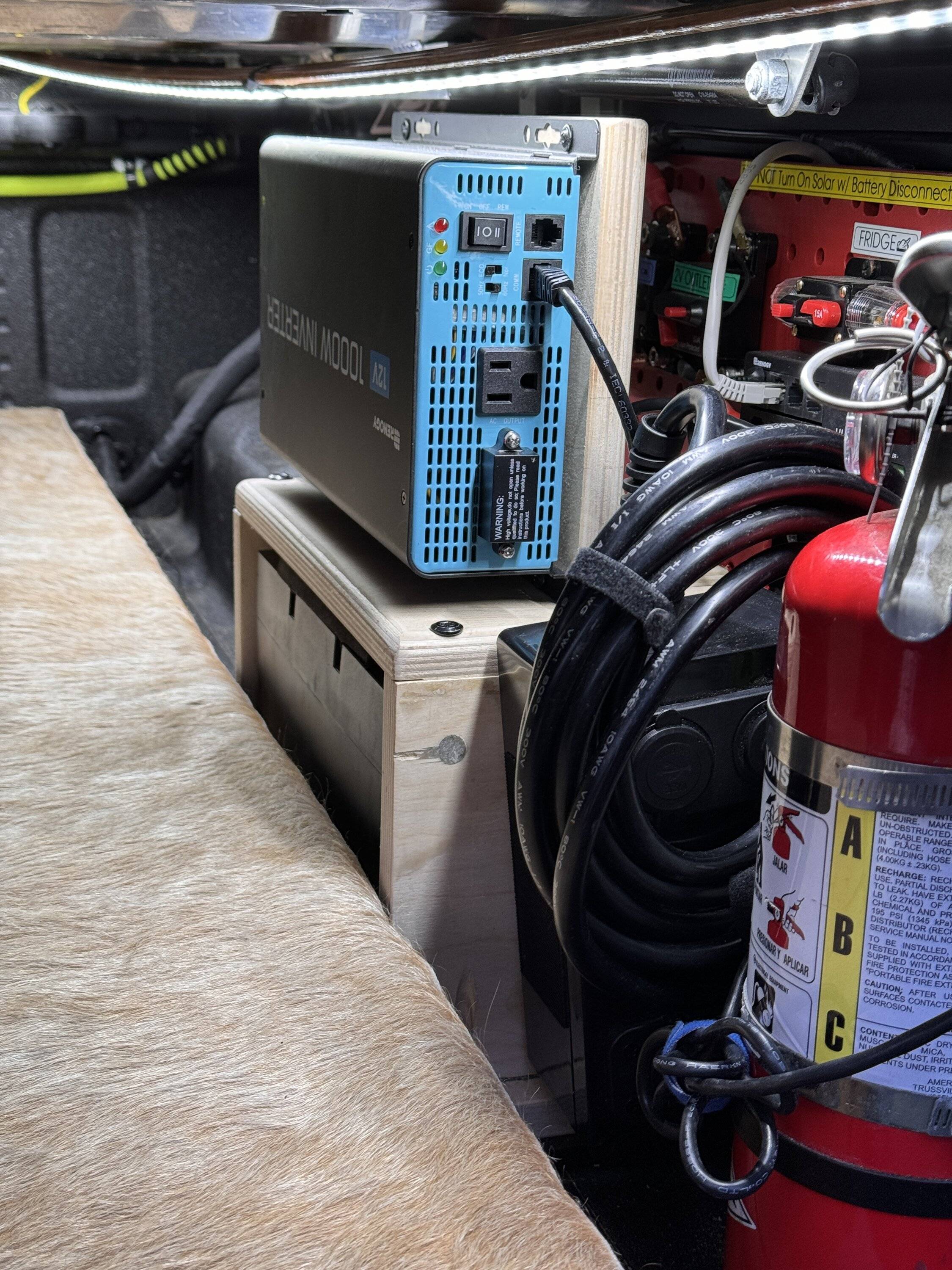
New Battery Mount, Inverter install:

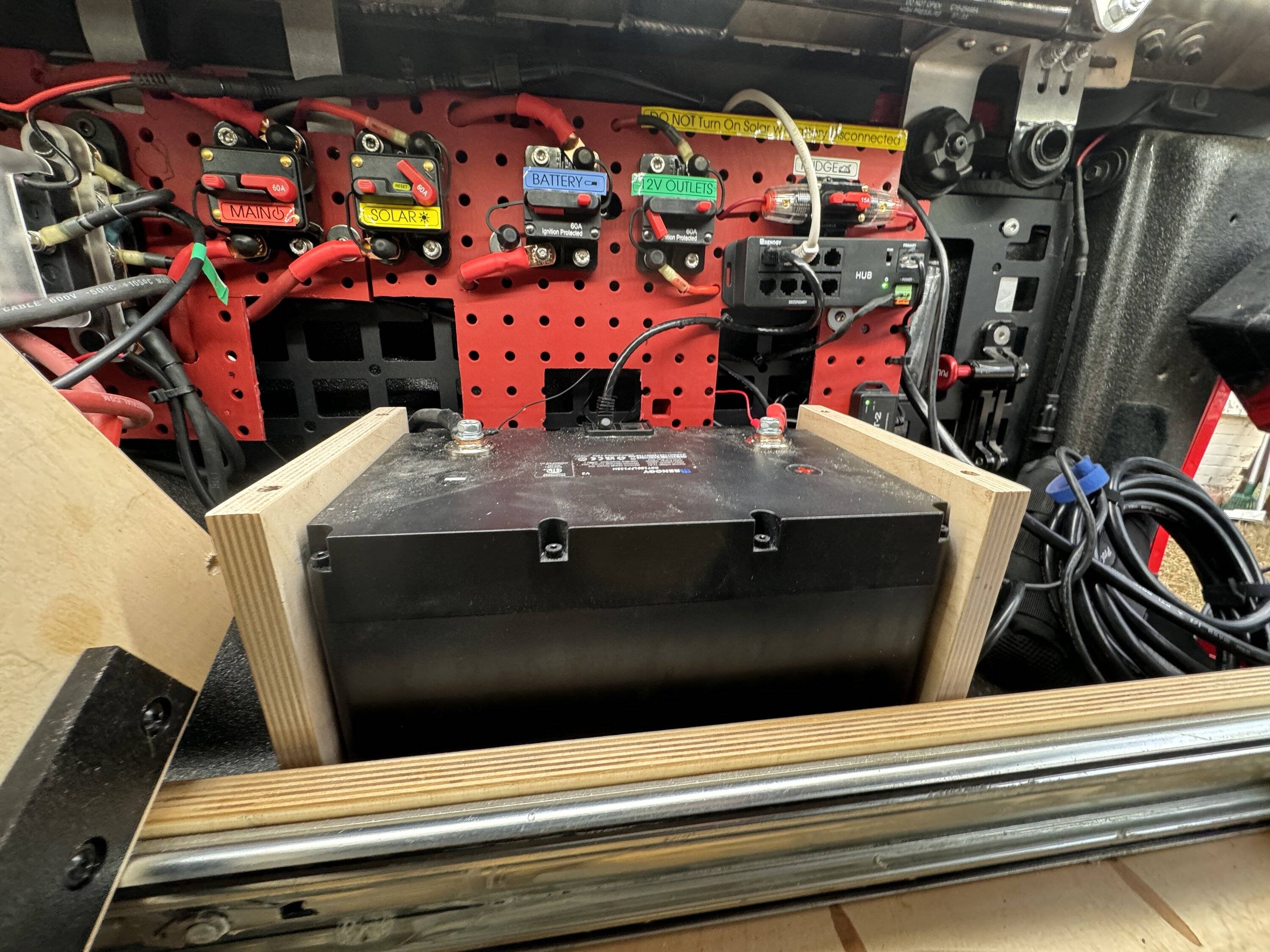
The Renogy plastic box was garbage and stuff on the slide out would interfere with the battery box strap. So I made a battery mount from leftover Baltic birch from my kitchen slide out project:

https://www.jeepgladiatorforum.com/forum/threads/diy-slide-out-w-sink.74944/

Jeep Gladiator Renogy LiFePO House (Dual) Battery Install IMG_2751


This is mounted to the floor of the bed with
M8 bolts in flush rivet nuts (painted, rtv’d). The bottom of the battery is fully surrounded. I used barrel nuts in the wood sealed in place with bees wax, so I could bolt, rather than screw the top down. A piece of high density foam and HDPE on the bottom of the top keep the battery secured. I made cutouts in the top so that it could connect/disconnect the battery cables and comms cat6 cable without removing the top. This mount has more clearance and is more secure than the plastic box.

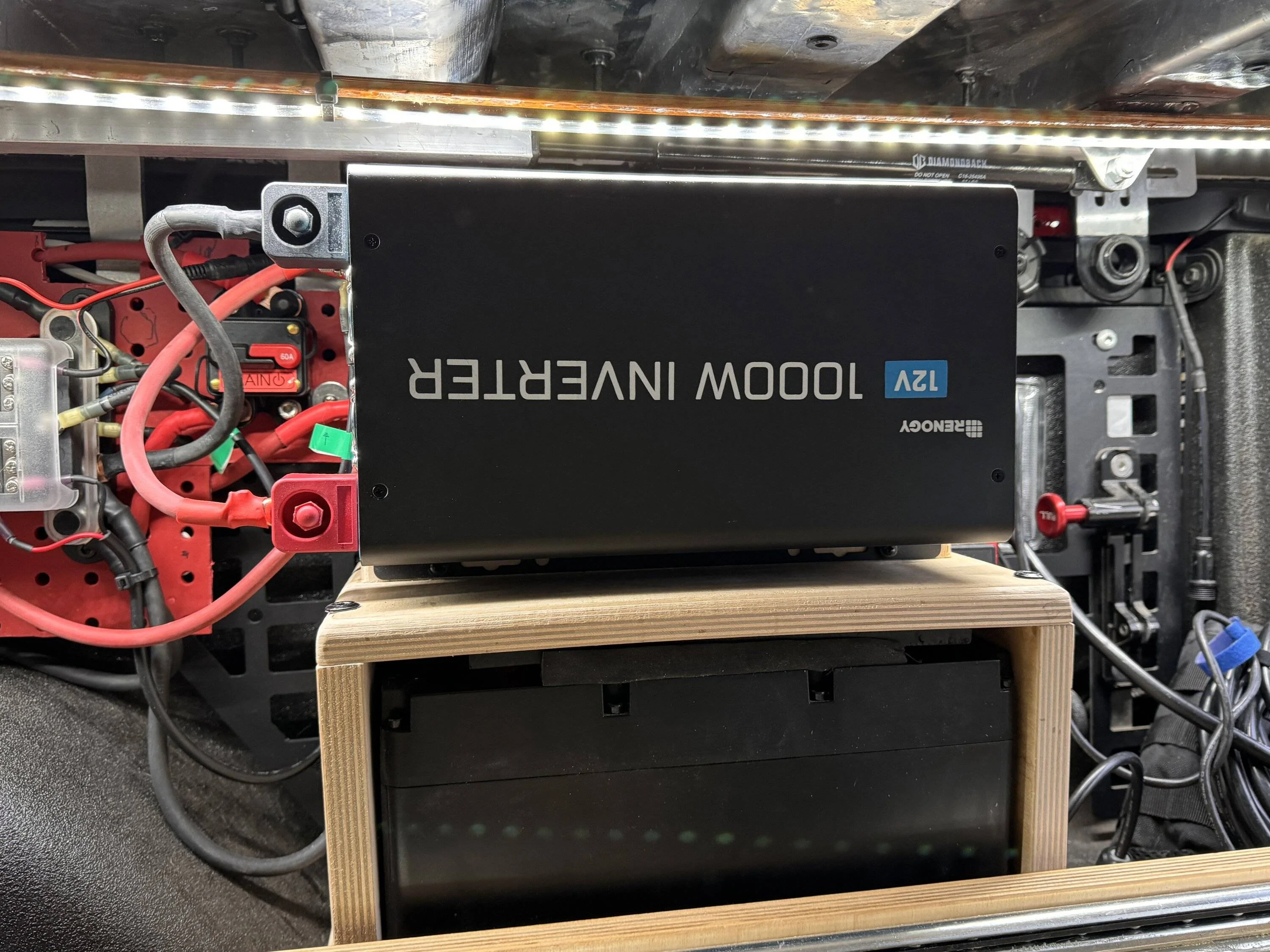
I affixed a braced vertical section to the top to mount a renogy 1000w psw inverter and accompanying 100amp breaker. That’s the maximum you’d want to run with a single 100ah battery. This inverter is a bit redundant considering the truck already has an inverter. But this one is bigger and it works when the truck is off.

Jeep Gladiator Renogy LiFePO House (Dual) Battery Install IMG_2752


plenty of clearance
Jeep Gladiator Renogy LiFePO House (Dual) Battery Install IMG_2756


Jeep Gladiator Renogy LiFePO House (Dual) Battery Install IMG_2757


Note about grounding:

The instructions for these Renogy inverters as typical, is confusing. There’s a case ground on the back next to the pos/neg hookups. There’s verbiage about not bonding the ground to the neutral. For a set up, like mine, without shore power, that doesn’t matter. Without going too much into it, this verbiage is about bonding ground to neutral in the case when shore power already has that and creating a ground loop. I have no direct shore power feeding this system. I’ve seen a lot of videos on these inverters and in none of them did the user connect the case ground to anything. This is dumb. 12v systems in vehicles aren’t going to electrocute you. But this inverter has a 110v side that absolutely will. The case ground exists so that if there’s a fault on the 110v side and the case becomes live, it can ground out to the chassis rather than you. I wouldn’t be surprised if this isn’t good for the ECU, but I know it’s not good for a human, so I’ll take my chances frying vehicle electronics in the case of an internal fault. These inverters have internal GFIs so the current that will feed through the system will last milliseconds. Hopefully not enough to do too much damage through the vehicle.
 
OP
OP
Wolf Island Diver

Wolf Island Diver

Well-Known Member
Joined
Apr 14, 2021
Threads
26
Messages
1,128
Reaction score
2,477
Location
Virginia
Vehicle(s)
2021 JT Rubicon EcoDiesel
Occupation
Software Engineer
Odd DCC50S behavior (or maybe not).

While working in the back of the truck I noticed that my lights, running off of the house battery continued working with the battery disconnected at the breaker. This means power was coming through the DCC50S from the starting battery with the truck off. The catch was that my truck was plugged into a NOCO battery maintainer. I now keep my truck plugged in through a MagCode port to keep the battery topped off I winter when it has to run the DEF heater.

There’s a lot of talk about the “smart” alternator wire. This is designed to make the DCC50S turn on when the ignition is on. Mine is definitely plugged into an ignition circuit in the IPM. The thing about these “smart” alternator signal wires is that they’re not the only way a DC-DC charger knows to turn on. They’re just a way to let the charger turn on when voltage is low, but it’s otherwise okay to pull from the starting battery. The charger will still cut on whenever it detects voltage over its threshold. I believe that’s around 14V but don’t quote me on that exact value. When I unplugged the MagCode plug from the NOCO the red (alternator) light on the DCC50S turned off along with my lights. Later when plugging it back in the DCC50S didn’t turn back on, but the NOCO indicated a full charge on the starting battery, and therefore it wasn’t charging anymore.

Still it makes you do a double take when you disconnect a battery and lights stay on. I’m 99% sure this was a function of the maintainer charging the starting battery and thus the system voltage going over the DCC50S’s threshold. I’ll probably check voltages with a multitester at some point just to make sure the DCC50S is working correctly but I’m pretty sure it’s fine. The cool thing about this is that at certain times with the NOCO you actually get free charging of the house battery too. You just won’t get it when the starting battery is full. It’s not a solution to charging the low house battery from a maintainer, but it will probably help keep it topped off, especially as the systems draw down the starting battery.
 
OP
OP
Wolf Island Diver

Wolf Island Diver

Well-Known Member
Joined
Apr 14, 2021
Threads
26
Messages
1,128
Reaction score
2,477
Location
Virginia
Vehicle(s)
2021 JT Rubicon EcoDiesel
Occupation
Software Engineer
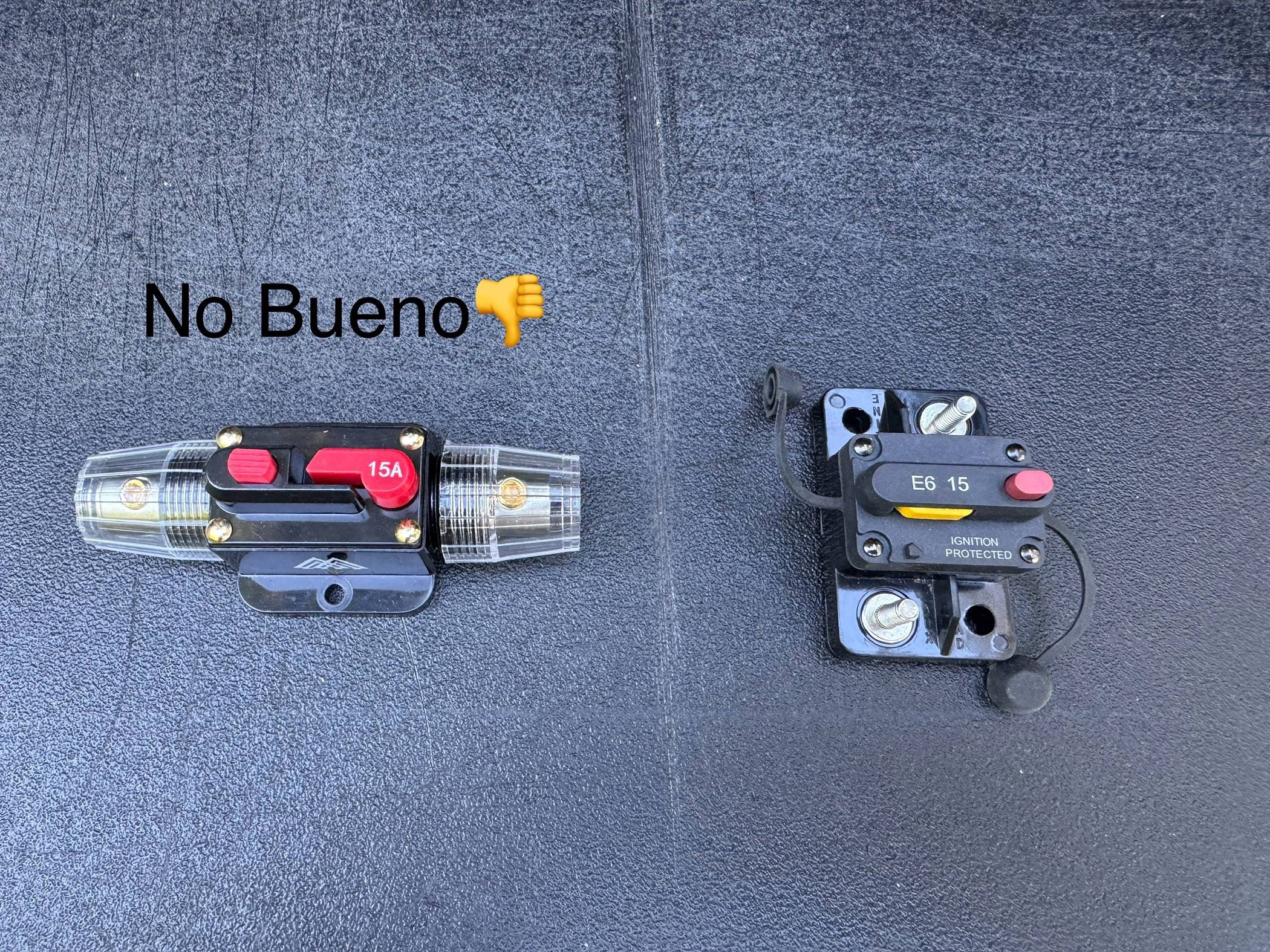
My ARB started freaking out. I replaced the chewed up power cord, but that wasn’t it. It was the 15A breaker. Avoid the one on the left. We’ll see how it’s replacement on the right does.

https://a.co/d/1ZvR4Sv

Jeep Gladiator Renogy LiFePO House (Dual) Battery Install IMG_4241
 

Sponsored

OP
OP
Wolf Island Diver

Wolf Island Diver

Well-Known Member
Joined
Apr 14, 2021
Threads
26
Messages
1,128
Reaction score
2,477
Location
Virginia
Vehicle(s)
2021 JT Rubicon EcoDiesel
Occupation
Software Engineer
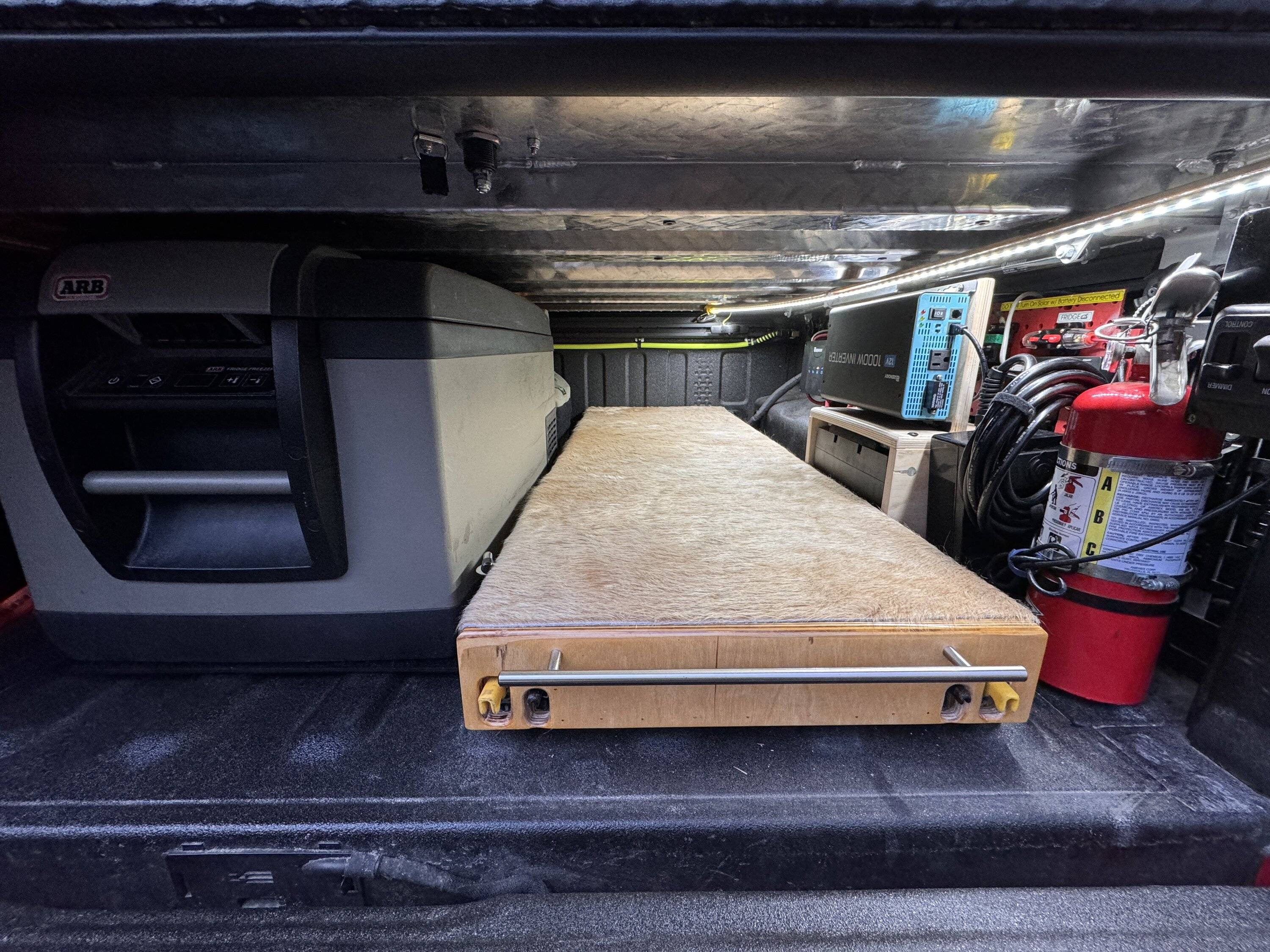
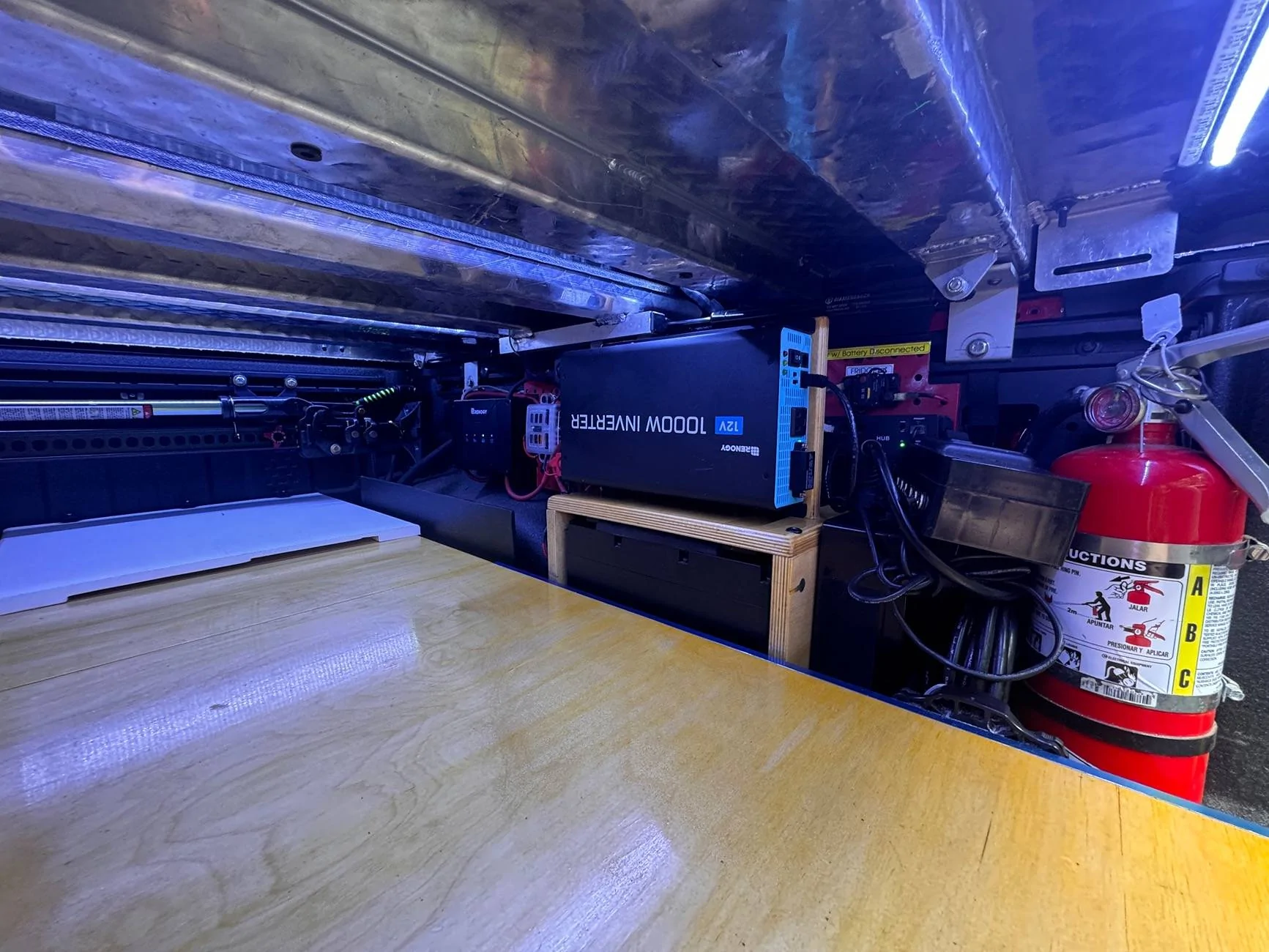
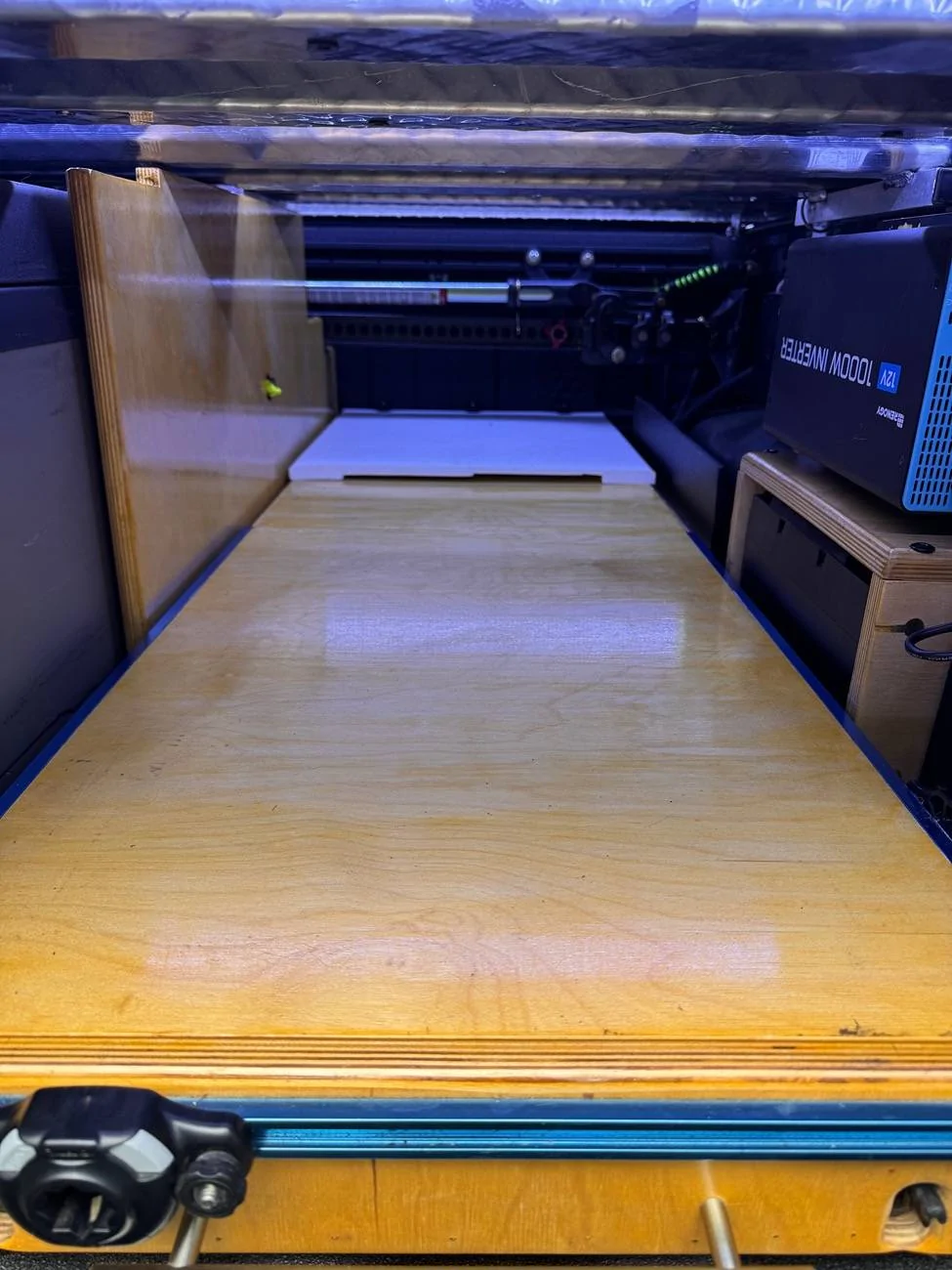
Finally got around to shellacking the battery box/inverter holder along with my new center divider wall.

Jeep Gladiator Renogy LiFePO House (Dual) Battery Install IMG_4311


Jeep Gladiator Renogy LiFePO House (Dual) Battery Install IMG_4313
 

MPMB

Well-Known Member
First Name
Michael
Joined
Apr 30, 2021
Threads
12
Messages
1,820
Reaction score
2,716
Location
Utah
Vehicle(s)
'21 JTR - SG
Occupation
Check your inbox.
Slight hijack for interested parties who want power and not a project (not that there's anything wrong with that), but the Ecoflow River 2 is on sale on AMZN for $169.

I'm going to have to read through this thread for my power solution in my Hiker trailer.
 
OP
OP
Wolf Island Diver

Wolf Island Diver

Well-Known Member
Joined
Apr 14, 2021
Threads
26
Messages
1,128
Reaction score
2,477
Location
Virginia
Vehicle(s)
2021 JT Rubicon EcoDiesel
Occupation
Software Engineer
Slight hijack for interested parties who want power and not a project (not that there's anything wrong with that), but the Ecoflow River 2 is on sale on AMZN for $169.

I'm going to have to read through this thread for my power solution in my Hiker trailer.
I actually made this thread after I switched from a portable power unit; Goal Zero in my case. GZ is a mixed bag in many ways but in the field my Yeti 500 worked without issue. I would never consider going back to one of those of any brand after using this setup. I’ve still got 2 GZ Yetis, that sit unused. You get way more power per dollar, that’s expandable with this setup. You don’t have to, remember to charge it, or keep it plugged in all the time when not in use, or find a place to stow the unit and make sure it’s secure and near the fridge. I don’t even think about my house battery or dcc50s. They’re always ready, passively. I can monitor everything from the dash.

My Yeti, as small as it was seemed to always be in the way, when what I really just wanted was conveniently located usb ports. I was always worried my 12v fridge plug would fall out or I’d forget to turn on the 12v port or it would get knocked and turned off. This setup is tailored to how I need it to work. Most importantly if you DIY a solution you don’t have the single point failure that comes with tightly coupling the battery and electronics of these devices. That was what always made me nervous about the GZ. They do a lot which is great in one sense. However, you’ve packed an AC/DC charger, DC/DC charger, MPPT solar charger, Lithium battery, battery monitor, inverter, LCD display, low voltage PD outputs, 12v outputs and 120v outlets into one box. You have no control or visibility into the quality of any of those components and if 1 of those breaks or more frequently if the logic controller for the whole system malfunctions, it’s a brick. GZ makes it worse (no idea about Ecoflow) by using proprietary cables and sub-standard solar input voltages.

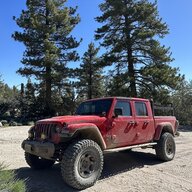
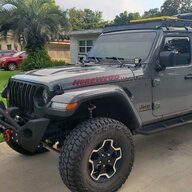
I think these have their uses for sure and building a dedicated in-Jeep system really requires the commitment to keep the bed covered, a rear seat delete or a huge custom enclosure. But this is the bed mod I’ve done to the truck, including the lift, tires, etc.
 

MPMB

Well-Known Member
First Name
Michael
Joined
Apr 30, 2021
Threads
12
Messages
1,820
Reaction score
2,716
Location
Utah
Vehicle(s)
'21 JTR - SG
Occupation
Check your inbox.
I actually made this thread after I switched from a portable power unit; Goal Zero in my case. GZ is a mixed bag in many ways but in the field my Yeti 500 worked without issue. I would never consider going back to one of those of any brand after using this setup. I’ve still got 2 GZ Yetis, that sit unused. You get way more power per dollar, that’s expandable with this setup. You don’t have to, remember to charge it, or keep it plugged in all the time when not in use, or find a place to stow the unit and make sure it’s secure and near the fridge. I don’t even think about my house battery or dcc50s. They’re always ready, passively. I can monitor everything from the dash.

My Yeti, as small as it was seemed to always be in the way, when what I really just wanted was conveniently located usb ports. I was always worried my 12v fridge plug would fall out or I’d forget to turn on the 12v port or it would get knocked and turned off. This setup is tailored to how I need it to work. Most importantly if you DIY a solution you don’t have the single point failure that comes with tightly coupling the battery and electronics of these devices. That was what always made me nervous about the GZ. They do a lot which is great in one sense. However, you’ve packed an AC/DC charger, DC/DC charger, MPPT solar charger, Lithium battery, battery monitor, inverter, LCD display, low voltage PD outputs, 12v outputs and 120v outlets into one box. You have no control or visibility into the quality of any of those components and if 1 of those breaks or more frequently if the logic controller for the whole system malfunctions, it’s a brick. GZ makes it worse (no idea about Ecoflow) by using proprietary cables and sub-standard solar input voltages.

I think these have their uses for sure and building a dedicated in-Jeep system really requires the commitment to keep the bed covered, a rear seat delete or a huge custom enclosure. But this is the bed mod I’ve done to the truck, including the lift, tires, etc.
Absolutely. Options are great to have, aren't they?

The portable stuff is uber flexible if you have to haul plants/trees/mulch/ATVs/lumber/etc, but yeah, they do get in the way. I have two Rivers (one with the extra battery, doubling capacity), and I end up swapping them around when one dies and needs to be recharged. Ecoflow was created by former DJI employees, iirc.

If I did a more permanent system, I'd probably build a similar box that takes up the side of the bed from the wheel hump to the side like what you've done, since it's rare I need anything that requires the full bed width. We get tons of dust here. Can't wait until they finish construction and the dirt gets recovered with grass, concrete, and rocks. A farmer/rancher nearby has tilled a big chunk of land twice this year. Just let the grass/weeds grow, man, it'll cut down on the dirt flying around.

With the recent equipment change (Hiker trailer), I now have an empty roof rack and bed rack, which I've put my 100w panel back on. The rack will eventually hold SUPs and a kayak, so my panel will be obscured a little. But I'll be able to put the fridge in the bed w/o issues that come with in-cab storage (still need the rear seats). I also wired in my own bed power panel with 2 12v plugs and a usb port. Problem is I didn't want an always-on power back there, so it's connected to my switchpod. Which I forget to turn on sometimes.

For the trailer I want something more reliable and built in, just need to find the time and money to do it right. I have a truck box on the front, so I'll mount a panel there. The RTT pretty much takes up the entire top of the trailer. I have a little space at the back I could probably put a narrow panel, but I want to put a water tank up there, since the "kitchen" is in the back. And probably where I'll put the bathroom/shower tent near.

Thule/Tepui really sucked the big one on the design of the Basin tent. The shell is angled with "steps" and not a flat surface, likely for aero reasons. But you can't put a flexible solar panel on there without it looking like crap. I'll poke around to see if anyone's mounted a roof rack to the Basin. That would be ideal, then I could put up 2 panels.
 
OP
OP
Wolf Island Diver

Wolf Island Diver

Well-Known Member
Joined
Apr 14, 2021
Threads
26
Messages
1,128
Reaction score
2,477
Location
Virginia
Vehicle(s)
2021 JT Rubicon EcoDiesel
Occupation
Software Engineer
Absolutely. Options are great to have, aren't they?

The portable stuff is uber flexible if you have to haul plants/trees/mulch/ATVs/lumber/etc, but yeah, they do get in the way. I have two Rivers (one with the extra battery, doubling capacity), and I end up swapping them around when one dies and needs to be recharged. Ecoflow was created by former DJI employees, iirc.

If I did a more permanent system, I'd probably build a similar box that takes up the side of the bed from the wheel hump to the side like what you've done, since it's rare I need anything that requires the full bed width. We get tons of dust here. Can't wait until they finish construction and the dirt gets recovered with grass, concrete, and rocks. A farmer/rancher nearby has tilled a big chunk of land twice this year. Just let the grass/weeds grow, man, it'll cut down on the dirt flying around.

With the recent equipment change (Hiker trailer), I now have an empty roof rack and bed rack, which I've put my 100w panel back on. The rack will eventually hold SUPs and a kayak, so my panel will be obscured a little. But I'll be able to put the fridge in the bed w/o issues that come with in-cab storage (still need the rear seats). I also wired in my own bed power panel with 2 12v plugs and a usb port. Problem is I didn't want an always-on power back there, so it's connected to my switchpod. Which I forget to turn on sometimes.

For the trailer I want something more reliable and built in, just need to find the time and money to do it right. I have a truck box on the front, so I'll mount a panel there. The RTT pretty much takes up the entire top of the trailer. I have a little space at the back I could probably put a narrow panel, but I want to put a water tank up there, since the "kitchen" is in the back. And probably where I'll put the bathroom/shower tent near.

Thule/Tepui really sucked the big one on the design of the Basin tent. The shell is angled with "steps" and not a flat surface, likely for aero reasons. But you can't put a flexible solar panel on there without it looking like crap. I'll poke around to see if anyone's mounted a roof rack to the Basin. That would be ideal, then I could put up 2 panels.
Opus seems to have switched to Renogy (also a Chinese company) for their trailers power systems. I think Renogy was already popular in the boating, van and camper world. I think their chassis are all made in China and the outfitting is done in the U.S. But traditionally it was the outfitting quality, eg., wiring that people complained about with Opus. I’m leaning towards and OP4 Limited Edition next year once the prime rate drops. My plan is to buy an Ecoflow AC unit for it.

I’ve been really impressed with some of these Chinese companies lately that are branding their own products instead of just making knockoffs or companIes peoducts. My DJI and Renogy stuff has been great. I just got a printer from Bambu Lab and it’s fantastic.
Sponsored


Top