Stan H
Well-Known Member
I made it 3 sentences , way too many words for oh so little .Hello All - The Pentastar V6 engine used in a Jeep environment for both commuting and off road use, offers number of advantages over the smaller 2.0L I4 turbo engine.
The naturally aspirated 3.6 L engine offers a wider power band, which is also smoother throughout its range compared to the 2.0L I4 turbo engine. For off-road use, running at different rpm’s for different terrains, the 3.6 L offers a much brooder choice of rpm and “smooth torque” with an absence of lag.
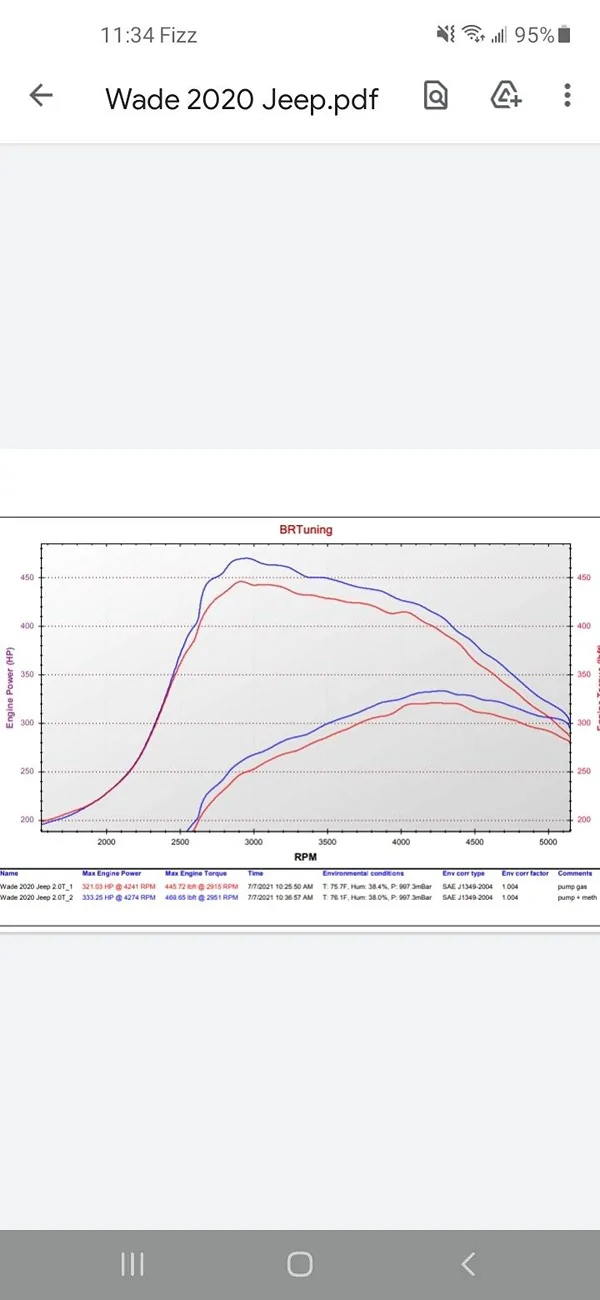
Since the 2.0L relies on its turbo to make additional power, correct rpm is crucial for turbo performance. For this reason, the 2.0 L engines operates on a more narrow power band compared to the naturally aspirated 3.6 L engine which can operate smoothly at any rpm. To help flatten lag, the 2.0L is equipped with a Garrett twin scroll housing design (cyl 1&4 / 2&3) as well as a small turbine / compressor wheel, which allows faster spooling and the ability to develop peak torque quicker at lower rpm. (295 peak@3000)
The 3.6 engine offers more longevity than the 2.0L turbo engine for a number of reasons. Component stress on the pistons, rods, crank and their bearing is shared by 6 cylinders, where on the 2.0L engine, the same or even higher loads are shared by only 4 cylinders increasing stress. Therefore, each 2.0L cylinder operates at higher loads and has to work harder than a 3.6 L engine to produce the same power output.
On each of my back to back 2.0L & 3.6L test drives, I found the throttle on the 2.0 L engine to be a bit non-linear in operation compared to a 3.6 L engine. While the 2.0L throttle does react fairly quickly, it was not followed up with the same response until the turbo engages. Another negative is all “4 cylinder engines” regardless of brand, have a raspy sound like they're coming apart under hard acceleration, while in contrast the V6 roars almost like a V8.
While I haven’t performed any 0-60 comparison tests with my salesman riding shot-gun, a number of Youtube videos show both engines getting similar 0-60 results. While Jeep specs the 2.0L with additional torque over the V6, unless you’re pulling a stacker trailer at gross, the 2.0 L turbo’s minimal torque advantage is pretty much a “nothing burger” for most Jeep owners.
Regardless of performance differences, both the 2.0L or 3.6L provide more than satisfactory performance with only minor differences in power or dependability. To the 2.0L advantage, she does offer slightly better mileage. Regardless, thanks to a Jeeps poor aerodynamics, combined with their merciless and worthless “Stop & Start” feature, good mileage is not in the cards.
Getting back to the original topic, converting a 3.6 Jeep to a 2.0L, would be a waste of time and money. You can get a new Mopar long block for $5-6k with a 3 yr /100k mile warranty, or a re-
man for around $3+k. Bottom line, there would be no real advantage switching from a 3.6L to 2.0L since both engines have similar power. Myself, I feel the 3.6L is a more suitable engine for Jeep since it has a more consistent output of torque. Finally, no matter how you twist it, the smaller 2.0 L “Turbo” engine has more components that can fail and has to work harder with more stress on each cylinder to make the same power as a 3.6L.
Ride Safe - Mike

Let me offer a summary :
3.6 good ,2.0 bad .
Sponsored