
Sponsored

Are the batteries really isolated during ESS stops?

ShadowsPapa

Well-Known Member
First Name
Bill
Joined
Oct 12, 2019
Threads
247
Messages
40,445
Reaction score
53,875
Location
Runnells, Iowa
Vehicle(s)
'25 JTMX, '23 JLU 4xe, '82 SX4, '73 Javelin
Occupation
Retired auto mechanic, frmr gov't ntwrk security admin
Vehicle Showcase
3
There's too much going on for me to follow.

@J Sierra Could you add a math trace showing the difference between whichever channels you have on N2 and N1, at 500 mV/div?
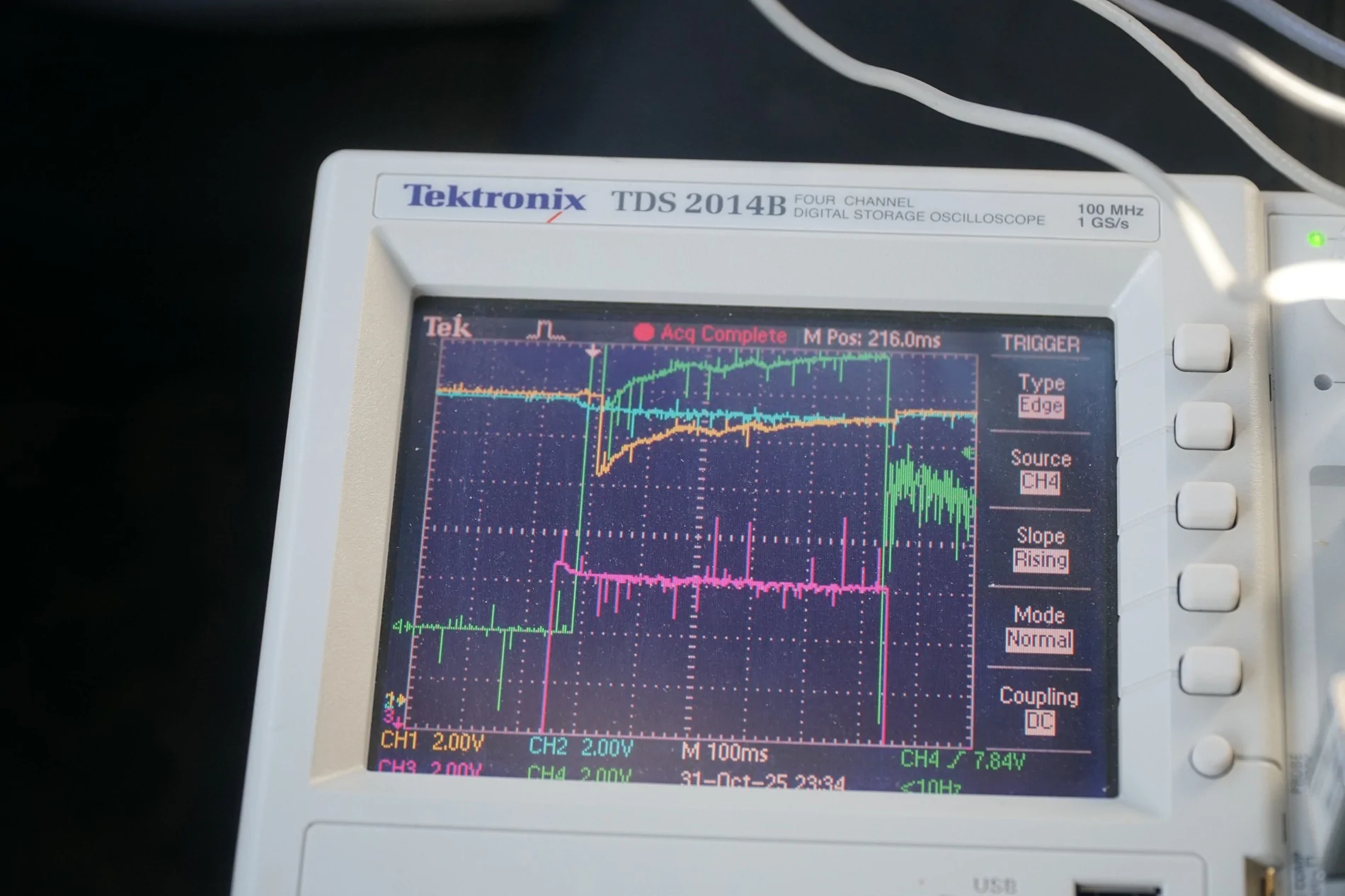
What would be helpful is tracking an ESS hot start
Track each battery AND the actual voltage going to trigger the PCR - to show when the PCR is told to open, and when it's released compared to the starter draw.
It should show the PCR open, starter sequence begin, and then shortly after, the voltage to the PCR coil itself drop off (the PCR relay in the PDC should open, killing the signal to the PCR to open)

We need to see -
relay for the PCR energize - opening the PCR
starter engage
moments later
relay for the PCR drop out, closing the PCR

Not much else matters - track the PCR and starter engagement directly and avoid all of the distractions some are getting tangled in.


PCR relay energize (telling PCR to open)
Starter relay engage - triggering the starter solenoid, then moments later, the draw from the starter.
PCR relay de-energized, closing PCR
Starter shut off.
Sponsored


 
OP
OP
Flanders

Flanders

Well-Known Member
Joined
Dec 2, 2023
Threads
11
Messages
152
Reaction score
121
Location
Dyer, NV
Vehicle(s)
2023 JT
And yet we know that the N3 fuse blows almost instantaneously when the aux battery positive cable is shorted to ground
Blowing quickly at 10x rated current is expected. The datasheet I linked shows both DMM fuses blowing within 0.1s at 1000% rated current. Both hold up for several minutes at 200%.

is that due to a residual charge like I referred to earlier in this thread?
Not a chance. To paraphrase a great author,
“Out,” he said. People who can supply that amount of firepower capacitance don’t need to supply verbs AUX batteries as well.
― Douglas Adams, The Restaurant at the End of the Universe
 

ShadowsPapa

Well-Known Member
First Name
Bill
Joined
Oct 12, 2019
Threads
247
Messages
40,445
Reaction score
53,875
Location
Runnells, Iowa
Vehicle(s)
'25 JTMX, '23 JLU 4xe, '82 SX4, '73 Javelin
Occupation
Retired auto mechanic, frmr gov't ntwrk security admin
Vehicle Showcase
3
Just the restart. The issue it is mitigating is voltage drop during starter engagement.


Combined at all times except for the moment of starter engagement during an ESS restart (and the initial startup test on a cold start, obviously).

Feels like I could just copy and paste this over and over, we're literally talking in circles with everyone here.

"I see the documentation, but I don't trust the documentation. I also see a oscilloscope image showing the documentation is accurate, but I don't believe it is being interpreted correctly. I also see wiring diagrams that support both the documentation and the oscilloscope interpretation, but I still need to verify how it works. I must continue to create new questions until I convince everyone else they're wrong."

Someone needs to explain how this thought process hasn't ended yet.
I'm not at the level of @Flanders who would trounce me in scope use (it's been YEARS since I've used a scope for anything other than DC motor diagnosis, alternator testing and diagnosis and the like) but batteries and starters - been there, done that, decades worth.

My scope is small and cheap - I blew out an HP and a Heath scope over the years (power supply issues and so on) but there's no way to lug one of those around anyway.

And, I'm still not up to standing on a block and getting things hooked up to my JT and checking it out. That will have to wait for a few more weeks.
 

Andy29847

Well-Known Member
First Name
Andy
Joined
Oct 25, 2020
Threads
14
Messages
554
Reaction score
934
Location
South Carolina
Vehicle(s)
2020 Wrangler Rubicon, 2020 Gladiator Rubicon
Occupation
Retired
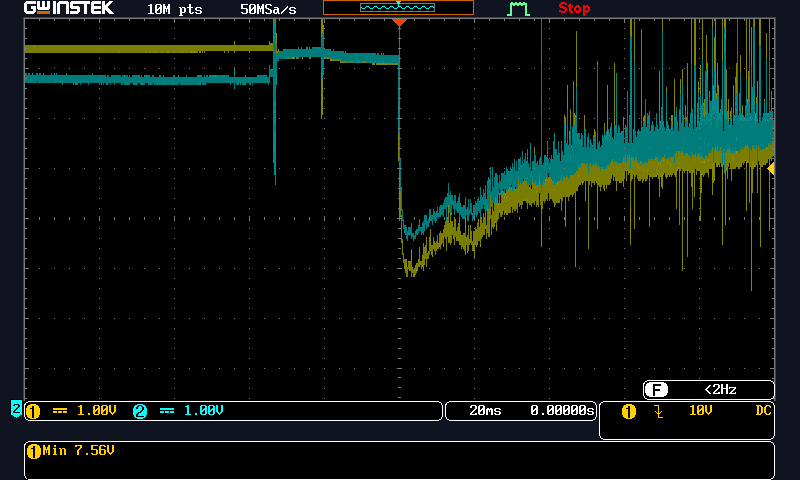
The cold start trace keeps getting posted, modified, and posted again. It's really about all we have short of someone actually capturing a FULL ESS restart - including PCR closing, and the trace showing the PCR being activated and then deactivated.
So far, I don't believe we have that. We are assuming because the images don't show the PCR trigger itself.
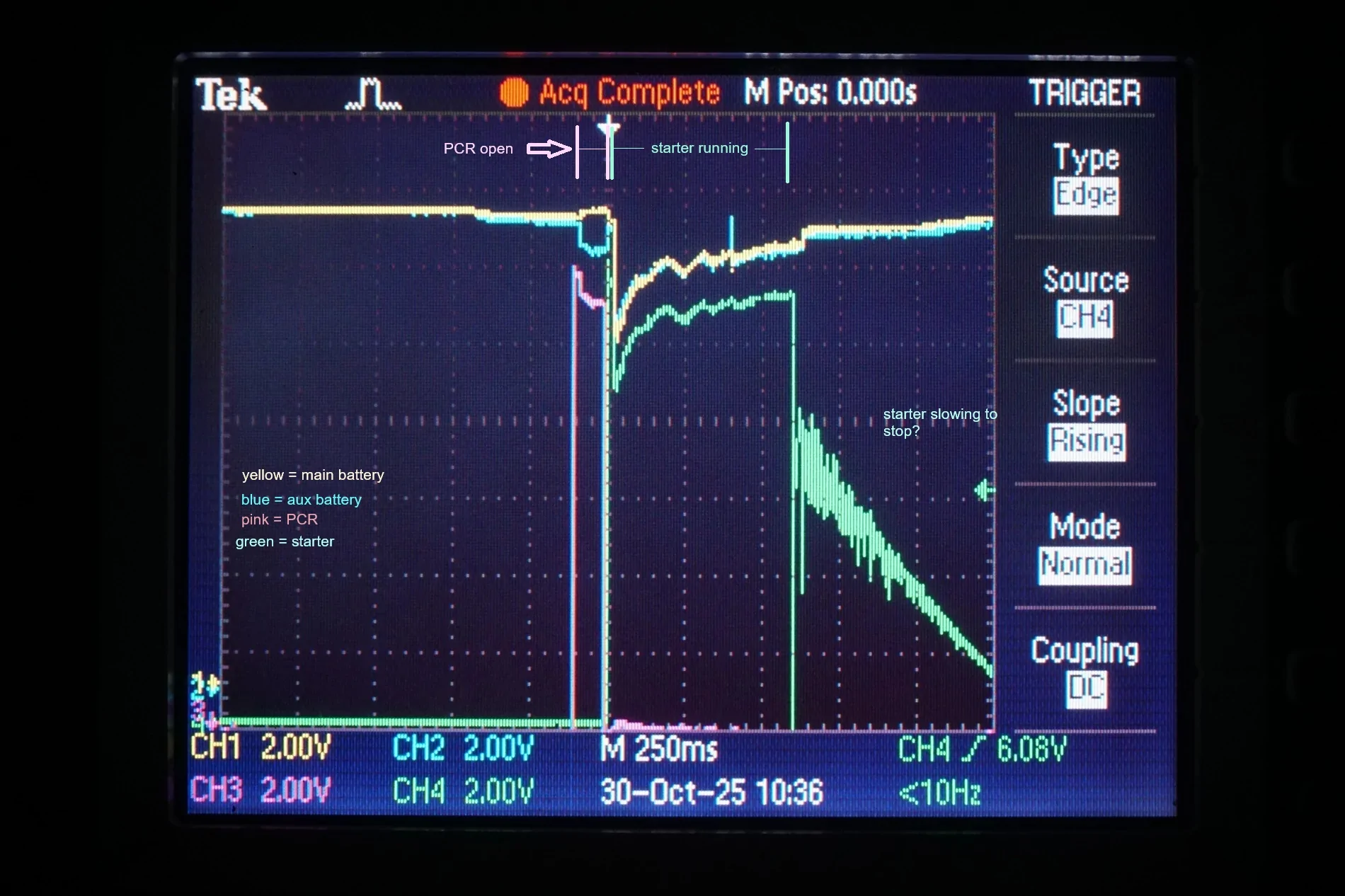
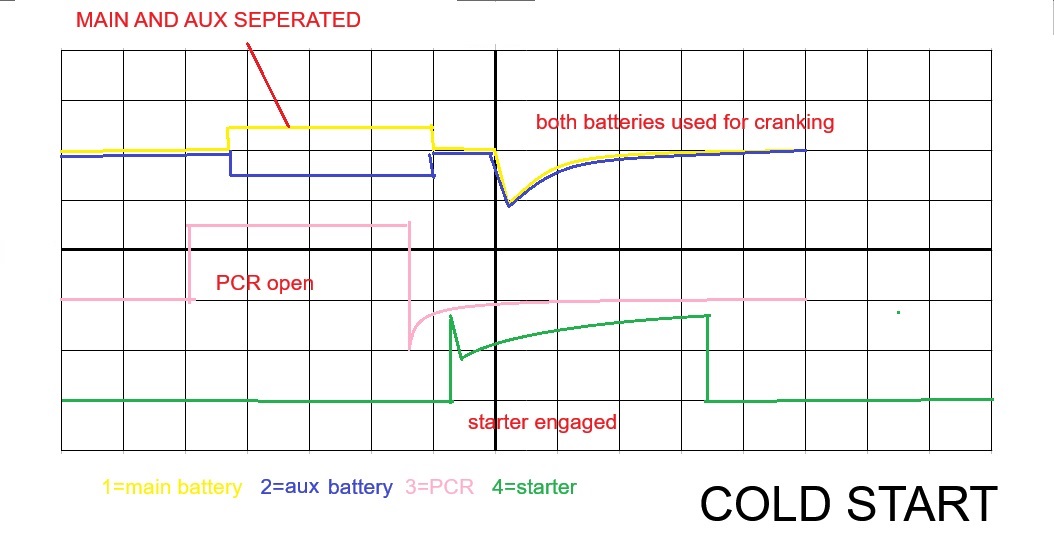
The initial cold start test were 2 channels, N1 and N2. Then someone added in the PCR circuit - 3 channels. The someone added in the starter circuit - 4 channels. All but one of the tests were cold start test. Below is a 4-channel test I accept as valid. I added some labels on J Serria's photo that show my interpretation of events. This seems to match the conclusion that most of us have arrived at regarding cold starts.

Jeep Gladiator Are the batteries really isolated during ESS stops? cold restart


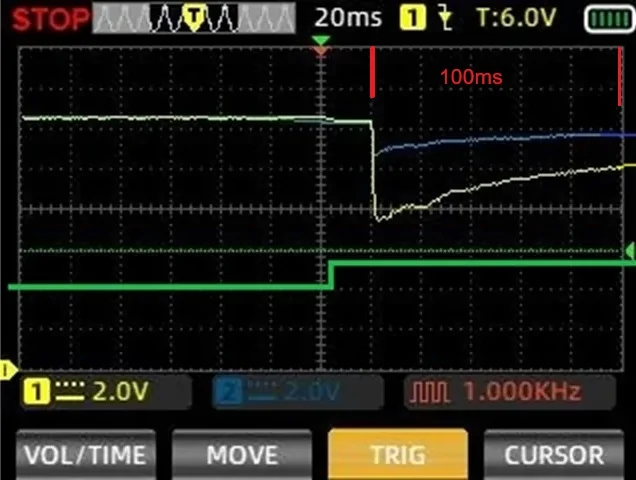
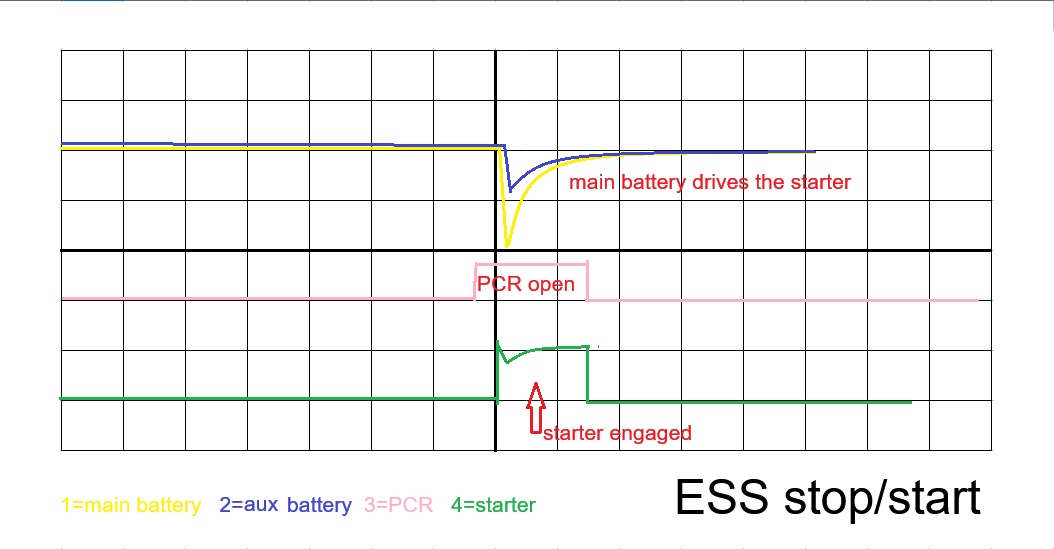
Next is the one test we have for ESS stop/start. It only shows 2 channels, N1 and N2. I added the green line (should have been pink to match the actual PCR traces) to predict PCR behavior. The period of time in question is at the end of the test - the last 100ms. Note that the lines do not rejoin.

Jeep Gladiator Are the batteries really isolated during ESS stops? ess restart 1


Also note that the time scales on the 2 tests are significantly different. It would be good if the criteria for the test were the same. Per documentation that Jerry shared earlier in the thread, I would expect N1 and N2 to rejoin in 20-40ms. I deduce that the aux battery is carrying the cab load for this time and that the ESS stop/start is initially on the main battery (not on both batteries as is for the cold start).

Jeep Gladiator Are the batteries really isolated during ESS stops? 1761861034423-


J Serria seems well on the way to making the ESS stop/start test that I think we can learn from.
 

Sponsored

ShadowsPapa

Well-Known Member
First Name
Bill
Joined
Oct 12, 2019
Threads
247
Messages
40,445
Reaction score
53,875
Location
Runnells, Iowa
Vehicle(s)
'25 JTMX, '23 JLU 4xe, '82 SX4, '73 Javelin
Occupation
Retired auto mechanic, frmr gov't ntwrk security admin
Vehicle Showcase
3
Cold start is easily seen. The PCR is the important bit.
Actually the PCR should be the important part in both, not when the voltages converge.
There's too much in play there, they won't converge really fast once the PCR closes again.

What we need is something showing the PCR trigger, the starter relay trigger, and something to show when the starter actually starts spinning or drawing from the battery, PCR relay opening, letting the PCR close.
The rest doesn't really matter.

We are lacking a good measure of the following (I understand what's happening, when, and why, but for the rest of the world to see)

  • PCR trigger (PCR relay in the PDC closing, energizing the PCR to open)
  • Starter relay trigger (triggering the starter solenoid to move the drive into the ring gear)
  • When does the starter actually start pulling a load or drawing. (this will be AFTER the solenoid moves the drive and closes the contacts to energize the starter.
    That will NOT be the same time as the starter relay closing!!
  • PCR relay releasing the PCR so it can close
 

jebiruph

Well-Known Member
First Name
Jerry
Joined
Dec 9, 2018
Threads
15
Messages
806
Reaction score
730
Location
IA
Vehicle(s)
2018 Wrangler JL 2024 Grand Cherokee L WL 2020 Gladiator JT
Blowing quickly at 10x rated current is expected. The datasheet I linked shows both DMM fuses blowing within 0.1s at 1000% rated current. Both hold up for several minutes at 200%.
The battery is rated at 200 amps due to it's internal resistance, where does 10x current come from?
 

jebiruph

Well-Known Member
First Name
Jerry
Joined
Dec 9, 2018
Threads
15
Messages
806
Reaction score
730
Location
IA
Vehicle(s)
2018 Wrangler JL 2024 Grand Cherokee L WL 2020 Gladiator JT
You are going by ONE trace which isn't very long at all.
If it stayed open until N1 and N2 are almost the same, that could be forever.
Stop looking at that one trace.
Since almost the entire vehicle load comes off N1 when the PCR is open, you'll be waiting a long time for the voltages to be equal.
You provided factory documentation that states the PCR closes and the batteries are reconnected after 20-40ms of the ESS restart. If the documentation is correct, wouldn't you see the battery voltages merge after 20-40ms. How much deviation will there be between traces and how many traces would it take to establish a pattern?
 

Andy29847

Well-Known Member
First Name
Andy
Joined
Oct 25, 2020
Threads
14
Messages
554
Reaction score
934
Location
South Carolina
Vehicle(s)
2020 Wrangler Rubicon, 2020 Gladiator Rubicon
Occupation
Retired
I'm an old, retired guy temporarily stuck at home. This thread has been fun for me. I've had a JT since 2020 and a JLU since 2022. I love my Jeeps, but sometimes I have wished the tech was more like my 2004 TJ. This is especially true about the battery system. As I read through this thread (5 times), I see where there has been some mistakes and a lot of learning. It remains to be seen what we can do with this info, but it is good to know.

The tests we have seen on this thread using an oscilloscope have eliminated a lot of the fog about how the Jeep battery system works. From those tests, we know that a cold start is different than an ESS start. We know that the batteries separate for milliseconds for a test of the aux battery on a cold start, prior to starter engagement. We know that after the test, the batteries are rejoined and both batteries together to power the starter for a cold start. It is suspected that the main battery provides the power for an ESS start, but we do not know yet when the main and the aux are rejoined. We know that the batteries are separated just before starter engagement. I am hoping that J Serria will soon be able to share an oscilloscope reading of an ESS start.

My career was with the telephone company. I'm more comfortable discussing voice and data than figuring out what is going on with my Jeep. One of my philosophies about running tests on telcom equipment was that the tester needed to have an expectation of the possible test results to make the actual test meaningful. Using that thought here, I've been guessing at what the scope readings would look like. Of the 2 below, the cold start scope is not a guess but reflects what has actually been measured. The ESS start is a guess.

Jeep Gladiator Are the batteries really isolated during ESS stops? i-NG62Ln9


Jeep Gladiator Are the batteries really isolated during ESS stops? i-xSxxfRn
 
OP
OP
Flanders

Flanders

Well-Known Member
Joined
Dec 2, 2023
Threads
11
Messages
152
Reaction score
121
Location
Dyer, NV
Vehicle(s)
2023 JT
I'm not at the level of @Flanders who would trounce me in scope use (it's been YEARS since I've used a scope for anything other than DC motor diagnosis, alternator testing and diagnosis and the like) but batteries and starters - been there, done that, decades worth.
I've seen scope ninjas who could capture a mouse fart in a hurricane. My scope-fu is second-rate.
 

Sponsored

OP
OP
Flanders

Flanders

Well-Known Member
Joined
Dec 2, 2023
Threads
11
Messages
152
Reaction score
121
Location
Dyer, NV
Vehicle(s)
2023 JT
The battery is rated at 200 amps due to it's internal resistance, where does 10x current come from?
200CCA means the battery can supply 200A at 0°F for 30 seconds without falling below 7.2V.

It can supply a great deal more current at 70°F for 0.1 seconds when allowed to fall to near 0V, i.e., short-circuited.
 

ShadowsPapa

Well-Known Member
First Name
Bill
Joined
Oct 12, 2019
Threads
247
Messages
40,445
Reaction score
53,875
Location
Runnells, Iowa
Vehicle(s)
'25 JTMX, '23 JLU 4xe, '82 SX4, '73 Javelin
Occupation
Retired auto mechanic, frmr gov't ntwrk security admin
Vehicle Showcase
3
200CCA means the battery can supply 200A at 0°F for 30 seconds without falling below 7.2V.

It can supply a great deal more current at 70°F for 0.1 seconds when allowed to fall to near 0V, i.e., short-circuited.
Guess I need to pull out the GM battery training manuals I have if people think a 200 CCA can only do that at room temp. A 200 amp battery will easily kill that number at 70 degrees, especially in short bursts.
 
OP
OP
Flanders

Flanders

Well-Known Member
Joined
Dec 2, 2023
Threads
11
Messages
152
Reaction score
121
Location
Dyer, NV
Vehicle(s)
2023 JT
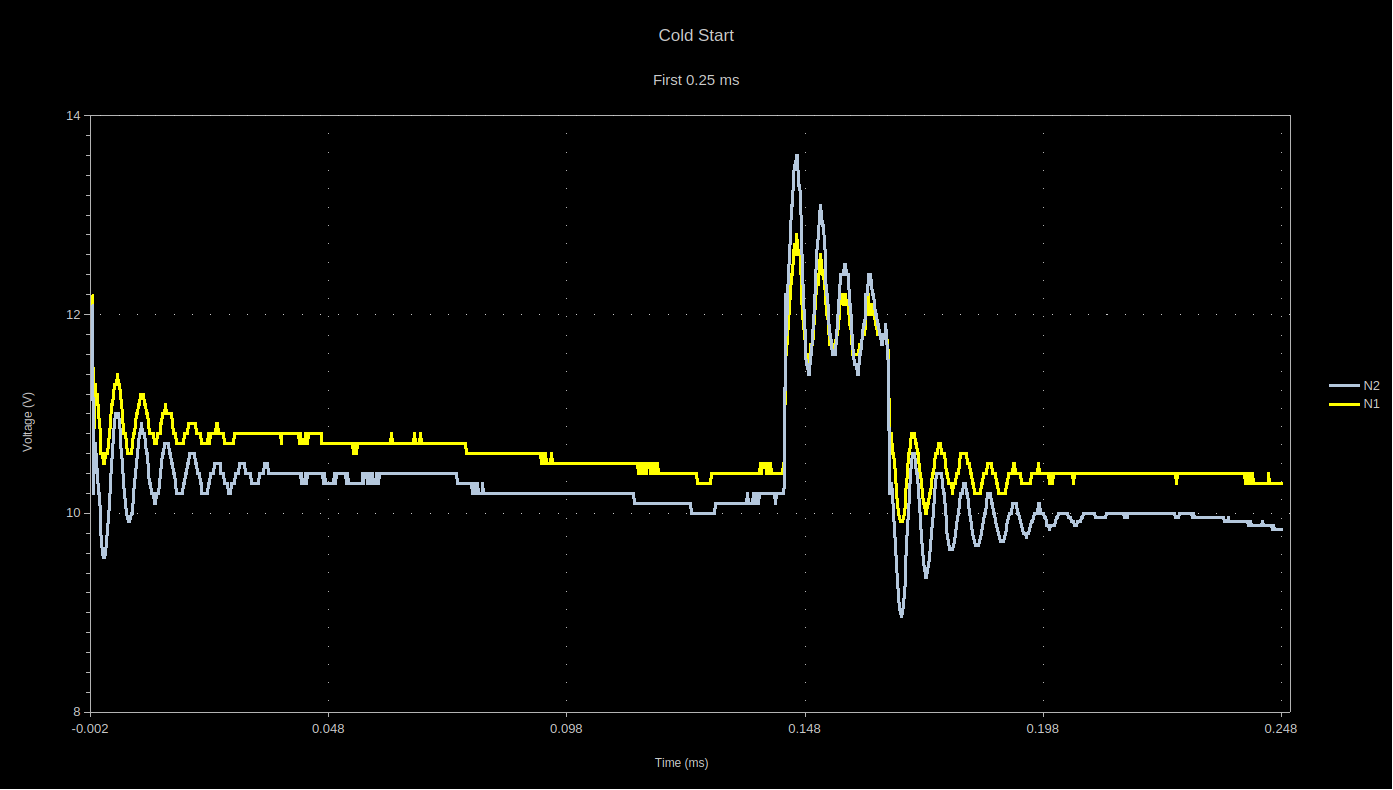
Here's a chart showing the first 250 microseconds from the first cold start trace I posted last year. It shows detail that was not visible in the trace.

Jeep Gladiator Are the batteries really isolated during ESS stops? cold_start_025


This is less than one pixel in the original trace below, right when both voltages drop sharply.
Jeep Gladiator Are the batteries really isolated during ESS stops? DS0011.PNG


I think the initial load that pulls it down from 12.2V is the starter solenoid. The spike over 13.5V at 0.145ms is inductive kickback. Then current starts flowing again.

@ShadowsPapa can probably explain this better.
 

J Sierra

Well-Known Member
First Name
James
Joined
Dec 29, 2020
Threads
9
Messages
157
Reaction score
197
Location
Tucson AZ
Vehicle(s)
2020 Jeep gladiator
Occupation
retired
Vehicle Showcase
1
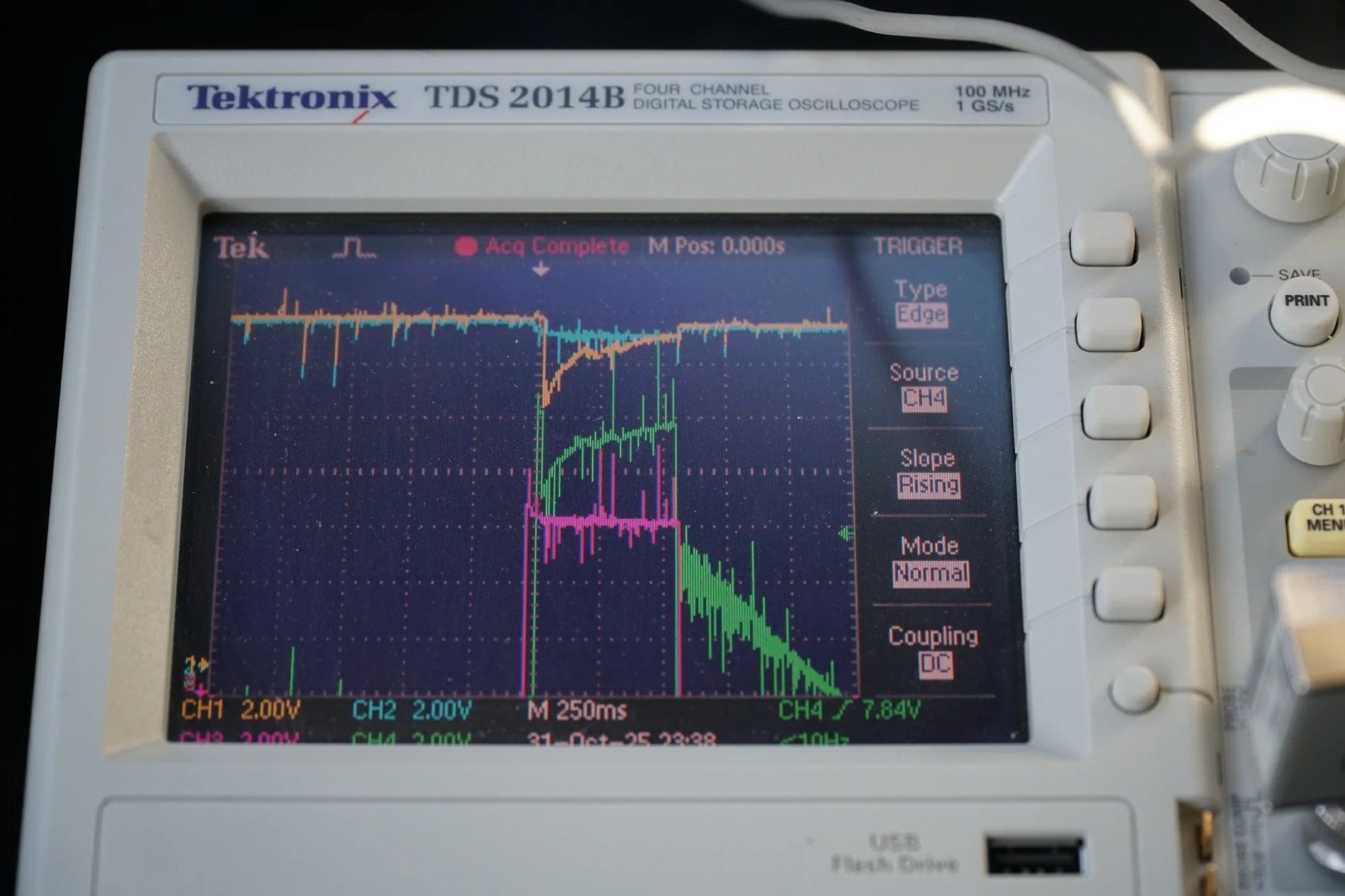
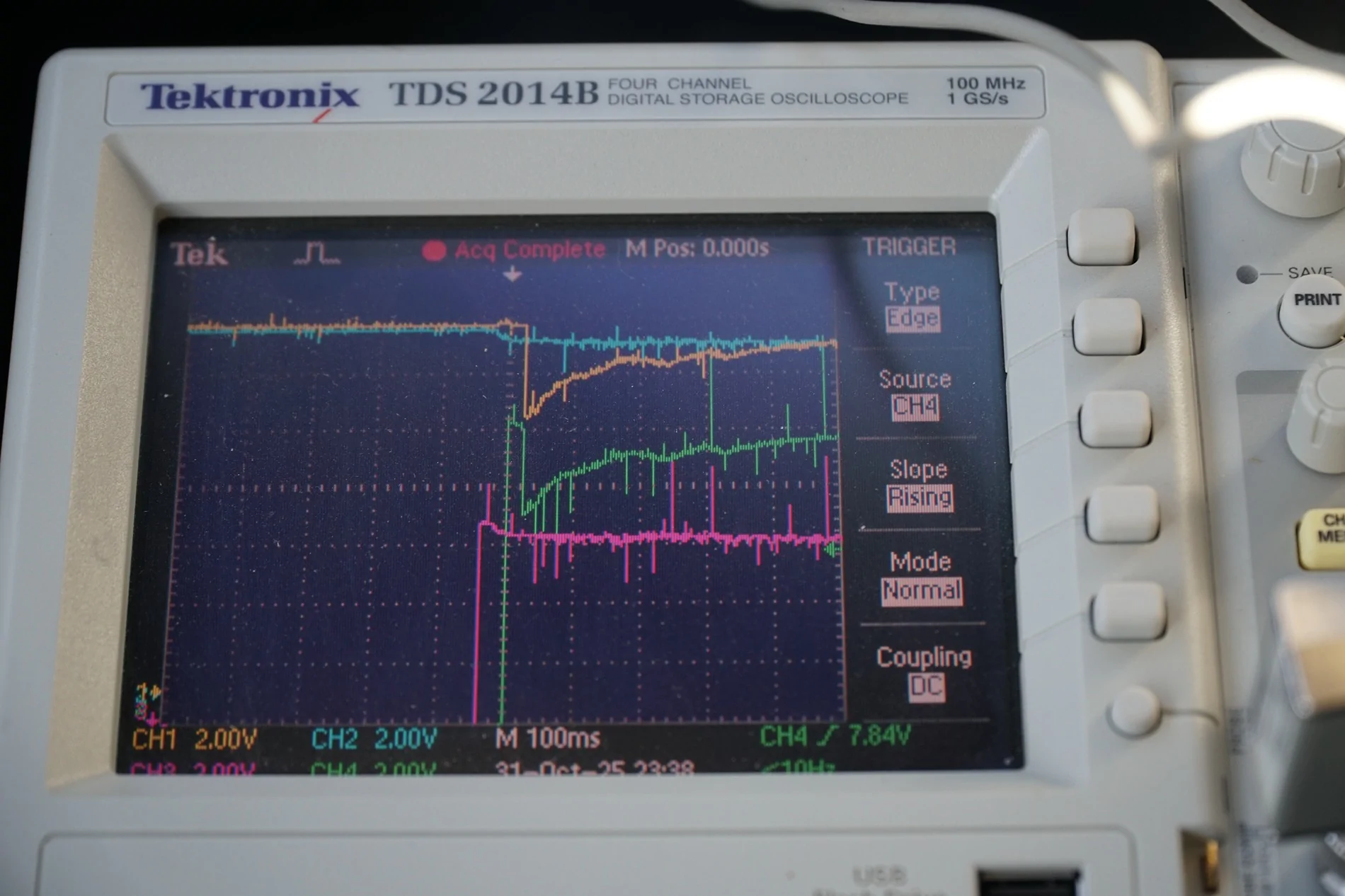
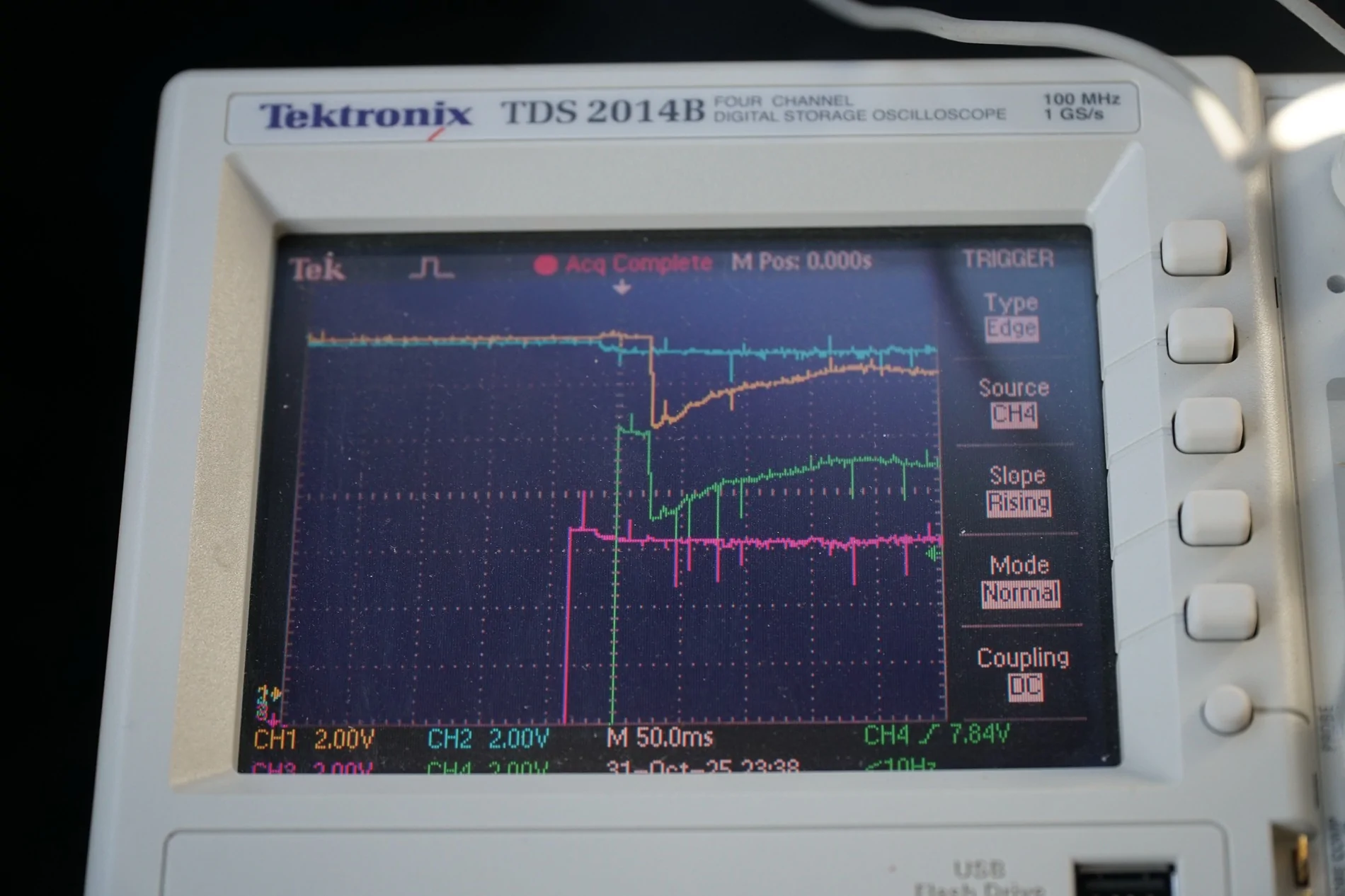
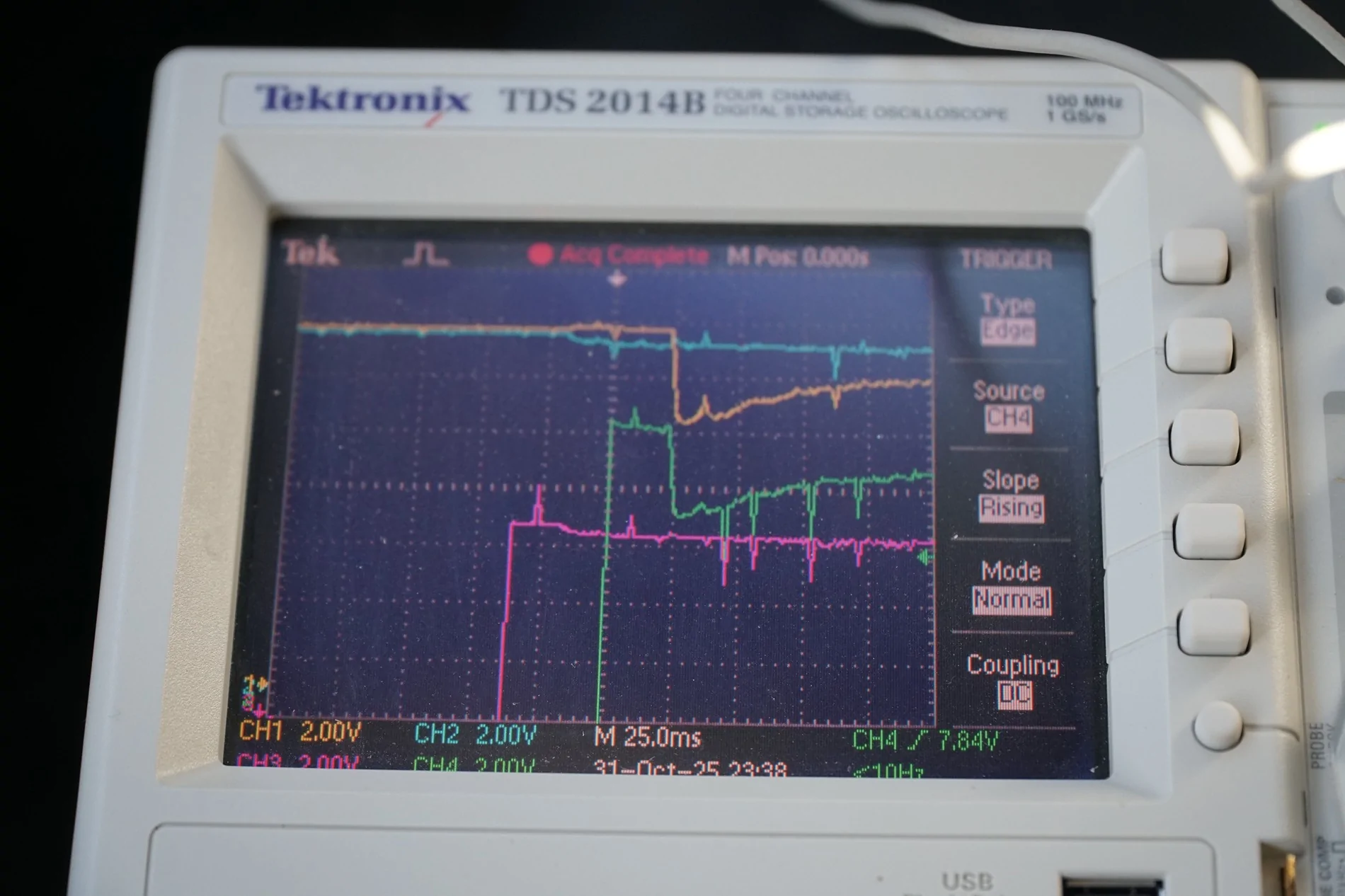
Ess hot start. Ignore the spikes they are from the inverter. The pcr and starter signals are moved down. Last image I moved green up.

Jeep Gladiator Are the batteries really isolated during ESS stops? DSC05484


Jeep Gladiator Are the batteries really isolated during ESS stops? DSC05483


Jeep Gladiator Are the batteries really isolated during ESS stops? DSC05482


Jeep Gladiator Are the batteries really isolated during ESS stops? DSC05472
 
Last edited:

J Sierra

Well-Known Member
First Name
James
Joined
Dec 29, 2020
Threads
9
Messages
157
Reaction score
197
Location
Tucson AZ
Vehicle(s)
2020 Jeep gladiator
Occupation
retired
Vehicle Showcase
1
PCR is open during ess start. Trigger is starter relay green.

Jeep Gladiator Are the batteries really isolated during ESS stops? DSC05481
Sponsored

 
Last edited:


Top