
Sponsored

ShadowsPapa
Well-Known Member
- First Name
- Bill
- Joined
- Oct 12, 2019
- Threads
- 247
- Messages
- 40,442
- Reaction score
- 53,860
- Location
- Runnells, Iowa
- Vehicle(s)
- '25 JTMX, '23 JLU 4xe, '82 SX4, '73 Javelin
- Occupation
- Retired auto mechanic, frmr gov't ntwrk security admin
- Vehicle Showcase
- 3
Likely reality forced a change after that number was in print.... and remains open for at least 150ms, contrary to the service manual.
The point is, however, that it is closed during the ESS stop, opens for the starter sequence, and closes.
So now we're going to poo-poo the whole thing over the time it appears open?
Fact - PCR closed during ESS stop - that's been a given for a long long time, proven many ways.
PCR opens for the startup sequence. Engine cranks.
In there the PCR closes - is the exact milliseconds of time going to mean the documents are wrong about it all?
As far as the starter itself - the only way to properly check the starter time is through the relay that triggers the starter.
There's going to be a build-up of power at the solenoid - taking time after the relay closes, then time for the solenoid to pull the lever that kicks the drive into the ring gear and once it's full-back, the solenoid closes contacts that actually energize the starter.
The starter spins the engine, the PCM detects it's running, and de-energizes the starter relay.
The field at the solenoid collapses, sending a strong reverse current spike back.
The solenoid will lose magnetic field, opening the contacts between the starter motor itself and the battery - the collapsing fields in the starter may cause some fuzzy line but these are permanent magnet motors, so there's no "field windings", only the armature windings.
What you see, and the time it takes, will totally depend on where you take the information from.
As far as the PCR operation, the only accurate way to demonstrate the time it's open is by taking the reading from the PCR relay on the PDC/fuse panel.
What we know (and really knew anyway)
The batteries are always connected when the truck is at rest, not running.
The batteries are always connected when the truck is running, moving or not.
The batteries are separated for a check just before the starter sequence begins during a push button start/TIP start.
When the truck shuts off via ESS stop event, the batteries are totally connected during the entire time the engine is OFF/not running.
When the ESS either times out, or a restart is otherwise triggered, the batteries are separated by the time the start sequence begins and reconnect shortly after than, so they are again connected once its running and you go with it.
Is that not correct?
and other than the exact milliseconds of the disconnect during the restart - is it not how it works?
So really, we're pissing on the whole thing because of milliseconds during an ESS restart?
I guess I'll see if I can find a more recent document since most of the last half of this whole thread was because of milliseconds - it was otherwise 100% correct.
jebiruph
Well-Known Member
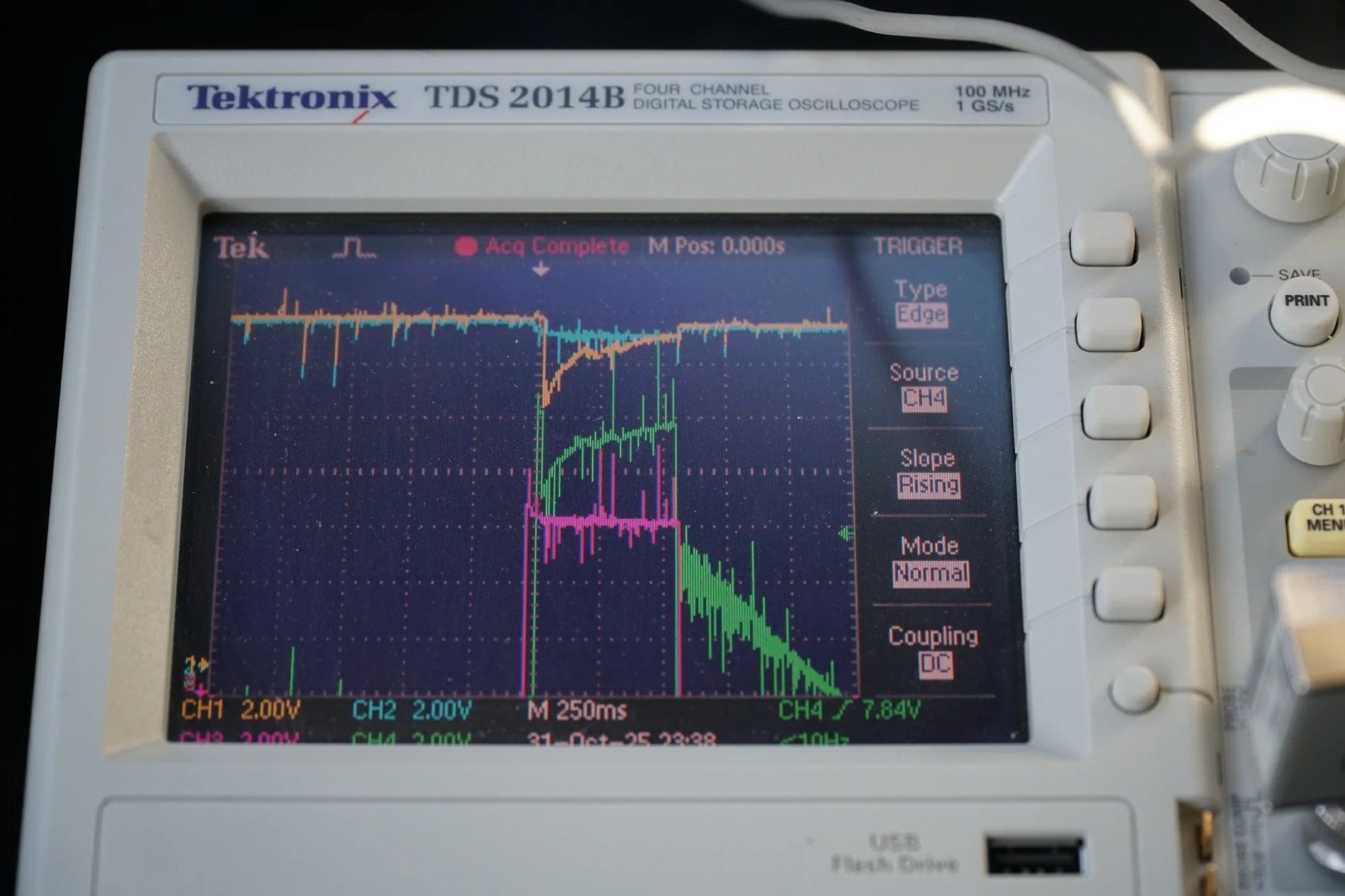
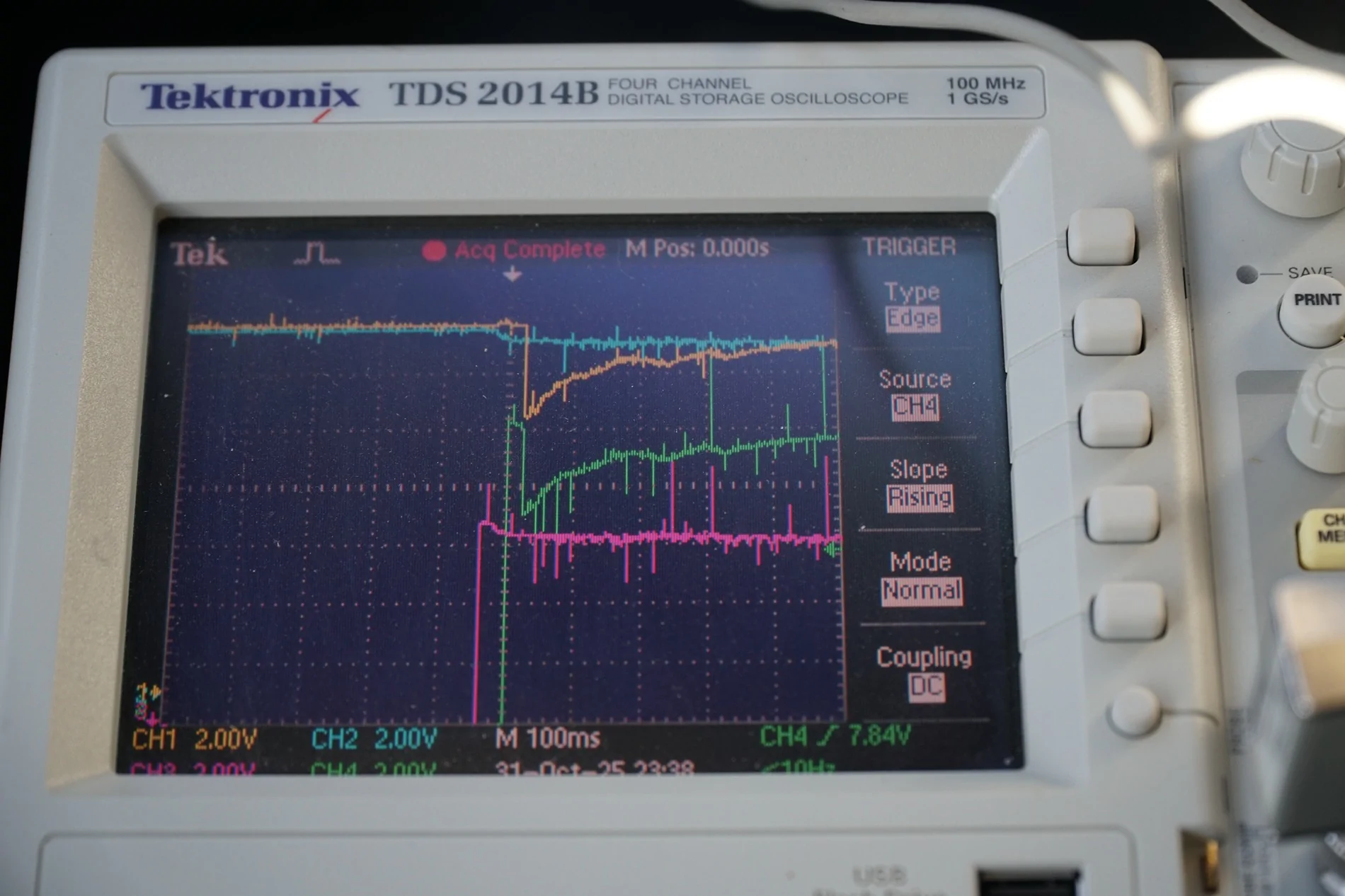
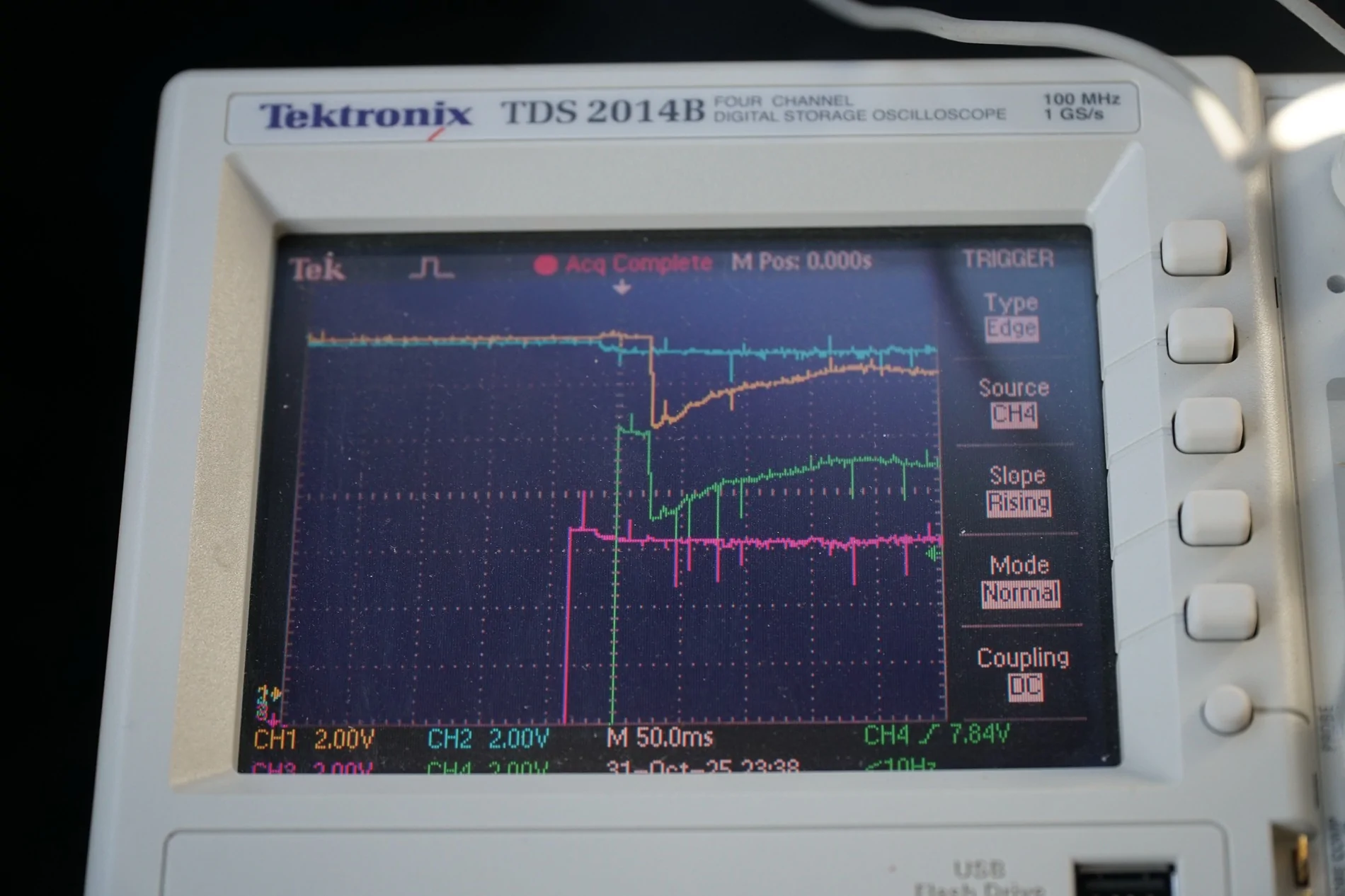
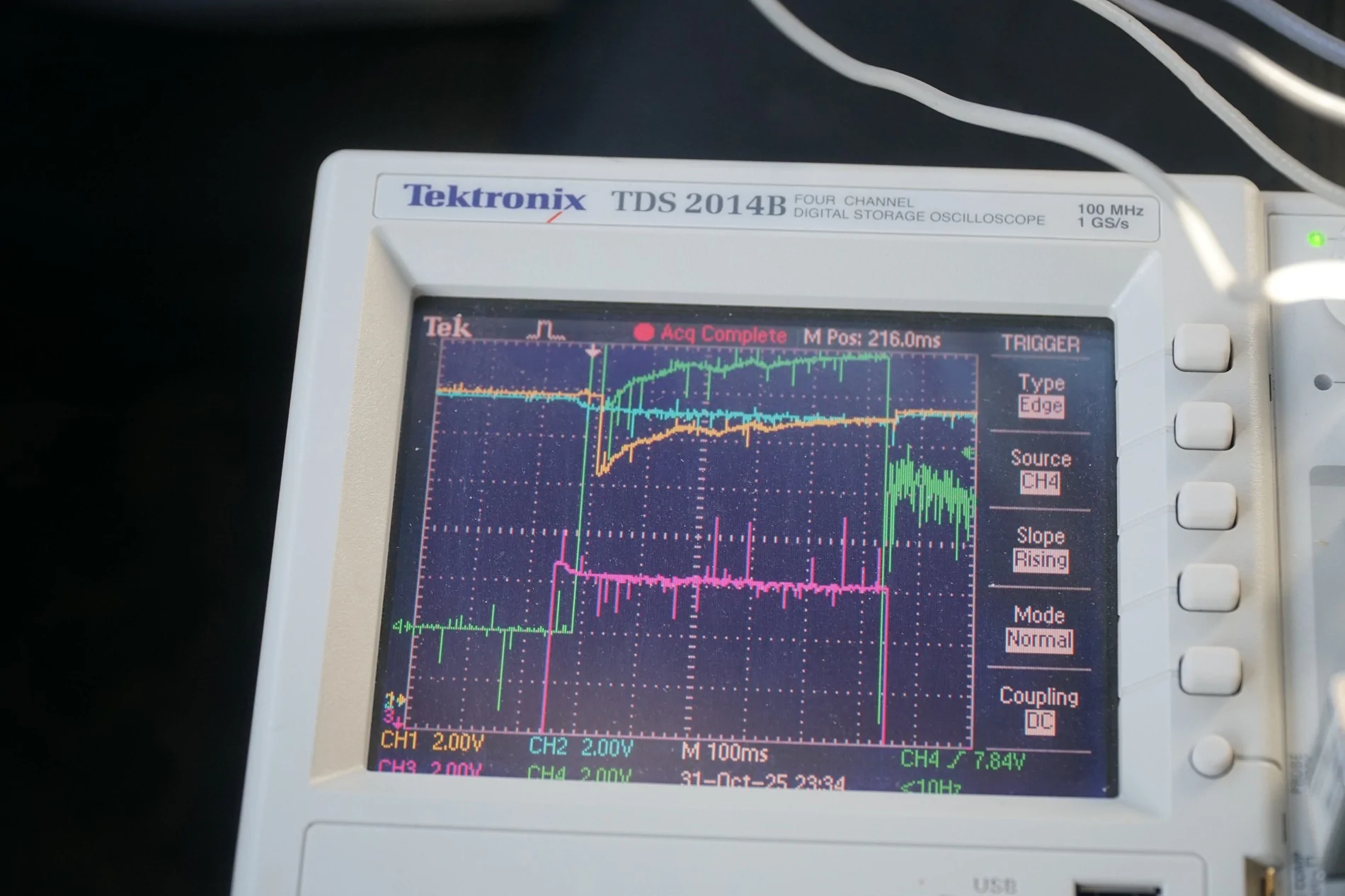
Good work, I nominate you for the Nobel peace prize of this thread. Where did you ground your probes, main battery negative or body?Ess hot start. Ignore the spikes they are from the inverter. The pcr and starter signals are moved down. Last image I moved green up.


J Sierra
Well-Known Member
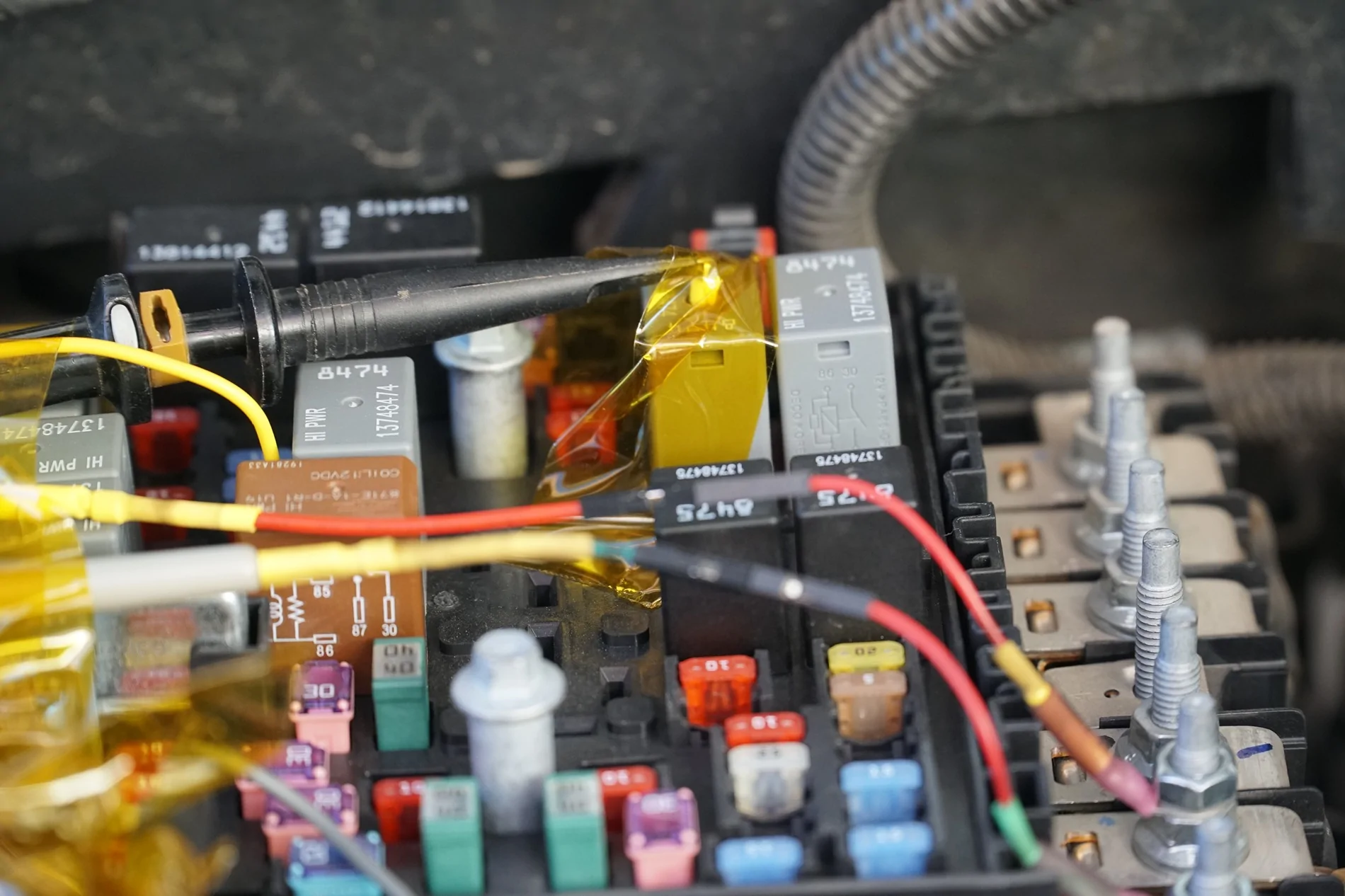
I made a relay with a test point, it is green trace. The probe is connected to the output of the stater relay. Trigger near 7.8V rise. The test point measures less than 1 ohm to GND. It is the coil of the starter solenoid. Main battery ground.
OP
OP

Flanders
Well-Known Member
- Thread starter
- #230
I agree with you 100%. This whole argument has been dumb. We've known what we needed to know for a year.Likely reality forced a change after that number was in print.
The point is, however, that it is closed during the ESS stop, opens for the starter sequence, and closes.
So now we're going to poo-poo the whole thing over the time it appears open?
We did get some new information from @J Sierra's efforts. Good stuff, IMO.
Sponsored
OP
OP
Flanders
Well-Known Member
- Thread starter
- #231
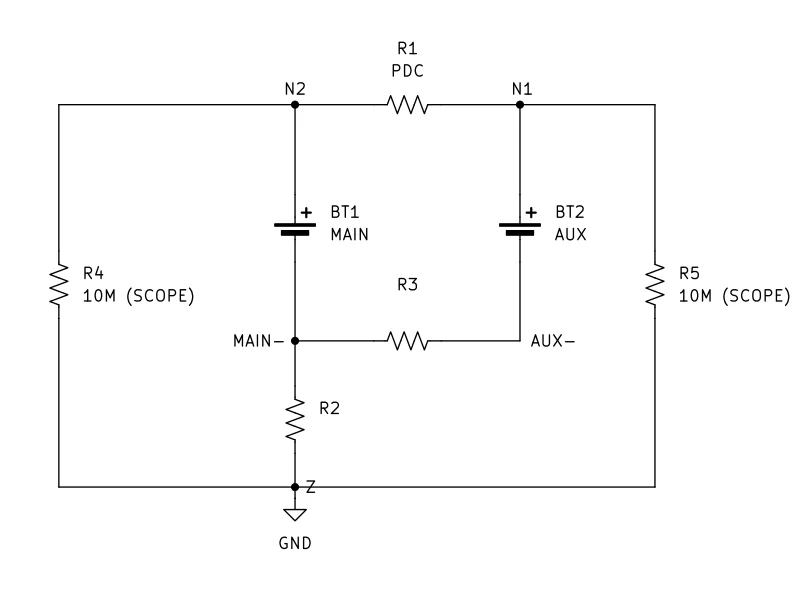
I wrote that almost a year ago. It would be a slam dunk to anyone with a basic understanding of circuits.The >2V difference between N1 and N2, persisting over 100ms, is pretty convincing evidence that the relay joining them is not closed during the ESS restart.
One does not simply declare 2V across a conductor. It takes a great deal of current to make that happen.
ShadowsPapa
Well-Known Member
- First Name
- Bill
- Joined
- Oct 12, 2019
- Threads
- 247
- Messages
- 40,442
- Reaction score
- 53,860
- Location
- Runnells, Iowa
- Vehicle(s)
- '25 JTMX, '23 JLU 4xe, '82 SX4, '73 Javelin
- Occupation
- Retired auto mechanic, frmr gov't ntwrk security admin
- Vehicle Showcase
- 3
It's a heavy winding, the solenoid on the starter itself taking a fair amount of power, and when power is cut, the collapsing magnetic field across the solenoid coils is going to generate some kickback current.The test point measures less than 1 ohm to GND. It is the coil of the starter solenoid.
I wish I had a 3.6 starter to play with here and get some real detailed info from it. I've got all of that for most other starters from the past, I suppose the 3.6 solenoid isn't too much unlike the 4.0 solenoid. I could measure the spikes from one of those.
ShadowsPapa
Well-Known Member
- First Name
- Bill
- Joined
- Oct 12, 2019
- Threads
- 247
- Messages
- 40,442
- Reaction score
- 53,860
- Location
- Runnells, Iowa
- Vehicle(s)
- '25 JTMX, '23 JLU 4xe, '82 SX4, '73 Javelin
- Occupation
- Retired auto mechanic, frmr gov't ntwrk security admin
- Vehicle Showcase
- 3
I wrote that almost a year ago. It would be a slam dunk to anyone with a basic understanding of circuits.
One does not simply declare 2V across a conductor. It takes a great deal of current to make that happen.

Has anyone ever wondered - why take the aux battery ground up to the top of the IBS on the main battery, THEN both over to the chassis ground instead of home-running the aux battery ground to the chassis?
Probably only people like me think about those things?


Andy29847
Well-Known Member
- First Name
- Andy
- Joined
- Oct 25, 2020
- Threads
- 14
- Messages
- 554
- Reaction score
- 934
- Location
- South Carolina
- Vehicle(s)
- 2020 Wrangler Rubicon, 2020 Gladiator Rubicon
- Occupation
- Retired
Youse guys that picture yourself as gurus, no more bickering or snarky comments (please). My view looking back through the thread is that everybody contributed and everybody wrote some things that turned out wrong.
Looking at J Serria’s (U Da Man!) recent scope tests, I would conclude that on an ESS start, the PCR is open as long as the starter is powered.
Shadowpapa wrote a list of things we now know (for sure). I’d like to add some stuff regarding the ESS system and deleting the aux battery. I’ll also ask the question we see over and over on Jeep forums; does the ESS not ready message mean the aux battery is bad.
It would be good if someone could condense the info here, include the conclusions, and post it as a sticky.
(more to come)
Looking at J Serria’s (U Da Man!) recent scope tests, I would conclude that on an ESS start, the PCR is open as long as the starter is powered.
Shadowpapa wrote a list of things we now know (for sure). I’d like to add some stuff regarding the ESS system and deleting the aux battery. I’ll also ask the question we see over and over on Jeep forums; does the ESS not ready message mean the aux battery is bad.
It would be good if someone could condense the info here, include the conclusions, and post it as a sticky.
(more to come)
OP
OP
Flanders
Well-Known Member
- Thread starter
- #235
I never thought to wonder. I might guess that a single ground connection makes it easy to break the circuit connecting the batteries and vehicle. Do you know something about it?Has anyone ever wondered - why take the aux battery ground up to the top of the IBS on the main battery, THEN both over to the chassis ground instead of home-running the aux battery ground to the chassis?
Probably only people like me think about those things?
Sponsored
ShadowsPapa
Well-Known Member
- First Name
- Bill
- Joined
- Oct 12, 2019
- Threads
- 247
- Messages
- 40,442
- Reaction score
- 53,860
- Location
- Runnells, Iowa
- Vehicle(s)
- '25 JTMX, '23 JLU 4xe, '82 SX4, '73 Javelin
- Occupation
- Retired auto mechanic, frmr gov't ntwrk security admin
- Vehicle Showcase
- 3
I have my hands on a CURRENT FCA document explaining ESS operation, IBS operation among may other things.
However, in exchange for obtaining it from my service advisor, I had to promise "not to publish it".
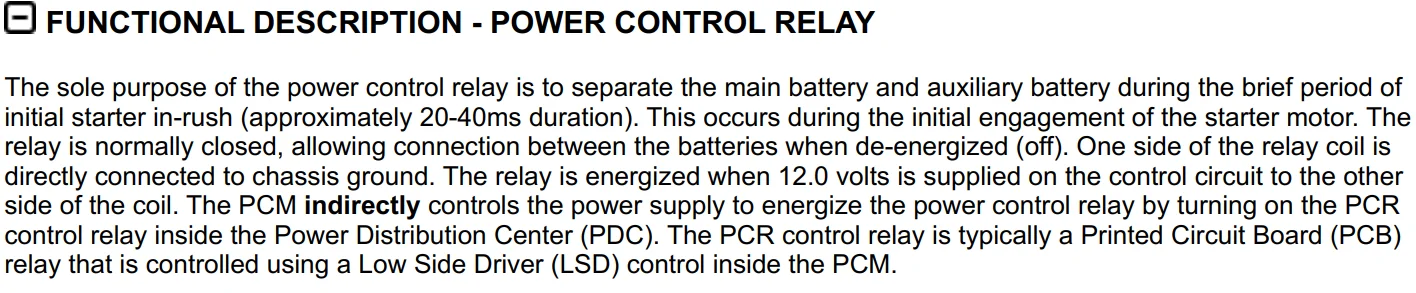
But some things of interest in it - and this is CURRENT as if this quarter, not something from a third party or dated back 6 years - I don't think a paragraph here and there about the description of a couple of things would be a bad thing -

There's a whole lot more in the document I'm reading through, including details on how the hood switches work which one is connected to which module and more.
I had that message on my 2022 now and then, but it was a new JT with good batteries.
What happened is that there was intermittent misfire. I never felt it, but the system did, and disabled the ESS. It was not available until a couple of start cycles later, and then started working again. That misfire was weird, sometimes I never felt it, it only triggered the MIL sometimes, other times not but it frequently disabled the ESS.
However, in exchange for obtaining it from my service advisor, I had to promise "not to publish it".
But some things of interest in it - and this is CURRENT as if this quarter, not something from a third party or dated back 6 years - I don't think a paragraph here and there about the description of a couple of things would be a bad thing -
There's a whole lot more in the document I'm reading through, including details on how the hood switches work which one is connected to which module and more.
"maybe"does the ESS not ready message mean the aux battery is bad.
I had that message on my 2022 now and then, but it was a new JT with good batteries.
What happened is that there was intermittent misfire. I never felt it, but the system did, and disabled the ESS. It was not available until a couple of start cycles later, and then started working again. That misfire was weird, sometimes I never felt it, it only triggered the MIL sometimes, other times not but it frequently disabled the ESS.
Last edited:
jebiruph
Well-Known Member
No, if the PCM detects the aux battery is bad it sets the PF00D, disables ESS and lights the error light. I brought this up here in post 159., https://www.jeepgladiatorforum.com/...-isolated-during-ess-stops.87524/post-1624343I’ll also ask the question we see over and over on Jeep forums; does the ESS not ready message mean the aux battery is bad.
ShadowsPapa
Well-Known Member
- First Name
- Bill
- Joined
- Oct 12, 2019
- Threads
- 247
- Messages
- 40,442
- Reaction score
- 53,860
- Location
- Runnells, Iowa
- Vehicle(s)
- '25 JTMX, '23 JLU 4xe, '82 SX4, '73 Javelin
- Occupation
- Retired auto mechanic, frmr gov't ntwrk security admin
- Vehicle Showcase
- 3
I feel really dumb, now. i should have nailed this right away but got caught up in the "bickering" over what a single example trace showed vs. what the documents state! Geesh, and this is so simple, it's stupid.... and remains open for at least 150ms, contrary to the service manual.
Edit: The trace in #224 shows it to be open for around 550ms.
The trace will show longer for some and shorter for others.
Why? Due to dozens of factors that contribute to the speed of the ESS engine start.
It hit me today at a stop light. I came up and the thing JUST STOPPED, and the light turned and I let up on the brake and I swear I barely heard the starter, a single revolution and it was running.
Depending on the AGE of your engine, the fuel, the engine temperature, the spark plug conditions, the battery voltage (will determine how FAST the engine cranks - mine really spins on fully charged batteries and that engine kicks in real fast) - it's going to take more or less time for the engine to reach the speed that tells the PCM that the engine is running, let go of the starter!
Let's say the pre-determined speed is 400 rpm (just a number, don't go setting it in stone!)
And it takes 4 revolutions of the engine for it to fire and catch on and hit 400 RPM.
Maybe mine takes only 3 revolutions, catches and is running much more quickly.
There are TWO starter relays! So, we have to take that into account as well as engine health and dozens of other factors - how fast will the starter spin it, how fast will the engine respond and how fast will it reach that set RPM where the PCM says hey, we have lift-off! Let go of the starter.......
So let's cut the "crap" being all concerned - but..........but..........but - it shows longer than the documents the documents must be WRONG!
Think about pre-TIP vehicles where you had to hold the key in crank position - do some start in a heartbeat while maybe the neighbor has the same vehicle and it takes twice as long?
Hmmmmm.

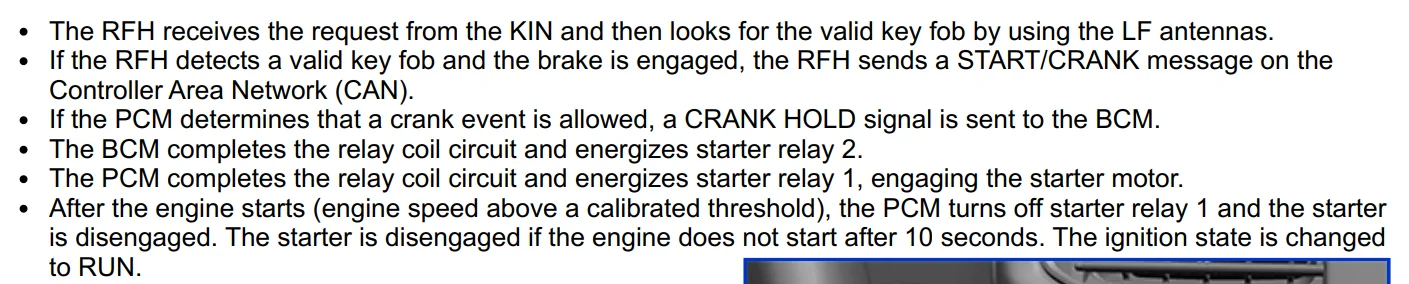
So, which of the two relays are these traces coming from? And will it matter? The relay only tells the solenoid GO, and that takes time to pull the starter drive out (or rather push it out) and kick in the main starter armature windings.
So maybe just accept that it works as described, regardless of how long a relay is actually closed or open because it appears to me, that may vary. It does work as described otherwise.
That's where that error light kicks in -" bad" "aux" battery......................... (or simply too low due to multiple possible causes.)No, if the PCM detects the aux battery is bad it sets the PF00D, disables ESS and lights the error light. I brought this up here in post 159., https://www.jeepgladiatorforum.com/...-isolated-during-ess-stops.87524/post-1624343
jebiruph
Well-Known Member
I guess we're going to keep at it. The issue of the common starter crank signal between the aux battery and the main battery indicating a connection between them had to be resolved, once I resolved that as the common ground wire, I agreed that the batteries were disconnected and there was never a need for any math.I wrote that almost a year ago. It would be a slam dunk to anyone with a basic understanding of circuits.
One does not simply declare 2V across a conductor. It takes a great deal of current to make that happen.
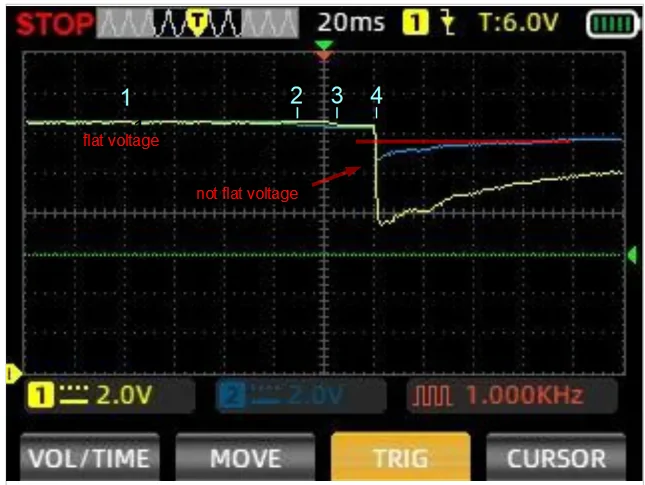
I also predicted that when the batteries were separated, the aux battery wave form should be flat due to the steady load of the electronics. With the probes grounded to the main battery and bypassing the common ground wire, I see I was correct about that also.
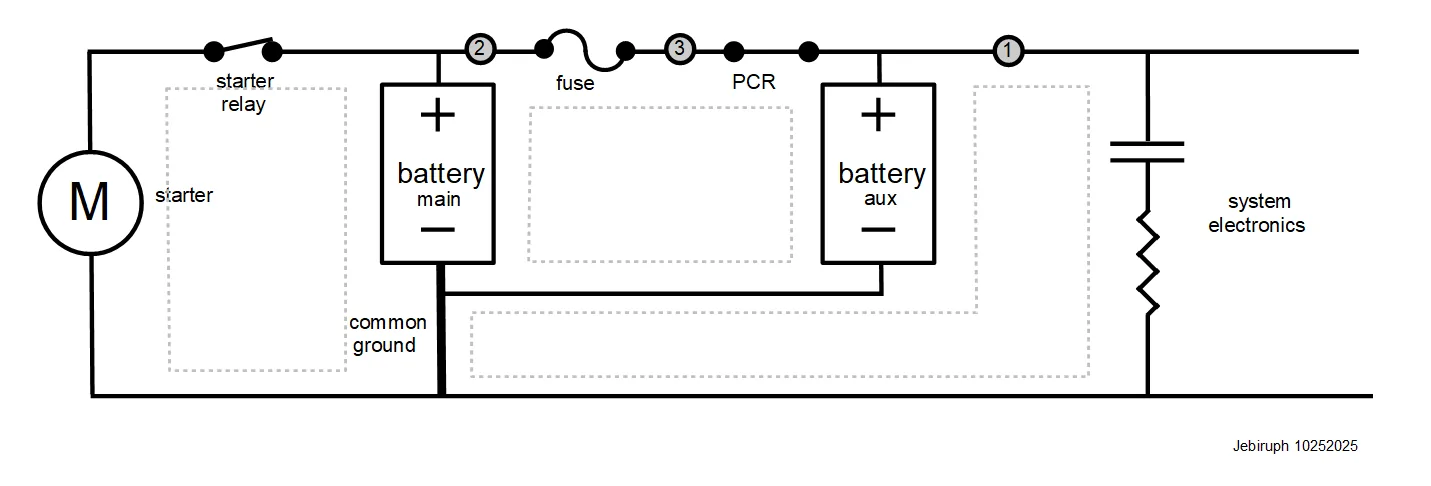
I see your diagram is over simplified and could lead to mis calculations, feel free to use mine in the future.
Andy29847
Well-Known Member
- First Name
- Andy
- Joined
- Oct 25, 2020
- Threads
- 14
- Messages
- 554
- Reaction score
- 934
- Location
- South Carolina
- Vehicle(s)
- 2020 Wrangler Rubicon, 2020 Gladiator Rubicon
- Occupation
- Retired
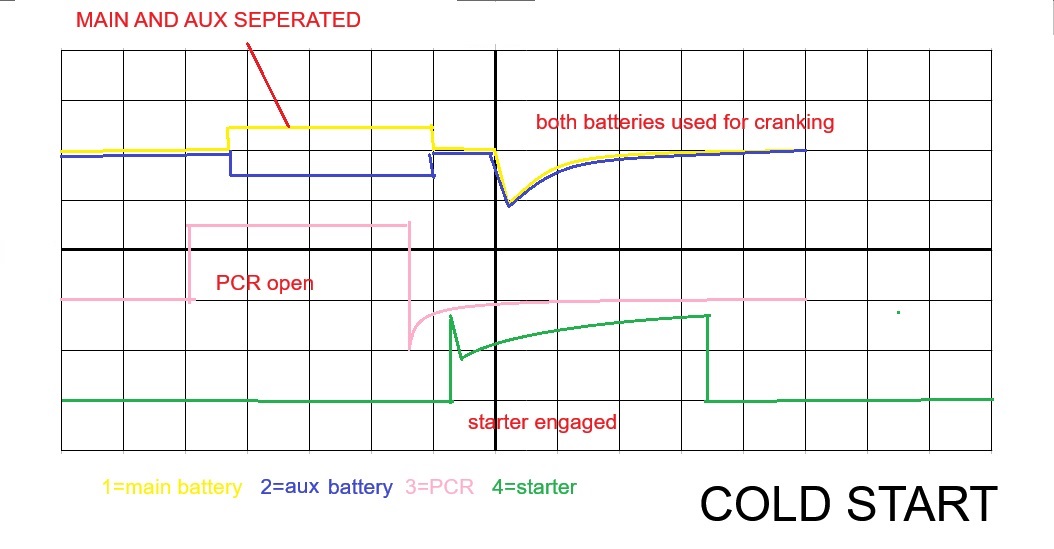
Late model Jeeps with batteries have 2 starting regimes. Let's call the first one "Cold Start." This does not mean that the engine (or weather) is cold.  For our purpose, a cold start is one where the vehicle ignition was in the "off" position when you start. When pressing the start button on a cold start, the first thing that happens is that the Power Control Relay separates the 2 batteries. This is for the purposes of testing the auxiliary battery to determine the suitably for a future ESS start. The relay rejoins the 2 batteries in a very short time (~40ms). Once rejoined, both batteries are used to start and run the Jeep.
Actual oscilloscope test for cold start:

Simplified illustration for a cold start:

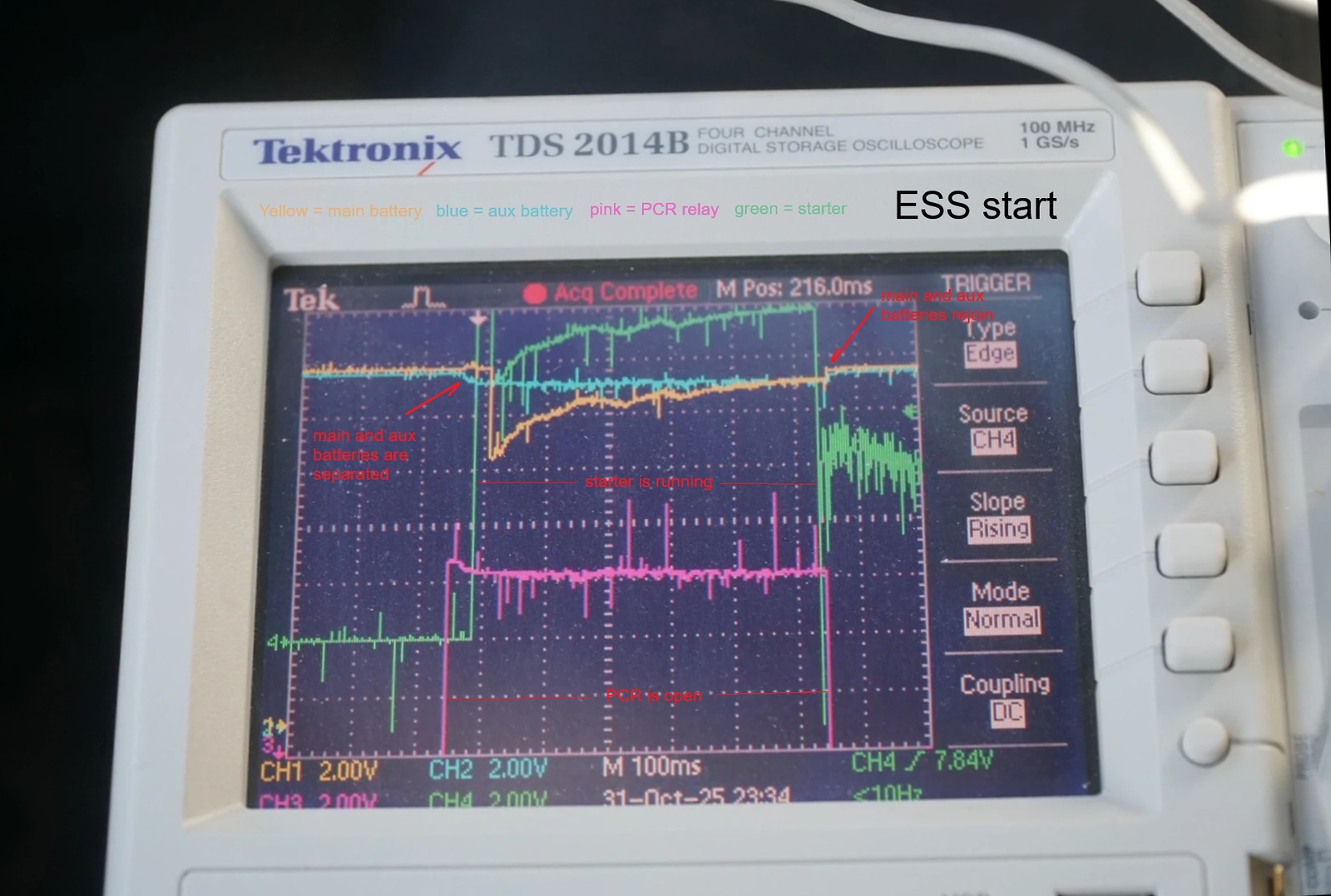
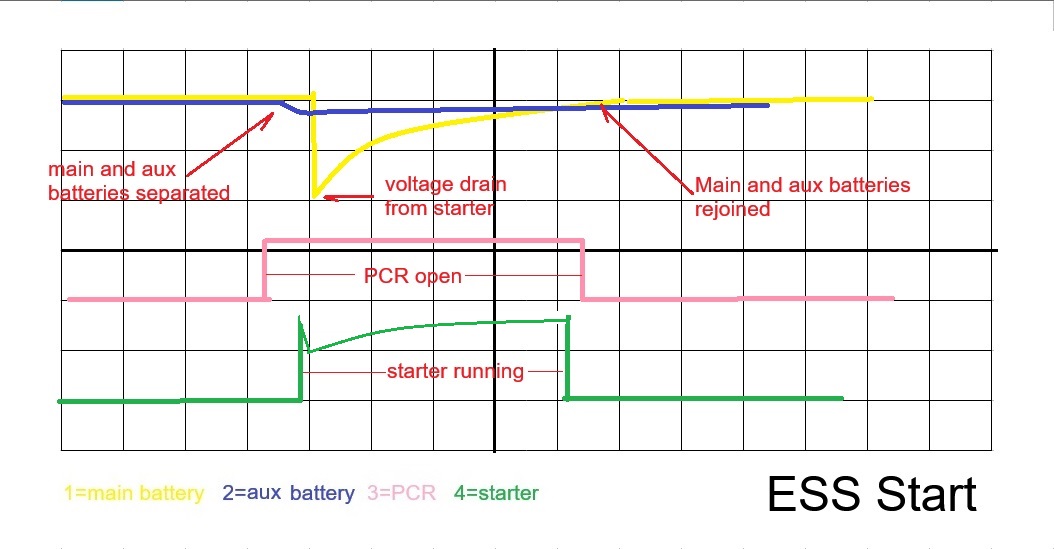
The second starting regime is an ESS start. The is where you are driving, you stop for a light, sign, or traffic, and the Jeep turns off (when you reach a full stop with the brake depressed). When you are ready to resume your drive, you let off the brake and the Jeep automatically restarts. When you make a stop with the ESS system turned on, and the engine shuts down, the 2 batteries remain connected together until you release the brake. Both batteries are keeping the vehicle electronics powered. When the brake is released, the Power Control Relay separates the batteries. When the batteries are separated, the auxiliary battery powers the vehicle electronics, keeping things like the radio and AC on while you wait. Next the starter is energized solely on the power of the main battery. The batteries remain separated until the engine is started, and the starter turns off. Once the starter turns off, the Power Control Relay rejoins the batteries.
Actual test for ESS start:

Simplified illustration for ESS Start test:
Revelations?
For the purpose of a cold start, the 2 batteries function as one.
In an ESS Start, the auxiliary battery powers the vehicle electronics while the main battery starts the engine. The time that the batteries are separated during an ESS Start is decided by the time it takes to start the Jeep.
If you are running your Jeep as delivered (with 2 batteries), and you get an ESS Stop/Start message or the infamous Avengers warning light, this might be your first signal that your batteries are nearing end of life.
If you are running your Jeep with the auxiliary battery removed, then you should disable ESS Stop/Start. The reason for this is that when you experience a low battery condition (old or discharged battery drawn down by the power needed to run the starter) you might get a Powertrain Control Module (PCM) reset and error code. You could also damage some of the sensitive electronic in the vehicle.
For our purpose, a cold start is one where the vehicle ignition was in the "off" position when you start. When pressing the start button on a cold start, the first thing that happens is that the Power Control Relay separates the 2 batteries. This is for the purposes of testing the auxiliary battery to determine the suitably for a future ESS start. The relay rejoins the 2 batteries in a very short time (~40ms). Once rejoined, both batteries are used to start and run the Jeep.Actual oscilloscope test for cold start:
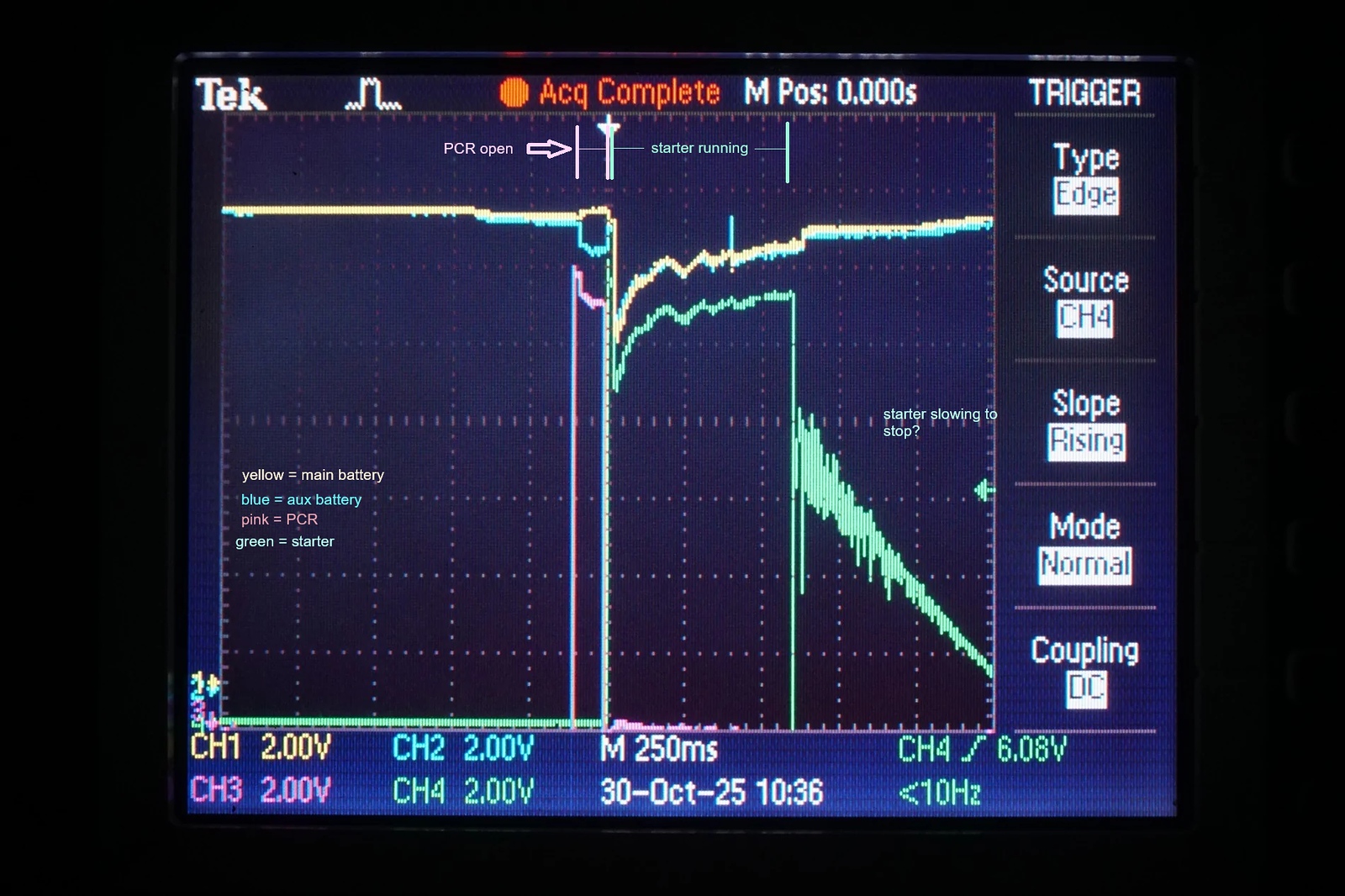
Simplified illustration for a cold start:
The second starting regime is an ESS start. The is where you are driving, you stop for a light, sign, or traffic, and the Jeep turns off (when you reach a full stop with the brake depressed). When you are ready to resume your drive, you let off the brake and the Jeep automatically restarts. When you make a stop with the ESS system turned on, and the engine shuts down, the 2 batteries remain connected together until you release the brake. Both batteries are keeping the vehicle electronics powered. When the brake is released, the Power Control Relay separates the batteries. When the batteries are separated, the auxiliary battery powers the vehicle electronics, keeping things like the radio and AC on while you wait. Next the starter is energized solely on the power of the main battery. The batteries remain separated until the engine is started, and the starter turns off. Once the starter turns off, the Power Control Relay rejoins the batteries.
Actual test for ESS start:
Simplified illustration for ESS Start test:
Revelations?
For the purpose of a cold start, the 2 batteries function as one.
In an ESS Start, the auxiliary battery powers the vehicle electronics while the main battery starts the engine. The time that the batteries are separated during an ESS Start is decided by the time it takes to start the Jeep.
If you are running your Jeep as delivered (with 2 batteries), and you get an ESS Stop/Start message or the infamous Avengers warning light, this might be your first signal that your batteries are nearing end of life.
If you are running your Jeep with the auxiliary battery removed, then you should disable ESS Stop/Start. The reason for this is that when you experience a low battery condition (old or discharged battery drawn down by the power needed to run the starter) you might get a Powertrain Control Module (PCM) reset and error code. You could also damage some of the sensitive electronic in the vehicle.
Sponsored
Last edited:
Similar threads


- Replies
- 13
- Views
- 4,672


- Replies
- 22
- Views
- 2,726

- Replies
- 43
- Views
- 5,607
