Sponsored

Trying to gather info to find commonality on "misfires"

ShadowsPapa

Well-Known Member
First Name
Bill
Joined
Oct 12, 2019
Threads
247
Messages
40,445
Reaction score
53,879
Location
Runnells, Iowa
Vehicle(s)
'25 JTMX, '23 JLU 4xe, '82 SX4, '73 Javelin
Occupation
Retired auto mechanic, frmr gov't ntwrk security admin
Vehicle Showcase
3
This is strictly for information gathering - wondering if ANY of the misfire cases have something in common.
Not all misfires or rough running will be the same causes, but some MAY share the same cause.

Of the engines with the mystery misfire, the MIL (malfunction indicator light) coming on, uneven running (and this only applies to the 3.6 with non-ignition related misfires) - has anyone here had to add coolant to their truck AT ALL, ever? For example, mine was manufactured November 2019. It has never been low on coolant and coolant has never been added.
~ It should not be required under normal conditions in a vehicle this new. ~

If you have added coolant, how much was required? (no matter how little or how much)
Have you added it more than once?

At this point it's only about coolant, nothing else.
Sponsored
 

Maximus Gladius

Well-Known Member
First Name
Kevin
Joined
Jan 30, 2021
Threads
74
Messages
2,908
Reaction score
3,704
Location
Calgary, AB, Canada
Vehicle(s)
2021 JTR, 2023 JTR
This is strictly for information gathering - wondering if ANY of the misfire cases have something in common.
Not all misfires or rough running will be the same causes, but some MAY share the same cause.

Of the engines with the mystery misfire, the MIL (malfunction indicator light) coming on, uneven running (and this only applies to the 3.6 with non-ignition related misfires) - has anyone here had to add coolant to their truck AT ALL, ever? For example, mine was manufactured November 2019. It has never been low on coolant and coolant has never been added.
~ It should not be required under normal conditions in a vehicle this new. ~

If you have added coolant, how much was required? (no matter how little or how much)
Have you added it more than once?

At this point it's only about coolant, nothing else.
Great thread! Ive had to add coolant AND my truck is in the shop second time now for a (PO302) #2 cylinder misfire. I bought my Gladiator R last February and I now have 16,500kms (10,252 miles) and in that time I’ve watched my coolant level drop to the MIN line when cold and had to fill back up to the MAX line 5 times already. That’s every 5500 kms I’d have to top it up. At first I thought there was an air lock and it needed to work itself out but I also have done 2 oil changes and 3 oil analysts to say I had glycol in the oil and was warned of a possible coolant leak and to watch for it.

I did my first oil change at 1000kms and oil analysts showed a “trace” of glycol in the oil. It made me think it was either contaminated oil at the factory OR I had a coolant leak. I drove to 10k and did my second oil change and analysis showed glycol again in the oil. I spoke with the lab tech and he said it’s not uncommon to see glycol in break-in oil (i didn’t press him to clarify) but he said it was possible I may have glycol contaminated break-in oil in solution and to wait for the 3rd analysis to know for sure what’s going on.

I then drove 6000kms and pulled a sample and took it to the lab. At this same moment in time my truck experienced its first CEL. (PO302, #2 cylinder misfire). Dropped off the oil sample at the lab and drove to my dealership for repair. Got it back the next day. They determined it to have a faulty injector, replaced it and gave it back.

I drove it 3 hours and it misfired again. Truck shaking, CEL flashing and dinging and they had me bring it back in the next day. I then received the lab results on the oil and the glycol numbers doubled since the last report.

I sent my 3 lab results to my service advisor, spoke to him and the shop manager and said Im 100% sure my misfire is a result of coolant pissing into #2 cylinder when I lean into the throttle, as that is when the CEL goes off. It’s not a faulty coil, plug, injector or cam shaft. It’s a faulty head gasket or cracked head but maybe a fouled up spark plug but everyone that I’ve read about that had service related to a misfire who had the heads removed for whatever part replaced, had to have a new gasket put on (coolant leak fixed) and no more misfires!

What puts me on top here with the service department is I have oil analysts reports that don’t lie. Both the service advisor and shop manager commented to me that they’ve never seen anyone in their time of employment do oil analysis and didn’t know why I would do that. I told them it’s a level of knowing the health of the engine or diffs or transmission or transfer case that you’d never otherwise know.

It’s like your Dr ordering a blood test. It will either prepare you for something coming or it tells you all is good.
 
OP
OP
ShadowsPapa

ShadowsPapa

Well-Known Member
First Name
Bill
Joined
Oct 12, 2019
Threads
247
Messages
40,445
Reaction score
53,879
Location
Runnells, Iowa
Vehicle(s)
'25 JTMX, '23 JLU 4xe, '82 SX4, '73 Javelin
Occupation
Retired auto mechanic, frmr gov't ntwrk security admin
Vehicle Showcase
3
It's amazing the amount of damage even a little glycol can do. Salts form, bearings blackened or darkened and aluminum eaten away, and grit balls form - causing things like lifters or phasers to lock up and cause wear surface damage.

I'm wondering if others with phaser and/or lifter issues also had to add any coolant at all.
I am beginning to strongly suspect that at least some have - but so far, no other responses.

Sodium present in an oil analysis means there's salts in the oil - likely glycol if any coolant has had to have been added.
Looking for that connection.
 

OldButStillJeeping

Well-Known Member
First Name
Eric
Joined
Apr 20, 2021
Threads
14
Messages
517
Reaction score
932
Location
Northwest Wisconsin
Vehicle(s)
2021 JTM, '92 Jeep YJ, 2017 F250 4WD, 1996 RAM D150 4x4, 2006 Jeep Liberty 4x4
Occupation
Tree farmer now. Retired first responder.
You two guys / gals are genius's. Great detective work!

I haven't had a misfire, (3,000 miles on my 2021 JT), but I'll be checking and monitoring my coolant level more closely.

Possibly help out all the 3.6 owners in any Jeep vehicle.
I don't know if head placement and torqueing is robotic or human in the factory. I'd bet it's human.

I hope Jeep is listening.

Some slacker may be out of a job. Easy enough to search VIN #'s and the auto worker 'on the line'.

Or it's a casting or machining flaw / crack.

Good work.
 

oldhp3

Well-Known Member
Joined
Jun 25, 2020
Threads
4
Messages
102
Reaction score
137
Location
Southern Illinois
Vehicle(s)
2021 Galdiator 80th Anniversary
Occupation
Retired
Heads are machine torqued. All at one time. You would so behind on production if Hoo-mans had to torque head bolts.
 

Sponsored

DAVECS1

Well-Known Member
First Name
David
Joined
Jan 24, 2020
Threads
56
Messages
1,861
Reaction score
2,538
Location
Peoria, IL
Vehicle(s)
2020 Gladiator Sport S Max Tow
There really is no good excuse for reoccurring glycol in the oil analysis. The plug on that cylinder should show it has been burning it.

I suppose there is one other way it could happen that is not entirely detrimental to the engine. We do have a cooled EGR heat exchanger. I suppose at upon acceleration you could be putting enough pressure into the exhaust to expose a leak in the cooler that the allows coolant to get in the exhaust stream.
 
OP
OP
ShadowsPapa

ShadowsPapa

Well-Known Member
First Name
Bill
Joined
Oct 12, 2019
Threads
247
Messages
40,445
Reaction score
53,879
Location
Runnells, Iowa
Vehicle(s)
'25 JTMX, '23 JLU 4xe, '82 SX4, '73 Javelin
Occupation
Retired auto mechanic, frmr gov't ntwrk security admin
Vehicle Showcase
3
There really is no good excuse for reoccurring glycol in the oil analysis. The plug on that cylinder should show it has been burning it.

I suppose there is one other way it could happen that is not entirely detrimental to the engine. We do have a cooled EGR heat exchanger. I suppose at upon acceleration you could be putting enough pressure into the exhaust to expose a leak in the cooler that the allows coolant to get in the exhaust stream.
Yes, it should show - but it sort of depends where and when the issue is - and it doesn't take much at all to form abrasives in the oil. And are dealers looking for that?

I'm not saying this IS THE cause but in at least 1, I'm betting it is. Oil analysis proves there's coolant contamination, coolant has been added, there was a misfire.
And in cases where phasers have stuck, lifters were replaced and so on - coolant contamination MAY cause that as well. The abrasives formed are tiny, but over time can also plug filters, oil passages and score parts.

So I'm looking at it this way -
*IF you have a misfire problem that's been hard to diagnose -
*Have you had to add coolant - at all. I don't mean every month, but at any time has it been low?
*Has an oil analysis been done? Look for silicon, sodium, glycol trace amounts. The first two should be almost non-existent in new oil. VERY low numbers.
Look for signs on the spark plugs - may not necessarily be obvious but still if it's getting into the combustion chamber, that plug should look different - perhaps even the plug in the adjacent cylinder.

Just looking for clues to see if this is happening to more than 1 or if it's an isolated case, especially since some people haven't found a solution while some have had heads removed, parts replaced and things were normal again. Hmmmmm.
 

Maximus Gladius

Well-Known Member
First Name
Kevin
Joined
Jan 30, 2021
Threads
74
Messages
2,908
Reaction score
3,704
Location
Calgary, AB, Canada
Vehicle(s)
2021 JTR, 2023 JTR
At the same period of time my 3rd oil sample was in on July 5, 2021; truck went in for second misfire repair July 8 with all 3 lab results to consider, I called FCA Canada, CASE #79937060, the file will show I discussed the lab results with two agents. The content of the call pointed out that the misfire problem is not an isolated one but that it is currently a 94 page discussion on jeepgladiator.com. My theory is that my coolant leak is causing the misfire and anyone else that had heads removed and stuff done had their misfires fixed with the head gasket replaced and coolant leak stopped. (Theory) I suggested the engineers need to be made aware and that there may be an assembly line problem with the torque specs on the heads. I also requested that they consider my fix would be to replace the engine as the coolant salts and Unburned gas has seeped down the rings and into the oil. They heard and thanked me for the information and said it’s all noted in my file. They want the service techs to have their time diagnosing the leak and misfire and have them determine the correct repair path. That was the discussion.

I should hear mid week as to what they’ve found and recommend for repairs.
 
OP
OP
ShadowsPapa

ShadowsPapa

Well-Known Member
First Name
Bill
Joined
Oct 12, 2019
Threads
247
Messages
40,445
Reaction score
53,879
Location
Runnells, Iowa
Vehicle(s)
'25 JTMX, '23 JLU 4xe, '82 SX4, '73 Javelin
Occupation
Retired auto mechanic, frmr gov't ntwrk security admin
Vehicle Showcase
3
At the same period of time my 3rd oil sample was in on July 5, 2021; truck went in for second misfire repair July 8 with all 3 lab results to consider, I called FCA Canada, CASE #79937060, the file will show I discussed the lab results with two agents. The content of the call pointed out that the misfire problem is not an isolated one but that it is currently a 94 page discussion on jeepgladiator.com. My theory is that my coolant leak is causing the misfire and anyone else that had heads removed and stuff done had their misfires fixed with the head gasket replaced and coolant leak stopped. (Theory) I suggested the engineers need to be made aware and that there may be an assembly line problem with the torque specs on the heads. I also requested that they consider my fix would be to replace the engine as the coolant salts and Unburned gas has seeped down the rings and into the oil. They heard and thanked me for the information and said it’s all noted in my file. They want the service techs to have their time diagnosing the leak and misfire and have them determine the correct repair path. That was the discussion.

I should hear mid week as to what they’ve found and recommend for repairs.
I have some photos I'll send you of damage caused by glycol in the oil. Granted, most are with higher levels but the point is - it DOES do damage.
It breaks down very quickly at temps of 200 and above and forms organic acids in the process that's why you look for the side effects and not necessarily the glycol itself - it may not show up by the time it gets to the lab. But the other compounds will.

This is a lot of speculation at this point - some educated guesses and perceptive reasoning, but it MAY explain some having lifters replaced, some having phasers cleaned or replaced, heads removed, etc. - if for example there's a head sealing issue, and some of this work is done, it could be that the act of replacing other parts actually solved the problem they didn't realize was there.
It's like when people tell me their charging system problems were solved by replacing the alternator. No, your ACT of replacing it solved the problem because you had a bad connection.
MAY be the case here - they remove heads, replace parts, put it back together and assume that replacing part xyz fixed it when it could have been the ACT of replacing the part that fixed it. OR, it could be those parts were damaged - and in the process the glycol issue was resolved, too.

Gathering information so there's nothing even close to concluded here - so far no one else has spoken up about exactly what was done, was it resolved, was coolant added at any point after purchase, was any oil analysis done, etc.

So this is just trying to get enough information.
 

OldButStillJeeping

Well-Known Member
First Name
Eric
Joined
Apr 20, 2021
Threads
14
Messages
517
Reaction score
932
Location
Northwest Wisconsin
Vehicle(s)
2021 JTM, '92 Jeep YJ, 2017 F250 4WD, 1996 RAM D150 4x4, 2006 Jeep Liberty 4x4
Occupation
Tree farmer now. Retired first responder.
Are these misfires, generally on the same bank or cylinder?
 

Sponsored

OP
OP
ShadowsPapa

ShadowsPapa

Well-Known Member
First Name
Bill
Joined
Oct 12, 2019
Threads
247
Messages
40,445
Reaction score
53,879
Location
Runnells, Iowa
Vehicle(s)
'25 JTMX, '23 JLU 4xe, '82 SX4, '73 Javelin
Occupation
Retired auto mechanic, frmr gov't ntwrk security admin
Vehicle Showcase
3
Are these misfires, generally on the same bank or cylinder?
Thanks, that's another thing I'd like to know.
Maybe I'll do a spreadsheet like I did for the trailer brake controller and other stuff.

I need info as far as:
is there a misfire,
what cylinder(s),
has the coolant level EVER dropped,
has an oil analysis every been performed,
If so, was sodium or silicon discovered in the oil? Any trace of glycol?

Here's something else to look for if sodium is found in the oil -

""When a sudden increase in sodium is observed, the analyst needs to be aware of other common sources. These include: salt and saltwater, grease, dirt, fly ash, sodium hydroxide, etc. For this reason, other members of the coolant additive family may be needed to confirm the contaminant is antifreeze, such as boron, potassium, silicon and phosphorous, bearing in mind that some of these elements may also be oil additives."

Limits and Alarms
Setting alarms and limits for glycol is difficult because of the different oil analysis instruments in use and the transient states of glycol in the lubricant. To the extent that the analyst can confirm a coolant leak, no matter how small, the matter is of serious concern.""
 
Last edited:

Maximus Gladius

Well-Known Member
First Name
Kevin
Joined
Jan 30, 2021
Threads
74
Messages
2,908
Reaction score
3,704
Location
Calgary, AB, Canada
Vehicle(s)
2021 JTR, 2023 JTR
Thanks, that's another thing I'd like to know.
Maybe I'll do a spreadsheet like I did for the trailer brake controller and other stuff.

I need info as far as:
is there a misfire,
what cylinder(s),
has the coolant level EVER dropped,
has an oil analysis every been performed,
If so, was sodium or silicon discovered in the oil? Any trace of glycol?

Here's something else to look for if sodium is found in the oil -

""When a sudden increase in sodium is observed, the analyst needs to be aware of other common sources. These include: salt and saltwater, grease, dirt, fly ash, sodium hydroxide, etc. For this reason, other members of the coolant additive family may be needed to confirm the contaminant is antifreeze, such as boron, potassium, silicon and phosphorous, bearing in mind that some of these elements may also be oil additives."

Limits and Alarms
Setting alarms and limits for glycol is difficult because of the different oil analysis instruments in use and the transient states of glycol in the lubricant. To the extent that the analyst can confirm a coolant leak, no matter how small, the matter is of serious concern.""
Also, at what MILAGE did the CEL go off. The info I’ve read suggests misfires have been showing up around the 1000 mile or so marker.
 

stew7710

Member
First Name
Chris
Joined
Jun 29, 2021
Threads
2
Messages
24
Reaction score
66
Location
Ashburn, VA
Vehicle(s)
2021 Gladiator Rubicon
May 2021 Build; Mojave 3.6, automatic
1,200 Miles

Not sure if mine is transmission programming related or engine related: During the first thousand miles, I have experienced a surging or slight 'bucking' sensation that seems like a misfire or the programming seems off.

Examples:
1. Sometimes simply rolling with no pedal input, at near idle RPMs through the neighborhood and there is a subtle bucking or pulsation like the transmission doesn't know what gear to be in.
2. Pulling through 3000-4500, partial throttle it feels like engine timing is fluctuating, something is misfiring or bad fuel type of pulsation sensations - not a smooth acceleration until higher RPMs.
3. 50% throttle, engine seems to struggle to rev, like it has constipation, gets to 4500 rpm and suddenly pops/snaps and comes alive - like something was constraining.

I've tried a different set of wheels and tires from an Overland, reducing unsprung weight by 125lbs. I think this may have amplified the sensations. I took it to the dealer, they thought the wheel tire setup may have been messing with the ECU but it's off by less than 1 mph when compared to Waze. They scanned for codes and did not find any. I put the Mojave stock wheels back on, drove 100 miles or so and its still randomly doing the issue.

Is there a data logging software that I could use to try and capture if its engine or transmission related?
 
Last edited:
OP
OP
ShadowsPapa

ShadowsPapa

Well-Known Member
First Name
Bill
Joined
Oct 12, 2019
Threads
247
Messages
40,445
Reaction score
53,879
Location
Runnells, Iowa
Vehicle(s)
'25 JTMX, '23 JLU 4xe, '82 SX4, '73 Javelin
Occupation
Retired auto mechanic, frmr gov't ntwrk security admin
Vehicle Showcase
3
May 2021 Build; Mojave 3.6, automatic
1,200 Miles

Not sure if mine is transmission programming related or engine related: During the first thousand miles, I have experienced a surging or slight 'bucking' sensation that seems like a misfire or the programming seems off.

Examples:
1. Sometimes simply rolling with no pedal input, at near idle RPMs through the neighborhood and there is a subtle bucking or pulsation like the transmission doesn't know what gear to be in.
2. Pulling through 3000-4500, partial throttle it feels like engine timing is fluctuating, something is misfiring or bad fuel type of pulsation sensations - not a smooth acceleration until higher RPMs.
3. 50% throttle, engine seems to struggle to rev, like it has constipation, gets to 4500 rpm and suddenly pops/snaps and comes alive - like something was constraining it and is alive.

I've tried a different set of wheels and tires from an Overland, reducing unsprung weight by 125lbs. I think this may have amplified the sensations. I took it to the dealer, they thought the wheel tire setup may have been messing with the ECU but it's off by less than 1 mph when compared to Waze. They scanned for codes and did not find any. I put the Mojave stock wheels back on, drove 100 miles or so and its still randomly doing the issue.

Is there a data logging software that I could use to try and capture if its engine or transmission related?
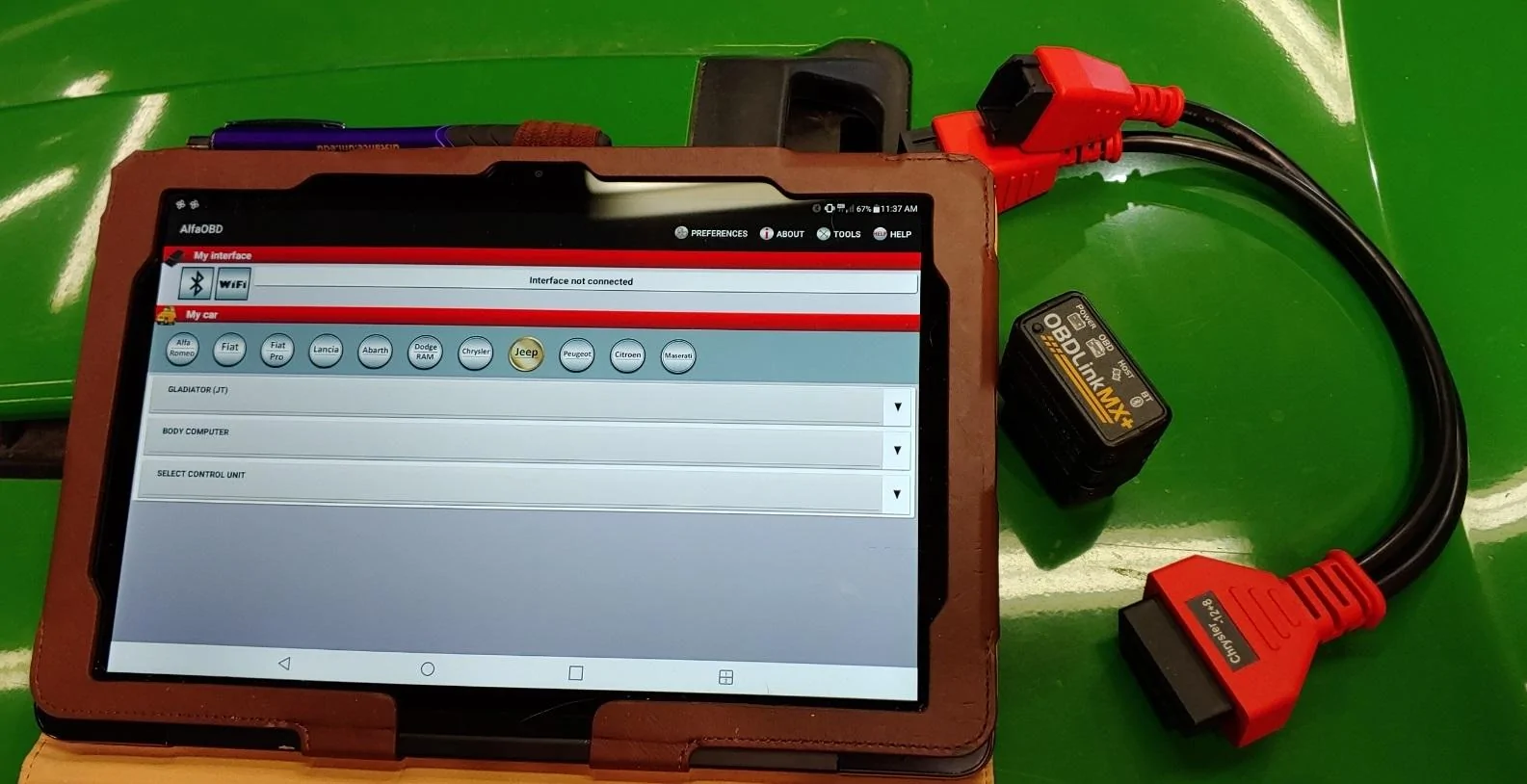
I used AlfaOBD along with my MX+ bluetooth adapter and captured the misfire with my wife's Jeep. Otherwise NO codes were saved, the light never came on. It simply bucked.

I "caught in the act" otherwise the dealer could have never seen it (it stopped by the time I got it there)
In her case I used the software on my phone, otherwise I also use it on my tablet for some things. That's the software, the cable and the bluetooth adapter I use.

Jeep Gladiator Trying to gather info to find commonality on "misfires" 20210110_113706


Example of the log I captured -

2021/01/04 11:56:32.011: Faults found: P0303
2021/01/04 11:56:35.970: Faults found: P0303
Error code: P0303
Cylinder 3 ignition failures
Test not complete
Error intermittent
Error warning lamp not requested
CARB Freeze Frame:
___________________
Fault code: P0303
PCM Mileage since MIL On: 0.00 miles
PCM Odometer: 950.27 miles
Open Loop - Bank 1: No
Closed Loop - Bank 1: Yes
Open Loop due to Driving Conditions - Bank 1: No
Open Loop with DTC - Bank 1: No
 

Kintama40

Well-Known Member
First Name
Todd
Joined
Nov 3, 2020
Threads
4
Messages
64
Reaction score
96
Location
Portland, OR
Vehicle(s)
2022 Jeep Gladiator Diesel
Occupation
Fleet Maintenance Manager
May 2021 Build; Mojave 3.6, automatic
1,200 Miles

Not sure if mine is transmission programming related or engine related: During the first thousand miles, I have experienced a surging or slight 'bucking' sensation that seems like a misfire or the programming seems off.

Examples:
1. Sometimes simply rolling with no pedal input, at near idle RPMs through the neighborhood and there is a subtle bucking or pulsation like the transmission doesn't know what gear to be in.
2. Pulling through 3000-4500, partial throttle it feels like engine timing is fluctuating, something is misfiring or bad fuel type of pulsation sensations - not a smooth acceleration until higher RPMs.
3. 50% throttle, engine seems to struggle to rev, like it has constipation, gets to 4500 rpm and suddenly pops/snaps and comes alive - like something was constraining.

I've tried a different set of wheels and tires from an Overland, reducing unsprung weight by 125lbs. I think this may have amplified the sensations. I took it to the dealer, they thought the wheel tire setup may have been messing with the ECU but it's off by less than 1 mph when compared to Waze. They scanned for codes and did not find any. I put the Mojave stock wheels back on, drove 100 miles or so and its still randomly doing the issue.

Is there a data logging software that I could use to try and capture if its engine or transmission related?

Mine was doing the same thing before it died. During acceleration there was a flat spot, like it wasn't getting any fuel. Once it got past a certain RPM it picked back up and took off. My engine was very noisy, had a knock on startup, and I also had a detonation problem that could be heard all of the time..Marbles in the motor.

At the time of my last oil change my coolant was low, I believe it took 1/2 a gallon to top off which I thought was strange. I had a ton of white smoke coming out of the tail pipe all of the time, hot or cold, and a lots of condensation also. I had taken it in for all of these things and was told by the dealer that it was normal. It obviously wasn't because now I am waiting on a new motor!
Sponsored


Top