
Sponsored

What have I done... (diagnosing severe wobble but not DW)

ShadowsPapa

Well-Known Member
First Name
Bill
Joined
Oct 12, 2019
Threads
247
Messages
40,491
Reaction score
53,989
Location
Runnells, Iowa
Vehicle(s)
'25 JTMX, '23 JLU 4xe, '82 SX4, '73 Javelin
Occupation
Retired auto mechanic, frmr gov't ntwrk security admin
Vehicle Showcase
3
You referring to the angle the bars/LCAs must be when torquing parts? Moment centers & roll centers?
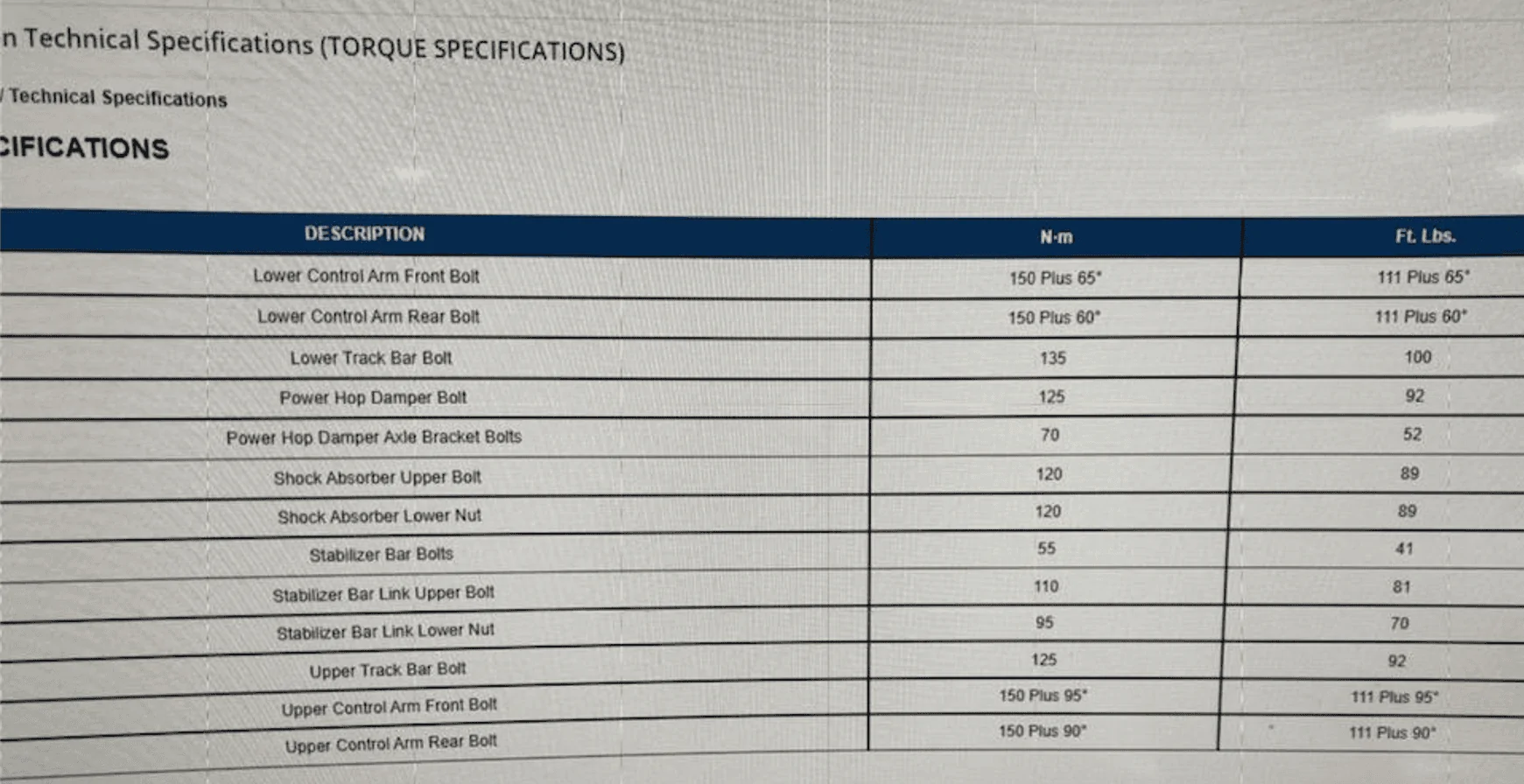
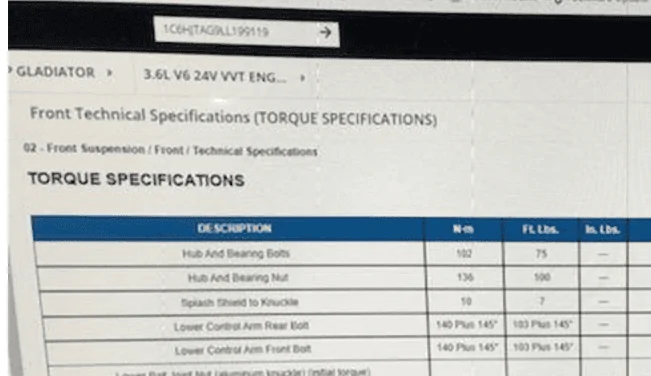
No, I'll give the example of the torque spec for the rear suspension upper control arm rear bolts - the spec is to torque to 111 ft/lb, then turn the bolt 90 degrees more.
It's a modern method the automakers have been moving to, especially critical when clamping force is the most important thing. They can get a much better idea of the force when done this way.

This snippet is right off the screen of a Jeep tech. I have the fronts but he used his phone to take a picture and it is really fuzzy. The rear turned out fine, or at least readable.....

TA is Torque plus Angle. Tighten to the spec for torque as usual, then the specified number of degrees more.

Jeep Gladiator What have I done... (diagnosing severe wobble but not DW) 1652293364816
Sponsored


ShadowsPapa

Well-Known Member
First Name
Bill
Joined
Oct 12, 2019
Threads
247
Messages
40,491
Reaction score
53,989
Location
Runnells, Iowa
Vehicle(s)
'25 JTMX, '23 JLU 4xe, '82 SX4, '73 Javelin
Occupation
Retired auto mechanic, frmr gov't ntwrk security admin
Vehicle Showcase
3
I tightened everything on the ground. I've worked on cars a long time and haven't heard of torgue plus angle. Hmm.
Excellent. Well, not everyone has even heard of tightening while on the ground, so one never knows.
I see the shadetree experts come into the FB groups complaining "I put new bushings and ball joints in and now my car sits too high in the front - must be bad parts".
 

ShadowsPapa

Well-Known Member
First Name
Bill
Joined
Oct 12, 2019
Threads
247
Messages
40,491
Reaction score
53,989
Location
Runnells, Iowa
Vehicle(s)
'25 JTMX, '23 JLU 4xe, '82 SX4, '73 Javelin
Occupation
Retired auto mechanic, frmr gov't ntwrk security admin
Vehicle Showcase
3
This is rear - I'm still trying to clean up the pictures of his screen he sent me of the front specs. I hate to ask him to do it again - I offered to pay but the manager said "no, I'll have my guy try to find time to get that for you" and I figured he'd do a screen shot or a print screen, not a photo on his phone LOL

By the way, I've had some argue "oh, then those are torque to yield bolts" - NO, they are not. This is not TTY, or TA yield.
This is what's happening in the automotive industry, among others, for more tightly controlled clamping forces.
TA or Torque + Angle is not torque to yield.

Jeep Gladiator What have I done... (diagnosing severe wobble but not DW) 1652293872228
 
OP
OP

Bonanza

Well-Known Member
Joined
Apr 22, 2020
Threads
41
Messages
829
Reaction score
1,317
Location
Southern CA
Vehicle(s)
Sport S Max Tow Punk'n
Excellent. Well, not everyone has even heard of tightening while on the ground, so one never knows.
I see the shadetree experts come into the FB groups complaining "I put new bushings and ball joints in and now my car sits too high in the front - must be bad parts".
Solid. Thank you for the discussion as well. While helping me, I'm sure the information will help others who search the forums. Regarding +angle, does that mean turn the bolt, without securing the nut? So just spinning the tightened bolt?
 

ShadowsPapa

Well-Known Member
First Name
Bill
Joined
Oct 12, 2019
Threads
247
Messages
40,491
Reaction score
53,989
Location
Runnells, Iowa
Vehicle(s)
'25 JTMX, '23 JLU 4xe, '82 SX4, '73 Javelin
Occupation
Retired auto mechanic, frmr gov't ntwrk security admin
Vehicle Showcase
3
Solid. Thank you for the discussion as well. While helping me, I'm sure the information will help others who search the forums. Regarding +angle, does that mean turn the bolt, without securing the nut? So just spinning the tightened bolt?
Prevent the nut from turning. Put a wrench on it if necessary.
Even numbers like 90 degrees is pretty easy - 1/4 of a turn.
I usually put a sharpie mark on the bolt (I'm easily distracted)
A hex head bolt has 6 sides, 360 degrees divided by 6 is 60 so turning the bolt so one "corner" is where another one was will get you 60 degrees.
So hold the nut from moving at all, and turn the bolt the specified number of degrees after the torque spec number without the nut moving.
Sometimes having 3 or 4 hands helps - or a kid or wife or neighbor or friend as these get pretty tight and trying to hold the nut can be tricky (if it wants to move - sometimes the nut doesn't argue with you)
 

Sponsored

OP
OP

Bonanza

Well-Known Member
Joined
Apr 22, 2020
Threads
41
Messages
829
Reaction score
1,317
Location
Southern CA
Vehicle(s)
Sport S Max Tow Punk'n
Prevent the nut from turning. Put a wrench on it if necessary.
Even numbers like 90 degrees is pretty easy - 1/4 of a turn.
I usually put a sharpie mark on the bolt (I'm easily distracted)
A hex head bolt has 6 sides, 360 degrees divided by 6 is 60 so turning the bolt so one "corner" is where another one was will get you 60 degrees.
So hold the nut from moving at all, and turn the bolt the specified number of degrees after the torque spec number without the nut moving.
Sometimes having 3 or 4 hands helps - or a kid or wife or neighbor or friend as these get pretty tight and trying to hold the nut can be tricky (if it wants to move - sometimes the nut doesn't argue with you)
Ok so it's torqued, "and then some", as it were. I wonder what is the technical difference between 111+90 and 150.
 

ShadowsPapa

Well-Known Member
First Name
Bill
Joined
Oct 12, 2019
Threads
247
Messages
40,491
Reaction score
53,989
Location
Runnells, Iowa
Vehicle(s)
'25 JTMX, '23 JLU 4xe, '82 SX4, '73 Javelin
Occupation
Retired auto mechanic, frmr gov't ntwrk security admin
Vehicle Showcase
3
Ok so it's torqued, "and then some", as it were. I wonder what is the technical difference between 111+90 and 150.
Torque by itself relies on many factors - friction of the threads as they mate, friction of the bolt head against the part which it is pressing against and so on.
Torque plus angle gives better control because as the torque increases, the frictions, thread mating, roughness, lubed or not, even the plating causes differences - zinc vs. black oxide, they torque very differently. So once you reach a point, these other factors play a bigger role. using the angle is more measuring the decrease in the distance between the surface of the nut and the surface of the bottom of the bolt head. You are measuring the squeeze factor, the force applied squeezing the parts together, not so much "how much force does it take to turn this bolt.
I can't tell you how it compares because with torque alone, we are only measuring the force needed to turn that bolt at that specific time under those circumstances and not really the force clamping the parts together.
Those specs are based on factory bolts with a known hardness and known thread pitch. The amount the bolt will or won't stretch is a known thing, the thread pitch is known so they know that if you turn that bolt half a turn you are pressing xx harder on the parts because the bolt will move yy based on the degrees turned.
In English terms - a screw with a 32 threads per inch pitch will turn in 1/32" of an inch for each turn of the screw. They know the same with these bolts. If it's a 1.0 pitch metric bolt, for each 180 degrees you turn it, it moves in .5mm One turn and the bolt moves in 1.0mm. Torque alone only tells you how much grunt you put into tightening it.
 

MPMB

Well-Known Member
First Name
Michael
Joined
Apr 30, 2021
Threads
12
Messages
1,820
Reaction score
2,716
Location
Utah
Vehicle(s)
'21 JTR - SG
Occupation
Check your inbox.
No, I'll give the example of the torque spec for the rear suspension upper control arm rear bolts - the spec is to torque to 111 ft/lb, then turn the bolt 90 degrees more.
It's a modern method the automakers have been moving to, especially critical when clamping force is the most important thing. They can get a much better idea of the force when done this way.

This snippet is right off the screen of a Jeep tech. I have the fronts but he used his phone to take a picture and it is really fuzzy. The rear turned out fine, or at least readable.....

TA is Torque plus Angle. Tighten to the spec for torque as usual, then the specified number of degrees more.

1652293364816.png
Ah. I remember things like this in racing. Torque to 35ft/lbs then add 1/4 turn.
 
OP
OP

Bonanza

Well-Known Member
Joined
Apr 22, 2020
Threads
41
Messages
829
Reaction score
1,317
Location
Southern CA
Vehicle(s)
Sport S Max Tow Punk'n
I'm adding all of the feedback to post #1 so it'll all be there.
 

ShadowsPapa

Well-Known Member
First Name
Bill
Joined
Oct 12, 2019
Threads
247
Messages
40,491
Reaction score
53,989
Location
Runnells, Iowa
Vehicle(s)
'25 JTMX, '23 JLU 4xe, '82 SX4, '73 Javelin
Occupation
Retired auto mechanic, frmr gov't ntwrk security admin
Vehicle Showcase
3
Ah. I remember things like this in racing. Torque to 35ft/lbs then add 1/4 turn.
Yeah, I've seen you post about having genuine experience with real racing. You cant survive that without a bit of science, math, and just plain knowing stuff.
My only "experiences", such as they are, are with straight lines - the quarter mile. (and not even close to a fraction of the depth of the real guys.)
 

Sponsored

OP
OP

Bonanza

Well-Known Member
Joined
Apr 22, 2020
Threads
41
Messages
829
Reaction score
1,317
Location
Southern CA
Vehicle(s)
Sport S Max Tow Punk'n
Update— I got the Jeep front end on jacks. Shaking tires at 12 and 6, nothing. Shaking 9-3, something… narrowed movement to drag link tie rod end at the pitman arm. I also felt internal movement in my LCAs.

I couldn’t feel anything from ball joints or in the knuckle. No knocking or movement in unit bearing. Tie rod, track bar, same- nothing out of the ordinary.

Pinion angle- 0.5 after zero’d angle finder. So my castor should be at 6ish.
 

j.o.y.ride

Well-Known Member
Joined
May 26, 2020
Threads
96
Messages
2,937
Reaction score
3,915
Location
Foster City
Vehicle(s)
20 Gladiator Overland
Torque by itself relies on many factors - friction of the threads as they mate, friction of the bolt head against the part which it is pressing against and so on.
Torque plus angle gives better control because as the torque increases, the frictions, thread mating, roughness, lubed or not, even the plating causes differences - zinc vs. black oxide, they torque very differently. So once you reach a point, these other factors play a bigger role. using the angle is more measuring the decrease in the distance between the surface of the nut and the surface of the bottom of the bolt head. You are measuring the squeeze factor, the force applied squeezing the parts together, not so much "how much force does it take to turn this bolt.
I can't tell you how it compares because with torque alone, we are only measuring the force needed to turn that bolt at that specific time under those circumstances and not really the force clamping the parts together.
Those specs are based on factory bolts with a known hardness and known thread pitch. The amount the bolt will or won't stretch is a known thing, the thread pitch is known so they know that if you turn that bolt half a turn you are pressing xx harder on the parts because the bolt will move yy based on the degrees turned.
In English terms - a screw with a 32 threads per inch pitch will turn in 1/32" of an inch for each turn of the screw. They know the same with these bolts. If it's a 1.0 pitch metric bolt, for each 180 degrees you turn it, it moves in .5mm One turn and the bolt moves in 1.0mm. Torque alone only tells you how much grunt you put into tightening it.
Sure. When you're building an airplane or rocket I get it. There's a buttload (technical term) of factors that go into final true clamping strength that needs to be adhered to.

But. These are Jeeps. And the bolts for *most* of the lift components (front LCA bolts come to mind as not) are reused from factory. So the type of bolt or nut isn't usually a variable. If it's not then figuring out that 110*90 is really about equal to 150 (or whatever it may be) and the 150 is easier to translate to people. So bet it.

And when you introduce a new type of bolt or nut in a kit, it still has the same variables of 'what type of bolt or nut is it' applied to the initial torque value. So the initial torque value being off and then adding degrees is still off. If your bolt doesn't torque to the initial specs the mfg put out, the 'plus X*' is no good either. And in that case, you're better off with net torque clamping value anyhow.
 

ShadowsPapa

Well-Known Member
First Name
Bill
Joined
Oct 12, 2019
Threads
247
Messages
40,491
Reaction score
53,989
Location
Runnells, Iowa
Vehicle(s)
'25 JTMX, '23 JLU 4xe, '82 SX4, '73 Javelin
Occupation
Retired auto mechanic, frmr gov't ntwrk security admin
Vehicle Showcase
3
Whatever it was you just said............

There's a reason that Jeep assembles these with TA.
Automotive factories have equipment that sets initial torque then turns to the correct angle. Jeep, GM, Ford and other use TA during factory assembly, then tell their technicians to do the same when doing service or repair.
When a good Jeep tech works on your truck's steering and suspension, he uses the specs I quoted.

I went to a dealership, spoke with the service manager (for a good 15 minutes) and said - if you were replacing control arms, shocks, track bar, or any other steering or suspension parts, what are the specs your employees would use in the shop.
And he had one of his guys send me images of the torque specs they use.

Another reason for TA is that if a bolt or nut is replaced, as long as it's the same pitch and the same class (please stop using "grade" - that's for English, with metric, it's "class" as in "class 10.9" Grade 8 is similar to metric class 10.9) if the bolt is the same pitch, same diameter and same class, then TA will be more accurate because as torque increases, the differences in the finish and fit of the bolt become more pronounced. And no, this is automotive, not rockets and airplanes. Manufacturers are using TA in important areas.

For the non-believers who say this is for bridges, jets and space rockets, this is from an automotive service site for automotive technicians - the guys in the shop:
Adhering to published torque (or torque-plus-angle) specifications is important for all installation or assembly tasks, but is especially critical for engine, transmission, steering, suspension and brake system applications.

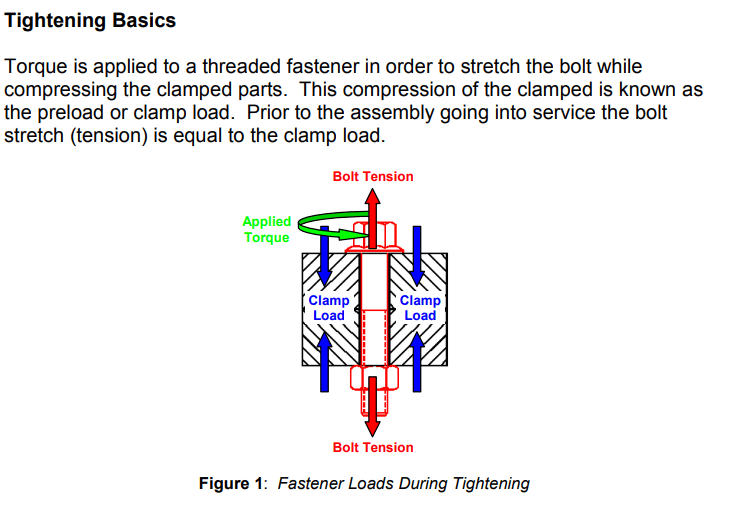
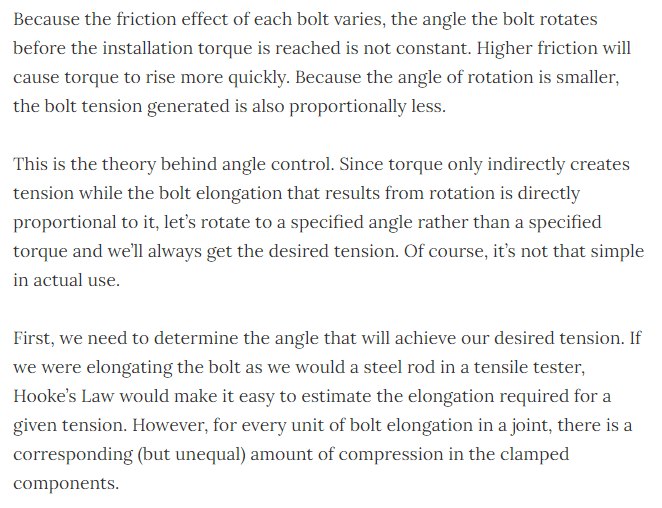
Torque alone does NOT give you an indication of bolt stretch or tension. Finish, thread contact areas, numbers of threads making contact, and other factors can mean you have reached the torque - but the bolt isn't stretched because friction stopped you. You can't accurately know the force holding those parts from moving based on torque alone because torque is resistance to turning. TA figures a starting point on torque, then moves to angle when those forces resisting turning the bolt further have increased to a certain point -


Jeep Gladiator What have I done... (diagnosing severe wobble but not DW) 1652361679732


This first paragraph alone should be a good reason to follow the TA specs -
Jeep Gladiator What have I done... (diagnosing severe wobble but not DW) 1652361998189


From another automotive site:
---
Since we’re going back to basics, let’s cover the basic purpose of a fastener. A bolt is used to hold two objects together. In automotive applications, there are often specifications for how tightly you want the two specific parts held together. Too tight and you risk damaging the parts or the fastener itself. Too loose, and there isn’t enough clamp load and the two parts can leak or shift under load.

The amount of clamp load (how much the fastener “squeezes” the two objects it’s joining) is determined by the fastener’s diameter, material, and how much the fastener is stretching. Since we can’t measure the actual stretch of a bolt (save for rod bolts, discussed in the linked article below) we need to find another way to measure bolt stretch.

For a lot of years, the automotive industry has used torque values to be that yardstick. The thought process being, by calculating the amount of resistance to rotation, it could be determined how much force was being exerted on the threads. While that is still a highly effective method of determining clamp load, there can be some drawbacks and inconsistencies with the method.

To explain how torque angle works, we need to work backward. Engineers first determine the desired clamp load for the items. Once they know that, they can run the numbers based on fastener size and material to determine the required bolt stretch to achieve that clamp load. From there, it’s simply a matter of taking the thread pitch of the fastener and determining how many degrees of rotation are required for the fastener to be stretched the desired amount.

While it seems complicated, the reality is that all of the big-brain calculations are done by the engineers of the application ahead of time. All you have to do is be able to accurately set the first-stage torque (which is usually relatively low, in order to be able to better withstand any variations in conditions) and then properly measure rotation from that point forward.

To accomplish that, there are tools at both ends of the price spectrum, ranging from home-made templates crafted with a protractor, marker, and paper, to inexpensive dial-gauges that fit between your ratchet and socket, all the way up to digital torque wrenches with built-in angle gauges.

Will we see torque angle measurements take over the automotive industry? Probably not any time soon. However torque angle specifications are becoming more and more prevalent, so understanding and knowing how to properly use them will be a valuable skill in your mental toolbox.
----

And finally, this is from General Motors - GM is using more and more TA specs on suspension and steering components as well as other areas. That's both at the factory during assembly, and for service specifications. Replace certain GM parts and there's a TA spec.
Anyway, this is from a GM Technical service bulletin (it's my hobby to read automotive tech stuff)
-----------------

Jeep Gladiator What have I done... (diagnosing severe wobble but not DW) 1652362787616


The following is information regarding the proper reading of torque specifications and the re-use of fasteners.
The desired result of tightening a fastener is to obtain a proper clamping force between the parts. The clamping force prevents loosening when the vehicle is in
use and external forces act on the clamped parts.
All fasteners have a specified torque. The method used for a particular application is determined by Engineering and specified in the Service Information. It is
necessary to apply the fastener torque to the specific fastener identified. Applying torque to the mating fastener can damage the fastener, mating components or
provide insufficient clamp load.
For example, when installing the adjust link on the 2014 Corvette rear suspension, the Service Information calls for tightening the adjust link nut to 70 N·m (52
lb. ft.), not the cam bolt.
There are three different methods for the specification of tightening fasteners: Torque (T), Torque Plus Angle (TA), and Torque Plus Angle to Yield (TAY).
Torque Plus Angle to Yield (TAY) is sometimes referred to Torque To Yield (TTY).
A fastener specification of Torque Plus Angle (TA) — for example, 30 N·m (22 lb. ft.) + 120 degrees — has more clamping force than a fastener specification of
Torque (T) — for example, 30 N·m (22 lb. ft). A fastener specification of Torque Plus Angle to Yield (TAY) has more clamping force than a fastener specification
of Torque Plus Angle (TA).

Torque (T)
A fastener with a Torque (T) specification can be tightened with a conventional torque wrench.
Tip: Generally, externally threaded fasteners (bolts, screws, studs) tightened to this specification method can be reused, unless otherwise specified in the Service Information.

Torque Plus Angle (TA)
A fastener with a Torque Plus Angle (TA) specification must be tightened first to the torque part of the specification and then must be tightened further by the addition of the specified angle. The angle must be applied relative to the mating fastener, if present, or relative to the mating surface. A backup wrench must be used, if required, to prevent the rotation of the mating fastener while the angle is added to the fastener with the Torque Plus Angle (TA) specification.
Tip: Generally, externally threaded fasteners tightened to this specification method can be reused, unless otherwise specified in the Service Information.

Reusing the Fastener
Think of an externally threaded fastener (bolt, screw or stud) as a spring. As a Torque (T) or Torque Plus Angle (TA) tightening specification is applied, the spring (externally threaded fastener) is stretched. With a Torque (T) or Torque Plus Angle (TA) tightening specification, the spring returns to its original length (elastically stretched) when loosened. In the case of a Torque Plus Angle to Yield (TAY) tightening specification, the spring is overstretched (plastically
deformed) and does not return to its original length. For this reason, the Torque Plus Angle to Yield (TAY) tightening specification requires the externally threaded fastener to ALWAYS be replaced.

Why is GM talking of this if it's not being used in automotive applications and they don't deem it important?
I want to avoid shimmy, wobble, shake, vibrations, etc. so I will torque the bolts on my truck according to the specifications in the service manuals and service bulletins.
Others can do whatever.
It's hard to imagine a company like FCA or GM investing millions in new equipment, new engineering and publishing new specs if there wasn't some reasoning.
Clamping force is what is keeping your control arms from moving around, not bolt torque.
Jeep says torque plus angle. Argue with them, not me, then don't complain if there's a shake or vibration.
----------
I was posting the correct torque specs from the Jeep service manuals to help Jeep people. To discourage someone diagnosing issues from using published proper specs is a bit, well...........

Jeep Gladiator What have I done... (diagnosing severe wobble but not DW) 1652362909782
 
OP
OP

Bonanza

Well-Known Member
Joined
Apr 22, 2020
Threads
41
Messages
829
Reaction score
1,317
Location
Southern CA
Vehicle(s)
Sport S Max Tow Punk'n
@ShadowsPapa good read. I appreciate learning new stuff, thank you for that.

On my quest to learn more, why is it that every bolt isn't TA? Like, lug nuts for instance?
 

ShadowsPapa

Well-Known Member
First Name
Bill
Joined
Oct 12, 2019
Threads
247
Messages
40,491
Reaction score
53,989
Location
Runnells, Iowa
Vehicle(s)
'25 JTMX, '23 JLU 4xe, '82 SX4, '73 Javelin
Occupation
Retired auto mechanic, frmr gov't ntwrk security admin
Vehicle Showcase
3
@ShadowsPapa good read. I appreciate learning new stuff, thank you for that.

On my quest to learn more, why is it that every bolt isn't TA? Like, lug nuts for instance?
Since I was a kid, I spend more time in tech books, parts manuals, service bulletins, whatever. My parents encouraged it. I don't read novels generally speaking - unless it's Asimov. My book shelves are loaded with plans for making things, libraries of service manuals (not the generic Chiltons). I get bored extremely easily and cant shut down in the evening so fill my time with reading and research.

In some cases there's just not the bolt length to stretch and put under tension. And with tapered lug nuts, you have more grip anyway. That taper is strong. Tapers are used for ball joints, tie rods, props on boats, and for decades, held the hubs on rear axles.
I guess AMC did a sort of similar thing on their differentials - on new assemblies the axle was to protrude through the hub a specific amount. If it didn't, you used the nut on the axle and greased washers to pull it through until you got there. I think it was something like 11/32". Then you took the nut off, wiped everything down, removed all grease, and torqued the nut back on to 250 ft/lb. The nut held the hub onto the axle in a pressure or tension situation, the hub was in a sense stretched onto the axle because of the taper. If done properly they'd handle a heck of a lot of power and torque.
Anyway, in the case of lug nuts, you just don't have a lot of bolt length, and the taper is there. The stresses are also a lot different.

I had three different career paths to choose from. I wanted to be a mechanic from the time I was 12 or so. My parents encouraged me. I got to HS and skipped the first two of the three classes. My teacher suggested I go into teaching automotive, but changed his mind after a while and groomed me for a future troubleshooting and repairing. I got to college, similar thing - I was told I could do either, things were wide open. Then I get a job in a shop right out of college by showing the service manager what was wrong with a Ford he had been working on. He was hot and frustrated. I read the scope, told him what I thought, he followed up and it was fixed. He said I started the following Monday.
After a year I got a call from the general manager of the local AMC/Jeep dealership offering me the job of service manager. I turned him down (I REALLY liked my boss then)
Some days I do wonder -what if I'd gone another way, gotten a degree, and taught, or what if I'd told that Jeep dealership yes?
I love learning, discovering, figuring things out.
The day I learn nothing new I'll be buried in the back yard by the oak tree, next to the cats.......maybe finally that tree will start growing a bit.
Sponsored


Top