Sponsored

Are the batteries really isolated during ESS stops?

Deleted member 57233

Unless the PCM is multiprocessor/multi threaded, it would trigger the associated relays one at a time.
1760754854942-u4.webp
The PCM doesn't use multi-threading, but it is a multi-core processor, using each core for a single process simultaneously.
Sponsored

 
OP
OP
Flanders

Flanders

Well-Known Member
Joined
Dec 2, 2023
Threads
11
Messages
152
Reaction score
121
Location
Dyer, NV
Vehicle(s)
2023 JT
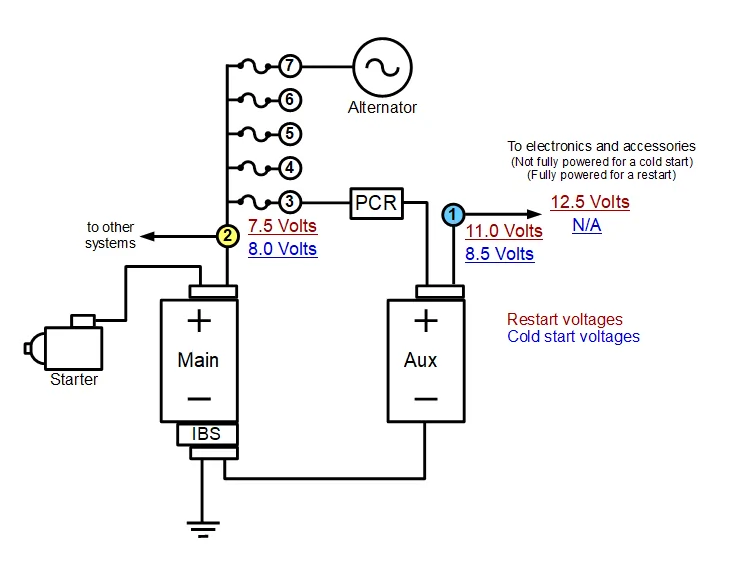
The characteristics of the system change between the cold start and the restart. The powered electronics act as an additional voltage source that can account for the voltage difference on the restart. How do you account for the similarity in the shape of the wave form if the circuits are separated?
When the PCR opens, the load on the AUX increases by a factor of about 7.

Do you understand that?

How do you account for the batteries being separated at the same instant in time as the starter is cranked? There should be some indication of the two different events on the oscilloscope image. Unless the PCM is multiprocessor/multi threaded, it would trigger the associated relays one at a time. I see the battery voltage is different between 2 and 3, identical from 3 to 4 and then the starter cranks. That would correspond to disconnected, connected and starter cranked.
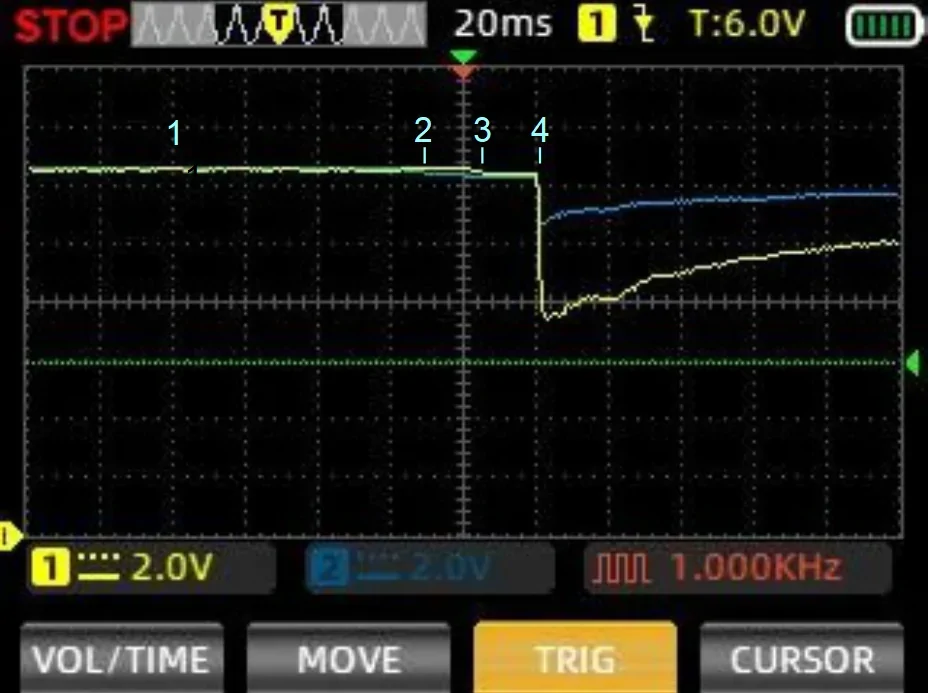
One pixel on that trace is about 2ms. The PCM could open and close hundreds of relays in 2ms.

Also, isolation between channels on the cheap scope is poor.
 
OP
OP
Flanders

Flanders

Well-Known Member
Joined
Dec 2, 2023
Threads
11
Messages
152
Reaction score
121
Location
Dyer, NV
Vehicle(s)
2023 JT
Also, this might be the dumbest statement I've read on this forum.

The powered electronics act as an additional voltage source that can account for the voltage difference on the restart.
 
OP
OP
Flanders

Flanders

Well-Known Member
Joined
Dec 2, 2023
Threads
11
Messages
152
Reaction score
121
Location
Dyer, NV
Vehicle(s)
2023 JT
The trace shows N1 is 4V higher than N2 when cranking after an ESS stop. If the two are connected through the closed PCR, a current must flow from one to the other. Ohm's law tells us how much:

V = IR, with

V = 4V
R ~ 7.5milliohms*

and thus

I = 4 / 0.0075 = 533A.

It would take roughly 500A flowing from the AUX to get that voltage drop. Do you think the AUX can supply that kind of current and remain above 10V?

*This was a rough estimate from the first post in this thread. I left off the milli prefix the first time.
 

jebiruph

Well-Known Member
First Name
Jerry
Joined
Dec 9, 2018
Threads
15
Messages
806
Reaction score
730
Location
IA
Vehicle(s)
2018 Wrangler JL 2024 Grand Cherokee L WL 2020 Gladiator JT
Consider these points.

Jeep Gladiator Are the batteries really isolated during ESS stops? 1760803421674-er

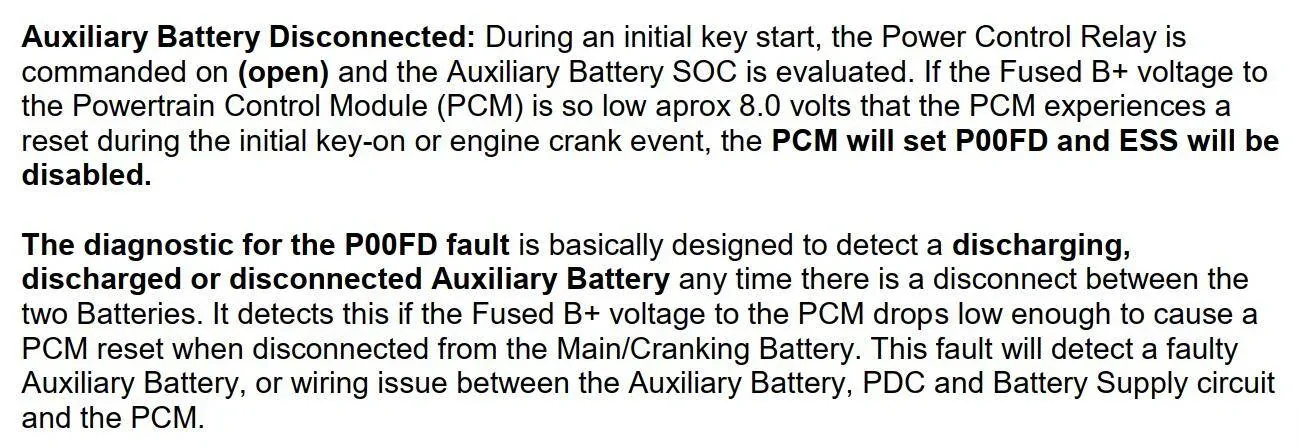
This text states that before every key start, the system is tested to see if the aux battery can power the PCM after the batteries are separated. If the aux battery can't power the PCM, ESS is disabled. This testing validates that the batteries are separated during an ESS event.


This post from 2 years ago https://www.jlwranglerforums.com/fo...lown-replaced-blown-again.117638/post-2449773 This relates to the N3 fuse getting blown just from an ESS event occurring. The only thing that happens during an ESS event that draws enough current to blow a 150A fuse is cranking the starter and the batteries would have to be connected when the starter is cranked to blow the fuse.

The oscilloscope image confirms that the batteries are connected during a restart. If the Aux battery was only powering the electronics during the restart, it would show a constant voltage related to the constant load of the electronics.

The post also shows that a substantial electrical charge still exists within the system electronics connected to the aux battery when the batteries are separated during an ESS event. This electrical charge is responsible for the difference in the voltage reading between the aux battery and main battery during the ESS restart.
 

Sponsored

jebiruph

Well-Known Member
First Name
Jerry
Joined
Dec 9, 2018
Threads
15
Messages
806
Reaction score
730
Location
IA
Vehicle(s)
2018 Wrangler JL 2024 Grand Cherokee L WL 2020 Gladiator JT
The trace shows N1 is 4V higher than N2 when cranking after an ESS stop. If the two are connected through the closed PCR, a current must flow from one to the other. Ohm's law tells us how much:

V = IR, with

V = 4V
R ~ 7.5milliohms*

and thus

I = 4 / 0.0075 = 533A.

It would take roughly 500A flowing from the AUX to get that voltage drop. Do you think the AUX can supply that kind of current and remain above 10V?

*This was a rough estimate from the first post in this thread. I left off the milli prefix the first time.
That explanation isn't valid because your voltage reading is taken from between the electronics and the aux battery and can't be used to calculate the current from the aux battery to the starter. Your calculation doesn't take account of the multiple voltage sources.

Jeep Gladiator Are the batteries really isolated during ESS stops? ess voltages


I'm perfectly willing to be proved wrong. I agree that the similar voltages during an ESS event are curious, but I'm not willing to ignore the evidence to the contrary just yet.
 

ShadowsPapa

Well-Known Member
First Name
Bill
Joined
Oct 12, 2019
Threads
247
Messages
40,442
Reaction score
53,859
Location
Runnells, Iowa
Vehicle(s)
'25 JTMX, '23 JLU 4xe, '82 SX4, '73 Javelin
Occupation
Retired auto mechanic, frmr gov't ntwrk security admin
Vehicle Showcase
3
When the PCR opens, the load on the AUX increases by a factor of about 7.
When closed they handle the total load as a parallel pair.
When the PCR opens, the aux battery handles the total of all modules, PCM, BCM, TCM, which includes lighting, HVAC, heated seats and wheel, electric sway bar module, wipers.......
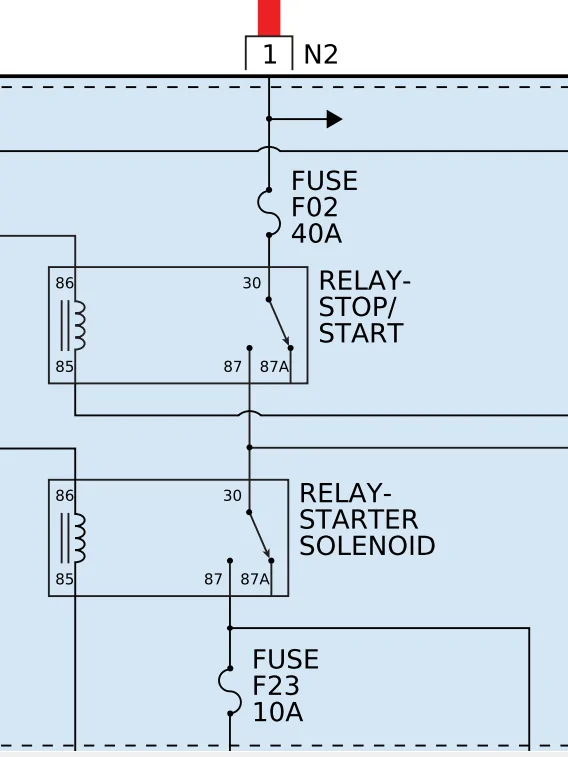
The main battery handles only the starting circuits - the starter, the relays involved in the startup process, cooling fan, EHPS.

The schematics are pretty clear on what is connected to which.
Jeep Gladiator Are the batteries really isolated during ESS stops? 1760806449510-1x


The oscilloscope image confirms that the batteries are connected during a restart. If the Aux battery was only powering the electronics during the restart, it would show a constant voltage related to the constant load of the electronics.
I disagree - both batteries are powering things while it's stopped. It makes sense the voltage of the aux battery would drop during a restart because suddenly, it has lost the larger partner in the load handling. Once the PCR opens the aux battery must handle a very large load all by itself instead of sharing the load with the main battery, which is much larger capacity.
It should drop, quickly, like a rock, once the PCR opens as it's now all alone in powering the entire vehicle. It can't show a constant voltage.

You can test that by putting two batteries together, small battery and a larger one. Place a volt meter on the leads to the smaller battery then take the other battery away and watch the voltage jump down as it suddenly has to handle the whole load by itself.

Makes perfect sense that the aux battery drops fast once that PCR opens as the whole load of the truck has shifted to that one, smaller battery.

The only thing that happens during an ESS event that draws enough current to blow a 150A fuse is cranking the starter and the batteries would have to be connected when the starter is cranked to blow the fuse.
Reconnecting the batteries together can blow that fuse - if the aux battery voltage drops enough during that short disconnect. We've seen it where people replace a batter, maybe both, and they are at uneven state of charge, or uneven voltage. There's a big ZAP when the connections are made. No, they didn't touch something to ground or that they should not have, it was the inrush of current from the main battery to the aux battery.

This text states that before every key start, the system is tested to see if the aux battery can power the PCM after the batteries are separated. If the aux battery can't power the PCM, ESS is disabled. This testing validates that the batteries are separated during an ESS event.
How does that validate that they are separated during an ESS event?
If as I've shown in multiple snips from FCA and other diagnostic documents that they are separated upon initial starter engagement, it needs to know that the aux can power the truck during those few milliseconds.
If the aux is dead, then things would shut down upon starter engagement. It needs to know it can handle that load even for 1 second or less.
The battery is tested during a key or cold start so that it knows a dead or bad aux battery won't drop the PCM and so on during initial starter engagement.

My testing with two volt meters during multiple ESS stops shows the batteries are absolutely connected during an ESS stop event - otherwise, the main battery would NOT drop voltage at all during a stop. The fact that the two drop voltage at the same rate, basically in lock-step, shows they both support the load of the truck during a stop.
Otherwise, the voltage at the main battery would remain stead and not drop at all during an ESS stop.
That alone is enough to show they share the load during the ESS stop, until the starter is told to go.

I'd love to hear an explanation for the main battery voltage dropping in step with the aux battery when stopped if they are separated - because the main battery would be connected to no load at all. It only handles the starter.

Anyone?
Why would the main battery voltage drop - tenth for tenth, during an ESS stop if they are not connected during the ESS stop. What would cause that?
Two digital volt meters show they they drop together.
Why, if not connected?
 

Sponsored

OP
OP
Flanders

Flanders

Well-Known Member
Joined
Dec 2, 2023
Threads
11
Messages
152
Reaction score
121
Location
Dyer, NV
Vehicle(s)
2023 JT
I'm perfectly willing to be proved wrong.
I'll give it one more shot. Tell me what you think I've got wrong here, in the fewest words you can.

1. The voltage across the PCR is the difference between the voltages at N1 and N2, shown in the traces.

2. The relationship between current, resistance and voltage across the PCR is given by Ohm's law, V = IR.

3. The voltage across the PCR for the ESS restart is at least 10x 4x that of the cold start.

If the PCR is closed in both cases:

4. The current through the PCR on the restart is at least 10x 4x that of the cold start. This is current flowing from the AUX side towards the MAIN and starter.

5. Hundreds of amps must be flowing through the PCR on the restart. Most of that does not come from the AUX - its voltage remains significantly higher on the restart than on the cold start.

Therefore, either

A. The vehicle electronics have the capacity (i.e., capacitance) to supply hundreds of amps towards the cranking effort; or

B. Everything after 3 is irrelevant because the PCR is open during the restart.

EDIT: Change 10x to 4x. The first rule of Dunning-Kruger club is you don't know you're a member of Dunning-Kruger club.
 
Last edited:

RudeJeepin

Well-Known Member
First Name
Carl
Joined
May 6, 2022
Threads
5
Messages
1,500
Reaction score
2,365
Location
Washington
Vehicle(s)
2022 JTRD
Build Thread
Link
I thought this had been settled long ago.
My understanding was the only time the two batteries are separated is upon first key on, to test charge state. Then, they are separated for a split second upon restart, that moment when the started is first excited. When the "extra" load is first applied to the starter to isolate sensitive electronics from that surge/draw.
 

sharpsicle

Well-Known Member
Joined
Apr 29, 2021
Threads
22
Messages
2,765
Reaction score
6,255
Location
Tampa, FL / Milwaukee, WI
Vehicle(s)
2020 Gladiator Overland, 2002 VTX1800
I thought this had been settled long ago.
My understanding was the only time the two batteries are separated is upon first key on, to test charge state. Then, they are separated for a split second upon restart, that moment when the started is first excited. When the "extra" load is first applied to the starter to isolate sensitive electronics from that surge/draw.
You would think so...

but funny logic is doing funny things in this tread...


Top