The Griz
Member
Sorry that’s wrong. What I said in my post is correct. Call any of the tire manufacturers and they will tell you the same.That used to be the case with bias tires, but not anymore with radials.
Sponsored

Sorry that’s wrong. What I said in my post is correct. Call any of the tire manufacturers and they will tell you the same.That used to be the case with bias tires, but not anymore with radials.
Below text is from: https://www.discounttire.com/learn/load-range-load-indexSorry that’s wrong. What I said in my post is correct. Call any of the tire manufacturers and they will tell you the same.
You originally said number of plies, not ply rating.What you just posted literally reinforces what I originally said. Load range pertains to ply rating. Whether the tire is thicker and stiffer due to more plies, more rubber, or fewer but stronger cords it all equates to the same thing:
-Higher load rating
-More load-carrying capacity per tire
-Stiffer sidewalls
Whether the stiffness comes from more plies, more rubber, or stronger but fewer cords E or F rated tires will ALWAYS be stiffer and heavier than C rated tires. Just the way it is!
...Load range also pertains to the number of plies....
Below text is from: https://www.discounttire.com/learn/load-range-load-index
The load range is based on an older measurement called ply rating. All tires are constructed of rubber and cord layers referred to as "plies". Historically, more plies gave a tire a larger load-carrying capacity, so manufacturers would count the plies and use this number to denote this measurement.
However, modern tire construction uses fewer, stronger plies. Therefore, load range simply defines the tire’s toughness and maximum allowable air pressure, as opposed to specific information about the actual plies being used. For example, a "C" load range indicates that a tire is equivalent to a 6-ply construction tire. This tire isn’t built with 6 plies, but rather one or two plies of equivalent strength.
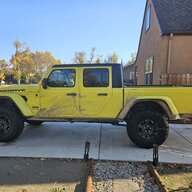
Experience for sure. We've run everything from stock 33s in the c rating to the E rated 37s on my JT mojave and E rated 39s on the wife's JLUR currently. A stiffer tire will stay on at lower psi, but you need lower psi to get the same footprint and flex. If the tire you want to run only comes in an E or an F (39s aren't scantily a popular size), they work just fine. That being said I only run them at 25psi on road and 10 psi offroad. The c rated tires I'd run at 32psi on road and 15psi off. I don't see any advantage either way. If the tires I wanted came in both C and E farms I'd go C for the lighter weight.Experience or quessing?

There’s no confusion just physics and facts. You can’t get around it. What do you think makes a sidewall not flex or deform under heavy load? You’re playing semantics with words. Stronger=stiffer. They’re both the same thing here when it comes to the sidewall. The sidewall 100% needs to be stiffer in order to not flex and deform in order to support the heavier load safely. So yes it is safe to make this blanket statement because it is true. I urge you to contact any one of the support departments at any tire manufacturer. They’ll tell you the same thing.The confusion about sidewall stiffness on LRE or LRF tires is coming from a misunderstanding of basic design principles.
LRE and LRF tires have stronger sidewalls in order to hold the higher air pressure required to carry heavier loads. I think everyone can agree on that. The issue is that stronger sidewalls do not always mean stiffer sidewalls. To make a blanket statement that all stronger sidewalls are stiffer is ignorant.
Wait a second. You don't even understand that it is actually the air pressure carrying the load and not the tire sidewall?The sidewall 100% needs to be stiffer in order to not flex and deform in order to support the heavier load safely.

Wait a minute.. You don’t even understand that it’s a COMBINATION of air pressure AND tire construction (includes sidewall) that’s carrying the load?Wait a second. You don't even understand that it is actually the air pressure carrying the load and not the tire sidewall?

The sidewall 100% needs to be stiffer in order to not flex and deform in order to support the heavier load safely.

Dude you clearly don’t know what you’re talking about. Do me a favor: call BF Goodrich support and ask if it’s only air pressure that supports the load when it comes to tires. Then get back to me.

You clearly don’t. Air down a Load Range F tire while it’s on a lighter truck like a Gladiator and watch the sidewall not deform much. Will be damn near a run-flat tire. Guaranteed you can air it down to 10 or even 5 PSI and that sidewall will still be supporting the weight with minimal deformation. Sidewall strength plays a huge role in supporting the weight of a vehicle. The percentage of what is supporting the weight, pressure vs sidewall changes depending on Load Range of the tire and how much weight is put on that tire. With a Load Range F on a lighter truck it’s mostly sidewall doing the job vs the pressure that’s in the tire, like 80/20%. Putting a Load Range C on the Gladiator, which is the correct Load Range for the vehicle, it becomes more of a 50/50%. Again, call any tire manufacturer’s tech department and ask.The amount of load that the sidewall can support is insignificant compared to what the air pressure supports. That's why tires go flat when you let the air out of them. Or maybe they don't. I clearly don't know.


