
Sponsored

Blackstone Oil Analysis first report

Jeep~N~Jay

Well-Known Member
First Name
Jay
Joined
Jul 26, 2023
Threads
6
Messages
69
Reaction score
79
Location
Utah!
Vehicle(s)
2023 Jeep Gladiator JT Sport S
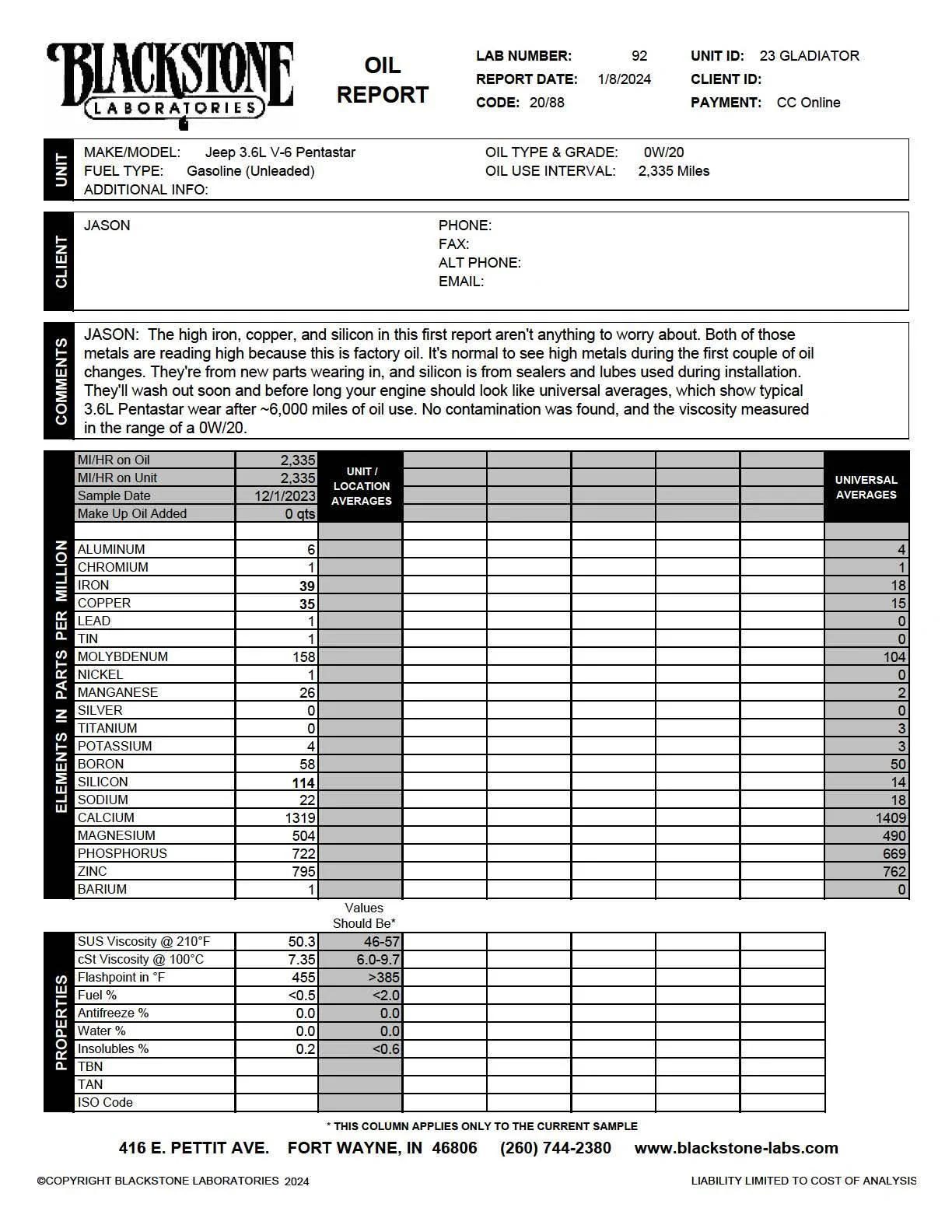
I changed my oil at 2400 miles on my 23 3.6 Gladiator. Sent the oil off to Blackstone. This is something I have never done in the past. For those more experienced is the higher numbers ok on a new vehicle during break in?

TIA!
Jeep Gladiator Blackstone Oil Analysis first report 23 GLADIATOR-231201_Redacted
Sponsored


Hootbro

Well-Known Member
First Name
Don
Joined
Apr 13, 2019
Threads
57
Messages
10,172
Reaction score
19,936
Location
Delaware
Vehicle(s)
2025 Gladiator Sport
Looks normal for the factory fill.

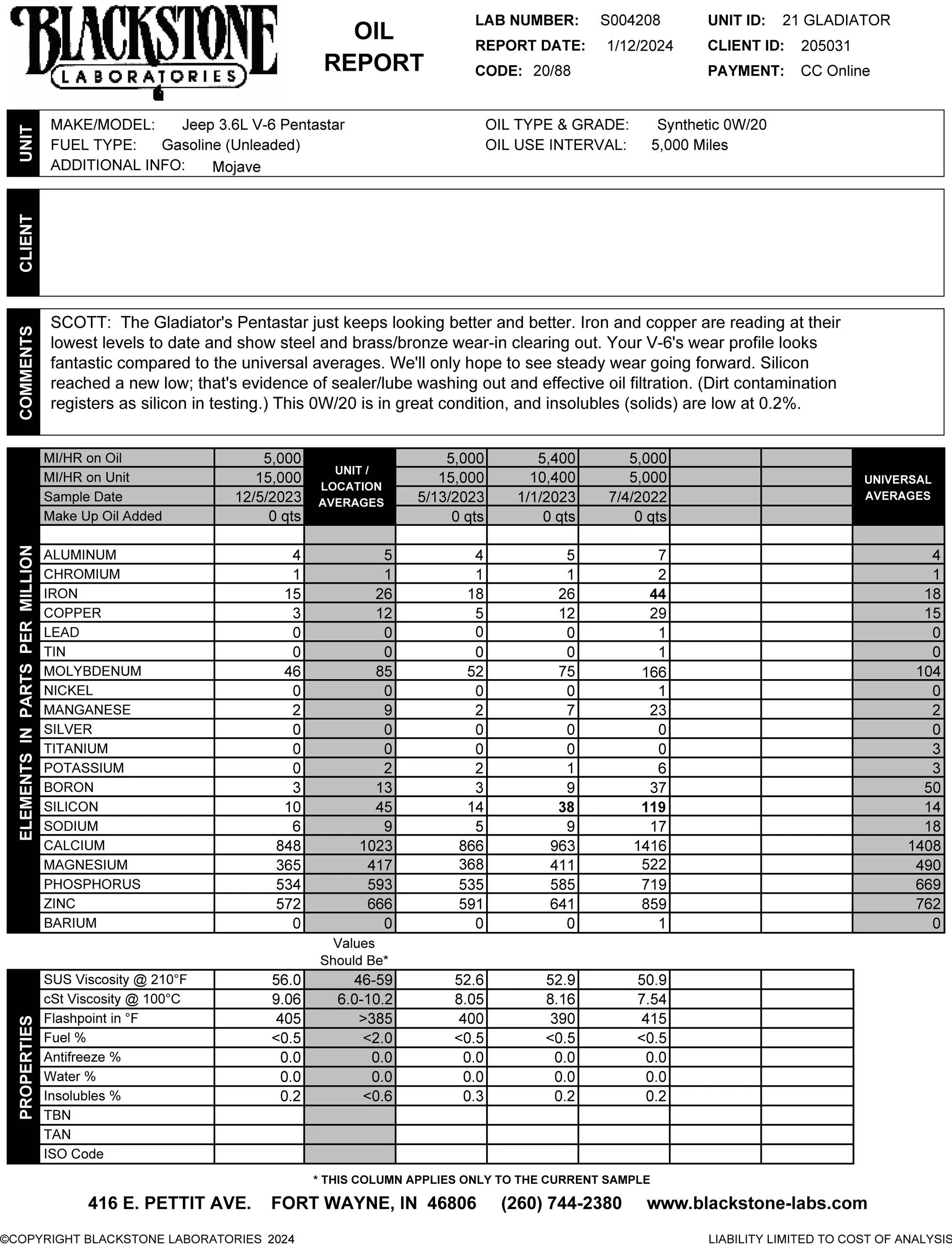
All three of my Gladiators had similar numbers for the copper, iron and silicon for the factory fill. It will almost halve by the second oil change and should level out by the third oil change and be in the universal averages.

Attached the PDF's I have for them. The 2021 had a early dump and fill before I did the first oil analysis but shows it declining regardless.
 

Attachments

OP
OP
Jeep~N~Jay

Jeep~N~Jay

Well-Known Member
First Name
Jay
Joined
Jul 26, 2023
Threads
6
Messages
69
Reaction score
79
Location
Utah!
Vehicle(s)
2023 Jeep Gladiator JT Sport S
I plan to send one in when I do my first. At 400 miles now, waiting until 700-800 to do it. Oil and filter are in the garage ready.
just a heads up it took 5 weeks to get the results. I was getting worried they lost it
 

Sponsored

KevinC

Well-Known Member
First Name
Kevin
Joined
Feb 6, 2021
Threads
17
Messages
840
Reaction score
1,596
Location
Central Florida
Vehicle(s)
2023 JT Mojave Sarge
Occupation
Hard Labor
just a heads up it took 5 weeks to get the results. I was getting worried they lost it
Yeah, word on the street is Blackstone is backed up more than normal. Not sure why. You would think less people are sending in samples based on the current economy. Maybe Blackstone cut workers.
 

ShadowsPapa

Well-Known Member
First Name
Bill
Joined
Oct 12, 2019
Threads
247
Messages
40,440
Reaction score
53,853
Location
Runnells, Iowa
Vehicle(s)
'25 JTMX, '23 JLU 4xe, '82 SX4, '73 Javelin
Occupation
Retired auto mechanic, frmr gov't ntwrk security admin
Vehicle Showcase
3
You would think less people are sending in samples based on the current economy
And less people are working........ due to shifting demographics, workers aging out, new ones with big demands coming in.
Yes, could be they've had to cut back a bit, but with the numbers coming in, it doesn't make sense since you typically cut back when works slows down and you no longer need the workers as there's few jobs to perform.
Could be the work load increasing because of the constant talk of "get an oil sample - Blackstone" being mentioned almost weekly in jeep forums. it's not just members who read such things, so they may be seeing an uptick in work load due to the constant chatter about analysis here and elsewhere.

These forums have got to be some of the best advertising money they've never spent.
 

TheRealStreetcommander

Well-Known Member
Joined
Apr 13, 2023
Threads
4
Messages
211
Reaction score
383
Location
East Coast
Vehicle(s)
Gladiator
Occupation
None of your business.
Agree with what the others have said. For another datapoint, here is mine representing a 6500mile OCI, from 2k-8500k mile period.

Keep in mind you will need to normalize your individual data by dividing your PPM, with your miles of use. i.e. for my UOA:

Fe = 39PPM / 6500 mile interval = 6PPM per each 1000 miles of use.
 

Attachments

Hootbro

Well-Known Member
First Name
Don
Joined
Apr 13, 2019
Threads
57
Messages
10,172
Reaction score
19,936
Location
Delaware
Vehicle(s)
2025 Gladiator Sport
Keep in mind you will need to normalize your individual data by dividing your PPM, with your miles of use. i.e. for my UOA:

Fe = 39PPM / 6500 mile interval = 6PPM per each 1000 miles of use.
Element data and calculating PPM based off of miles over time is not on a one for one linear scale to mathematically extrapolate from.
 

TheRealStreetcommander

Well-Known Member
Joined
Apr 13, 2023
Threads
4
Messages
211
Reaction score
383
Location
East Coast
Vehicle(s)
Gladiator
Occupation
None of your business.
Element data and calculating PPM based off of miles over time is not on a one for one linear scale to mathematically extrapolate from
Interesting thoughts Hootbro. Not to hijack the thread, but I think there's value in understanding how a reader should interpret their UOA.

In terms of wear metals, like Fe, why would the data interpreter be in error for drawing a correlation between the quantity of Fe thrown off a Pentastar at the same or similar mileage/stage of break-in? For my engine, between 2000-8500 miles, my engine shed an average of 6PPM of Fe for each 1000 miles. Why should that not be used as a valid data point for another engine analyzed during the same period of its life?

If another Pentastar owner was presented with a UOA for the same period of mileage and time, and they had 20PPM Fe total (3PPM/1000miles), wouldn't it be accurate to say their engine had worn at a 50% reduced rate to that of mine? In terms of Iron. (clearly we would know they were using Rotella oil though ;) )

I would certainly agree that the PPM Fe/mile should decrease substantially as the engine miles go up and it becomes fully broken-in. Stated differently; the relationship between Fe PPM/mile is not linear throughout an entire 1,000,000 mile service life, but there should be some linear correlation of wear metal concentrations at similar engine lifecycles of most engines.

The greater point I am trying to establish is that you have to correct for your OCI and engines lifecycle in order to understand what you UOA is really telling you.

Do you agree, or am I not fully understanding how the UOA is presenting the data?
 

Sponsored

Hootbro

Well-Known Member
First Name
Don
Joined
Apr 13, 2019
Threads
57
Messages
10,172
Reaction score
19,936
Location
Delaware
Vehicle(s)
2025 Gladiator Sport
Interesting thoughts Hootbro. Not to hijack the thread, but I think there's value in understanding how a reader should interpret their UOA.
I will not pontificate I am an expert on this but just a better than average understanding for using Blackstone for the last 20+ years.

The link below is direct from Blackstone on guideance to interpet their lab results and formatting:

https://www.blackstone-labs.com/wp-content/uploads/2019/01/Understanding-Engine-combined.pdf

Thing to keep in mind is that Blackstone's "Universal Averages" is for all the samples they have received for a particular engine model over many different in service mileage when samples were take. IIRC, the average mileage for their universal averages for the Pentastar was around 6K miles.

There has been many 10K samples taken that do not show wear metal rates double of a 5K mile sample. A few years back on the "Bob Is The Oil Guy" forum, a handful of people have done the experiment of doing a fresh oil change and send in a virgin sample. Then at every 1K miles took sample up to like 10K miles. What they found was most wear metals were shown to have been incurred and plateaued around the 3K-4K miles with very little increase past 5K miles. Conclusion was that it took that amount of time for the anti-wear materials of an oil to bed in properly. So the PPM of wear metals in not a linear increase over time/miles past a certain point until the TBN depletion threshold of an oil achieved and then the oil is no longer protecting and wear then increases again.

In my opinion, once factory manufacturing wear materials have been flushed out with a few oil changes and actual engine wear in has been achieved around 10K-15k miles, there is no benefit to doing early like 3K miles or less oil changes and the sweet spot is 5K-10K mile oil changes.
 

ShadowsPapa

Well-Known Member
First Name
Bill
Joined
Oct 12, 2019
Threads
247
Messages
40,440
Reaction score
53,853
Location
Runnells, Iowa
Vehicle(s)
'25 JTMX, '23 JLU 4xe, '82 SX4, '73 Javelin
Occupation
Retired auto mechanic, frmr gov't ntwrk security admin
Vehicle Showcase
3
In terms of wear metals, like Fe, why would the data interpreter be in error for drawing a correlation between the quantity of Fe thrown off a Pentastar at the same or similar mileage/stage of break-in? For my engine, between 2000-8500 miles, my engine shed an average of 6PPM of Fe for each 1000 miles. Why should that not be used as a valid data point for another engine analyzed during the same period of its life?
Because how it's used, how hard it's used, average or typical RPM and so on matter. For a given number of miles, an engine in another truck may have spun many thousands of RPM more than mine, or less than mine.
When loaded towing and keeping RPM up in the 3,000 range for half the trip, I'm putting a lot more wear miles on mine than someone else would. Gear ratios will come into play to a small extent, shift points and more.
I'd bet that my engine has turned a whole lot more RPM in the first 8,000 miles than a whole lot of Jeeps, and the torque load was higher. Someone driving in Florida isn't putting as much wear on their engine at 75 mph as someone here in the hills and constant wind would - I've driven 20 miles and not seen 7th gear due to wind and hills, and that was on I80/35.
That engine was loaded more than someone driving the same distance on the flat in 8th.
 

ShadowsPapa

Well-Known Member
First Name
Bill
Joined
Oct 12, 2019
Threads
247
Messages
40,440
Reaction score
53,853
Location
Runnells, Iowa
Vehicle(s)
'25 JTMX, '23 JLU 4xe, '82 SX4, '73 Javelin
Occupation
Retired auto mechanic, frmr gov't ntwrk security admin
Vehicle Showcase
3
Conclusion was that it took that amount of time for the anti-wear materials of an oil to bed in properly. So the PPM of wear metals in not a linear increase over time/miles past a certain point until the TBN depletion threshold of an oil achieved and then the oil is no longer protecting and wear then increases again.
If you are talking ZDDP, it takes time to form the protective surface which over time is then depleted and the amount in the oil is reduced so there's a peak of protection in the middle somewhere, depending on how frequently you change the oil. Very frequent changes means there's more left before you put in the fresh, longer intervals mean a reduction to some extent.
That's over-simplified for sure, and we rely a whole lot less on ZDDP as modern oils have chemistry that takes the place of ZDDP.
That protection builds to a point, then actually, literally stops building (thus why more is not always good, and has been proven to actually cause damage)
 

ErylFlynn

Well-Known Member
First Name
Brett
Joined
Aug 15, 2023
Threads
40
Messages
447
Reaction score
397
Location
Washington
Vehicle(s)
2023 Punkn Mojave, 2008 JK Unlimited Det Yellow
Sounds like from what I have heard you don't want to change oil too often for this reason. Is 5k the general real world target? I plan to do uoa but only have 400 miles and plan to change the oil in the 700 range.

Also I don't drive much and do shorter drives, would that impact how often to change and would see that how on the uoa?
Sponsored


Top