Sponsored

Brand Spanking NEW Death Wobble on way home...

OP
OP

Redfour5

Well-Known Member
First Name
Karl
Joined
Nov 18, 2023
Threads
28
Messages
504
Reaction score
390
Location
Montana
Vehicle(s)
Jeep Renegade, Cherokee, Ram 2500 Hemi,
Occupation
Retired
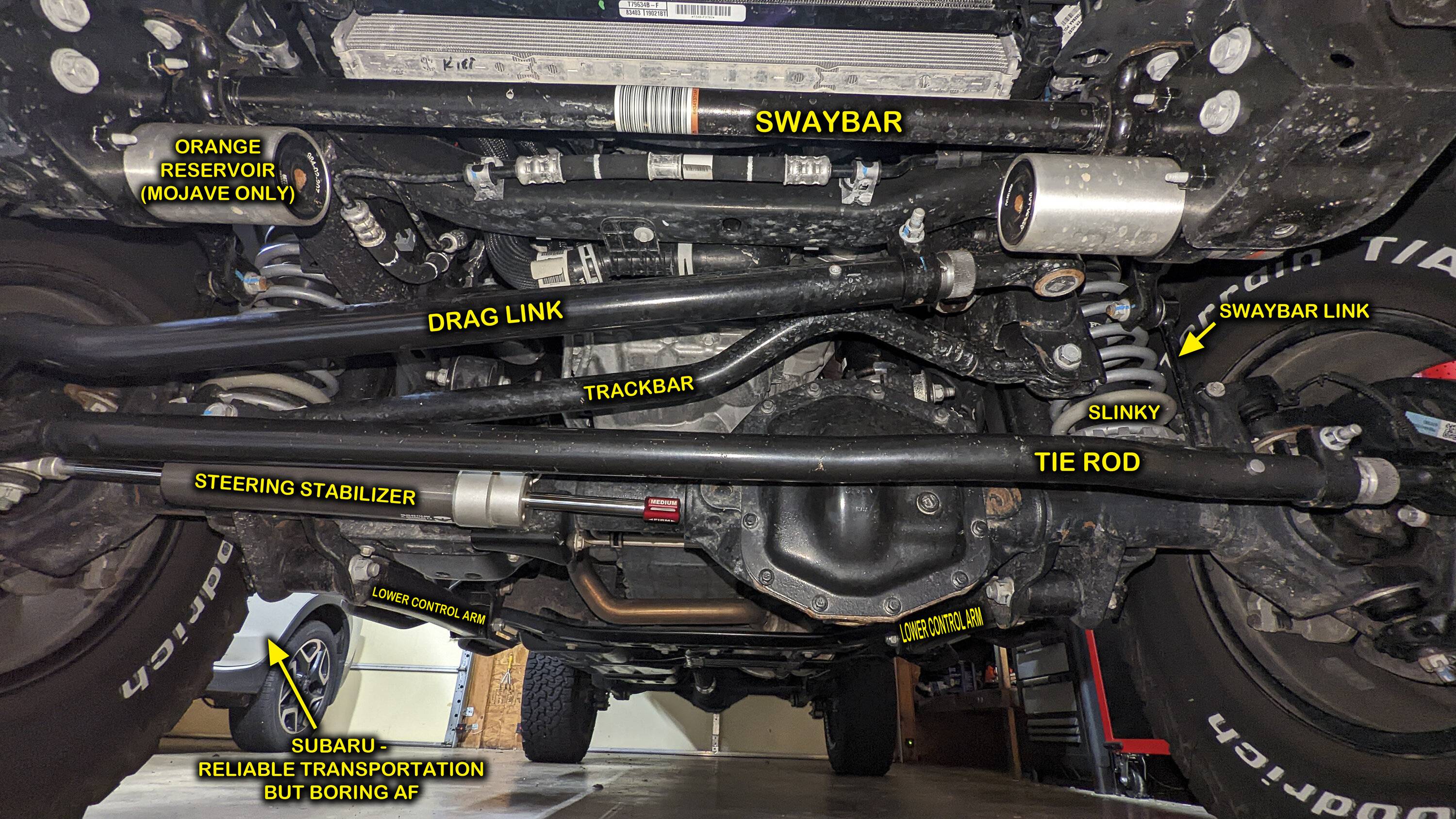
If you have the means and another person to help, you can get someone to move the steering wheel through right and left cycles while you lie under the front end and look for loose components and play.

Ideally, however, I'd recommend making sure that every fastener is properly torqued.
It's a very common issue to find that they're not from the factory.

If I were to buy another Jeep it's the first thing I would do.

https://www.jeepgladiatorforum.com/forum/threads/?-2020-2023-jt-gladiator-torque-values-all-of-them-in-one-place.67915/

PXL_20221209_004510195.jpg


I just noticed the Subaru arrow and comment and laughed my behind off. My wife has had Suby's since the early 2000's, and I got her a Cherokee Trailhawk with the Elite package V6. She wants a Suby... BORING AF.
Sponsored


KevinC

Well-Known Member
First Name
Kevin
Joined
Feb 6, 2021
Threads
17
Messages
841
Reaction score
1,602
Location
Central Florida
Vehicle(s)
2023 JT Mojave Sarge
Occupation
Hard Labor
Tire balance, alignment , specifically caster. Shocks, A dampener is just a bandaid.
Please explain/elaborate how a dealership can adjust castor on a stock JT?
 
OP
OP

Redfour5

Well-Known Member
First Name
Karl
Joined
Nov 18, 2023
Threads
28
Messages
504
Reaction score
390
Location
Montana
Vehicle(s)
Jeep Renegade, Cherokee, Ram 2500 Hemi,
Occupation
Retired
Please explain/elaborate how a dealership can adjust castor on a stock JT?
I have zero idea. I saw someone else mention it in another thread on death wobble so threw it into the mix of things I had seen referenced as part of fixes.
 

Farmer Fran

Well-Known Member
Joined
Dec 9, 2023
Threads
14
Messages
150
Reaction score
209
Location
EARTH
Vehicle(s)
2023 Gladiator High Altitude (Metro-Jethro) 2023
Check the lug torque
 

Sponsored

Farmer Fran

Well-Known Member
Joined
Dec 9, 2023
Threads
14
Messages
150
Reaction score
209
Location
EARTH
Vehicle(s)
2023 Gladiator High Altitude (Metro-Jethro) 2023
Also I found this...
Jeep Gladiator Brand Spanking NEW Death Wobble on way home... Screensho
 

Bjeepz

Well-Known Member
First Name
B
Joined
Nov 21, 2019
Threads
10
Messages
1,010
Reaction score
1,062
Location
Canada
Vehicle(s)
2025 Willy's
I have zero idea. I saw someone else mention it in another thread on death wobble so threw it into the mix of things I had seen referenced as part of fixes.
Castor can not be adjusted on the Wrangler platform with stock control arms up front. I'd suggest that before you go tossing things at the service dept that you know what your tossing at them. Printing this thread out won't do much to help your cause.

I hope the dealership tech that gets this is competent and you get things smoothed out asap!
 
OP
OP

Redfour5

Well-Known Member
First Name
Karl
Joined
Nov 18, 2023
Threads
28
Messages
504
Reaction score
390
Location
Montana
Vehicle(s)
Jeep Renegade, Cherokee, Ram 2500 Hemi,
Occupation
Retired
Castor can not be adjusted on the Wrangler platform with stock control arms up front. I'd suggest that before you go tossing things at the service dept that you know what your tossing at them. Printing this thread out won't do much to help your cause.

I hope the dealership tech that gets this is competent and you get things smoothed out asap!
Me also. They have been relatively competent in the 10 years I've dealt with them... Had a great guy on Hemi tick issues...
 

Wolf Island Diver

Well-Known Member
Joined
Apr 14, 2021
Threads
26
Messages
1,130
Reaction score
2,478
Location
Virginia
Vehicle(s)
2021 JT Rubicon EcoDiesel
Occupation
Software Engineer
You can’t adjust caster on the stock vehicle. You can only adjust caster with adjustable control arms. You can’t adjust camber on a solid axle at all without resetting the axle tubes in the differential. You can’t adjust axle center on the stock truck. You can only adjusted that with an adjustable track bar. Alignment issues will manifest themselves much more immediately and subtly than a “death wobble” and they don’t usually contribute to oscillation. Alignment contributes to pulling and excessive wear.

A death wobble is front steering system oscillation of increasing amplitude that occurs when you reach the system’s natural frequency, the frequency at which it tends to oscillate on its own, and apply an external force of the same or nearly same frequency. The 2x4 they run over with 1 wheel in death wobble videos is that external force. The result is oscillation rapidly increasing to its maximum amplitude. A mild to moderate front end wobble that is speed dependent is not a death wobble. All systems oscillate. All solid axles vehicles wobble. Jeep tries to engineer the resonant frequency higher. Higher unsprung weight tends to lower it, so it’s a challenge. The result is that these trucks are more susceptible to death wobble. Without seeing this, I have to take your word for it that you’re experiencing a death wobble level shimmy that clears on its own depending on speed. Maybe it doesn’t matter whether we call it a death wobble or severe shimmy. The things that can cause either are similar.

Folks say the steering damper does nothing. That’s not true. It’s a notch filter for oscillations. The problem is that it’s only between the axle and tie rod. Steering dampers also are not appropriate compensation for bad geometry or loose components. The axle shock absorbers also dampen movement but unfortunately this is mostly in the wrong plane, although it can affect wobble to some degree. My stock diesel had severely underdamped shocks, which apparently resulted in a TSB (I lifted it before that happened). My truck would routinely bottom out but I never had an shimmy.

The rest of the front end connections are rigid. They shouldn’t contribute to oscillations. However if they’re loose, they become part of the dynamic system and lower the resonant frequency.

Here are things to check:
  1. Track bar. This is the number one cause of issues, in that it is the most common loose front end component on a solid axle vehicle, it is under a lot of pressure and tends to come loose, it does double duty keeping the axle centered and maintaining the geometry of the steering system, and a lose track bar can easily contribute to lower resonant frequency. Check both the axle and frame side bolts.
  2. Steering box. This is the rigid component between the frame and the steering system. It’s frequently overlooked when people check their front ends for loose bolts. It can contribute to lots of issues including death wobble. This generation of Jeeps have had steering problems just from the rigidity (lack of) of the steering box alone. I assume all newer JTs get the cast iron box from the factory now, but maybe I’m wrong
  3. The rest of the steering components: drag link, tie rod, tie rod adjusters, ball joints, steering damper (bad damper or loose connection).
These trucks are known to come from the factory with loose steering components, loose ball joints and loose body mounts. I don’t know about control arm bolts but that wouldn’t surprise me. My body bolts were hand tight.

Tires:

Tires can cause all sorts of issues, but directly causing an actual death wobble isn’t usually one of them. Large oversize tires as increased unsprung weight lower resonant frequency. So big tires + loose bolts = death wobble at a lower external force. Tires that are out of round, not uncommon on large mud tires that are defective or wearing unevenly, can cause oscillations but these are generally vertical. Jeep front ends, especially on lifted ones, tend to bounce subtly increasing the chances of uneven (scalloped) wear on aggressive tread tires. My TJ had severely scalloped mud tires at one point and drove like shit, shaking your teeth out, but I had zero side to side shimmy.

Tire pressure issues mostly result in poor wear but could lead to vibration. But again, generally not enough to result in death wobble. Dealerships techs, factory vehicle transporters, and anyone dumb enough to use the tire sidewall as a guide jack high pressure into the tires. Personally, I don’t go by the door placard either on a vehicle with larger tires, even a stock Jeep. I chalk test my tires. Factory pressure isn’t causing a death wobble. Radically low pressure generally won’t cause this either. I’ve driven down the road in Ocracoke from beach ramp to beach ramp with 12PSI. It drives like mush. It doesn’t oscillate. Even with uneven tires (5-10psi delta) shouldn’t result in death wobble level oscillations. The tires are too big and the system is already too dynamic for that to cause this.

Tire balance can induce a wobble. My 37s are starting to wobble and I’m increasingly feeling it in the steering wheel. They’re probably due for a rebalancing which is something you have to do when large mud tires wear. Again, tire balance outside of some extreme shouldn’t contribute to death wobble level oscillations independent of some other problem and you will feel it a low speed and high speed.

There’s extreme stuff in no particular order. Extreme in the sense that it’s a major failure or extreme in that it’s jaw droppingly dumb.
  • Wheels are loose. I’ve actually had a wheel fall off an IFS truck after having tires mounted. I didn’t notice anything until it fell off. I could see this manifesting itself as a vibration.
  • Severely damaged/defective wheel or tire (I would expect non speed dependent issues)
  • Severally loose control arm (I would expect non speed dependent issues)
  • Frame issues (generally pulling, not vibrations, but a cracked frame at the steering box could cause oscillations)
  • Severely bent or non parallel axle ends. Most D44s, when you run big tires will bend slightly over time without anyone noticing. I think you would notice an extremely bent axle immediately
  • Defective steering box or internals, broken/deformed pitman arm, etc. Any severe and uncommon defect in the front end.

Lastly, since this is a forum and none of us are actually driving/seeing this, there’s the human factor. If I drive a CX-5 for a few hours and then get in my truck I notice just how Jeepy it is. It wanders, it shimmies, its axle isn’t centered perfectly, it bounces, and hobby horses. It drives like shit. I love it because I’m a Jeep person. I’m not saying what you’re experiencing is normal but it might not rise to the level of a death wobble. If you’re okay driving it and can post a video it would help.
 

Shift Happens

Well-Known Member
Joined
Jul 5, 2023
Threads
9
Messages
220
Reaction score
220
Location
NC
Vehicle(s)
2023 Mojave
Occupation
IT
Had this exact same thing happen on my wrangler with 35k on it.
When I checked the components, the track bar had a tiiiiiiny bit of lateral movement but you couldn't feel it move if you put your hand on it. I could however feel movement in the tie rod.
Weirdly enough, I moved the steering wheel back and forth almost lock to lock ~ 20 times and it fixed it. On the last one I heard a creaking/groaning noise from the passenger side and then a clunk as I came back to center and immediately felt a difference.
Got the tires balanced(they were all out of balance), got an alignment(lifetime alignment at firestone is great).
Checking torque on all the suspension/steering components and visually inspecting the bushings to see if there's any obvious damage.
Dealer said they'll replace the steering stabilizer which I'm going to let them do because it's under warranty. It's on back-order so while I wait for it, I'm going to remove the old one and see how it feels.
 

Sponsored

OP
OP

Redfour5

Well-Known Member
First Name
Karl
Joined
Nov 18, 2023
Threads
28
Messages
504
Reaction score
390
Location
Montana
Vehicle(s)
Jeep Renegade, Cherokee, Ram 2500 Hemi,
Occupation
Retired
You can’t adjust caster on the stock vehicle. You can only adjust caster with adjustable control arms. You can’t adjust camber on a solid axle at all without resetting the axle tubes in the differential. You can’t adjust axle center on the stock truck. You can only adjusted that with an adjustable track bar. Alignment issues will manifest themselves much more immediately and subtly than a “death wobble” and they don’t usually contribute to oscillation. Alignment contributes to pulling and excessive wear.

A death wobble is front steering system oscillation of increasing amplitude that occurs when you reach the system’s natural frequency, the frequency at which it tends to oscillate on its own, and apply an external force of the same or nearly same frequency. The 2x4 they run over with 1 wheel in death wobble videos is that external force. The result is oscillation rapidly increasing to its maximum amplitude. A mild to moderate front end wobble that is speed dependent is not a death wobble. All systems oscillate. All solid axles vehicles wobble. Jeep tries to engineer the resonant frequency higher. Higher unsprung weight tends to lower it, so it’s a challenge. The result is that these trucks are more susceptible to death wobble. Without seeing this, I have to take your word for it that you’re experiencing a death wobble level shimmy that clears on its own depending on speed. Maybe it doesn’t matter whether we call it a death wobble or severe shimmy. The things that can cause either are similar.

Folks say the steering damper does nothing. That’s not true. It’s a notch filter for oscillations. The problem is that it’s only between the axle and tie rod. Steering dampers also are not appropriate compensation for bad geometry or loose components. The axle shock absorbers also dampen movement but unfortunately this is mostly in the wrong plane, although it can affect wobble to some degree. My stock diesel had severely underdamped shocks, which apparently resulted in a TSB (I lifted it before that happened). My truck would routinely bottom out but I never had an shimmy.

The rest of the front end connections are rigid. They shouldn’t contribute to oscillations. However if they’re loose, they become part of the dynamic system and lower the resonant frequency.

Here are things to check:
  1. Track bar. This is the number one cause of issues, in that it is the most common loose front end component on a solid axle vehicle, it is under a lot of pressure and tends to come loose, it does double duty keeping the axle centered and maintaining the geometry of the steering system, and a lose track bar can easily contribute to lower resonant frequency. Check both the axle and frame side bolts.
  2. Steering box. This is the rigid component between the frame and the steering system. It’s frequently overlooked when people check their front ends for loose bolts. It can contribute to lots of issues including death wobble. This generation of Jeeps have had steering problems just from the rigidity (lack of) of the steering box alone. I assume all newer JTs get the cast iron box from the factory now, but maybe I’m wrong
  3. The rest of the steering components: drag link, tie rod, tie rod adjusters, ball joints, steering damper (bad damper or loose connection).
These trucks are known to come from the factory with loose steering components, loose ball joints and loose body mounts. I don’t know about control arm bolts but that wouldn’t surprise me. My body bolts were hand tight.

Tires:

Tires can cause all sorts of issues, but directly causing an actual death wobble isn’t usually one of them. Large oversize tires as increased unsprung weight lower resonant frequency. So big tires + loose bolts = death wobble at a lower external force. Tires that are out of round, not uncommon on large mud tires that are defective or wearing unevenly, can cause oscillations but these are generally vertical. Jeep front ends, especially on lifted ones, tend to bounce subtly increasing the chances of uneven (scalloped) wear on aggressive tread tires. My TJ had severely scalloped mud tires at one point and drove like shit, shaking your teeth out, but I had zero side to side shimmy.

Tire pressure issues mostly result in poor wear but could lead to vibration. But again, generally not enough to result in death wobble. Dealerships techs, factory vehicle transporters, and anyone dumb enough to use the tire sidewall as a guide jack high pressure into the tires. Personally, I don’t go by the door placard either on a vehicle with larger tires, even a stock Jeep. I chalk test my tires. Factory pressure isn’t causing a death wobble. Radically low pressure generally won’t cause this either. I’ve driven down the road in Ocracoke from beach ramp to beach ramp with 12PSI. It drives like mush. It doesn’t oscillate. Even with uneven tires (5-10psi delta) shouldn’t result in death wobble level oscillations. The tires are too big and the system is already too dynamic for that to cause this.

Tire balance can induce a wobble. My 37s are starting to wobble and I’m increasingly feeling it in the steering wheel. They’re probably due for a rebalancing which is something you have to do when large mud tires wear. Again, tire balance outside of some extreme shouldn’t contribute to death wobble level oscillations independent of some other problem and you will feel it a low speed and high speed.

There’s extreme stuff in no particular order. Extreme in the sense that it’s a major failure or extreme in that it’s jaw droppingly dumb.
  • Wheels are loose. I’ve actually had a wheel fall off an IFS truck after having tires mounted. I didn’t notice anything until it fell off. I could see this manifesting itself as a vibration.
  • Severely damaged/defective wheel or tire (I would expect non speed dependent issues)
  • Severally loose control arm (I would expect non speed dependent issues)
  • Frame issues (generally pulling, not vibrations, but a cracked frame at the steering box could cause oscillations)
  • Severely bent or non parallel axle ends. Most D44s, when you run big tires will bend slightly over time without anyone noticing. I think you would notice an extremely bent axle immediately
  • Defective steering box or internals, broken/deformed pitman arm, etc. Any severe and uncommon defect in the front end.

Lastly, since this is a forum and none of us are actually driving/seeing this, there’s the human factor. If I drive a CX-5 for a few hours and then get in my truck I notice just how Jeepy it is. It wanders, it shimmies, its axle isn’t centered perfectly, it bounces, and hobby horses. It drives like shit. I love it because I’m a Jeep person. I’m not saying what you’re experiencing is normal but it might not rise to the level of a death wobble. If you’re okay driving it and can post a video it would help.
I appreciate the detail. I drove my five year old Renegade the same 500 miles to trade it. I've always liked it. Most of my vehicles have been log wagons of various types. I even put pinks on my 2007 Subaru Forester slamming it... I liked the Renegade a lot for it quickness, smallness and decent mileage if nothing spectacular.

Driving the new Gladiator before the "wobble" death or otherwise... I found it handled surprisingly well. Driver's position is excellent and the seats were superior to the Renegade. Not quite as quick, but after all the hate on the steering, I found it very acceptable. I'm taking it to the dealer on Monday so, I will likely not drive it. But during that two hunded miles I was able to ID the criteria that caused it. Speed which goes with what I call system resonance and you called "increasing amplitude." It's also called a positive feedback mechanism. Like a furnace with a thermostat. The thermostat provides a negative input into the system shutting it down. It will run until it either runs out of fuel or the thermostat shuts it down. Me taking my foot off the gas was negative feedback into the system.

I noticed it first when I put the cruise control on and hit the first bridge transition with the cruise on. All positive feedback mechanisms need external "fuel" and the constant input of power from cruise reinforced the increasing amplitude "resonance" of the system. As soon as it was turned off, the system began to shut down and the amplitude declined. the input of brakes carefully caused the speed to decline and right at 58 mph the "wobble" went away as the system went back to the original steady state. I also noted that it would happen more easily if the wheels were turned a bit like entering a bridge that was on a corner.

I 90 between Missoula and Idaho is kind of unique in that the road crosses the Clark Fork river like 18 times with bridges. I counted once years ago and seem to remember that. I was actually "testing" the wobble once I understood its core characteristics and had a certain element of control over its occurring. I realized that taking my foot off the gas just prior to hitting the transition point removing that input would prevent it from happening as long as I didn't put the gas back on immediately after crossing the transition (bump) point. Being in a curve exacerbated the situation and would trigger it irrespective of the input of power into the system. As noted, I was engaged in the "breaking in" of the vehicle for the first 300 miles and never crossed 65 miles per hour and seldom 60. I was varying RPM's constantly to prevent. During this first 300 miles not once did the "wobble" even hint at happening. It was a non-issue until 306 miles exactly into the trip when I put the cruise control on for the first time and hit a bridge transition. I had 160 miles left for the trip and during that time I "experimented" to better understand the dynamics of the "wobble."

So, if I stayed below 65 it would NOT occur. Between 65 and 72 mph, whether it occurred or not could to a degree be controlled by what I did as a driver in terms of inputting power (hitting the gas) at key points during a transition or hitting a road repair that would trigger the resonance of the system... Once above like 72 mph it would be triggered pretty much irrespective of any drivers actions and was more prone to it so, I deduced that speed was a factor/variable in the overall process in addition to the input of "fuel" into the system itself. It did not occur on a perfectly smooth road. It took a "bump" to trigger it. I did stop and shined a light and looked at the "system" to make sure there wasn't something obviously out of whack like a big chunk of metal or track bar hanging down.

Having read quite a bit about this and understanding the nature of such systems in general, I had a good ideal of the KINDS of things that might cause this including the tendencies of the system itself (solid axles vs independent suspension) and the reciprocating nature of the steering system vs rack and pinion that is extant in most other vehicles.

But having been impressed with the experience, knowledge and expertise in this forum I wanted to ask. I really appreciate your response and the others as they have fleshed out my understanding.
 
Last edited:

22EcoDs

Well-Known Member
Joined
Oct 14, 2021
Threads
16
Messages
1,515
Reaction score
1,684
Location
NY
Vehicle(s)
22jtsD , 06XK, 21KL - Retired(97ZJ,15JKU, 00WJ,)
Please explain/elaborate how a dealership can adjust castor on a stock JT?
Easy killer, I missed his PS mentioning it was not modified. Just purchased doesn't mean it was stock.
 

Wolf Island Diver

Well-Known Member
Joined
Apr 14, 2021
Threads
26
Messages
1,130
Reaction score
2,478
Location
Virginia
Vehicle(s)
2021 JT Rubicon EcoDiesel
Occupation
Software Engineer
I appreciate the detail. I drove my five year old Renegade the same 500 miles to trade it. I've always liked it. Most of my vehicles have been log wagons of various types. I even put pinks on my 2007 Subaru Forester slamming it... I liked the Renegade a lot for it quickness, smallness and decent mileage if nothing spectacular.

Driving the new Gladiator before the "wobble" death or otherwise... I found it handled surprisingly well. Driver's position is excellent and the seats were superior to the Renegade. Not quite as quick, but after all the hate on the steering, I found it very acceptable. I'm taking it to the dealer on Monday so, I will likely not drive it. But during that two hunded miles I was able to ID the criteria that caused it. Speed which goes with what I call system resonance and you called "increasing amplitude." It's also called a positive feedback mechanism. Like a furnace with a thermostat. The thermostat provides a negative input into the system shutting it down. It will run until it either runs out of fuel or the thermostat shuts it down.

I noticed it first when I put the cruise control on and hit the first bridge transition with the cruise on. All positive feedback mechanisms need external "fuel" and the constant input of power from cruise reinforced the increasing amplitude "resonance" of the system. As soon as it was turned off, the system began to shut down and the amplitude declined. the input of brakes carefully caused the speed to decline and right at 58 mph the "wobble" went away as the system went back to the original steady state. I also noted that it would happen more easily if the wheels were turned a bit like entering a bridge that was on a corner.

I 90 between Missoula and Idaho is kind of unique in that the road crosses the river like 18 times with bridges. I was actually "testing" the wobble once I understood its characteristics. I realized that taking my foot off the gas just prior to hitting the transition point removing that input would prevent it from happening as long as I didn't put the gas back on immediately after crossing the transition (bump) point. Being in a curve exacerbated the situation and would trigger it irrespective of the input of power into the system. As noted, I was engaged in the "breaking in" of the vehicle for the first 300 miles and never crossed 65 miles per hour and seldom 60. I was varying RPM's constantly to prevent. During this first 300 miles not once did the "wobble" even hint at happening. It was a non-issue until 306 miles exactly into the trip when I put the cruise control on for the first time and hit a bridge transition. I had 160 miles left for the trip and during that time I "experimented" to better understand the dynamics of the "wobble."

So, if I stayed below 65 it would NOT occur. Between 65 and 72 mph, whether it occurred or not could to a degree be controlled by what I did as a driver in terms of inputting power (hitting the gas) at key points during a transition or hitting a road repair that would trigger the resonance of the system... Once above like 72 mph it would be triggered pretty much irrespective of any drivers actions and was more prone to it so, I deduced that speed was a factor/variable in the overall process in addition to the input of "fuel" into the system itself.

Having read quite a bit about this and understanding the nature of such systems in general, I had a good ideal of the KINDS of things that might cause this including the tendencies of the system itself (solid axles vs independent suspension) and the reciprocating nature of the steering system vs rack and pinion that is extant in most other vehicles.

But having been impressed with the experience, knowledge and expertise in this forum I wanted to ask. I really appreciate your response in particular.
The fact that this started to happen after driving essentially normally, is concerning. I think it’s a wise choice to minimize driving it. Also you seem to understand the basic nature of the beast so this doesn’t sound like a user sensitivity issue. On forums you never know and it’s easy to assume either way.

Hopefully this is something obvious to the techs when they get into it. My experience with dealerships is that most techs are just that. In the same sense that a lot of carpenters today are really just installers with a staple gun. A lot of techs aren’t true mechanics that can follow their own troubleshoot logic. They can follow the steps in their systems like STAR but not much else. Of course even good mechanics are stymied by the process they have to follow and dealerships are under pressure not to stray from procedures if they want reimbursement for warranty work. Thankfully, in 4 plus years a lot of issues have been discovered and documented.

I could not get my dealership to check my body bolts. To me a popping sound when coming to a stop from reverse and then another popping sound when stopping after coming to a stop driving forward was classic body shifting on a frame issue. Especially, considering where it was coming from. Problems with these bolts were documented on forums but rare. I asked my dealership to simply put a wrench on the rear passenger cab bolt. Based on the noise, this is the one I suspected and ultimately was the loosest. I didn’t want to mess with them myself because they can break unless heated.

The dealership didn’t check them. Instead they drove around and declared that they “could not replicate” the noise. A month or so later, after buying an inductive heater for $400 and needing to remove the bolts anyway to install ARB sliders, I discovered I was right all along. Multiple bolts were loose and never Loctited. The passenger rear cab bolt was hand tight.

I don’t think your issue is these bolts, but the anecdote is illustrative of the problem of trying to steer a dealership in the right direction. They will unfortunately throw parts at a problem rather than dig deeper which costs you the time of having to go back and forth. Hopefully what it needs is just them checking things or indeed one of the first line parts for this described issue in their diagnostic procedures and there’s not a deeper problem.

Good luck.
 
OP
OP

Redfour5

Well-Known Member
First Name
Karl
Joined
Nov 18, 2023
Threads
28
Messages
504
Reaction score
390
Location
Montana
Vehicle(s)
Jeep Renegade, Cherokee, Ram 2500 Hemi,
Occupation
Retired
" My experience with dealerships is that most techs are just that."

You are not kidding. I'm originally from Indiana and a friend of mine now retired was a long term "mechanic" (25/30 years) with Chrysler. They made him stay another year or so during Covid with more money. They still call him on retainer. But, My 2015 Ram 1500 began shutting down on the highway at 65 mph, not throwing any codes and telling me to shut it off and restart...while I was still going at like fifty with no engine power.

So, I took it in. They had it three days, called me and said it was going to have to wait for a couple weeks till a guy from Stellantis came in for some other problems... The computers were not telling them what to fix and they had no clue how to troubleshoot or apparently even use logic. They then offered me almost 30K for my used truck with 70K miles on it. I called my friend back in Indiana and he asked some questions and said its in the ignition. He said they should work their way up the "stalk" on the ignition system and gave the most likely place it was... Look there first... I told my people they just stared at me. I shrugged and took the almost 30K on the five year old truck with 70K miles on it and bought another one.
Sponsored


Top