
Sponsored



bleda2002
Well-Known Member
Vehicle weight has nearly no effect on actual steady state fuel economy, even then it typically takes very large changes in vehicle weight (300 pounds on a 6k pound truck is nothing) to have a noticeable effect.What about the 300+ pound advantage of the Gladiator? No physics in that?

WoolyKris
Well-Known Member
- First Name
- Kris
- Joined
- Aug 19, 2021
- Threads
- 8
- Messages
- 179
- Reaction score
- 344
- Location
- Western Mass.
- Vehicle(s)
- 2021 Jeep Gladiator Willys
- Occupation
- Engineer
Ram uses a mild hybrid 3.6 etorque setup you gain a couple mpg, 12hp and like 40 lb-ft of torque.
OP
OP

Jrap
Well-Known Member
- Thread starter
- #20
Not talking steady state, talking city start and stop. Ram 1500 heavier by 300+, same engine, gets better city mpg in start and stop traffic where 300 lbs should come into play.Vehicle weight has nearly no effect on actual steady state fuel economy, even then it typically takes very large changes in vehicle weight (300 pounds on a 6k pound truck is nothing) to have a noticeable effect.
Sponsored
bleda2002
Well-Known Member
Even then 300 lbs is negligible. You are talking 1-2% mpg at most. Compare that to aero that can easily cost 20% or more mpgNot talking steady state, talking city start and stop. Ram 1500 heavier by 300+, same engine, gets better city mpg in start and stop traffic where 300 lbs should come into play.
Deleted member 57233
Sure there is. But the truck's weight has nothing to do with your claim that physics don't apply at 5mph ?What about the 300+ pound advantage of the Gladiator? No physics in that?
Sponsored
antwon412
Well-Known Member
- First Name
- Tony
- Joined
- Sep 25, 2021
- Threads
- 42
- Messages
- 1,086
- Reaction score
- 2,222
- Location
- Northern Ca - Yuba City
- Vehicle(s)
- TJ, JT Mojave
I had a fully loaded 2020 ram rebel with a 5.7.
I got the same 12 to 14 miles a gallon in that that I get in my Gladiator with the 3.6.
I got the same 12 to 14 miles a gallon in that that I get in my Gladiator with the 3.6.
Last edited:
Plywood
Well-Known Member
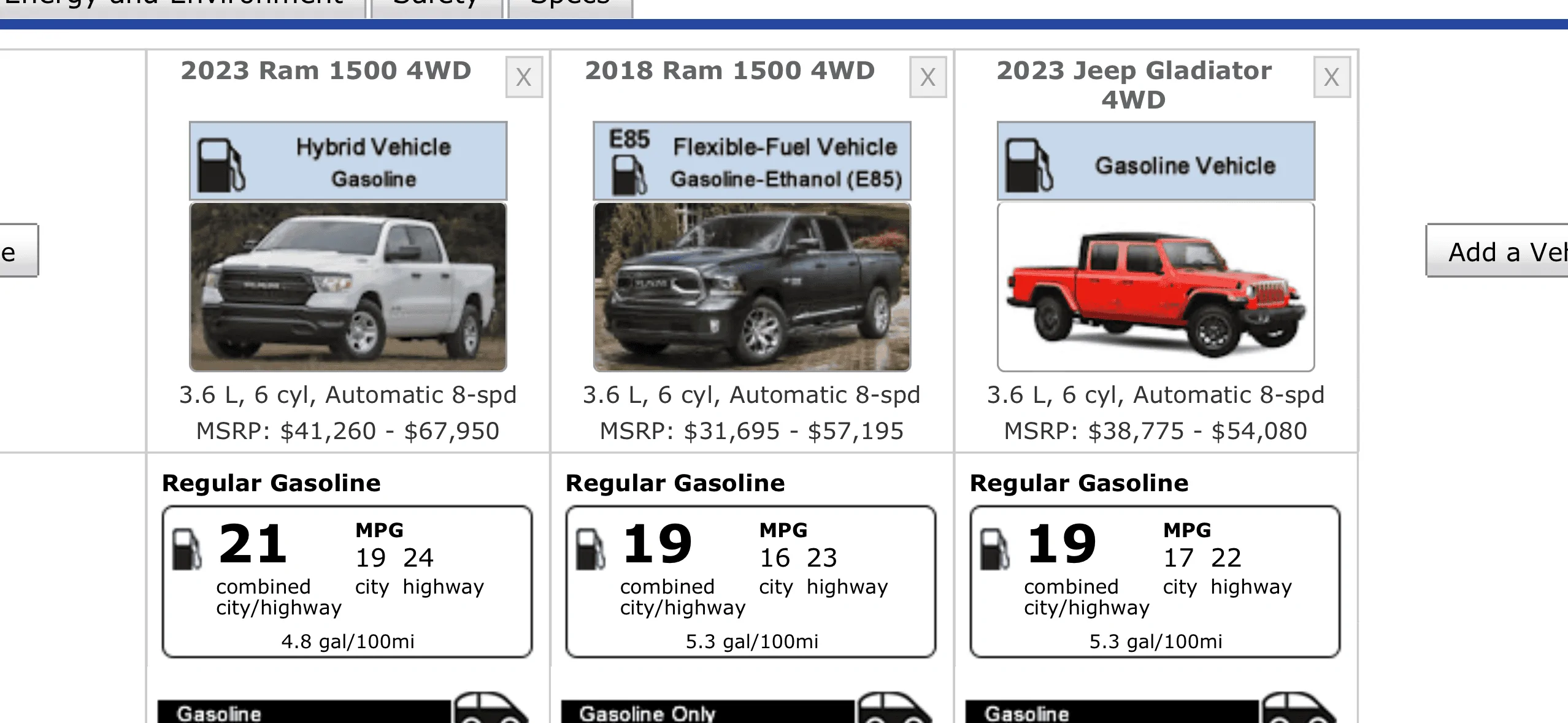
Because of etorque. Here’s a comparison, left one has etorque and middle doesn’t. Compared to a non etorque 1500 the JT is 1 mpg better in city and 1 less on highway. 1 less on the highway is because of gearing.


ShadowsPapa
Well-Known Member
- First Name
- Bill
- Joined
- Oct 12, 2019
- Threads
- 247
- Messages
- 40,442
- Reaction score
- 53,859
- Location
- Runnells, Iowa
- Vehicle(s)
- '25 JTMX, '23 JLU 4xe, '82 SX4, '73 Javelin
- Occupation
- Retired auto mechanic, frmr gov't ntwrk security admin
- Vehicle Showcase
- 3
Maybe some don't realize this but the "city driving" isn't what you think it is.
The test's average speed is 21 mph, it's a dyno test about 11 miles long, takes just over 31 minutes to complete, involves 23 stops, reaches a top speed of 56 mph.
So that 5mph is out the window. Yes, drag will factor in, and like I posted before - the EPA even says the drag of cargo on top can drop CITY mpg up to 8%. That's almost 2 mpg if you usually get 22 mpg in town. So can't say drag doesn't matter. And factor in that the EPA testing is up to 56 mph with an average speed of 21 - yes, there's drag.
And if RAM being compared is e-torque, then there ya go.
The test's average speed is 21 mph, it's a dyno test about 11 miles long, takes just over 31 minutes to complete, involves 23 stops, reaches a top speed of 56 mph.
So that 5mph is out the window. Yes, drag will factor in, and like I posted before - the EPA even says the drag of cargo on top can drop CITY mpg up to 8%. That's almost 2 mpg if you usually get 22 mpg in town. So can't say drag doesn't matter. And factor in that the EPA testing is up to 56 mph with an average speed of 21 - yes, there's drag.
And if RAM being compared is e-torque, then there ya go.
Plywood
Well-Known Member
EPA city mpg test gets up to 56.7 mph and roughly 15% of the test is at or near those speeds.
https://www.fueleconomy.gov/feg/fe_test_schedules.shtml
https://www.fueleconomy.gov/feg/fe_test_schedules.shtml
ShadowsPapa
Well-Known Member
- First Name
- Bill
- Joined
- Oct 12, 2019
- Threads
- 247
- Messages
- 40,442
- Reaction score
- 53,859
- Location
- Runnells, Iowa
- Vehicle(s)
- '25 JTMX, '23 JLU 4xe, '82 SX4, '73 Javelin
- Occupation
- Retired auto mechanic, frmr gov't ntwrk security admin
- Vehicle Showcase
- 3
Meh, so I rounded and pulled from memory ?EPA city mpg test gets up to 56.7 mph and roughly 15% of the test is at or near those speeds.
https://www.fueleconomy.gov/feg/fe_test_schedules.shtml
The EPA doesn't actually test most vehicles, they take the manufacturer's word for it and do spot checks.
I haven't read every post in this thread, but if it's comparing a 3.6 JT with a 3.6 e-torque RAM, it's a big DUH on the differences.
Sponsored
Similar threads


- Replies
- 53
- Views
- 15,801

