Sponsored

Jeep pulls to the right after lower control arm change

BallisticJT

Active Member
Joined
Oct 5, 2022
Threads
2
Messages
44
Reaction score
53
Location
Intermountain West
Vehicle(s)
2023 Gladiator EcoDiesel Sport S, 2004 WJ 4.0L
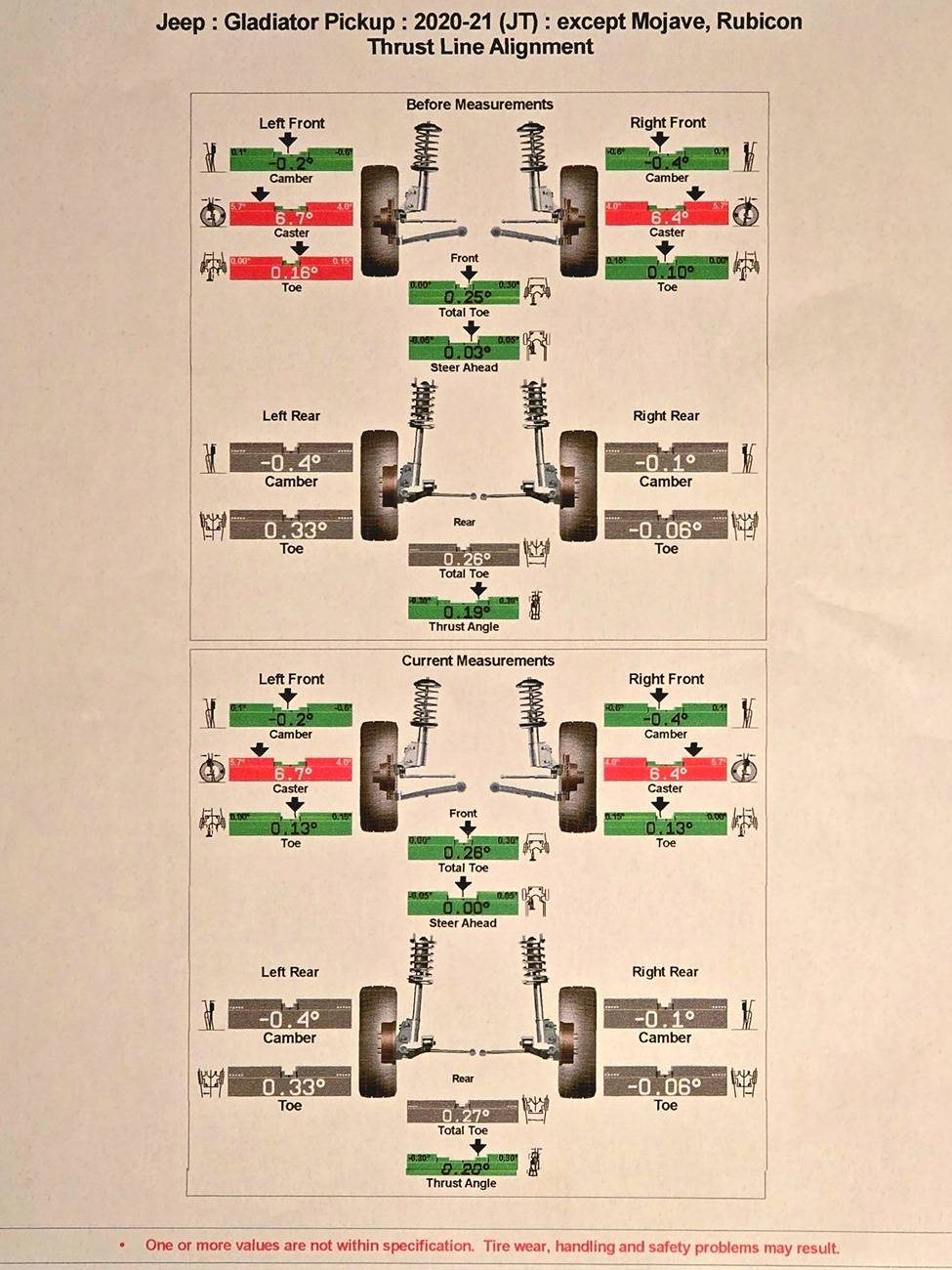
I have a '23 Sport S Eco D and upgraded the LCAs with ones from the Mopar lift kit to increase caster. Immediately, I noticed a pull to the right. I then proceeded to install 1" coil spacers, Bilstein shocks and steering dampener. I also retorqued the lower control arms again with the truck on the ground, but it still pulls to the right. This is with new tires with less than 500 miles on them.

I took the truck to a shop for alignment, and they noted that the caster is 0.3 degrees less on the passenger side, potentially causing the right pull. Ideally, they said that the right side should have 0.5 to 1.0 degrees more caster than the left to accommodate road crown. However, I think I would prefer them to be equal anyway. They suggested I could find offset ball joints online to correct this, although the truck only has 25K miles and no accident history.

Possible solutions:

1) I installed the driver-side LCA first and wonder if there's some play when tightening them down. Could I use ratchet straps to pull the driver side in slightly and then torque it down to correct this?

Or

2) It's possible the Mopar 2" lift kit LCAs may have different lengths (due to tolerances). Switching the driver-side LCA with the passenger side might correct the issue.

What do you think? Would I be wasting time with these solutions, or do you have other ideas? Please see the attached alignment sheet.


Jeep Gladiator Jeep pulls to the right after lower control arm change 20240619_223357
Sponsored


Sweetums

Well-Known Member
Joined
Mar 30, 2023
Threads
28
Messages
2,032
Reaction score
4,391
Location
Utah
Vehicle(s)
'05 LJR, '21 JTDR, '00 VFR800, RSV4, '11 MTS 1200
Swap them and see where you're at, or get aftermarket adjustable control arms so you can correctly set your alignment and pinion.
 

Lunentucker

Well-Known Member
Joined
Apr 24, 2022
Threads
248
Messages
5,877
Reaction score
15,392
Location
Virginia
Vehicle(s)
2021 Jeep Gladiator Mojave
Occupation
People Work?
Loosen the bolts and retorque them with the full weight of the vehicle on the tires. Jounce it a few times before you retighten them.
 

Idlethunder

Well-Known Member
First Name
David
Joined
Mar 22, 2022
Threads
14
Messages
759
Reaction score
951
Location
Oklahoma
Vehicle(s)
2022 JTR, 23 JTRD
Occupation
Manufacturing
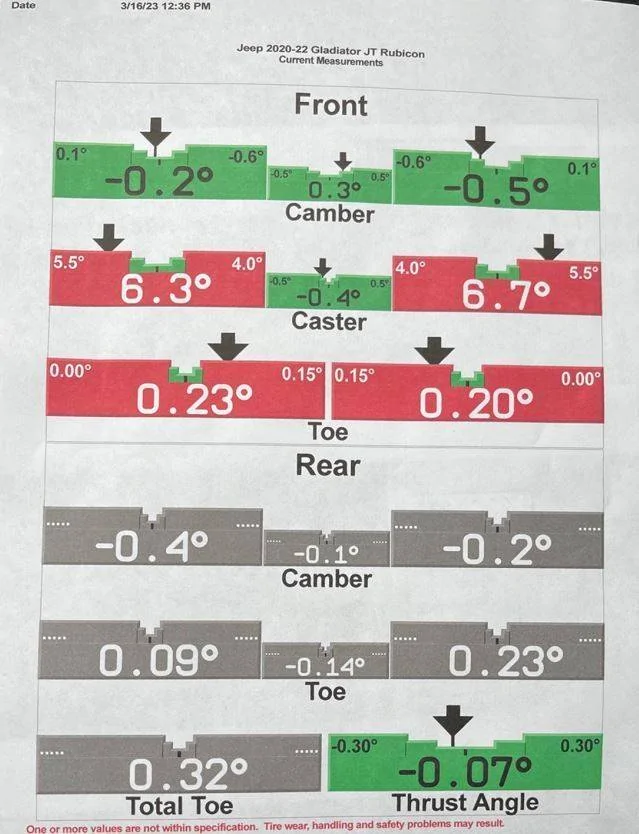
My first thought was caster. Attached is my alignment after installing the Mopar lift arms and my caster is reversed and it drove great. I was instructed to install and torque them down with the front wheels on the ground and that's how I did mine. It has been a couple of years since I installed them but I believe the part numbers were identical. Swapping them side to side may help but they should definitely be tightened down with weight on them

Jeep Gladiator Jeep pulls to the right after lower control arm change Alignment on 3-16-22
 

Vtur

Well-Known Member
First Name
Le
Joined
Mar 6, 2021
Threads
11
Messages
1,940
Reaction score
2,294
Location
Norcal
Vehicle(s)
JTOD
Occupation
Electrical Foreman
Loose the 8 lca & uca bolts (not too much). Backup a few feet then drive forward a few then retorque the bolts. Mono tube damper can make it pulls right slightly too.
 

Sponsored

Wolf Island Diver

Well-Known Member
Joined
Apr 14, 2021
Threads
26
Messages
1,128
Reaction score
2,476
Location
Virginia
Vehicle(s)
2021 JT Rubicon EcoDiesel
Occupation
Software Engineer
The Mopar LCAs shouldn’t be different lengths. They have the same part number. If they were, the alignment would be inherently off, the geometry would be jacked up, etc. Maybe they have terrible QA. That’s not a lot caster difference on a solid axle vehicle.

This is probably an issue of axle centering. When you move the axle vertically, the fixed length track bar limits this movement and pulls the axle to the side. It’s pretty typical that with the stock track bar, which cannot be lengthened to compensate for this, it will make the axle off center at rest. For example, AEV claims its 2.5 lift doesn’t require an aftermarket track bar. However, the axle will be off center at rest after installation. In my experience the truck pulls. The solution is to replace the stock tract bar with an aftermarket one. I installed a Synergy one.

During alignment, this can be adjusted. Note that you can only adjust toe in on these trucks stock. Camber cannot be adjusted on a solid axle vehicle. I’m not sure why they even provided those figures. Camber, adjusts itself over time as your D44 axle slowly bows running big tires 😆. Caster is set via brackets (AEV) or control arm length.
Personally, I don’t like adjustable control arms. I’ve had them fail catastrophically. They will corrode internally at the threads. Lift manufacturers use them because it’s cheaper than manufacturing different length control arms for different tire sizes/lift heights. They could just well make different length arms for different tire/spring combinations. Yes, you can solve “problems” with adjustable LCAs, but outside of a bent frame, these are usually user induced problems or just really radical setups, like tie rod relocations, ram steering, after market axles, 40’s, etc., where clearance is an issue or you’re going for max articulation. Daily driven JTs with 37s really shouldn’t need adjustable control arms even though that’s what everyone sells.

You shouldn’t need to move from fixed control arms to adjustable ones to correct a pulling truck (unless your frame is bent) and in that case you have a much bigger issue. Caster affects the suspension movement, brake performance and overall handling. Unless it’s radically uneven side to side, it shouldn’t cause the truck to pull. When you have adjustable control arms and it’s pulling, then yes unequal control arms can be the cause.

There’s one last thing. All stock-ish, non heim joint control arms need to be torqued on the ground at rest, upper and lower, axle side and frame side. This is critical. The OEM control arm bushings have limited movement (this is actually a good thing). Back in the TJ days we all wanted heim joints, partially because to fit even 35s you needed 6 inch lifts and everything would bind without them and partially because they’re cool. The problem is that they transmit lots of shock into the vehicle constantly. This adds up over time. Good “rubber” bushings are better unless you’re building a buggy or serious crawler. But, because they have limited movement, they need to be reindexed for the lift. That’s done by only tightening them down when the truck is on the ground. Now, improperly indexed control arms shouldn’t technically cause pulling. It will destroy the bushings. But I could see how the limited movement of incorrectly indexed bushing could cause poor stictiony movement of the arm which might be able to manifest as a pull. I would redo the control arm torquing for all control arms, not just the Mopar lowers.

Lastly, don’t discount post-mod psychological hyper sensitivity. Like confirmation bias “this cold air intake, I paid $500 for, really makes the truck feel faster”, you may be more inclined to notice the things that you didn’t before as you check the truck post-lift. In my experience all Jeeps wander and the JT seems to really fall off of center quickly. In other words it is really sensitive to road crowning. And this is exacerbated by bigger tires and a lift. Unequal tire pressure, tread wear, etc also have a pre pronounced effect the higher/bigger you go on these trucks.

Even post-alignment and adjustable track bar, I sometimes feel like my JTRD pulls. Sometimes, not.
 
OP
OP
BallisticJT

BallisticJT

Active Member
Joined
Oct 5, 2022
Threads
2
Messages
44
Reaction score
53
Location
Intermountain West
Vehicle(s)
2023 Gladiator EcoDiesel Sport S, 2004 WJ 4.0L
Sorry for the late update. I suddenly had a lot going on that needed my attention. Thank you all for the replies. To provide some more background, I only loosened the lower control arms when I installed the 1" spacers. I did not touch the track bar or upper control arms.

Fast forward to today, I parked the vehicle on as level ground as I could find and then loosened all eight control arm bolts. I then moved the truck backward and forward a few times and pushed the front and back bumpers down a few times to make sure everything settled. Then I torqued it all up. Lastly, I loosened the track bar, inspected the bushings and bolt holes, and then torqued it up.

I went on a short test drive, and the truck still pulls to the right, but perhaps not as much as it did before (placebo?). I do have Patagonia X/T tires, which have a slight crown to them, which might make them more susceptible to a right pull on crowned roads. I also acknowledge that the monotube damper can cause a pull as well.

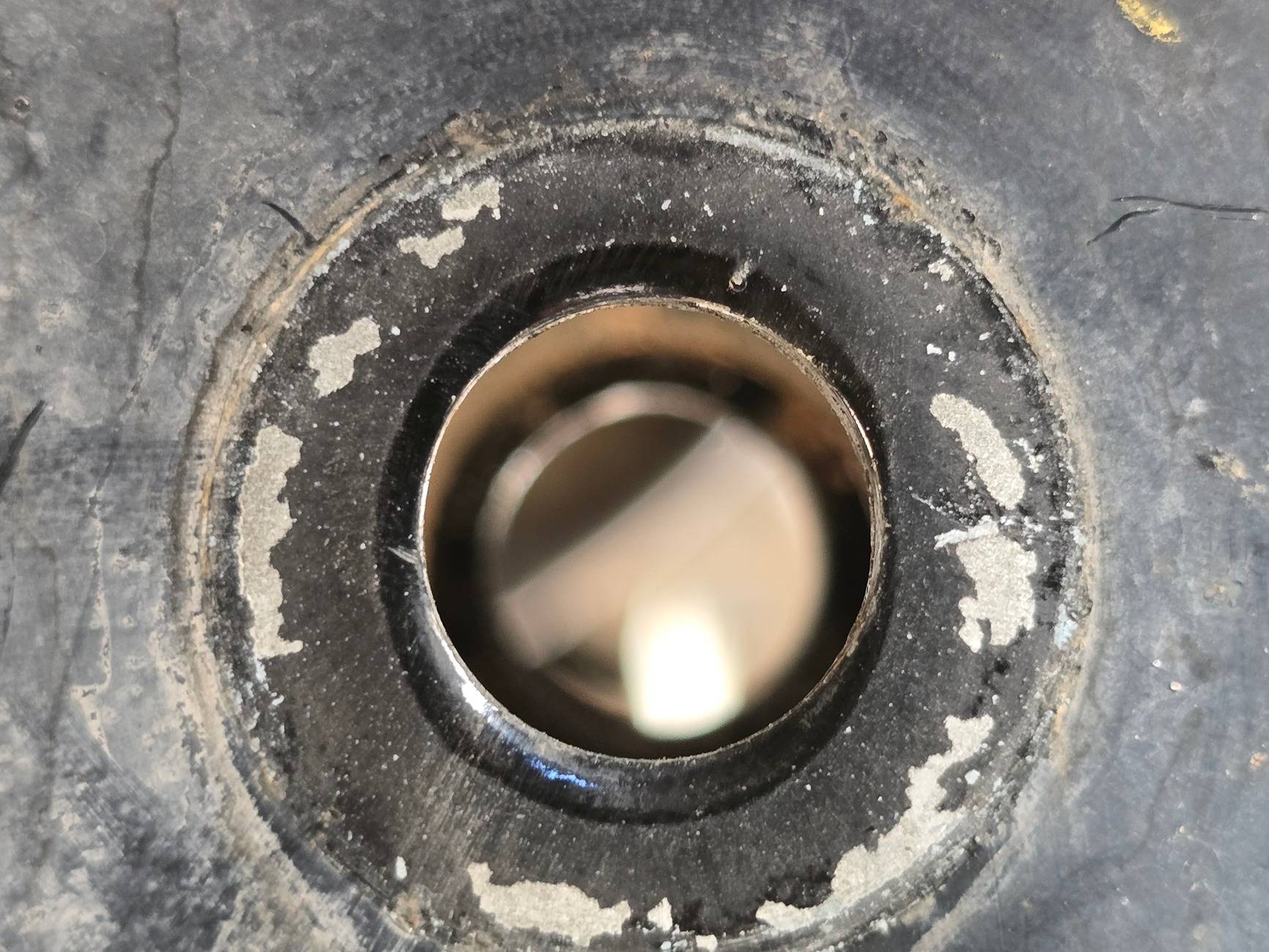
However, I am even more concerned about what I found when I checked the track bar bushings and bolt holes. The axle side looked fine, but the frame side didn't look so good. I could easily tilt the frame side bushing sleeve back and forth with just my fingers. Is that normal? Also, the bolt hole looks like it is just starting to go oblong which I know is a common issue. However, I don't think it is quite that bad yet. I don't have deathwobble but I do have intermittent vibrations at speeds 65 mph and higher. However, this was something I experienced even before the coil spacers and the 34" tires. It just didn't seem enough of an issue to mention before but now I suspect it could be the trackbar causing this as well.

Please take a look at the video and picture and let me know what you guys think.
Jeep Gladiator Jeep pulls to the right after lower control arm change 20240905_151327


Sponsored


Top