Sponsored

rchandler341

Well-Known Member
First Name
Ron
Joined
May 9, 2021
Threads
13
Messages
106
Reaction score
292
Location
Utah
Vehicle(s)
2021 Jeep Gladiator Rubicon
No parts available for the fix as of yet. Mine was replaced at 4581 miles after it blew. I still got a recall. Even though I have a newish pump. I've got 27k miles on it with no issues.
Did they replace the entire HP fuel system? Injectors? Fuel Rails? Lines?
Sponsored


Free2roam

Well-Known Member
First Name
Robert
Joined
Mar 1, 2021
Threads
30
Messages
5,452
Reaction score
11,618
Location
89521
Vehicle(s)
Gladiator
Occupation
Fabricator by trade/ Maintenance Mechanic

rchandler341

Well-Known Member
First Name
Ron
Joined
May 9, 2021
Threads
13
Messages
106
Reaction score
292
Location
Utah
Vehicle(s)
2021 Jeep Gladiator Rubicon
I just got a second updated notice from FCA on this recall which says in bold print:
The remedy for this condition is not currently available.
The previous letter stated that this was waiting on part availability.

In talking to my dealership we agreed that replacing a CP4 with another CP4 makes no sense, since it’s a not a faulty pump. My dealership stated that on Rams, they replaced the CP4 with the CP3. Since the regulator is now involved and it’s costing Jeep a ton of money, I assume they are currently working out the engineering solution (CP3 packaging and fitment) or supply chain issues. At least that’s what we hope. I don’t want to throw CP4s at this and I assume neither does FCA.
I agree that replacing the CP4 with another CP4 is not the final solution. But replacing a known failing CP4 with another new CP4 will gain me more time until the solution is completed. I am just trying to keep my JTRD on the road and use it.
 

Wolf Island Diver

Well-Known Member
Joined
Apr 14, 2021
Threads
26
Messages
1,119
Reaction score
2,463
Location
Virginia
Vehicle(s)
2021 JT Rubicon EcoDiesel
Occupation
Software Engineer
I agree that replacing the CP4 with another CP4 is not the final solution. But replacing a known failing CP4 with another new CP4 will gain me more time until the solution is completed. I am just trying to keep my JTRD on the road and use it.
Yeah, I’m definitely not arguing that if your pump fails you should wait. I’m talking about how this recall will and should be handled. If your pump blows up or shows signs of obvious problems you obviously just can’t wait until Q2 2023 to drive it. If they replace your pump with a new CP4, I don’t think that has any bearing on the recall unless it’s tied to some specific lot number of pumps that the new pump satisfies. That new pump will still have to be replaced once the new design, old design or whatever final solution is determined. I don’t think NHTSA will allow them to claim a replaced pump counts unless, again, it’s associated with a specific lot or generation of CP4 pumps. I haven’t heard that it is. There’s a regulator-mandated Stop Sale on these trucks, so they’re not screwing around.

Out of curiosity, was your truck making any noise prior to the pump failure? Mines been making some occasional weird whining sounds occasionally on startup that doesn’t sound like a typical belt sound. It’s so infrequent, I haven’t really investigated it.
 

rchandler341

Well-Known Member
First Name
Ron
Joined
May 9, 2021
Threads
13
Messages
106
Reaction score
292
Location
Utah
Vehicle(s)
2021 Jeep Gladiator Rubicon
Here is another thing I have found that could possibly save the system in case of failure. I called and spoke to them about installation on a Jeep EcoDiesel. They said that they do not know if it would work and have never been asked that question. If it does bolt up and plug in, possibly this could be a preemptive part to save the entire HPF system, until the solution has been found? I dunno. Here is the Mopar Part also.

https://www.mymoparparts.com/oem-pa...9MjAyMSZ0PXJ1Ymljb24mZT0zLTBsLXY2LWRpZXNlbA==

https://www.spemotorsport.com/products/exergy-cp4-2-inlet-metering-valve-mprop

 
Last edited:

Sponsored

rchandler341

Well-Known Member
First Name
Ron
Joined
May 9, 2021
Threads
13
Messages
106
Reaction score
292
Location
Utah
Vehicle(s)
2021 Jeep Gladiator Rubicon
Yeah, I’m definitely not arguing that if your pump fails you should wait. I’m talking about how this recall will and should be handled. If your pump blows up or shows signs of obvious problems you obviously just can’t wait until Q2 2023 to drive it. If they replace your pump with a new CP4, I don’t think that has any bearing on the recall unless it’s tied to some specific lot number of pumps that the new pump satisfies. That new pump will still have to be replaced once the new design, old design or whatever final solution is determined. I don’t think NHTSA will allow them to claim a replaced pump counts unless, again, it’s associated with a specific lot or generation of CP4 pumps. I haven’t heard that it is. There’s a regulator-mandated Stop Sale on these trucks, so they’re not screwing around.

Out of curiosity, was your truck making any noise prior to the pump failure? Mines been making some occasional weird whining sounds occasionally on startup that doesn’t sound like a typical belt sound. It’s so infrequent, I haven’t really investigated it.
I agree, the recall should replace this pump again even if this replacement I purchased does not fail.

As of now my JTRD runs perfectly and has not suffered a complete pump failure. I do not hear any different noises coming from the pump or engine. I truly believe I have caught this at the first signs of a failure by changing the fuel filter myself and documenting that there were metal shavings in the bottom of the canister. Cutting open the filter did not show any additional metal that I could see with the naked eye.

Every time I change these filters, at 10k miles, they are really dark in color compared to a new filter. I did not see metal in the prior (2)two filter changes. This is one reason I try to do all of my own maintenance. So I can freak myself out sooner!
 
Last edited:

Rusty PW

Well-Known Member
First Name
Russ
Joined
Jan 10, 2022
Threads
37
Messages
11,355
Reaction score
30,305
Location
Fayette Nam, Pennsyltucky
Website
www.youtube.com
Vehicle(s)
'22 JTRD, '11 370Z Nismo, '07 Honda VFR
Build Thread
Link
Occupation
Muff Diver
My build date is 2/22. I still haven't got a recall notice yet. either on the Jeep app, or in the mail.
 

22EcoDs

Well-Known Member
Joined
Oct 14, 2021
Threads
16
Messages
1,515
Reaction score
1,684
Location
NY
Vehicle(s)
22jtsD , 06XK, 21KL - Retired(97ZJ,15JKU, 00WJ,)
My build date is 2/22. I still haven't got a recall notice yet. either on the Jeep app, or in the mail.
Same, Dec 21 build.
 

rchandler341

Well-Known Member
First Name
Ron
Joined
May 9, 2021
Threads
13
Messages
106
Reaction score
292
Location
Utah
Vehicle(s)
2021 Jeep Gladiator Rubicon
My build date is 2/22. I still haven't got a recall notice yet. either on the Jeep app, or in the mail.
I really doubt your CP4.2 is any different than the one they built mine with. But I did get the letter in the mail and my dealer service department says my vin is on the list. This will be interesting to see how Chrysler sorts all of this out.
 

Escape.idiocracy

Well-Known Member
First Name
Rich
Joined
Jan 23, 2022
Threads
37
Messages
1,569
Reaction score
1,822
Location
PNW
Vehicle(s)
Jt
Occupation
Hitchhiker
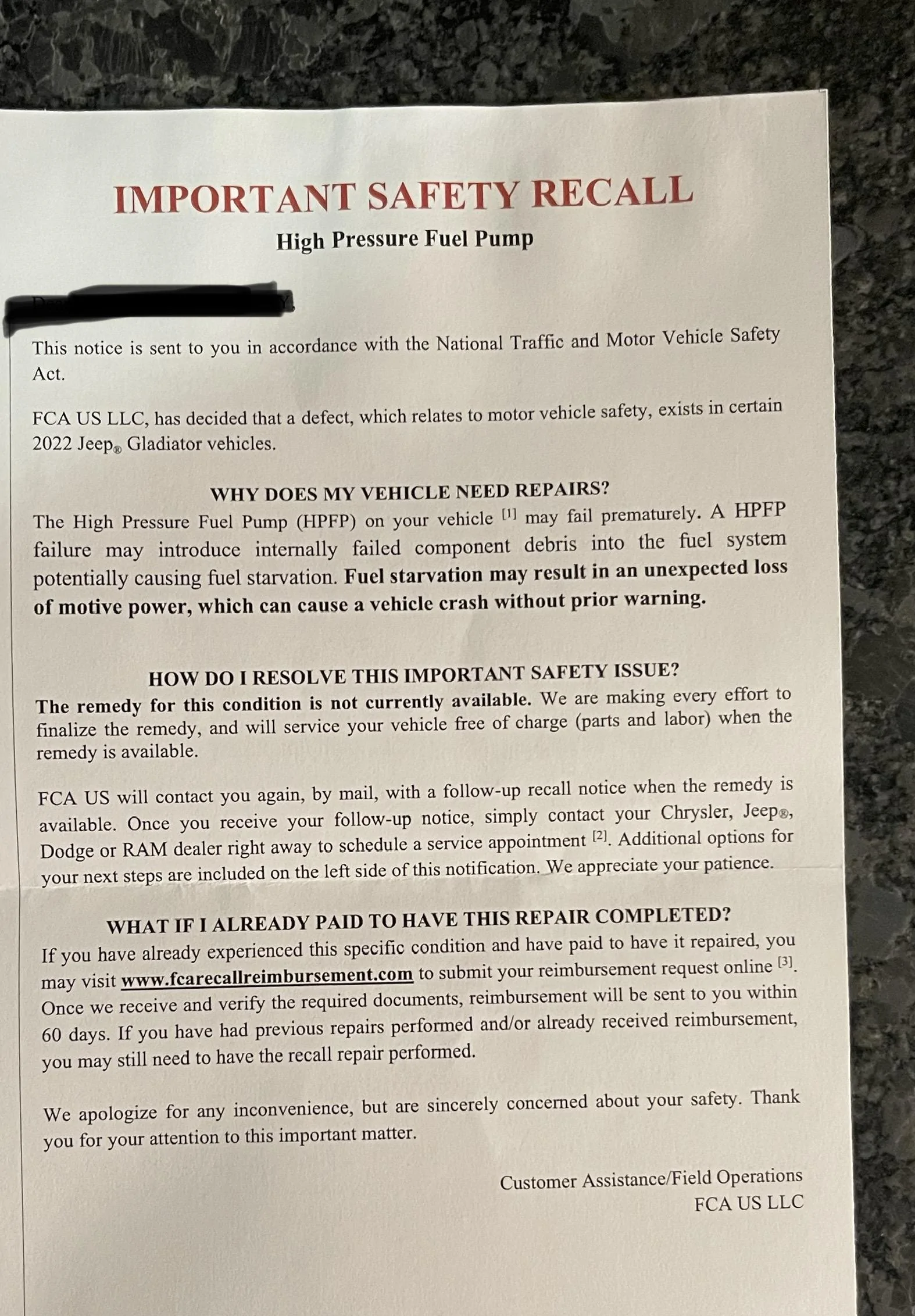
First Mail notification.

Jeep Gladiator 3.0L Diesel High Pressure Fuel Pump Recall Z96 2ED6C4CD-4661-4332-993C-ED8730EBF437
 

Sponsored

22EcoDs

Well-Known Member
Joined
Oct 14, 2021
Threads
16
Messages
1,515
Reaction score
1,684
Location
NY
Vehicle(s)
22jtsD , 06XK, 21KL - Retired(97ZJ,15JKU, 00WJ,)
Those of you that received mail notifications, does your mopar app also have the com?
 

rchandler341

Well-Known Member
First Name
Ron
Joined
May 9, 2021
Threads
13
Messages
106
Reaction score
292
Location
Utah
Vehicle(s)
2021 Jeep Gladiator Rubicon
Just an FYI.

In reading this article there are some tips to possibly help keep your CP4 alive until the recall.
It is below in the Preventing CP4 Injection Pump Failures.

Bosch CP4 Injection Pump Failures
Failure rates of Bosch CP4 injection pumps are high enough that it has spawned multiple class-action lawsuits against automakers who've employed the device that seeks compensation for affected vehicle owners. The greatest concern is not that the injection pumps fail; any fuel pump has a finite life and will eventually require replacement. The problem lies in how the CP4 fails and the contamination it creates within the fuel system.

Typical CP4 Failure Event
The dreaded "failure event", as it has been coined, occurs when fine metal particles accumulate in the crankcase of the CP4. This is typically the result of wear between the roller follower and camshaft and/or the follower body and the cylinder wall. Most tear-downs of a CP4 after failing reveal particle buildup on the roller bearing of the follower and score marks on the camshaft lobe. Scuffing on the body of the follower is generally less severe and may be the result of metal particles being suspended in the lubricating fuel supply. The mesh screen on the fuel volume control actuator cannot secure the extremely fine metal particles created inside the crankcase and they eventually find their way into the pumping chambers where they are sent to the high pressure fuel rail(s). This litters the entire fuel system, from the fuel injectors to the fuel tank, with these metallic particles. Eventually, this debris prohibits proper operation of the fuel injectors, fuel volume control valve, and injection pump; the fuel system is effectively starved and the engine will begin to sputter before ultimately stalling and failing to restart.

The best case scenario following a CP4 failure is that the injection pump will need to be replaced. The worst case scenario, and seemingly more common occurrence, is that you'll need to replace the entire fuel system (injectors, common rail(s), injector lines, injection pump, lift pump, fuel filters, etc) and thoroughly clean the fuel tank. Most dealerships will warranty a failed CP4 pump, but not the entire fuel system should it require attention. Their argument, generally, is that the warranty does not cover fuel contamination, and once metal filings are distributed throughout the fuel system it is classified as a contamination issue that is not covered under the powertrain warranty (thus the pending class-action lawsuits). General Motors TSB 16-NA-102 outlines the procedures for replacing the entire fuel system on an affected Duramax diesel and estimates it at a 18 to 21 hour task.

Causes of Premature CP4 Failure
The most commonly held theory on why the CP4 injection pump fails prematurely is that the ultra-low sulfur diesel (ULSD) fuel available in the United States lacks the lubricity required for the CP4 to be lubricated properly. Some argue that Bosch designed the CP4 for European applications (Bosch is headquartered in Germany) and that the fuel overseas has a higher lubricity than that in the U.S. This is the most common accusation being made in the aforementioned class-action lawsuits seeking compensation from Bosch and the Big 3 automakers. Based on the high amount of metal debris found in the fuel systems following a CP4 failure, in addition to the scouring found on many of the components, this theory makes complete sense; what could cause such extensive wear in a short period of time if not a lack of lubrication.

The CP4 injection pump's sensitivity to lubrication would also lend it an increased sensitivity to water contamination, poor fuel quality, air intrusion, and lift pump pressure. This also helps to explain why failures are seemingly most common on 6.6L Duramax applications, because the Duramax does not employ an electric lift pump and instead relies on the mechanical pump driven by the CP4 camshaft. This may prohibit the fuel system from bleeding properly following fuel filter service or fuel system repairs, and one could argue that additional wear may occur at each start-up before fuel pressure stabilizes.

This would also dictate that the CP4 is sensitive to aeration of diesel fuel. Minute air bubbles become trapped in diesel fuel for a number of reasons including fuel sloshing, minute fuel system leaks, cavitation, and turbulence caused by return fuel flow. Even tiny air bubbles could accelerate wear inside the CP4 pump and create a recipe for disaster.

A lesser pursued theory is in the mechanical design of the injection pump or, more specifically, the geometry of the camshaft and how it contacts the bearing on the follower. The camshaft design is extremely aggressive with steep ramp up and down angles. Furthermore, there are no guides to keep the followers from spinning inside their bores, and the roller on the follower needs to remain perpendicular to the cam lobe contact surface or the roller will glide across the camshaft instead of rolling as it should; this could result in scuffing and accelerated wear of the roller and camshaft lobe contact surfaces. Also recall that the CP4 rotates at twice the engine speed; at 3,000 rpm engine speed, the injection pump is rotating at 6,000 rpm, so the pumping cycles are occurring very rapidly.

The cam design on the Bosch CP3 has a much smoother movement pattern with a lower propensity for wear because 1) the polygonal ring translates on an arced path but does not rotate, 2) the spring tension at each follower is significantly lower, and 3) the stroke length of the follower is shorter.

Preventing CP4 Injection Pump Failures
• Don't run your vehicle out of fuel - ever. Fuel starvation will accelerate wear inside the injection pump due to a lack of lubrication.

• Properly bleed and prime the fuel system after performing service by cycling the key to the "run" position 5 to 10 times for 20 to 30 second intervals so that the electric fuel pump can cycle and prime the fuel system prior to starting. In Duramax applications, use the priming mechanism integrated into the fuel filter housing to thoroughly bleed the system after service.

• Start a fuel additive regiment and use it at each fill-up to increase the lubricity of your diesel fuel so that your CP4 is adequately lubricated. There are many commercially available fuel additives that will significantly improve fuel lubricity. Ensure that the additive you select is compatible with modern exhaust aftertreatment systems (see diesel fuel additives for recommendations).

• Routinely drain your water separator and and replace the fuel filter(s) before being required to do so (adhere to the "severe service" maintenance schedule if one is provided for your vehicle). Always inspect for metallic debris when replacing fuel filters, as this is a sign that the CP4 may be failing.

• Allow the lift pump to run before starting the vehicle. You do not need to cycle the key repeatedly, but let the electric fuel pump run for 5 to 10 seconds after the wait-to-start light is turned off. This will prime the fuel system before each start and allow fuel pressure to stabilize before the engine is started.

• Consider replacing the injection pump preemptively before the 100,000 mile mark. Although some failures happen much earlier, this pump is known to require replacement at or near the 100,000 mile mark.

• Invest in a disaster prevention kit. Although this will not keep a CP4 from failing, it will prevent the fine metal particles from circulating, potentially saving the rest of the fuel system.

• Use an anti-gel/waxing additive in extremely cold weather to improve fuel flow and prevent injection pump starvation.

https://www.dieselhub.com/tech/bosch-cp4-injection-pump-failure.html
 

my dog Trigger

Well-Known Member
First Name
Dale
Joined
Mar 27, 2022
Threads
4
Messages
112
Reaction score
94
Location
Colton California
Vehicle(s)
2022 rubicon gladiator Diesel
Occupation
construction
Vehicle Showcase
2
Hey free2roam mine happened shortly after yours I remembered reading about yours 15,000 miles after they replaced mine dealer said he never seen it happen twice I believed him. I was very care full with fuel and every thing I was just glad it was close to home both times, some have been in the woods wow what a headache no warning or anything just stalls wherever you are glad yours is still going how many miles since done?
Sponsored


Top