
chorky
Well-Known Member
- First Name
- Chad
- Joined
- Feb 26, 2022
- Threads
- 175
- Messages
- 3,466
- Reaction score
- 3,801
- Location
- Montana
- Website
- www.youtube.com
- Vehicle(s)
- '22JTR, '06 LJ, '06 TJ GE
- Build Thread
- Link
- Occupation
- GIS Specialist
- Thread starter
- #1
So I have been doing a LOT of reading, watching, and exploring - to try and find the best option for me. I realize there is a wide range of experiences, preferences, and products, but I want to try and nail down some pro's and cons of bushing types in relation to various products. For this case I am specifically looking at track bar applications - which has different needs than say control arms. But the information might be able to be used for others in different ways.
Theres some major players here and each one offers something great, but also things not so great IMO. Through this thread I am hoping to nail down the right direction to go for track bars.
Steersmarts (standard)
Uses a clevite bushing. I believe this is the same style of bushing in OEM arms. So maximum NVH reduction at the cost of maximum articulation.
Steersmarts HD
Bushings used here are a standard polyurethane bushing with an inner and outer sleeve. I find it coincidental that bushing replacements are easily found and purchased (not easily installed). This is not something I want to deal with on a regular basis and several 'reviews' have discussed the hard bushing failing and and being noisy. But, they e-coat their product which is good for areas with higher levels of corrosion
Clayton
Uses their designed GIIRO bushing. Finding detailed specs on it is difficult but in their own video they say it is a dual durometer self centering bushing - which is the same that Synergy uses. One thing not clear (and not bushing related though) is, are their components e-coated? Are they just powder coated?
Synergy
Use a dual-durometer self centering bushing. Now at first I wasn't sure what this was, but as I read more into it and did some reading, the term 'durometer' found to not necessarily relate to a bushing type or style itself but the hardness of the material. So Clayton and synergy both use a polyurethane bushing that is slightly more advanced than the basic one in the steersmarts. I have recently read reports of synergy bushings also failing - and their arms are not e-coated so corrosion can be a concern. But with all 'reviews' you only hear about the bad typically....so that's not fully helpful.
Teraflex
They use their in house Independent Rotation (IR bushing). This is a type of bonded rubber which allows for more articulation at the cost of some structural stability as there is less internal rubber. Their cutaway shows this. . This can be good and bad of course and there are plenty of reports of their bushings being both good and bad, but the bigger problem is their inner sleeve apparently is larger than the bolt that goes through it allowing for clunking.
Icon
On one end they use a Johnny Joint, and the other end is a multi durometer bushing - without specifications so who knows. Their arms are double powder coated
Rockjock
Johnny Joint on one end and a Flex Axis joint on the other. Johnny Joints are great for movement and articulation - terrible NVH quality. The Flex Axis joint seems to be a standard poly pushing like in the steersmarts HD bar
MetalCloak
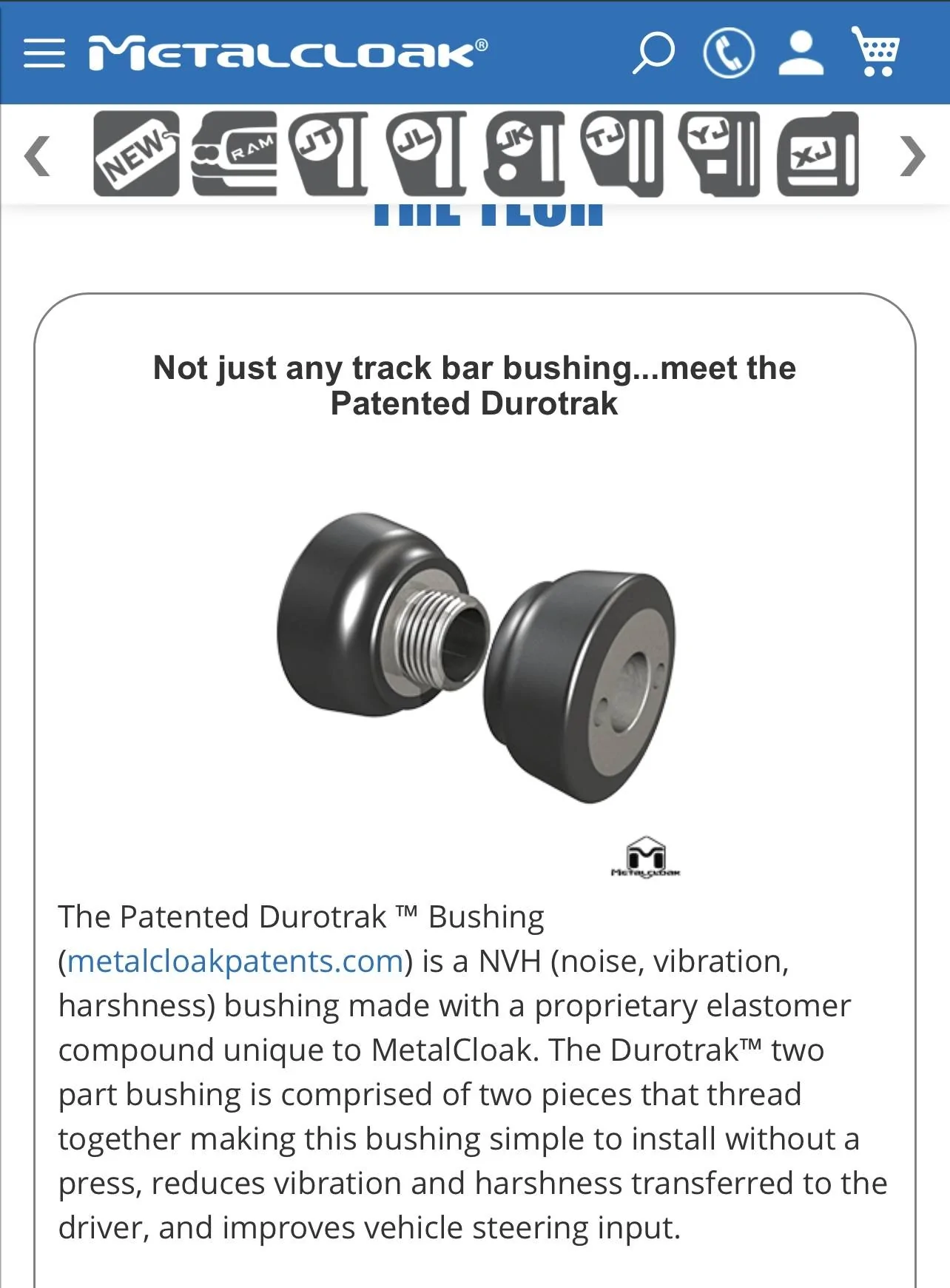
MetalCloak has their own patented bushing discussed here https://metalcloak.com/metalcloak-durotrak-bushing-1.6w-.56id.html Now this particular bushing Is for track bars and is a little different than the bushings in their control arms. They comment on it being a rotational bushing which a key point as track bars would see more rotational forces in bushings that other lateral or vertical forced. They say it is a blend of rubber compounds that offers maximum flex and quality NVH reduction but dont really specify much else. This is frustrating because, like any company, they say theirs is the ‘best’ but that is so subjective. But we all know they make great parts.
JKS
Thanks to another forum member because I forgot about these guys. After looking at their products and watching some videos it is apparent that their standard duty track bars offer a OEM style rubber bushing. They don't necessarily specify the material, and in the written description they do simply use the word 'durometer' which is not at all specific - but in the video they make a point to discuss their bushings being 'soft' like OEM. They also do mention having a heavy duty style bar where the frame side is still a OEM style bushing, while the axle side is a heim joint style for better articulation for those in more hard core situations. One downside is, like most, they only use a powder coat on the steel bar - so when it cracks/chips, rust will become an issue most likely. But another solid option, and JSK seems to be forgotten a lot so hopefully this reminds everyone that they are another option of many.
Now some discussion for bushings
Polyurethane
Can be noisy and 'rough', is more robust in theory than rubber, several companies infuse teflon in some way to quiet them down
Bonded rubber (like OEM)
offers the lowest NVH ride, does not offer the most or best articulation
JohnnyJoint style
More articulation at the cost of NVH. Some styles are like a combination of Johnny Joint and a rubber bonded bushing.
Now - one specific topic I want to discuss is the word DUROMETER. Some googling shows that the word "durometer' means "hardness" of rubber/plastic. So, a "dual-durometer" bushing as described by synergy, or a "multi-durometer" bushing as described by Icon, simply means a bushing with multiple hardness levels. The concern here, is there is not an easy way to understand and know what this hardness level specifically is. Plus, it really does not specify if the bushings are rubber or poly! Which...I think is bad practice. People (well me) want to know specifics without having to spend 5 hours researching each individual item. I would like to know - most people probably don't care because hardness can relate directly or indirectly to NVH. Keeping in mind I am after low NVH at the cost of max articulation. Anyway, soap box over - but just know that "dual-drometer" or "multi-Durometer' as specified on product pages, does not really mean anything without context of hardness levels or specifics. So that makes it difficult to choose the right option for you.
Theres some major players here and each one offers something great, but also things not so great IMO. Through this thread I am hoping to nail down the right direction to go for track bars.
Steersmarts (standard)
Uses a clevite bushing. I believe this is the same style of bushing in OEM arms. So maximum NVH reduction at the cost of maximum articulation.
Steersmarts HD
Bushings used here are a standard polyurethane bushing with an inner and outer sleeve. I find it coincidental that bushing replacements are easily found and purchased (not easily installed). This is not something I want to deal with on a regular basis and several 'reviews' have discussed the hard bushing failing and and being noisy. But, they e-coat their product which is good for areas with higher levels of corrosion
Clayton
Uses their designed GIIRO bushing. Finding detailed specs on it is difficult but in their own video they say it is a dual durometer self centering bushing - which is the same that Synergy uses. One thing not clear (and not bushing related though) is, are their components e-coated? Are they just powder coated?
Synergy
Use a dual-durometer self centering bushing. Now at first I wasn't sure what this was, but as I read more into it and did some reading, the term 'durometer' found to not necessarily relate to a bushing type or style itself but the hardness of the material. So Clayton and synergy both use a polyurethane bushing that is slightly more advanced than the basic one in the steersmarts. I have recently read reports of synergy bushings also failing - and their arms are not e-coated so corrosion can be a concern. But with all 'reviews' you only hear about the bad typically....so that's not fully helpful.
Teraflex
They use their in house Independent Rotation (IR bushing). This is a type of bonded rubber which allows for more articulation at the cost of some structural stability as there is less internal rubber. Their cutaway shows this. . This can be good and bad of course and there are plenty of reports of their bushings being both good and bad, but the bigger problem is their inner sleeve apparently is larger than the bolt that goes through it allowing for clunking.
Icon
On one end they use a Johnny Joint, and the other end is a multi durometer bushing - without specifications so who knows. Their arms are double powder coated
Rockjock
Johnny Joint on one end and a Flex Axis joint on the other. Johnny Joints are great for movement and articulation - terrible NVH quality. The Flex Axis joint seems to be a standard poly pushing like in the steersmarts HD bar
MetalCloak
MetalCloak has their own patented bushing discussed here https://metalcloak.com/metalcloak-durotrak-bushing-1.6w-.56id.html Now this particular bushing Is for track bars and is a little different than the bushings in their control arms. They comment on it being a rotational bushing which a key point as track bars would see more rotational forces in bushings that other lateral or vertical forced. They say it is a blend of rubber compounds that offers maximum flex and quality NVH reduction but dont really specify much else. This is frustrating because, like any company, they say theirs is the ‘best’ but that is so subjective. But we all know they make great parts.
JKS
Thanks to another forum member because I forgot about these guys. After looking at their products and watching some videos it is apparent that their standard duty track bars offer a OEM style rubber bushing. They don't necessarily specify the material, and in the written description they do simply use the word 'durometer' which is not at all specific - but in the video they make a point to discuss their bushings being 'soft' like OEM. They also do mention having a heavy duty style bar where the frame side is still a OEM style bushing, while the axle side is a heim joint style for better articulation for those in more hard core situations. One downside is, like most, they only use a powder coat on the steel bar - so when it cracks/chips, rust will become an issue most likely. But another solid option, and JSK seems to be forgotten a lot so hopefully this reminds everyone that they are another option of many.
Now some discussion for bushings
Polyurethane
Can be noisy and 'rough', is more robust in theory than rubber, several companies infuse teflon in some way to quiet them down
Bonded rubber (like OEM)
offers the lowest NVH ride, does not offer the most or best articulation
JohnnyJoint style
More articulation at the cost of NVH. Some styles are like a combination of Johnny Joint and a rubber bonded bushing.
Now - one specific topic I want to discuss is the word DUROMETER. Some googling shows that the word "durometer' means "hardness" of rubber/plastic. So, a "dual-durometer" bushing as described by synergy, or a "multi-durometer" bushing as described by Icon, simply means a bushing with multiple hardness levels. The concern here, is there is not an easy way to understand and know what this hardness level specifically is. Plus, it really does not specify if the bushings are rubber or poly! Which...I think is bad practice. People (well me) want to know specifics without having to spend 5 hours researching each individual item. I would like to know - most people probably don't care because hardness can relate directly or indirectly to NVH. Keeping in mind I am after low NVH at the cost of max articulation. Anyway, soap box over - but just know that "dual-drometer" or "multi-Durometer' as specified on product pages, does not really mean anything without context of hardness levels or specifics. So that makes it difficult to choose the right option for you.
Sponsored
Last edited: