Sponsored

Manual Shift option wears out transmission

Scott L

Well-Known Member
First Name
Scott
Joined
Feb 16, 2022
Threads
5
Messages
314
Reaction score
527
Location
Strasburg VA
Vehicle(s)
21 Gladiator Rubicon Gecko
Occupation
Depends who you ask
Seriously whatever yall can conclude whatever going back and forth over manually shifting and engine blowby the reality is OP has to have some of the worst luck out of anyone as far as vehicles go and I have to give him credit for not throwing in the towel and buying a Toyota or Honda. One thing is certain if we ever meet in person Kevin you may NOT drive my Gladiator nor any of my other vehicles.
The end
Sponsored


MPMB

Well-Known Member
First Name
Michael
Joined
Apr 30, 2021
Threads
12
Messages
1,820
Reaction score
2,716
Location
Utah
Vehicle(s)
'21 JTR - SG
Occupation
Check your inbox.
Yeah, but boring it doesn't make the engine smaller. It's the same physical dimensions with increased displacement.
It was long ago, it might have been just related to the block.

There's more than one measurement that fits the definition of "smaller." Removing .030" or .060" of each cylinder wall will decrease - make smaller - the mass/weight of the engine.

So you make the engine [block] bigger (displacement) by making it smaller (total mass/weight).
 

ShadowsPapa

Well-Known Member
First Name
Bill
Joined
Oct 12, 2019
Threads
247
Messages
40,499
Reaction score
54,015
Location
Runnells, Iowa
Vehicle(s)
'25 JTMX, '23 JLU 4xe, '82 SX4, '73 Javelin
Occupation
Retired auto mechanic, frmr gov't ntwrk security admin
Vehicle Showcase
3
It was long ago, it might have been just related to the block.

There's more than one measurement that fits the definition of "smaller." Removing .030" or .060" of each cylinder wall will decrease - make smaller - the mass/weight of the engine.

So you make the engine [block] bigger (displacement) by making it smaller (total mass/weight).
Maybe compare the AMC 290 vs. 304 vs. 343 vs. 360 vs. 390 vs. 401
If you don't look at the displacement numbers cast on the block, they all look alike on the outside.
I love it when people ask "oh, is that a small block"? I answer - it's the only block. (well, sort of - you can't bore a 290 and make it a 343 or 360 - the cylinder wall thickness is the factor)
 

ShadowsPapa

Well-Known Member
First Name
Bill
Joined
Oct 12, 2019
Threads
247
Messages
40,499
Reaction score
54,015
Location
Runnells, Iowa
Vehicle(s)
'25 JTMX, '23 JLU 4xe, '82 SX4, '73 Javelin
Occupation
Retired auto mechanic, frmr gov't ntwrk security admin
Vehicle Showcase
3
Seriously whatever yall can conclude whatever going back and forth over manually shifting and engine blowby the reality is OP has to have some of the worst luck out of anyone as far as vehicles go and I have to give him credit for not throwing in the towel and buying a Toyota or Honda. One thing is certain if we ever meet in person Kevin you may NOT drive my Gladiator nor any of my other vehicles.
The end
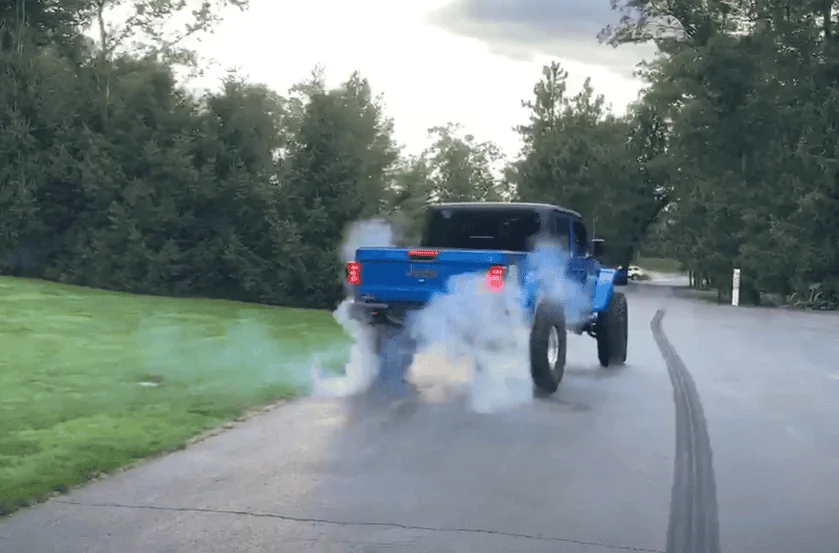
Has anyone ever noted - he's never posted a pic or video of him driving his JT?
I found one.........

Jeep Gladiator Manual Shift option wears out transmission 1700515008619
 

Sponsored

biplaneguy

Well-Known Member
First Name
Dana
Joined
Oct 28, 2023
Threads
15
Messages
221
Reaction score
270
Location
CT
Vehicle(s)
2023 Gladiator Sport
Occupation
Engineer
Sure, it's ultimately the engine working against compression to slow the vehicle, but the transmission is being engaged to do this. And due to friction, this generates heat in the transmission. I think it is a bad idea to intentionally and routinely perform an unnecessary action that results in extra heat in a transmission.
Modern transmissions are pretty efficient; I imagine most of the heat comes from the work of pumping the fluid through it, and fluid friction around the gears. You only get sliding friction at the moment of downshift, until the bands stop slipping.

We have a transmission temperature indicator on the dash... to the OP, have you noticed anything awry there?

It's one thing to use the transmission to help the brakes from time to time, but it's a different thing to consistently use the transmission as the brakes.
Right. Brakes work via sliding friction, so there will always be wear (and friction heat generated proportional to the energy being dissipated) as you use them. When engine braking, the heat comes come from the work of pumping air through the engine; little heat is generated through friction except at the moment of shifting when the bands are slipping.
 
OP
OP
Maximus Gladius

Maximus Gladius

Well-Known Member
First Name
Kevin
Joined
Jan 30, 2021
Threads
75
Messages
2,912
Reaction score
3,717
Location
Calgary, AB, Canada
Vehicle(s)
2021 JTR, 2023 JTR
Modern transmissions are pretty efficient; I imagine most of the heat comes from the work of pumping the fluid through it, and fluid friction around the gears. You only get sliding friction at the moment of downshift, until the bands stop slipping.

We have a transmission temperature indicator on the dash... to the OP, have you noticed anything awry there?


Right. Brakes work via sliding friction, so there will always be wear (and friction heat generated proportional to the energy being dissipated) as you use them. When engine braking, the heat comes come from the work of pumping air through the engine; little heat is generated through friction except at the moment of shifting when the bands are slipping.
At temperatures were always 190 - 199F but mostly at 190F
 
OP
OP
Maximus Gladius

Maximus Gladius

Well-Known Member
First Name
Kevin
Joined
Jan 30, 2021
Threads
75
Messages
2,912
Reaction score
3,717
Location
Calgary, AB, Canada
Vehicle(s)
2021 JTR, 2023 JTR
You are speculating based on being a non-mechanic?
I identify as a non-certified mechanic mechanic. Street learned as far as I wanted to learn and dangerous enough to do amazing things and to also get myself into trouble where my wife will have to then lovingly bail me out. I’m on the spectrum of losing sleep while critically thinking through things without having had the book knowledge or done the classroom time, some would call I have a type or level of genius rarely seen but is tolerated.
 

Sponsored

OP
OP
Maximus Gladius

Maximus Gladius

Well-Known Member
First Name
Kevin
Joined
Jan 30, 2021
Threads
75
Messages
2,912
Reaction score
3,717
Location
Calgary, AB, Canada
Vehicle(s)
2021 JTR, 2023 JTR
One common denominator in all this (I'm going to assume) is it's the same shop doing the work. Could it be they're doing something wrong on install? Suppose you'd never know........
You’re right, same shop has done the work….and unless I take it elsewhere to have their install checked, I’d never know if anything got missed. I would suspect that if the tranny wasn’t quite married with the engine quite right, I’d feel “vibration”?? Just my thinking. This new one is smooth.
 

ShadowsPapa

Well-Known Member
First Name
Bill
Joined
Oct 12, 2019
Threads
247
Messages
40,499
Reaction score
54,015
Location
Runnells, Iowa
Vehicle(s)
'25 JTMX, '23 JLU 4xe, '82 SX4, '73 Javelin
Occupation
Retired auto mechanic, frmr gov't ntwrk security admin
Vehicle Showcase
3
I would suspect that if the tranny wasn’t quite married with the engine quite right, I’d feel “vibration”?? Just my thinking. This new one is smooth.
IF the alignment isn't perfect, yes, vibrations. For a stick, it also skews the nose of the input shaft in the pilot bearing, causing stress, and can cause clutch release issues.
(I learned that at age 15 when doing my first clutch job for a fellow in my shop - WTF - re-aligned and life was good again)
For older manual transmissions with a pilot bushing instead of a real roller bearing, you can get the angry bull elephant sound as the nose of the input shaft rubs too hard against that bronze bushing when you release the clutch and stop for a light.
For an automatic, you put stresses on the flex plate or torque converter (talking legacy transmissions here).
In the past, if you got your hands on some real TSMs, you'd find sometimes there were alignment tools and processes. These days things are so finely machined and pinned, it would take some debris, something on the mating surfaces, or someone not watching and cranking one side down before the other to cause an alignment issue - so it's possible, but man, it would take someone not paying attention to detail. (that's one of the things I'm known for in the restoration world - attention to detail)
I'd also suspect you'd risk breaking something if it was skewed.

If it's smooth, then it's a safe bet things are lined up, mated properly and even.
Otherwise the effect can be similar to a "bent shaft" trying to spin 3,000 RPM or so.

Since I had my own shop by the time I was a junior in high school, I got to skip the first two steps in auto mechanics - my "test" for testing out of the HS level classes was to explain much of this, along with the operation of a Ford C6 automatic, the hydraulic circuits, how the clutches and bands applied to get the various gear combinations, the operation of the governor valve, throttle valve, line pressure and so on. But I have not kept up since the early 90s so these 8 speed transmission I couldn't even begin to tell which clutches apply for what or even ID the spool valves in the valve body. I'd be lost inside one of 'em.
The basics are the same but the technology is superior, the bearings used, thrust bearings and other devices, far better than years ago.

Piston rings I also had to learn very early because of the various cuts of rings, the various shapes, knowing which are used in the top groove, which in the 2nd, types of oil control rings, etc. but this is where college kicked in for the finer points beyond just putting things together correctly.
There's reasons why downshifting won't have impact on piston rings or wear them weird or anything if one wants to get deeper into it.
All one really has to do is think of all of the vehicles over the years with manual transmissions that get downshifted constantly - and that it's been many decades since square cut rings were used.................
About the worst that would happen would be if your valve seals were toast or the valve guides worn, you'd pull oil down past the intake valve stems due to the much higher than normal vacuum created during a hard downshift. I'd have to look close at the design of these PCV systems, but in the past, the PCV actually closed under high vacuum to prevent oil being pulled in during downshifts or high vacuum events.
 

Gvsukids

Well-Known Member
First Name
Justin
Joined
Mar 7, 2020
Threads
26
Messages
7,310
Reaction score
6,950
Location
Grand Rapids
Website
www.youtube.com
Vehicle(s)
2020 Gladiator Sport S Max Tow
Occupation
Delivery Driver
Can we all go back to regular scheduled programming? I've got to go shift my automatic transmission manually.


Top