
ParatusExpeditions
Well-Known Member
Right, my issue is that I can’t file this on the app they don’t have it:Amsoil MS is product code: AFLQT-EA.


Sponsored

Right, my issue is that I can’t file this on the app they don’t have it:Amsoil MS is product code: AFLQT-EA.
That and If I use the Amsoil and keep the interval closer to 10k it would end up costing about the same as changing it twice as often with the cheaper Quaker oil.For a 5K mile change interval, I think you will be wasting your money using the Amsoil.
I'm a bigger fan of shorter intervals. Regardless of oil life your basically doubling the amount of soot in the engine unless it's deleted. I would rather not drive the additional 5K miles with heavy soot loads and a filter that is potentially already at capacity. For this I change mine at 5K or 50% oil life.That and If I use the Amsoil and keep the interval closer to 10k it would end up costing about the same as changing it twice as often with the cheaper Quaker oil.
Just wasn’t sure if it might be better to change it more frequently since it’s a relatively dirty engine.

It's really going to be a personal decision. Do you want 20% lower wear metals? If so, go with Amsoil MS. Are you okay with 20% higher wear metals? Then go with the Quaker State. Is it going to matter when you sell/trade your EcoDiesel in 5 - 7 years? Probably not.So after reading the many pages on different oils I’m still at a loss on if there’s any real world benefit of paying almost double for the Amsoil MS vs just using the Quaker state Euro and keeping oil change intervals around ever 5k miles?
Here's the link for the product: SAE 5W-40 MS Synthetic European Motor Oil | AFL - AMSOILRight, my issue is that I can’t file this on the app they don’t have it:
I'm pretty hard on my EcoDiesel engines. I do a lot if idling, short commutes, heavy towing, and high temp operation when pulling mountain grades, plus I run biodiesel blends. For this reason, I change the oil somewhere between 5,000 - 6,000-mile intervals.That and If I use the Amsoil and keep the interval closer to 10k it would end up costing about the same as changing it twice as often with the cheaper Quaker oil.
Just wasn’t sure if it might be better to change it more frequently since it’s a relatively dirty engine.
I personally wouldn't run the oil for 10,000 miles either, at least not on an emissions compliant EcoDiesel. I've mentioned my high temp operation (running the oil above 250*F), but the low temperature operation is also hard on engine oil, which is why I track engine hours as well as miles.I'm a bigger fan of shorter intervals. Regardless of oil life your basically doubling the amount of soot in the engine unless it's deleted. I would rather not drive the additional 5K miles with heavy soot loads and a filter that is potentially already at capacity. For this I change mine at 5K or 50% oil life.
| Date | Odometer Mileage | Idle Hours | Driving Hours | Total Hours | Oil | Filter | Interval |
| 08/29/22 | 107,008 | 322 | 2,540 | 2,862 | T6 5W-40 | Mopar | 6,460 |
| 02/20/23 | 112,010 | 343 | 2,676 | 3,019 | T6 5W-40 | Mopar | 5,002 |
Monitoring wear metals is a very important part of the story. If you start to see wear metals increase, then you need to investigate why. Did the viscosity fall below spec due to fuel dilution? Has the oil oxidized to the point that the additive package no longer protects the engine? Has the sample been flagged due to contamination (coolant leak caused by a failed head gasket)?Correct me if I could be wrong here.......
Wear metals in the oil only tell part of the story?
Sure can’t beat that price. I’m going to take delivery of mine in a couple weeks and also plan to keep it for a long time so trying to plan a good but reasonable maintenance plan for it. I do plan to remove certain things upon delivery so that will help with longevity of the oil but I still think 10k is a bit much. The only vehicle I do 10k oil changes on are my 05 vw tdi with 270k currently on it.I'm pretty hard on my EcoDiesel engines. I do a lot if idling, short commutes, heavy towing, and high temp operation when pulling mountain grades, plus I run biodiesel blends. For this reason, I change the oil somewhere between 5,000 - 6,000-mile intervals.
I'm keeping both of my trucks for the long haul (15+ years). There are many things that can cause an engine failure. Generally speaking, the oil that you use isn't going to be one of those causes.
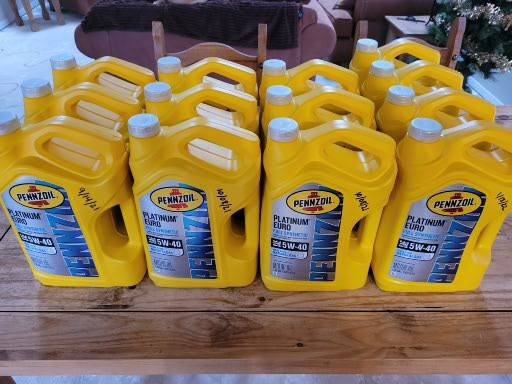
I bought 13 jugs of Platinum Euro for $14.25 per jug, which comes out to $2.85 per quart. I purchased enough oil to get me through the next 4+ years.

Agreed....it's all about norms and trends.Monitoring wear metals is a very important part of the story. If you start to see wear metals increase, then you need to investigate why. Did the viscosity fall below spec due to fuel dilution? Has the oil oxidized to the point that the additive package no longer protects the engine? Has the sample been flagged due to contamination (coolant leak caused by a failed head gasket)?
The reason we submit oil samples is to establish norms for the engine. The more people who submit samples, the easier it is to establish those norms. For example, we know that aluminum in the Jeeps is lower than aluminum found in the Ram samples.
My 5k qs numbers looked good.So after reading the many pages on different oils I’m still at a loss on if there’s any real world benefit of paying almost double for the Amsoil MS vs just using the Quaker state Euro and keeping oil change intervals around ever 5k miles?
It's always important to refer to data based on miles. Here's an example:The engine who has double the wear metals as my engine does but changes it at 5,000 miles rather than my 9-10,000 miles has 4 times the wear assuming we are using the same filter in theory?
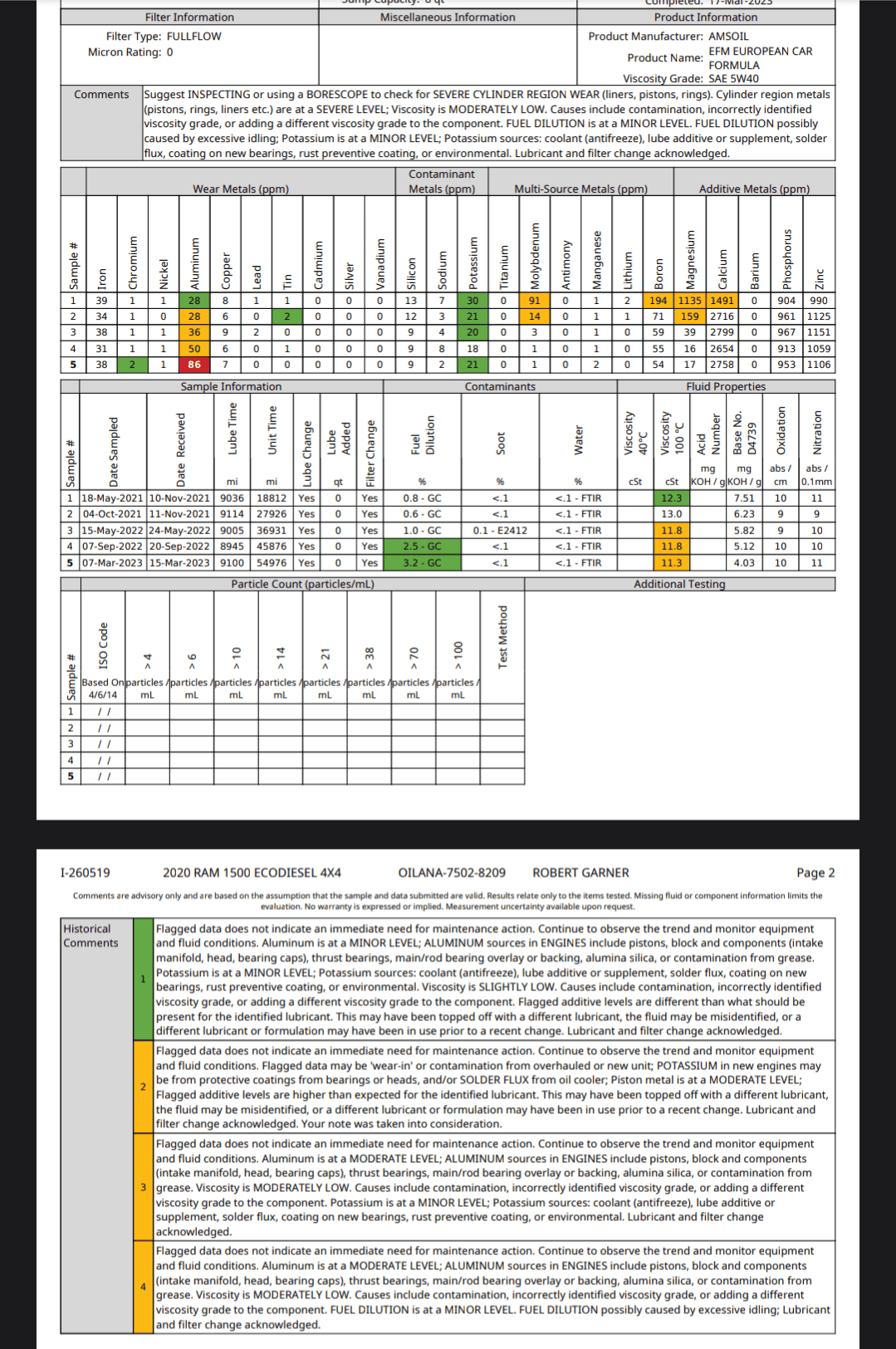
In my opinion, taking oil samples is more important than the oil you run. However, a superior oil (as tested) will outperform a cheaper oil (as tested) in various categories. For example, I run Rotella T6 in my 2015 EcoDiesel. It is a relatively cheap oil; however, it produces good UOA results. With that said, Rotella T6 is really only suitable for up to 6,000 miles for my type of use before I begin to notice oxidation and wear numbers. Also, cheaper oils, like Rotella T6, have a high NOACK rating, which sends vapors back into the intake. This isn't good for those of us with emissions compliant trucks. If I pull the Charge Air Cooler pipe, intake, or PCV hose, then I'm going to see a lot of oily residue. That oil vapor also causes buildup in the DPF. So yes, there are lots of reasons why a good oil is better than a cheap oil.This is why I spend the money for the [arguably] better oils. I have a buddy that swears new cheap oil is better for the engine than higher quality, better filtered, and better additive packed oils run for more miles.......I disagree.
I have my issues with Horizon, too. They use a good lab, and I like their UPS pre-paid testing kits, but their online system is outdated and needs overhauled.My problem with Horizon is that they keep asking me for the engine component model? How much more descriptive can I be than 3.0 Ecodiesel? I have tried in the past to correct it on their website, but the Ecodiesel was not an available component at that time.


