Sponsored

My thoughts on the auxiliary battery

Mr._Bill

Well-Known Member
First Name
Bill
Joined
Jul 22, 2019
Threads
38
Messages
6,647
Reaction score
7,727
Location
North Las Vegas, NV
Vehicle(s)
2023 Gladiator High Altitude - 2013 Nissan Leaf SV
Vehicle Showcase
1
This situation is also one of the reasons I went the route of the Genesis system and stuck with AGM house batteries. Self jump starting. Because I and many I know have been in the middle of nowhere with a no-start battery issue. Just throwing that out there
My DIY Genesis kit saved me when my main battery failed. I had to jump start myself for a week until I got the new battery installed.
Sponsored


chorky

Well-Known Member
First Name
Chad
Joined
Feb 26, 2022
Threads
175
Messages
3,466
Reaction score
3,801
Location
Montana
Website
www.youtube.com
Vehicle(s)
'22JTR, '06 LJ, '06 TJ GE
Build Thread
Link
Occupation
GIS Specialist
My DIY Genesis kit saved me when my main battery failed. I had to jump start myself for a week until I got the new battery installed.
That has always been a worry of mine especially in a cold climate. All 3 vehicles I have owned here, plus our gov trucks, pretty much charge at the maximum output they are capable of 9 months out of the year. It's pretty crazy. But every year theres more than a handful of people who get in a really bad situation with winter temps and breakdowns or accidents on the highway. And those are all on major highways.

Im curious what you used for a solenoid/combiner.
 

Wageslave

Well-Known Member
Joined
Mar 26, 2021
Threads
8
Messages
208
Reaction score
399
Location
IL
Vehicle(s)
'06 GC Overland, '21 Gladiator Overland EcoDiesel
In my case, the AUX battery has failed on me both times coming into cold weather. I replaced both batteries as a precaution the first time but that main battery lives on 'til this day in my Grand Cherokee with no issues. I replaced the AUX battery with an ES-TX14-BS motorcycle battery the first time due to availability issues with the AUX14 battery (Same guts, nut and bolt posts instead of stud posts). No more issues and ESS readily available through fall of this year. Original AUX battery tested bad.

This week I started getting getting Aux switches unavailable errors again any time I hadn't ran it or had it on the trickle charger for more than 24 hours. Main battery tested good, AUX battery needed charging but tested good afterwards. I threw it in my motorcycle and haven't had any issues cold starting it with that battery so it seems to have nearly all its rated CCA still available.

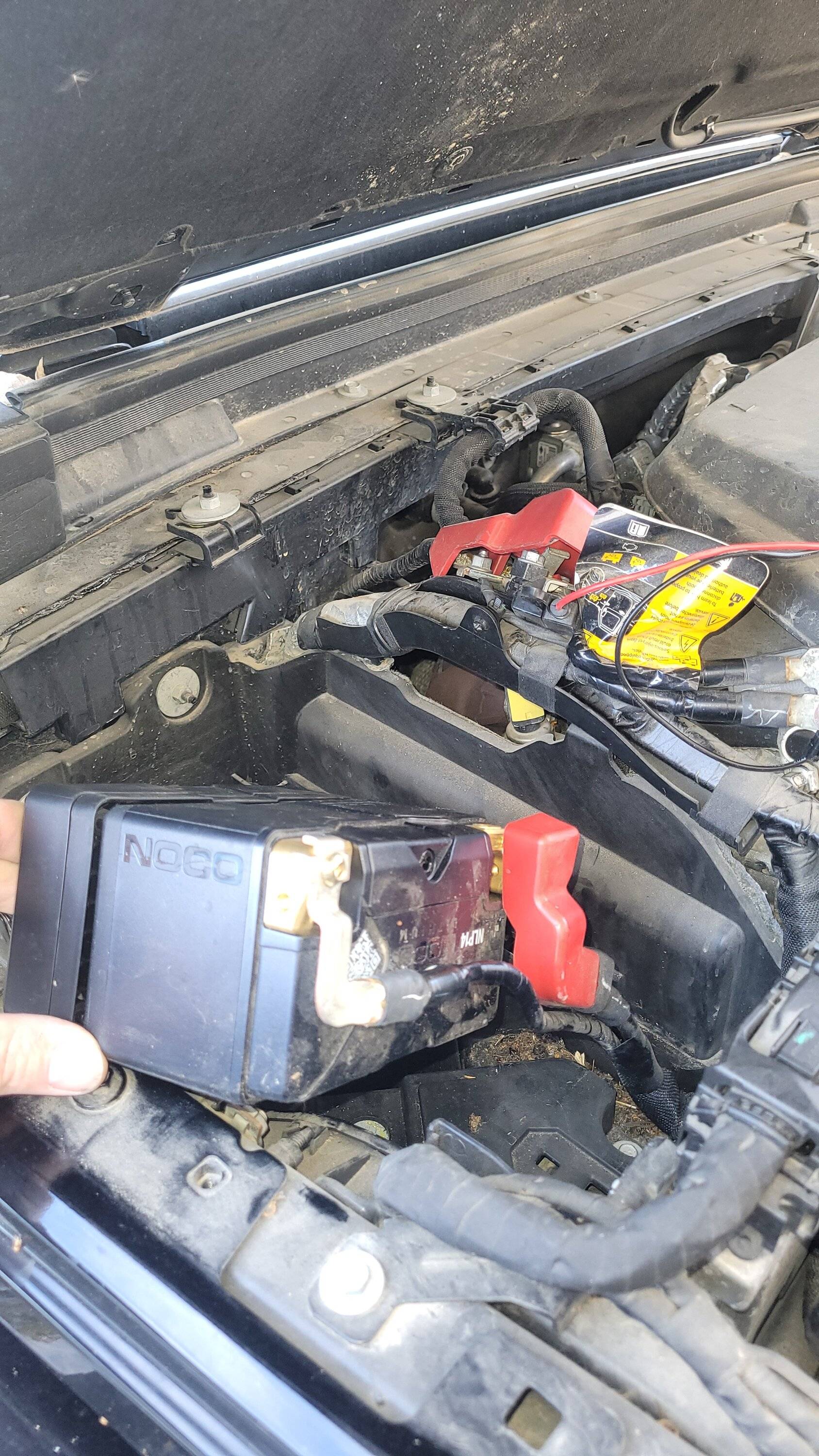
This time around, I decided to try out a theory that I had and installed a NOCO NLP14 LiFePO4 battery in the AUX battery position. My theory is that when cold weather hits and possibly even in warmer weather, the charge profile for low temperatures is correct for the main battery but is too conservative for the AUX battery and the computer ends up holding it at a lower than ideal voltage. This fatigues the battery over time and shortens the life a battery that is probably designed for a 3-5 year service life in the best case.

What should make the NLP14 special is the fact that it is a retrofit Lithium battery that has a charge controller that is programmed to simulate an AGM lead acid battery. This should mean it can be connected in the same way with no modifications to the truck and the charge voltages will be compatible.

The internal charge controller should regulate the battery separate from what the PCM is doing with the main battery, allowing it to basically protect itself.

I installed the NLP14 a week ago and reset the IBS, and after it relearned my ESS has been showing ready as soon as it was up to full temperature. I have had it stop the motor for 2 minutes at a light, then stop again a few blocks down the road so capacity doesn't seem to be an issue. After sitting for 48 hours, there was no abnormal issues with voltages at startup and no extended wait times for the ESS to become ready.

Unless there is a very slow draw between the batteries that shows itself after weeks of sitting, I don't see any reason why this setup wouldn't have superior reliability to the AGM battery for the same price (-ish) as an AUX14.

Jeep Gladiator My thoughts on the auxiliary battery 20231215_125149
 
Last edited:

jebiruph

Well-Known Member
First Name
Jerry
Joined
Dec 9, 2018
Threads
15
Messages
806
Reaction score
730
Location
IA
Vehicle(s)
2018 Wrangler JL 2024 Grand Cherokee L WL 2020 Gladiator JT
In the past, airbag, ABS would typically trigger faults during an engine start due to the voltage drop. U codes also also pop up ( communication errors) It may not cause permanent damage bit repeated over and over is asking for trouble. Relying on one battery ( aux deleted f42 pulled) is not the design of the system. I can see a good main battery holding up. Eventually, it will degrade and cause issues.
Which past vehicle are you referring to?
 

Mr._Bill

Well-Known Member
First Name
Bill
Joined
Jul 22, 2019
Threads
38
Messages
6,647
Reaction score
7,727
Location
North Las Vegas, NV
Vehicle(s)
2023 Gladiator High Altitude - 2013 Nissan Leaf SV
Vehicle Showcase
1
That has always been a worry of mine especially in a cold climate. All 3 vehicles I have owned here, plus our gov trucks, pretty much charge at the maximum output they are capable of 9 months out of the year. It's pretty crazy. But every year theres more than a handful of people who get in a really bad situation with winter temps and breakdowns or accidents on the highway. And those are all on major highways.

Im curious what you used for a solenoid/combiner.
This is what I installed in the fall of 2019. At the time, it was the retail equivalent of what Genesis was using in their kit. I installed a remote status light and button under the edge of the dash above the OBD port.

Cole Hersee 48530 Smart Battery Isolator 200A https://a.co/d/iSq7Bal
 

Sponsored

@californiajeeping

Well-Known Member
Joined
Apr 1, 2020
Threads
16
Messages
953
Reaction score
1,006
Location
California
Vehicle(s)
2022 Jeep Gladiator diesel, 1977 cj5 LS swapped
I deleted my aux battery and ran the positive lead up to the main and negative to the fender ground location. I used a larger odyssey battery.
I’ve owned 2 of these and both had major battery issues and never say more than 13v. Each trip to the dealer they would repeatedly charge both batteries all day then test and say they are fine. Only to be met with issues down the road the next morning.

Now? I see 14.4-14.8v while driving. In park the alternator turns off and it drops to 12.8-13v why? Nobody knows. Also while cruising with the stock setup voltage drops as part of the smart charging crap. Now it says solid above 14v.

With one battery ESS works as normal EXCEPT! Here is what the aux is supposed to cure. With one battery occasionally during auto stop (I normally disable it) the aftermarket stinger radio will power cycle.

was the aux battery garbage worth curing the above? No. A special radio would have been the way to go. Or in fact don’t sell the vehicle with auto start stop.
 

sharpsicle

Well-Known Member
Joined
Apr 29, 2021
Threads
22
Messages
2,767
Reaction score
6,257
Location
Tampa, FL / Milwaukee, WI
Vehicle(s)
2020 Gladiator Overland, 2002 VTX1800
Now? I see 14.4-14.8v while driving. In park the alternator turns off and it drops to 12.8-13v why? Nobody knows. Also while cruising with the stock setup voltage drops as part of the smart charging crap. Now it says solid above 14v.
The solid 14V+ indicates there's a heavier than needed load on your system, battery related or otherwise. These aren't the same charging systems from decades ago. Today that definitely is not normal and I'd hate to see signs get ignored and then hear "oh no it won't start this came out of nowhere".

Things like smart alternators aren't 'crap' just because you don't understand them.
 

Lost1wing

Well-Known Member
First Name
Tim
Joined
Dec 22, 2020
Threads
24
Messages
2,609
Reaction score
2,858
Location
West Georgia
Vehicle(s)
2020 Jeep Gladiator Rubicon
Occupation
Retired AMT
Well we definitely know without a doubt that a bad aux or main battery will pull down the other and making some really messy problems. I fail to see how that situation would be any better than relying on one battery and it slowly dying. Either way, unless ESS is turned off, a person will see Christmas lights.

I could understand how, if keeping the factory aux battery, it somehow protects all those circuits, doesn't throw codes or lights, and truly stabilizes voltages. But that's just not the case..... And that really can't be the case unless said circuits are totally isolated and running purely on the aux battery. But in that event, when the aux eventually does go bad it will still cause those systems to freak out. The only way to prevent any of this, that I can see, is be presumptive and replace batteries every 2-3 years no matter if they are good or bad - just to stay ahead of the game.
I drag it out, replacing batteries. I would be looking at 30 batteries in a 3 year period, not including the lawn tractors and utvs. And somehow, I never get stranded.
 

@californiajeeping

Well-Known Member
Joined
Apr 1, 2020
Threads
16
Messages
953
Reaction score
1,006
Location
California
Vehicle(s)
2022 Jeep Gladiator diesel, 1977 cj5 LS swapped
The solid 14V+ indicates there's a heavier than needed load on your system, battery related or otherwise. These aren't the same charging systems from decades ago. Today that definitely is not normal and I'd hate to see signs get ignored and then hear "oh no it won't start this came out of nowhere".

Things like smart alternators aren't 'crap' just because you don't understand them.
What does it need to do. Charge the battery and provide power to needed systems. What’s the float voltage of an agm battery? 14.6-14.8v. I don’t need smart charging. I just need a reliable electrical system which this is now providing. Intact if I could turn off the smart charging crap and go load based that would be perfect.
 

Raven65

Well-Known Member
Joined
Oct 25, 2022
Threads
12
Messages
275
Reaction score
427
Location
SC
Vehicle(s)
2022 Jeep Gladiator Sport S
My biggest gripe with ESS and the aux battery is simply where they decided to put it and the fact that it requires an hour of work to change it out! If you could swap it out in just a few minutes (like the main battery), it would be FAR less of a hassle. I get that there isn't a lot of room under the hood for the Jeep engineers to work with, but they should have come up with a better place to put it. Hell, they could have located it under the rear seat - or in a compartment behind the glove box! Burying it under the main fuse panel so that you have to remove that - or remove the pass. front tire and go in through the fender well (likely breaking mounting clips in the process) to access it is just ludicrous. I'll let Jeep replace my batteries if/when they crap out while it's under warranty - and if I keep it beyond that, I'll be eliminating the aux batt and ESS.
 

Sponsored

sharpsicle

Well-Known Member
Joined
Apr 29, 2021
Threads
22
Messages
2,767
Reaction score
6,257
Location
Tampa, FL / Milwaukee, WI
Vehicle(s)
2020 Gladiator Overland, 2002 VTX1800
My biggest gripe with ESS and the aux battery is simply where they decided to put it and the fact that it requires an hour of work to change it out! If you could swap it out in just a few minutes (like the main battery), it would be FAR less of a hassle. I get that there isn't a lot of room under the hood for the Jeep engineers to work with, but they should have come up with a better place to put it. Hell, they could have located it under the rear seat - or in a compartment behind the glove box! Burying it under the main fuse panel so that you have to remove that - or remove the pass. front tire and go in through the fender well (likely breaking mounting clips in the process) to access it is just ludicrous. I'll let Jeep replace my batteries if/when they crap out while it's under warranty - and if I keep it beyond that, I'll be eliminating the aux batt and ESS.
100% agree the placement is nuts. I'm sure there would be far less people complaining if they could easily swap out that battery when the time comes.

What does it need to do. Charge the battery and provide power to needed systems. What’s the float voltage of an agm battery? 14.6-14.8v.
That's not float voltage, that's charging voltage. AGM float voltage is in the low to mid 13's. Something's up if your system constantly thinks the battery needs to be recharged.

Your excess load is probably draining your battery repeatedly and it never gets to the float voltage. The system then supplies charge voltage (14v+) in an attempt to get it there. Would also explain why you've gone through so many batteries.
 
Last edited:

ShadowsPapa

Well-Known Member
First Name
Bill
Joined
Oct 12, 2019
Threads
247
Messages
40,445
Reaction score
53,876
Location
Runnells, Iowa
Vehicle(s)
'25 JTMX, '23 JLU 4xe, '82 SX4, '73 Javelin
Occupation
Retired auto mechanic, frmr gov't ntwrk security admin
Vehicle Showcase
3
The literature I have read indicates that the purpose of splitting the aux battery during a stop/start event is to shield the main battery and alternator from excessive starting loads.
What literature could possibly claim that?
What startup load does the alternator need to be shielded from? They can't be serious.
If this were the case, that alternators needed to be shielded from something, then the automotive world would be in a heap of trouble. Many engines take a whole lot more to crank and start than these do. There's no load on the alternator until the startup sequence is finished and it's in charging mode - and even then, it's charging two batteries - similar load to one larger battery (as you already understand)

If the main battery were much larger, there'd be no load to shield it from. It could handle it.

So that "literature" is from who, or what? Hope not a forum, or one of those "i used to be an engineer for......" types.
 

ShadowsPapa

Well-Known Member
First Name
Bill
Joined
Oct 12, 2019
Threads
247
Messages
40,445
Reaction score
53,876
Location
Runnells, Iowa
Vehicle(s)
'25 JTMX, '23 JLU 4xe, '82 SX4, '73 Javelin
Occupation
Retired auto mechanic, frmr gov't ntwrk security admin
Vehicle Showcase
3
The solid 14V+ indicates there's a heavier than needed load on your system, battery related or otherwise. These aren't the same charging systems from decades ago. Today that definitely is not normal and I'd hate to see signs get ignored and then hear "oh no it won't start this came out of nowhere".

Things like smart alternators aren't 'crap' just because you don't understand them.
It can mean it's cold outside, or that the IBS is out of sync due to blind charging or pulling loads from under the IBS, or the batteries are below 80% and it takes a lot more power to get that last bit of charge in, several things come to mind, including batteries that are low or not properly charged. AGM batteries take a whole different approach. My NAPA charger and my BatteryMinder both have charts in the books that show the way they are charged, including the absorption phase which is the next to the last phase of charging. It's an elevated voltage phase. So sometimes I'll see voltages up in the high 14s before things finally settle down to low 13s or lower. Depending on battery age, condition and so on, it can take some time.

What should make the NLP14 special is the fact that it is a retrofit Lithium battery that has a charge controller that is programmed to simulate an AGM lead acid battery. This should mean it can be connected in the same way with no modifications to the truck and the charge voltages will be compatible.

The internal charge controller should regulate the battery separate from what the PCM is doing with the main battery, allowing it to basically protect itself.
For the aux battery that makes sense because there is NO regulation or charge handling of the stock AGM aux battery. The only sensing is done for the main/crank battery. the aux gets whatever is tossed out there.
With the built-in electronics, it will hopefully make that battery less prone to failures from being over or under charged because the charging system doesn't really directly monitor that battery for temperature or state of charge.
Seems a reasonable replacement direction.
Would be interested in long-term results over some time.

I do hope you did a full charge on the main/crank AGM battery when you reset the IBS.
Otherwise, sound theory.
 
Last edited:

ShadowsPapa

Well-Known Member
First Name
Bill
Joined
Oct 12, 2019
Threads
247
Messages
40,445
Reaction score
53,876
Location
Runnells, Iowa
Vehicle(s)
'25 JTMX, '23 JLU 4xe, '82 SX4, '73 Javelin
Occupation
Retired auto mechanic, frmr gov't ntwrk security admin
Vehicle Showcase
3
Well we definitely know without a doubt that a bad aux or main battery will pull down the other and making some really messy problems.
MAY, not WILL. you can have one fail and not have a bad impact on the other.
That's where one of the problems is out there, the belief that one goes and always takes out the other and that's really not true. It can, depending on how it fails and so on, but there's been enough people here have one battery fail, they move forward replacing that one and live another year before replacing the other battery. Some live with a bad aux battery for some time before replacing it, not really having a huge impact on the other.
Batteries can fail in multiple ways. If one fails with an open, or an open cell, it simply does nothing to contribute to or take away from the other battery, for example.
If one fails with a shorted cell - then attempts to jump will be problematic and leaving it unreplaced will cause troubles by draining the other battery, being a load on it like leaving a light on.
This is the case with almost any dual battery system that doesn't isolate the batteries while idle or not in use.
Look at the diesel farm tractors running 2 or 4 batteries - one can fail, the engine turns over very slowly, and yet you only have one bad battery, the others are fine (I know this from experience)
I've replaced 1 of 4 batteries in a M-F tractor where just the one battery was bad, it didn't take down the others. I replaced the one battery for the guy and charged all of them just because that's how it should be done, and he went on using it for a long time. The one dead battery did no harm to the others.
Sponsored


Top