Sponsored

Hmm, this is an interesting solution. No More Dry Starts

629

Well-Known Member
First Name
J
Joined
Nov 18, 2024
Threads
2
Messages
48
Reaction score
76
Location
Town Mountain
Vehicle(s)
Gladiator, K5, XJ, 5.9 Cummins, 72 Buick, etc etc
Occupation
The man
What I found on my first oil change surprised me.
I left the jeep over night and drained the oil the next morning.
When I removed the filter cap and pulled the filter out there was NO oil in the housing and no oil even dripping off the filter. I said to my self. This is not right.
That's when I started looking for a solution and came across the Baxter.
A year later and after talking to my local 4x4 shop how has installed dozens I installed one on my Rubicon. NO MORE BONE CHILLING RATTLE RATTLE ON COLD STARTS.
I now have one on both my jeeps and wish I had done it sooner.
Do the test. Let it sit over night and remove the filter and you will find no oil in the housing.
All the oil from the housing and oil cooler has drained back to the pan.
Thanks for the “real world” advice. I’ll give it a try this weekend. I’m going to do it’s first oil change anyway.
Sponsored


willys 41

Well-Known Member
First Name
Larry Olund
Joined
Oct 12, 2022
Threads
1
Messages
446
Reaction score
442
Location
Pleasanton Ca.
Vehicle(s)
2020 Jeep Willys
Occupation
Machinist / Auto Technician
Thanks for the “real world” advice. I’ll give it a try this weekend. I’m going to do it’s first oil change anyway.
I think you will find no oil put also all the air in the housing and oil cooler now has to be though the oil galleys.
 

ShadowsPapa

Well-Known Member
First Name
Bill
Joined
Oct 12, 2019
Threads
247
Messages
40,501
Reaction score
54,021
Location
Runnells, Iowa
Vehicle(s)
'25 JTMX, '23 JLU 4xe, '82 SX4, '73 Javelin
Occupation
Retired auto mechanic, frmr gov't ntwrk security admin
Vehicle Showcase
3
No, it's not really an issue on these engines. It really is a solution in search of a problem.

Sometimes kits like this will help mask another issue that's present though, but if you have a healthy engine it really isn't needed.
There's a valve in the bottom of the filter housing - that's to hold oil until you remove the cap and relieve pressure on the filter.

I've yet to own a 3.6 of all the jeeps we've owned that ever had a rattle of any sort on a cold start.

I have run experiments - when I park my truck in the garage, before shutting down, I change the screen to show oil pressure.
Next time I get in, I watch that display closely as I push the big round start button.
The oil pressure builds all but instantly, hitting 70 pretty quickly and then drops back to about 30 (exact numbers vary with temperatures, DUH)
Keeping in mind that the digital display is definitely about a second behind reality (a mechanical gauge would show nearly instant pressure build, these digitals are slow to respond due to the sending unit functionality - it's buffered so as to not flicker or bounce.)
Almost instant pressure due to a high volume pump defaulting to high volume mode during the startup cycle means you aren't running a "dry" engine. It's also the oil film that lubricates, not the pressure. The pressure is required for the operation of the dual-function intake followers and the lash adjusters. Oil pressure overcomes the spring pressure in the lash adjuster, opening a sleeve allowing it to fill with oil.
A good lash adjuster won't bleed down very fast, like older lifters won't bleed down fast. (I have test equipment for the legacy V8s)

As far as air in the oil galleries - anyone who is very detail oriented and observant and who has done many dozens of engine builds and/or repairs over the years knows that the oil drains out of the galleries anyway. I've torn down many engines and not had a big mess of oil on the floor because oil will, over a few hours, seep out. You will have empty oil galleries in almost any engine design.
The oiling schematic of the 3.6 shows several areas where oil can literally drain or seep out of the oil galleries - past or through things. I've opened a lot of engines that had empty or nearly empty oil galleries. There's nothing plugging them.
I've pulled the pipe plugs out of V8 blocks to clean things up - only to find there wasn't anything in them. Drop the oil pan and once the pump and pickup tube and screen drain out, there's hardly any oil coming out. They all drain down.
So, air in systems is a fact of life and has been for many decades. Once that pressure builds, the air is compressed and shoved out pretty fast. The flow rates of these pumps is pretty high. I'd love to compare the actual rate of these vs the high volume pumps I have in my classics. I bet the 3.6 would blow those high volume pumps away in what they can move in 1 minute.

And we could, of course, refer back to the millions of these engines out there - many with well over 100,000 miles, no internal damage, no rattles on startup.
I can go out after 3 or 4 days and start mine and it will be silent, no ticking let alone "a rattle".
 

sharpsicle

Well-Known Member
Joined
Apr 29, 2021
Threads
22
Messages
2,772
Reaction score
6,272
Location
Tampa, FL / Milwaukee, WI
Vehicle(s)
2020 Gladiator Overland, 2002 VTX1800
There's a valve in the bottom of the filter housing - that's to hold oil until you remove the cap and relieve pressure on the filter.

I've yet to own a 3.6 of all the jeeps we've owned that ever had a rattle of any sort on a cold start.

I have run experiments - when I park my truck in the garage, before shutting down, I change the screen to show oil pressure.
Next time I get in, I watch that display closely as I push the big round start button.
The oil pressure builds all but instantly, hitting 70 pretty quickly and then drops back to about 30 (exact numbers vary with temperatures, DUH)
Keeping in mind that the digital display is definitely about a second behind reality (a mechanical gauge would show nearly instant pressure build, these digitals are slow to respond due to the sending unit functionality - it's buffered so as to not flicker or bounce.)
Almost instant pressure due to a high volume pump defaulting to high volume mode during the startup cycle means you aren't running a "dry" engine. It's also the oil film that lubricates, not the pressure. The pressure is required for the operation of the dual-function intake followers and the lash adjusters. Oil pressure overcomes the spring pressure in the lash adjuster, opening a sleeve allowing it to fill with oil.
A good lash adjuster won't bleed down very fast, like older lifters won't bleed down fast. (I have test equipment for the legacy V8s)

As far as air in the oil galleries - anyone who is very detail oriented and observant and who has done many dozens of engine builds and/or repairs over the years knows that the oil drains out of the galleries anyway. I've torn down many engines and not had a big mess of oil on the floor because oil will, over a few hours, seep out. You will have empty oil galleries in almost any engine design.
The oiling schematic of the 3.6 shows several areas where oil can literally drain or seep out of the oil galleries - past or through things. I've opened a lot of engines that had empty or nearly empty oil galleries. There's nothing plugging them.
I've pulled the pipe plugs out of V8 blocks to clean things up - only to find there wasn't anything in them. Drop the oil pan and once the pump and pickup tube and screen drain out, there's hardly any oil coming out. They all drain down.
So, air in systems is a fact of life and has been for many decades. Once that pressure builds, the air is compressed and shoved out pretty fast. The flow rates of these pumps is pretty high. I'd love to compare the actual rate of these vs the high volume pumps I have in my classics. I bet the 3.6 would blow those high volume pumps away in what they can move in 1 minute.

And we could, of course, refer back to the millions of these engines out there - many with well over 100,000 miles, no internal damage, no rattles on startup.
I can go out after 3 or 4 days and start mine and it will be silent, no ticking let alone "a rattle".
I don't want to sound like I'm discounting his experience with the noise/rattle. It very well could be there's some kind of issue in his engine that caused that, and this device fixed it. But that wouldn't be the norm.

That would be an issue with his engine, not all engines.
 

ShadowsPapa

Well-Known Member
First Name
Bill
Joined
Oct 12, 2019
Threads
247
Messages
40,501
Reaction score
54,021
Location
Runnells, Iowa
Vehicle(s)
'25 JTMX, '23 JLU 4xe, '82 SX4, '73 Javelin
Occupation
Retired auto mechanic, frmr gov't ntwrk security admin
Vehicle Showcase
3
I don't want to sound like I'm discounting his experience with the noise/rattle. It very well could be there's some kind of issue in his engine that caused that, and this device fixed it. But that wouldn't be the norm.

That would be an issue with his engine, not all engines.
Exactly my point.
 

Sponsored

Charles 236

Well-Known Member
First Name
Charles
Joined
Feb 13, 2022
Threads
0
Messages
608
Reaction score
1,230
Location
Greenville, SC
Vehicle(s)
Jeep Gladiator Overland
Occupation
Jeep technician
I started a new 3.6 Pentastar upgrade today. It came as a long block engine, so no oil pan or covers. It stared up after turning over for less than five seconds, and had absolutely no ticking or rattling. Despite having no oil in the passages, and only assembly oil on surfaces, it was quiet. I do not spin these engines over to prime them, it is not necessary. This has been my experience with the 3.6 engine since it came out.
 

ShadowsPapa

Well-Known Member
First Name
Bill
Joined
Oct 12, 2019
Threads
247
Messages
40,501
Reaction score
54,021
Location
Runnells, Iowa
Vehicle(s)
'25 JTMX, '23 JLU 4xe, '82 SX4, '73 Javelin
Occupation
Retired auto mechanic, frmr gov't ntwrk security admin
Vehicle Showcase
3
I started a new 3.6 Pentastar upgrade today. It came as a long block engine, so no oil pan or covers. It stared up after turning over for less than five seconds, and had absolutely no ticking or rattling. Despite having no oil in the passages, and only assembly oil on surfaces, it was quiet. I do not spin these engines over to prime them, it is not necessary. This has been my experience with the 3.6 engine since it came out.
I do "prime" engine builds to ensure oil is going where it should and how it should (talking engines where exact factory parts aren't always available, or maybe performance parts have been used). I finish the build, install the engine, get everything right, and start it. I run at a high idle, check for leaks and so on, then drive it out the door and break it in.
In other words, the "priming" may be days or even weeks before the engine runs.

I recall all of the many dozens, if not hundreds, of oil changes I did over the years where you get in and start it and the red light stays on, the engine rattles, literally for 3 or 4 seconds before oil fills the filter and galleries.

The high volume pump on these has to displace at least triple the amount of oil that older engines did. Not only that, but it's driven from the crankshaft, not gear driven from the camshaft, so it's running engine RPM, not half of engine RPM.
My clue was watching the oil pressure shoot up as soon as the engine was firing on its own. Then I dug into the oil system schematics, and pump operation. Amazing oil supply in these things.
The filter is also tiny - doesn't really hold all that much oil anyway.
My wife's Grand Cherokees used to sit for days, sometimes over a week, between trips. It never made a sound even close to a ticking.
 

Charles 236

Well-Known Member
First Name
Charles
Joined
Feb 13, 2022
Threads
0
Messages
608
Reaction score
1,230
Location
Greenville, SC
Vehicle(s)
Jeep Gladiator Overland
Occupation
Jeep technician
Back in the day, I did prime engines. I still have, somewhere in my tool box, the priming shaft that I used for the old Chrysler V8 engines. Of the modern Mopar engines, the 3.6 has the highest volume oil pump, more volume than any of the V8s. It also has less restriction on the intake side (pickup) than the V8s.
 

ShadowsPapa

Well-Known Member
First Name
Bill
Joined
Oct 12, 2019
Threads
247
Messages
40,501
Reaction score
54,021
Location
Runnells, Iowa
Vehicle(s)
'25 JTMX, '23 JLU 4xe, '82 SX4, '73 Javelin
Occupation
Retired auto mechanic, frmr gov't ntwrk security admin
Vehicle Showcase
3
Back in the day, I did prime engines. I still have, somewhere in my tool box, the priming shaft that I used for the old Chrysler V8 engines. Of the modern Mopar engines, the 3.6 has the highest volume oil pump, more volume than any of the V8s. It also has less restriction on the intake side (pickup) than the V8s.
I've looked at the schematics of the oiling system - that's a large "pipe" there. And I believe it on the volume.

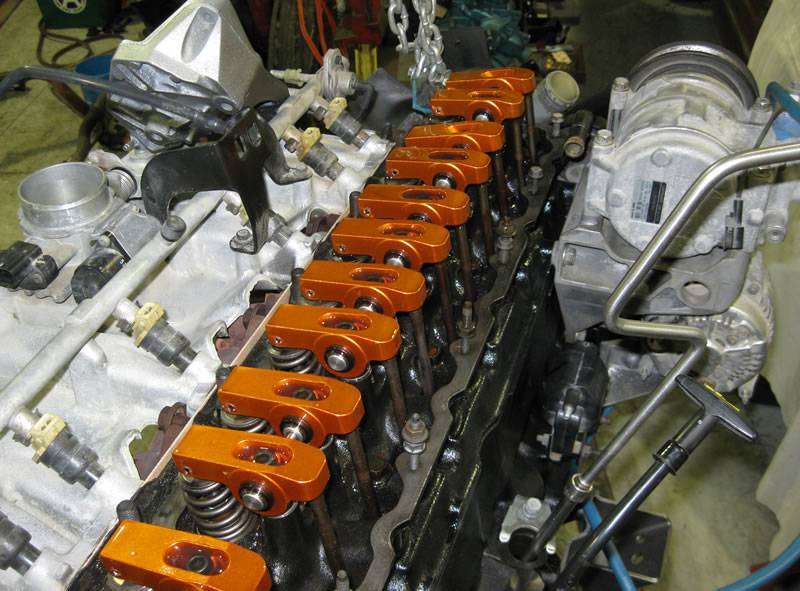
You may appreciate this - the blue line is a hose going to an oil pressure gauge. I'm using a speed handle to drive the "high volume" oil pump. Those are H-S full roller aluminum rockers, MOPAR performance valve springs, 0.024" shaved off the head. I primed the system by hand and built up 50 psi of pressure. I wanted to ensure the rockers were oiling since as far as I knew, I was among the first to use these rockers on a 4.0 and had to shim the pedestals to get the contact area over the end of the valve stem just right, and set lifter preload.
Closing in on 40,000 miles on that engine now.

Jeep Gladiator Hmm, this is an interesting solution. No More Dry Starts eagle-jeep-rockers-002


I used to work on a lot of MOPAR V8s in the 70s and 80s, the IHP used their cars. We did the work on some of them, usually not major things - the state patrol took care of the heavy stuff on their cars. I hated those exhaust manifolds that wrapped up over the lower edge of the valve cover. Burned valve cover gaskets until I started using Walker exhaust system sealer on the valve covers LOL
 
Last edited:

Charles 236

Well-Known Member
First Name
Charles
Joined
Feb 13, 2022
Threads
0
Messages
608
Reaction score
1,230
Location
Greenville, SC
Vehicle(s)
Jeep Gladiator Overland
Occupation
Jeep technician
The exhaust manifolds, especially the right one on the high performance 383s and 440s, always cooked the cork valve cover gaskets on those engines. Chrysler finally came up with a"high temperature " valve cover gasket for those engines that helped a bit, but leakage was always a problem.
 

Sponsored

ShadowsPapa

Well-Known Member
First Name
Bill
Joined
Oct 12, 2019
Threads
247
Messages
40,501
Reaction score
54,021
Location
Runnells, Iowa
Vehicle(s)
'25 JTMX, '23 JLU 4xe, '82 SX4, '73 Javelin
Occupation
Retired auto mechanic, frmr gov't ntwrk security admin
Vehicle Showcase
3
The exhaust manifolds, especially the right one on the high performance 383s and 440s, always cooked the cork valve cover gaskets on those engines. Chrysler finally came up with a"high temperature " valve cover gasket for those engines that helped a bit, but leakage was always a problem.
Yeah, I recall it was the right side. We eventually moved to that new material.
When you push those engines like the troopers did, you generated some heat.

HAHA, forgot the pic in the other post!
You've likely seen a lot of those engines.
 

629

Well-Known Member
First Name
J
Joined
Nov 18, 2024
Threads
2
Messages
48
Reaction score
76
Location
Town Mountain
Vehicle(s)
Gladiator, K5, XJ, 5.9 Cummins, 72 Buick, etc etc
Occupation
The man
I've looked at the schematics of the oiling system - that's a large "pipe" there. And I believe it on the volume.

You may appreciate this - the blue line is a hose going to an oil pressure gauge. I'm using a speed handle to drive the "high volume" oil pump. Those are H-S full roller aluminum rockers, MOPAR performance valve springs, 0.024" shaved off the head. I primed the system by hand and built up 50 psi of pressure. I wanted to ensure the rockers were oiling since as far as I knew, I was among the first to use these rockers on a 4.0 and had to shim the pedestals to get the contact area over the end of the valve stem just right, and set lifter preload.
Closing in on 40,000 miles on that engine now.

eagle-jeep-rockers-002.jpg


I used to work on a lot of MOPAR V8s in the 70s and 80s, the IHP used their cars. We did the work on some of them, usually not major things - the state patrol took care of the heavy stuff on their cars. I hated those exhaust manifolds that wrapped up over the lower edge of the valve cover. Burned valve cover gaskets until I started using Walker exhaust system sealer on the valve covers LOL
[/QUOTE

You may appreciate this - the blue line is a hose going to an oil pressure gauge. I'm using a speed handle to drive the "high volume" oil pump. Those are H-S full roller aluminum rockers, MOPAR performance valve springs, 0.024" shaved off the head. I primed the system by hand and built up 50 psi of pressure. I wanted to ensure the rockers were oiling since as far as I knew, I was among the first to use these rockers on a 4.0 and had to shim the pedestals to get the contact area over the end of the valve stem just right, and set lifter preload.
Closing in on 40,000 miles on that engine now.

eagle-jeep-rockers-002.jpg


I used to work on a lot of MOPAR V8s in the 70s and 80s, the IHP used their cars. We did the work on some of them, usually not major things - the state patrol took care of the heavy stuff on their cars. I hated those exhaust manifolds that wrapped up over the lower edge of the valve cover. Burned valve cover gaskets until I started using Walker exhaust system sealer on the valve covers LOL
On that note I have been an LEO for a long time…I recently retired from one department and moved to WV where I’m again working as a LEO. The old department I worked for had a bunch of 3.6 chargers (plus fords etc)…we dog them 24/7. Most cites don’t use V8s and we used a lot of unmarked chargers for detectives etc not even police package cars (no HD cooling etc). Oh the idle times…jesus..I’ve seen idle hours of 4500 plus. We have one were I work now a 1500 pickup. That factor made me feel good about my gladiator purchase. It’s certainly no 440…but I think it will hold together.
 

Charles 236

Well-Known Member
First Name
Charles
Joined
Feb 13, 2022
Threads
0
Messages
608
Reaction score
1,230
Location
Greenville, SC
Vehicle(s)
Jeep Gladiator Overland
Occupation
Jeep technician
Yeah, I recall it was the right side. We eventually moved to that new material.
When you push those engines like the troopers did, you generated some heat.

HAHA, forgot the pic in the other post!
You've likely seen a lot of those engines.
Part of the oil change process was taking a 1/4" ratchet and 7/16" socket and snugging the valve cover bolts to try to slow the leaks.
 

ShadowsPapa

Well-Known Member
First Name
Bill
Joined
Oct 12, 2019
Threads
247
Messages
40,501
Reaction score
54,021
Location
Runnells, Iowa
Vehicle(s)
'25 JTMX, '23 JLU 4xe, '82 SX4, '73 Javelin
Occupation
Retired auto mechanic, frmr gov't ntwrk security admin
Vehicle Showcase
3
Part of the oil change process was taking a 1/4" ratchet and 7/16" socket and snugging the valve cover bolts to try to slow the leaks.
Man, you keep bringing up fond memories of those old days in Porter's shop.
I really enjoyed working with the troopers, too.
Although there was one younger guy, had been a member of the Iowa Highway Patrol only a few months and I found that working with his car was "special"............. he kept white gloves in the glove box.. When he came to pick up the car, he'd pull those gloves out and run them over the door handles, across the top of the dash, on the windows inside and out, check the floor mats and carpet, and look under the hood. There'd better not be any drops of oil or any grease where it didn't belong. Those gloves better come off his hands as white as when he put them on.
Pros and cons to working on IHP cars - the bottoms were always spotless clean! No grease, no oil, no rust. Zipping through the medians between the lanes of the interstates kept the bottoms of the cars polished.
But at times, they discovered hidden concrete culverts and you'd have to repair some very bent parts.
And the brakes? LOL - one came in "it's making a noise up front and the brakes don't work as well as they did".
Pulled the left front tire/wheel off - the inner part of the rotor was gone, there was no pad left, the caliper piston was rubbing on the cooling fins that should have been in the middle of the rotor.
Dude? You didn't notice something weird several hundred miles ago??
 

Charles 236

Well-Known Member
First Name
Charles
Joined
Feb 13, 2022
Threads
0
Messages
608
Reaction score
1,230
Location
Greenville, SC
Vehicle(s)
Jeep Gladiator Overland
Occupation
Jeep technician
Man, you keep bringing up fond memories of those old days in Porter's shop.
I really enjoyed working with the troopers, too.
Although there was one younger guy, had been a member of the Iowa Highway Patrol only a few months and I found that working with his car was "special"............. he kept white gloves in the glove box.. When he came to pick up the car, he'd pull those gloves out and run them over the door handles, across the top of the dash, on the windows inside and out, check the floor mats and carpet, and look under the hood. There'd better not be any drops of oil or any grease where it didn't belong. Those gloves better come off his hands as white as when he put them on.
Pros and cons to working on IHP cars - the bottoms were always spotless clean! No grease, no oil, no rust. Zipping through the medians between the lanes of the interstates kept the bottoms of the cars polished.
But at times, they discovered hidden concrete culverts and you'd have to repair some very bent parts.
And the brakes? LOL - one came in "it's making a noise up front and the brakes don't work as well as they did".
Pulled the left front tire/wheel off - the inner part of the rotor was gone, there was no pad left, the caliper piston was rubbing on the cooling fins that should have been in the middle of the rotor.
Dude? You didn't notice something weird several hundred miles ago??
I know what you mean about memories. My shop foreman says my job title is "3.6 Headmaster and Keeper of the Arcane Knowledge". I always make time to help the youngsters, but they usually also get a dose of theory to go with how or why something works the way it does.
Sponsored


Top