
Sponsored

It's cold again. Guess who's back? Old St. Death Wobble. (edit-Not true DW, just a big shimmy)

ACAD_Cowboy

Well-Known Member
First Name
Francis
Joined
May 1, 2019
Threads
22
Messages
1,414
Reaction score
1,960
Location
NY
Vehicle(s)
15 jkur
I had thundersnow for a few minutes last night in Rankin with temps cruising just above freezing and I still climbed down tower in just a t-shirt.

SoCal "cold" is always amusing. Last I was in LA they were wearing parkas with hoods in the 50's and I was rocking shorts, have flown out of teens with snow. I got into Midland and my crew was complaining how it was sooooo cold that day... 70's? Cold? Wait what?
Sponsored
 

sass JT

Banned
Banned
First Name
Bryan
Joined
Jun 12, 2019
Threads
31
Messages
1,688
Reaction score
2,896
Location
Colorado
Website
youtube.com
Vehicle(s)
2020 Jeep Gladiator Rubicon
Build Thread
Link
Occupation
MWD

CerOf

Well-Known Member
Joined
Jan 1, 2021
Threads
18
Messages
1,375
Reaction score
1,624
Location
Dallas
Vehicle(s)
‘21 JTRD
If the “wobble” you have can be accelerated out of, as in, going faster, that is not death wobble.

death Wobble leaves you barely able to hold the wheel as your tires alternately hop up and down violently until you slow down to less than ~40mph.
 

insanitize

Well-Known Member
First Name
Steve
Joined
Dec 5, 2021
Threads
0
Messages
82
Reaction score
91
Location
Queens, NY
Vehicle(s)
72 Commando, 07 Rubi JKU, 2024 MINI, 21 Gladiator+
Occupation
NYC-DOT, Retired
I've been a Jeep guy for years and have never heard of weather related DW
 

Sponsored

Wheelin98TJ

Well-Known Member
First Name
Ryan
Joined
Jul 27, 2021
Threads
12
Messages
3,717
Reaction score
4,380
Location
Devils Lake, MI
Vehicle(s)
2021 Jeep Gladiator
Occupation
Bean Counter
If the “wobble” you have can be accelerated out of, as in, going faster, that is not death wobble.

death Wobble leaves you barely able to hold the wheel as your tires alternately hop up and down violently until you slow down to less than ~40mph.
You can throttle through death wobble.

You have to stab the throttle and have enough power to lift the front end.
 

HenrytheDestroyer

Well-Known Member
Joined
Dec 10, 2021
Threads
2
Messages
94
Reaction score
62
Location
MI
Vehicle(s)
2022 JT
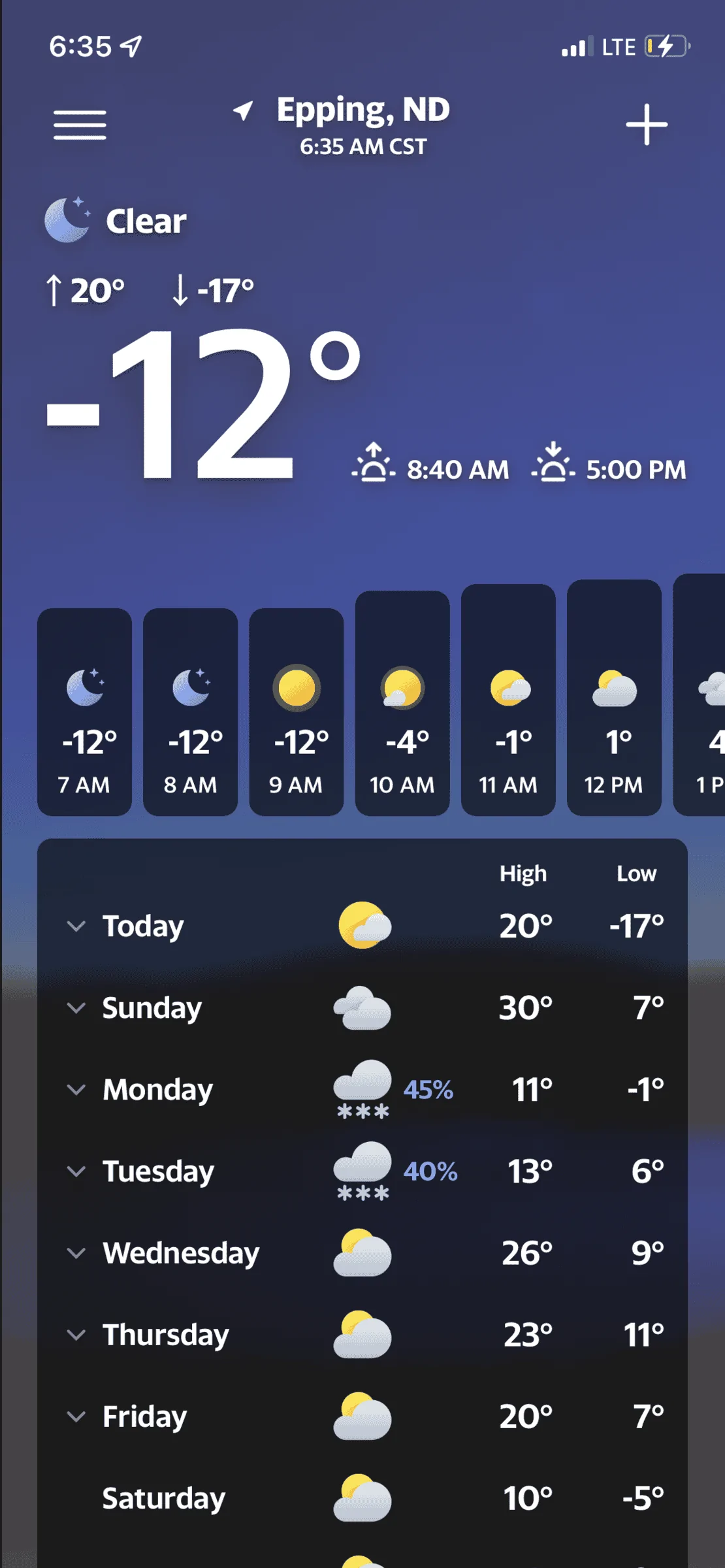
So it definitely got cold last night… not quite the -16° they forecasted but the windchill made up for it… oh and my Jeep drove fine when I went to town for a burger. No wobbles.

0574309D-47EF-4D21-B19E-81E4611756E9.png


C8FBBF98-10A6-4E2B-8F52-003CDFBA5697.png
What phone/app do you use for this info? My iPhone doesn’t have all these widgets available ?
 

Challenger85

Well-Known Member
First Name
Joseph
Joined
Aug 15, 2021
Threads
26
Messages
1,254
Reaction score
1,667
Location
Colorado
Vehicle(s)
21’ Gladiator Mojave
Occupation
Electrical
its been freezing in so cal this past week. We hit 55 degrees today. Cold AF
55 is shorts, flip flops and take off the freedom panel weather. I just did this 2 weeks ago in December, in Colorado, and for Thanksgiving.
 

ShadowsPapa

Well-Known Member
First Name
Bill
Joined
Oct 12, 2019
Threads
247
Messages
40,465
Reaction score
53,921
Location
Runnells, Iowa
Vehicle(s)
'25 JTMX, '23 JLU 4xe, '82 SX4, '73 Javelin
Occupation
Retired auto mechanic, frmr gov't ntwrk security admin
Vehicle Showcase
3
You can throttle through death wobble.

You have to stab the throttle and have enough power to lift the front end.
Turn off traction control/stability control first and it works better.
 

ShadowsPapa

Well-Known Member
First Name
Bill
Joined
Oct 12, 2019
Threads
247
Messages
40,465
Reaction score
53,921
Location
Runnells, Iowa
Vehicle(s)
'25 JTMX, '23 JLU 4xe, '82 SX4, '73 Javelin
Occupation
Retired auto mechanic, frmr gov't ntwrk security admin
Vehicle Showcase
3
"Death wobble" isn't an up and down - that's tire or wheel balance.
DW is a shimmy - a back and forth.. The wheel shakes left and right.
You can't speed up and drive out of it.
A bent wheel, or tire issue, you can often speed through it. I experienced it with one of my cars and it took a long time to find the real culprit. I took my wheels to a shop that did CNC restoration and refinishing of machined wheels. As quick as they started up their equipment on one of the wheels it threw a red flag. Oddly although the wheel passed inspection by 3 tire shops, being balanced multiple times and a specialty axle and driveline shop saying all tires and wheels were perfect, that one wheel was not as indicated by their CNC wheel refinishing machine.

Anyway, DW is back and forth, it's described as suspension and steering experts (not forum experts, REAL experts that build and design such things) as a shimmy.

Norm Layton wrote that the "Jeep death wobble" is basically a shimmy, and can affect any suspension with a continuous tie rod (which nearly all solid axles have) to connect the front wheels. He noted, "Shimmy is normally cause by aftermarket application of larger tires, lifts that change the front axle setting for toe, or caster and camber, or worn or damaged parts. An out of balance tire, a broken tire cord, a bent wheel, or worn shocks can be the cause."
(look up his name)


Suspension engineer Bob Sheaves wrote,

"Death wobble" first showed up in vehicles in the 1960s with early aftermarket lift kits, primarily on Jeep CJs and Land Rover S1s.

He talks of the steering geometry, the parts like drag link, tie rods and so on and continues -
These parts are sized in compression strength and torsional strength for the original maximum size tires and no larger. In stock form, flexing out of plane for these pieces is minimized.

Once you change to a larger overall diameter tire, you do two things - both bad. You increase the rotating mass, increasing the gyroscopic effect of the tire on handling; and you change the theoretical length of the arm resisting the toe change from ground induced inputs.

----------------------------------------

Real death wobble is a hard shimmy and you have to slow down to come out of it - even under 40 mph or so.
Up and down is almost always a bad/weak shock, tire or wheel issue. As i my case, a wheel that was oddly damaged and only setting it on a CNC refinisher did it ever show up. 3 tire shops, a specialty wheel/axle/driveline shop, all missed it (and embarrassingly, so did I)

Hard to see how a tire might cause this to appear only when cold unless the tire has cord issues or some defect that softer warmer rubber compensates for.
 

Sponsored

cmb396

Well-Known Member
Joined
May 30, 2021
Threads
26
Messages
360
Reaction score
471
Location
WV
Vehicle(s)
2018 JLUR
Glad I just stumbled onto this, I thought I was crazy for thinking the same.
While I haven't had DW, I def have more front end shakes during this cold weather. I just attributed it to bushings and everything being cold and harder than in warm weather if that's possible?!
 

ACAD_Cowboy

Well-Known Member
First Name
Francis
Joined
May 1, 2019
Threads
22
Messages
1,414
Reaction score
1,960
Location
NY
Vehicle(s)
15 jkur
In crude terms death wobble is hysterical bump steer compounded by harmonic resonance.

At stock ride height with stock wheels and tires, your tie rod (steering box to knuckle) and drag link (knuckle to knuckle) are relatively in plane, not perfectly parallel but close enough. Your track bar should be able to be taken on and off by hand.

As your suspension compresses and extends the angle of the tie rod changes relative to the drag link. This is controlled by the track bar to keep the axle centered in the chassis.

Under normal conditions the angle changes cause some perturbation ( hehhehh) of the steering inputs with compression and extension seeming like steering inputs to the system.

Everyone tracking so far? (?)

Soo... to combat this the steering box has some play, the steering linkages have some play and the tires "burn off" some force through scrubbing. You drive over an irregularity, the axle moves and the system uses it's engineered dead zones so squash the bump steer effect. Your damper helps as well to mitigate flutter and the track bar goes through compression and tension to hold the axle in the right place.

So as you add distance between the chassis and the axle and compound the forces with larger wheels and tires spaced further from the axle center, you need to increase the length of both your tie rod and track bar and lower the connection point on your steering box connection to keep the bump steer under control.

The unspoken part of this is control arm geometry. The axle does not move in a linear vertical fashion like a leaf spring system but rather rotates through an arc about a center. As the distance from axle to chassis increases (suspension extension) the steering knuckles roll forward and down (increasing caster, think wobbly shopping carts) which changes the rate at which the system reacts to inputs from the road back feeding the steering linkage.

So by lifting the truck are removing enginered dead spots, increasing rate of reaction and increasing sensitivity to perturbation which we see and feel as death wobble and describe as hysterical bump steer.

The solutions are to correct the control arm geometery for the additional height, correct the tie rod length and angle for the increased distance and angle and correct the steering box connection to correct the tie rod angle.

Now as for suspension spooky in the cold, I am more inclined to say it is tire carcass related, the construction is not allowing for good articulation which make it feel stiff and out of round which shows as an out of balance rotation. Back in the good old days I would often have issues with bias ply tires in the cold, sit for a bit and they would feel lumpy until warmed up. This would lead to my CJ shaking horribly, all out of phase then randomly in phase etc for a while. Come back out after a decent drive and it was smooth as peanut butter.
 

Wheelin98TJ

Well-Known Member
First Name
Ryan
Joined
Jul 27, 2021
Threads
12
Messages
3,717
Reaction score
4,380
Location
Devils Lake, MI
Vehicle(s)
2021 Jeep Gladiator
Occupation
Bean Counter
"Death wobble" isn't an up and down - that's tire or wheel balance.
DW is a shimmy - a back and forth.. The wheel shakes left and right.
You can't speed up and drive out of it.
A bent wheel, or tire issue, you can often speed through it. I experienced it with one of my cars and it took a long time to find the real culprit. I took my wheels to a shop that did CNC restoration and refinishing of machined wheels. As quick as they started up their equipment on one of the wheels it threw a red flag. Oddly although the wheel passed inspection by 3 tire shops, being balanced multiple times and a specialty axle and driveline shop saying all tires and wheels were perfect, that one wheel was not as indicated by their CNC wheel refinishing machine.

Anyway, DW is back and forth, it's described as suspension and steering experts (not forum experts, REAL experts that build and design such things) as a shimmy.

Norm Layton wrote that the "Jeep death wobble" is basically a shimmy, and can affect any suspension with a continuous tie rod (which nearly all solid axles have) to connect the front wheels. He noted, "Shimmy is normally cause by aftermarket application of larger tires, lifts that change the front axle setting for toe, or caster and camber, or worn or damaged parts. An out of balance tire, a broken tire cord, a bent wheel, or worn shocks can be the cause."
(look up his name)


Suspension engineer Bob Sheaves wrote,

"Death wobble" first showed up in vehicles in the 1960s with early aftermarket lift kits, primarily on Jeep CJs and Land Rover S1s.

He talks of the steering geometry, the parts like drag link, tie rods and so on and continues -
These parts are sized in compression strength and torsional strength for the original maximum size tires and no larger. In stock form, flexing out of plane for these pieces is minimized.

Once you change to a larger overall diameter tire, you do two things - both bad. You increase the rotating mass, increasing the gyroscopic effect of the tire on handling; and you change the theoretical length of the arm resisting the toe change from ground induced inputs.

----------------------------------------

Real death wobble is a hard shimmy and you have to slow down to come out of it - even under 40 mph or so.
Up and down is almost always a bad/weak shock, tire or wheel issue. As i my case, a wheel that was oddly damaged and only setting it on a CNC refinisher did it ever show up. 3 tire shops, a specialty wheel/axle/driveline shop, all missed it (and embarrassingly, so did I)

Hard to see how a tire might cause this to appear only when cold unless the tire has cord issues or some defect that softer warmer rubber compensates for.
If I ever get death wobble again, I’ll get a video for you. You can absolutely throttle out if it.

You are contradicting the experts you are quoting. You said it can’t be from a wheel or tire, but the experts say it can.
 

ShadowsPapa

Well-Known Member
First Name
Bill
Joined
Oct 12, 2019
Threads
247
Messages
40,465
Reaction score
53,921
Location
Runnells, Iowa
Vehicle(s)
'25 JTMX, '23 JLU 4xe, '82 SX4, '73 Javelin
Occupation
Retired auto mechanic, frmr gov't ntwrk security admin
Vehicle Showcase
3
If I ever get death wobble again, I’ll get a video for you. You can absolutely throttle out if it.

You are contradicting the experts you are quoting. You said it can’t be from a wheel or tire, but the experts say it can.
It can be a wheel or tire but isn't normally a balance issue by itself - there's other stuff going on. They mentioned the common/normal causes then go on to say "could be" - (but not normally - and not usually alone).
A balance issue normally doesn't cause DW unless other factors are in play as well is what's also discussed. If all else is fine, you get a vibration or shimmy from out of balance but if everything is ok, that's it.
It's when you have other problems that the out of balance sends it crazy. By itself out of balance won't be a problem more than annoying - but combined with other factors.........

So if you have tire imbalance causing DW - you'd better be checking out the rest of the front end once the tire is balanced because by itself, it shouldn't be that severe. The rest of the steering and suspension normally keep out of balance in check because things are tight and rigid.
They also say that lifts and after-market parts in cases actually lead to simple things getting out of control because they allow movement the factory doesn't.

If you are driving out of it - you have something bigger going on like I had - wheel out of shape or imperfect, tire that's imperfect and the suspension is letting it happen.
I'll pull up the diagnostics charts AMC and Jeep used in the 70s and 80s if I get a chance.

The trouble with diagnosing DW is it's often not a single thing but multiple things have stacked up.
 

ShadowsPapa

Well-Known Member
First Name
Bill
Joined
Oct 12, 2019
Threads
247
Messages
40,465
Reaction score
53,921
Location
Runnells, Iowa
Vehicle(s)
'25 JTMX, '23 JLU 4xe, '82 SX4, '73 Javelin
Occupation
Retired auto mechanic, frmr gov't ntwrk security admin
Vehicle Showcase
3
In crude terms death wobble is hysterical bump steer compounded by harmonic resonance.

At stock ride height with stock wheels and tires, your tie rod (steering box to knuckle) and drag link (knuckle to knuckle) are relatively in plane, not perfectly parallel but close enough. Your track bar should be able to be taken on and off by hand.

As your suspension compresses and extends the angle of the tie rod changes relative to the drag link. This is controlled by the track bar to keep the axle centered in the chassis.

Under normal conditions the angle changes cause some perturbation ( hehhehh) of the steering inputs with compression and extension seeming like steering inputs to the system.

Everyone tracking so far? (?)

Soo... to combat this the steering box has some play, the steering linkages have some play and the tires "burn off" some force through scrubbing. You drive over an irregularity, the axle moves and the system uses it's engineered dead zones so squash the bump steer effect. Your damper helps as well to mitigate flutter and the track bar goes through compression and tension to hold the axle in the right place.

So as you add distance between the chassis and the axle and compound the forces with larger wheels and tires spaced further from the axle center, you need to increase the length of both your tie rod and track bar and lower the connection point on your steering box connection to keep the bump steer under control.

The unspoken part of this is control arm geometry. The axle does not move in a linear vertical fashion like a leaf spring system but rather rotates through an arc about a center. As the distance from axle to chassis increases (suspension extension) the steering knuckles roll forward and down (increasing caster, think wobbly shopping carts) which changes the rate at which the system reacts to inputs from the road back feeding the steering linkage.

So by lifting the truck are removing enginered dead spots, increasing rate of reaction and increasing sensitivity to perturbation which we see and feel as death wobble and describe as hysterical bump steer.

The solutions are to correct the control arm geometery for the additional height, correct the tie rod length and angle for the increased distance and angle and correct the steering box connection to correct the tie rod angle.

Now as for suspension spooky in the cold, I am more inclined to say it is tire carcass related, the construction is not allowing for good articulation which make it feel stiff and out of round which shows as an out of balance rotation. Back in the good old days I would often have issues with bias ply tires in the cold, sit for a bit and they would feel lumpy until warmed up. This would lead to my CJ shaking horribly, all out of phase then randomly in phase etc for a while. Come back out after a decent drive and it was smooth as peanut butter.
You know how the IFS inner tie rod is positioned on the drag link so that as the control arms pivot up and down the tie rod pivots on nearly the same arc, centered in roughly the same place. On our trucks as one end of the axle raises is has little impact on steering, as the other end raises and lowers, it "pulls" on the steering. If shocks allow too many oscillations, you are also moving the tires back and forth.

I just had a nice discussion with a guy who runs a "restoration shop" about chopping springs to lower a Javelin. He was advising that's the best way to do it. Uh, no. You swing the control arms up - and because the upper is much shorter is swings inward at the end a lot more than the longer lower arm, resulting in crazy camber on bumps and turns. I suggested lowering plates - raise the spindle on the knuckle and leave the springs alone, and thus the control arm angles. They need to be straight out to minimize the inward movement of the upper ball joint compared to the lower. He argued that he's done it "and it felt fine". Ok, on your highways, normal, non-emergency driving but it leads to excessive wear, inability to align camber (I know this first hand - my front springs are too long, lifting the front of my SX4, swinging the upper arm in and making camber unadjustable.
If you lift these trucks and don't correct for the geometry, for the arc, you can introduce issues.

Once you deviate from the factory angles, which are pushing boundaries as it is, all bets are off.
Sponsored


Top