
Sponsored

Large wire crimpers

whiteglad

Well-Known Member
First Name
Joe
Joined
Feb 12, 2020
Threads
13
Messages
1,305
Reaction score
1,215
Location
Vegas
Vehicle(s)
2022 Gladiator Mojave
I have used a metal-working chisel that has the cutting end blunted to hammer a crimp, and then solder using rosin core solder and a propane torch for heavy cables. I use the size connector that is as close as possible to the actual wire diameter--which sometimes says it is for 6 gauge (as an example) but 4 gauge wire will go in if you are careful.
I also drill a small hole at the end of the connector to feed in the solder while heating the connector. I want to fill the joint rather than a lot of solder traveling up the cable.
Sponsored

 

Radio Guy

Well-Known Member
First Name
Mike
Joined
Feb 24, 2021
Threads
6
Messages
716
Reaction score
882
Location
So Cal
Vehicle(s)
2021 Jeep Gladiator Mojave
Occupation
Retired Broadcast Engineer
I have used a metal-working chisel that has the cutting end blunted to hammer a crimp, and then solder using rosin core solder and a propane torch for heavy cables. I use the size connector that is as close as possible to the actual wire diameter--which sometimes says it is for 6 gauge (as an example) but 4 gauge wire will go in if you are careful.
I also drill a small hole at the end of the connector to feed in the solder while heating the connector. I want to fill the joint rather than a lot of solder traveling up the cable.
Crimp it, don’t solder it. Not counting all the hobby soldering I did starting back in the late 60s I got formal training in the early 80s working for the largest aerospace company in the US and also became a mil spec inspector for mechanical and solder connections in small electronic assemblies.

Then in the mid 90s we had a project where we had to build a complete wiring harness for a Douglas A-3 Skywarrier aircraft used as a radar tested and learned there are no soldered wiring connections in an aircraft, it’s illegal and everything is crimped. Why? Because lives are at stake when aircraft wiring fails and crimping is the most reliable connection, so nothing but crimping. I spent 6mo with a crew of 6 people building that harness and learned a lot crimping thousands of connections and every crimp was visually inspected and pull tested. A few of that crew were NASA certified solderers for space born equipment, the highest certification you can get and they were not allowed to get near the aircraft harness with a soldering iron.

You also never see soldering in home or commercial building wiring, soldering multi conductor wire will make it brittle at the solder junction and it can be slightly higher resistance causing heating at high currents.
 

Pat Witt

Well-Known Member
First Name
Pat
Joined
Mar 14, 2024
Threads
3
Messages
110
Reaction score
106
Location
Indianapolis
Vehicle(s)
2021 jeep gladiator
Occupation
Service technician
Solder them, remove the plastic cover buy electrical solder with Flux in it and solder them that is going to be the best connection you can get
 

Radio Guy

Well-Known Member
First Name
Mike
Joined
Feb 24, 2021
Threads
6
Messages
716
Reaction score
882
Location
So Cal
Vehicle(s)
2021 Jeep Gladiator Mojave
Occupation
Retired Broadcast Engineer
Solder them, remove the plastic cover buy electrical solder with Flux in it and solder them that is going to be the best connection you can get
Nope, for large diameter multi strand wire, crimp is the lowest resistance and best mechanical connection and soldering is not allowed in many industries because of potential problems.
 

fourfa

Well-Known Member
Joined
Dec 12, 2021
Threads
14
Messages
1,103
Reaction score
1,398
Location
CA
Vehicle(s)
22 JTRD + ACCC
Build Thread
Link
+1 Temco TH0006. Really great, true-to-size dies, plus over- and under-size dies. Most of the generic hydraulic hand crimpers come with metric dies that just claim to be “equivalent” to gauge sizes. They aren’t, and you can end up with fairly bad crimps that can pull out, and worst-case cause fires.
 

Sponsored

ChrisNLA

Well-Known Member
First Name
Chris
Joined
Jun 7, 2022
Threads
16
Messages
2,017
Reaction score
3,665
Location
Louisiana
Vehicle(s)
2022 JT Sport Max Tow
Build Thread
Link
OP
OP
chorky

chorky

Well-Known Member
First Name
Chad
Joined
Feb 26, 2022
Threads
175
Messages
3,466
Reaction score
3,801
Location
Montana
Website
www.youtube.com
Vehicle(s)
'22JTR, '06 LJ, '06 TJ GE
Build Thread
Link
Occupation
GIS Specialist

Radio Guy

Well-Known Member
First Name
Mike
Joined
Feb 24, 2021
Threads
6
Messages
716
Reaction score
882
Location
So Cal
Vehicle(s)
2021 Jeep Gladiator Mojave
Occupation
Retired Broadcast Engineer
+1 for the hydraulic crimp tool. Should have gotten one long time ago.

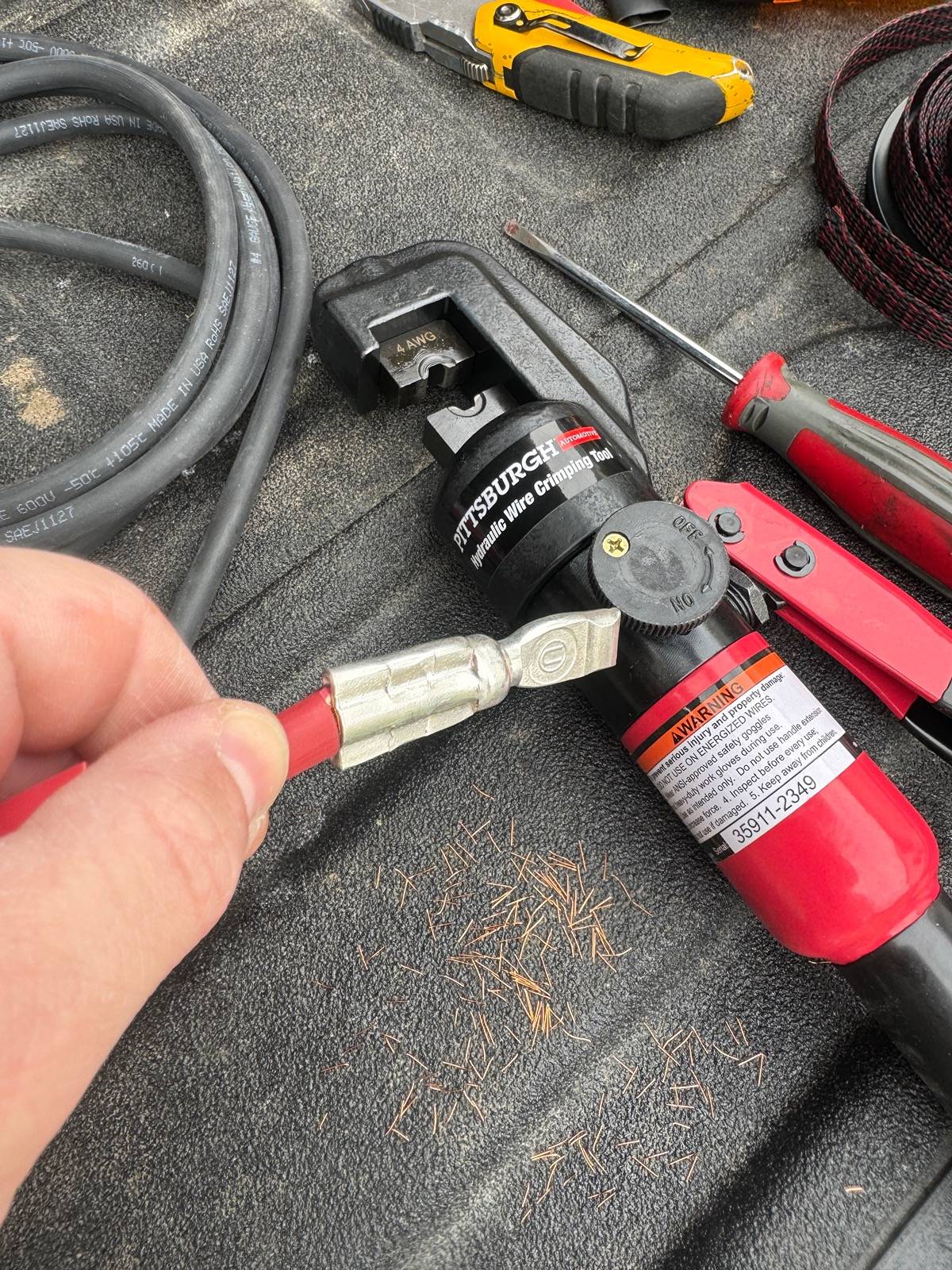
IMG_4421.JPG
Looks like the wrong size die was used. There should be a perfect hex shaped crimp all around the lug thing (Anderson Power Pole?) where the wire goes in. Instead the die is too small and it pinched off the crimp area and squished some out sideways from the die.
 
OP
OP
chorky

chorky

Well-Known Member
First Name
Chad
Joined
Feb 26, 2022
Threads
175
Messages
3,466
Reaction score
3,801
Location
Montana
Website
www.youtube.com
Vehicle(s)
'22JTR, '06 LJ, '06 TJ GE
Build Thread
Link
Occupation
GIS Specialist
Looks like the wrong size die was used. There should be a perfect hex shaped crimp all around the lug thing (Anderson Power Pole?) where the wire goes in. Instead the die is too small and it pinched off the crimp area and squished some out sideways from the die.
It's the correct size. it's the cheapie Chinese Anderson connector. It's supposed to fit up to 2 ga, but I am using 4 ga, so it's a little large.
 

Sponsored

ShadowsPapa

Well-Known Member
First Name
Bill
Joined
Oct 12, 2019
Threads
247
Messages
40,442
Reaction score
53,858
Location
Runnells, Iowa
Vehicle(s)
'25 JTMX, '23 JLU 4xe, '82 SX4, '73 Javelin
Occupation
Retired auto mechanic, frmr gov't ntwrk security admin
Vehicle Showcase
3
+1 for the hydraulic crimp tool. Should have gotten one long time ago.

IMG_4421.JPG
The flat sides squeezed out would drive me nuts. I like a perfect symmetrical shape. How does that slide into a shell with the wings on it?
 
OP
OP
chorky

chorky

Well-Known Member
First Name
Chad
Joined
Feb 26, 2022
Threads
175
Messages
3,466
Reaction score
3,801
Location
Montana
Website
www.youtube.com
Vehicle(s)
'22JTR, '06 LJ, '06 TJ GE
Build Thread
Link
Occupation
GIS Specialist
The flat sides squeezed out would drive me nuts. I like a perfect symmetrical shape. How does that slide into a shell with the wings on it?
It slides in just fine. No problems at all. Function is more important than form. It's not perfect, but better than what I had before with the cheapie Chinese crimper, and the connection is solid and tight. Some day I will swap it out with better quality anderson connectors but it will work for now anyway.
 

Pliny

Well-Known Member
First Name
Philip
Joined
Dec 17, 2022
Threads
21
Messages
230
Reaction score
382
Location
AZ
Vehicle(s)
22 JTR, 99 F250 SD, 24 BMW X3
Occupation
Retired
One thing I learned when using a hydraulic crimper to do the electrical cables for my winch is that although the wire gauges are standardized (either AWG or metric sizes) the wall thicknesses of the lugs / terminals / connectors are not.

If you're using a heavy duty lug with thicker than expected walls using the die marked for that size wire gauge will likely result in a less than ideal crimp that has "ears" or "wings" where the excess material got squished out the sides between the halves of the die.

The image of the crimp provided by the OP is what I would expect to happen with #4 cable, #2 sized connector when a #4 size die is used. Physically too much material to fit in the #4 size hex die. The connector shown looks to me as if it may have thicker than average walls, so even if a #2 cable, #2 die and that #2 sized connector were used in the crimp it may still end up with "wings" squishing out the sides.

My recommendation would be to buy a little extra cable, a couple of extra lugs / terminals and then do a some test crimps beforehand to dial in to which size die is going to result in an acceptable crimp for what you're doing.
 
OP
OP
chorky

chorky

Well-Known Member
First Name
Chad
Joined
Feb 26, 2022
Threads
175
Messages
3,466
Reaction score
3,801
Location
Montana
Website
www.youtube.com
Vehicle(s)
'22JTR, '06 LJ, '06 TJ GE
Build Thread
Link
Occupation
GIS Specialist
One thing I learned when using a hydraulic crimper to do the electrical cables for my winch is that although the wire gauges are standardized (either AWG or metric sizes) the wall thicknesses of the lugs / terminals / connectors are not.

If you're using a heavy duty lug with thicker than expected walls using the die marked for that size wire gauge will likely result in a less than ideal crimp that has "ears" or "wings" where the excess material got squished out the sides between the halves of the die.

The image of the crimp provided by the OP is what I would expect to happen with #4 cable, #2 sized connector when a #4 size die is used. Physically too much material to fit in the #4 size hex die. The connector shown looks to me as if it may have thicker than average walls, so even if a #2 cable, #2 die and that #2 sized connector were used in the crimp it may still end up with "wings" squishing out the sides.

My recommendation would be to buy a little extra cable, a couple of extra lugs / terminals and then do a some test crimps beforehand to dial in to which size die is going to result in an acceptable crimp for what you're doing.
Thats exactly what happened. I should have ordered a 4ga specific connector - but time is not on my side right now so I went with it. The connection is still very solid, it just doesn't look nice. And these connectors being Chinese made, they are not the greatest. The wall thickness is way too much.
 

Lost1wing

Well-Known Member
First Name
Tim
Joined
Dec 22, 2020
Threads
24
Messages
2,606
Reaction score
2,845
Location
West Georgia
Vehicle(s)
2020 Jeep Gladiator Rubicon
Occupation
Retired AMT
Crimp it, don’t solder it. Not counting all the hobby soldering I did starting back in the late 60s I got formal training in the early 80s working for the largest aerospace company in the US and also became a mil spec inspector for mechanical and solder connections in small electronic assemblies.

Then in the mid 90s we had a project where we had to build a complete wiring harness for a Douglas A-3 Skywarrier aircraft used as a radar tested and learned there are no soldered wiring connections in an aircraft, it’s illegal and everything is crimped. Why? Because lives are at stake when aircraft wiring fails and crimping is the most reliable connection, so nothing but crimping. I spent 6mo with a crew of 6 people building that harness and learned a lot crimping thousands of connections and every crimp was visually inspected and pull tested. A few of that crew were NASA certified solderers for space born equipment, the highest certification you can get and they were not allowed to get near the aircraft harness with a soldering iron.

You also never see soldering in home or commercial building wiring, soldering multi conductor wire will make it brittle at the solder junction and it can be slightly higher resistance causing heating at high currents.
B727 a/p control panel had a 55 pin connector, all solder pins. If you have ever done one of those, you will know why they went to crimper terminals. Douglas and Boeing have solder terminals for ptt and a/p disconnect switches.

The fail point was always at the wire where the solder stops.
Sponsored


Top