
Sponsored

Meltdown (sorry it repeated)

Kevin_D

Well-Known Member
First Name
Kevin
Joined
Oct 18, 2020
Threads
54
Messages
2,382
Reaction score
3,200
Location
Inland Northwest
Vehicle(s)
2021 Sport S, 1971 J4000, a bunch of other stuff
So now you have revealed your ignorance. I am not talking about anything that is AC. A lot of people install air compressors in their rig. That's an inductive load.

A refrigerator that runs on 12v is a pure inductive load.

Accessories like stereos and lights are resistive loads and would go along with what I said.
Inductance is a function of a varying field, as in AC power systems.
You won’t have inductance in a DC system.

Kevin
Sponsored

 

dcmdon

Well-Known Member
First Name
Don
Joined
Mar 31, 2021
Threads
60
Messages
3,656
Reaction score
4,427
Location
Boston Metro-West, Northern NH
Vehicle(s)
.
V=IR. P=IV, or I squared R.
I'm not sure what you were getting at.

The proper variable name is P for potential. But sometimes people use V for voltage since its clearer. Same thing.
 

dcmdon

Well-Known Member
First Name
Don
Joined
Mar 31, 2021
Threads
60
Messages
3,656
Reaction score
4,427
Location
Boston Metro-West, Northern NH
Vehicle(s)
.
Inductance is a function of a varying field, as in AC power systems.
You won’t have inductance in a DC system.

Kevin
Excellent point. So how do DC electric motors present themselves to a voltage?

I am using the term "inductive load" to describe how an electric motor loads a system.
1) start up draw 2-3 times running draw.
2) if the motor is stalled, resistance go down precipitously like with an AC motor

So you are right. I shouldn't use the term inductive load. But its not a resistive load like a bulb. So what is the proper term for a load that behaves like an electric motor when powered by DC power.

Again, I was using motors as a possible exception to the point I was trying to make. So maybe they should be included. It doesn't negate my point. (which excluded inductive loads)
 

Sponsored

Aonarch

Well-Known Member
First Name
Alec
Joined
May 13, 2021
Threads
23
Messages
596
Reaction score
715
Location
GA/ MT
Vehicle(s)
2021 Gladiator Sport S Max Tow
Build Thread
Link
Occupation
Engineer
Over GVWR?
 

IamAlan

Well-Known Member
Joined
Jan 3, 2021
Threads
21
Messages
795
Reaction score
1,905
Location
Ohio
Vehicle(s)
2021 Snazzberry Willys
Occupation
Retired
I'm not sure what you were getting at.

The proper variable name is P for potential. But sometimes people use V for voltage since its clearer. Same thing.
Ohm's laws state that where:
P=power. V=voltage. I=current and R=resistance.
Power (Watts) equals voltage times current.
Voltage equals current times resistance.
Therefore:
Power also equals Current squared times resistance.

If you want to bypass all the math, simply go back to page one and use the chart for proper wire sizing with a known current rating and distance from the source. If you don't like that chart, Google it and you will fond that they're all calculated using the some SAE Standard wiring methods.
 

dcmdon

Well-Known Member
First Name
Don
Joined
Mar 31, 2021
Threads
60
Messages
3,656
Reaction score
4,427
Location
Boston Metro-West, Northern NH
Vehicle(s)
.
p=power. V=voltage.
We are getting into a semantic dick measuring contest. I can play if you want.

We both know that we both understand the issues here.

P=IR = Ohms law. Potential (or voltage) = Amps (current) x Ohms (resistance) The P for potential is often swapped for a V for voltage since it means the same thing and avoids the confusion with P meaning power.

To avoid any more dick measuring, I'll be sure to express Ohm's law as V=IR from this point forward.

Good?
 

Challenger85

Well-Known Member
First Name
Joseph
Joined
Aug 15, 2021
Threads
25
Messages
1,251
Reaction score
1,664
Location
Colorado
Vehicle(s)
21’ Gladiator Mojave
Occupation
Electrical
I love watching electrical and electrical mathematical arguments.

Jeep Gladiator Meltdown (sorry it repeated) 1634752507893
 

Sponsored

Challenger85

Well-Known Member
First Name
Joseph
Joined
Aug 15, 2021
Threads
25
Messages
1,251
Reaction score
1,664
Location
Colorado
Vehicle(s)
21’ Gladiator Mojave
Occupation
Electrical
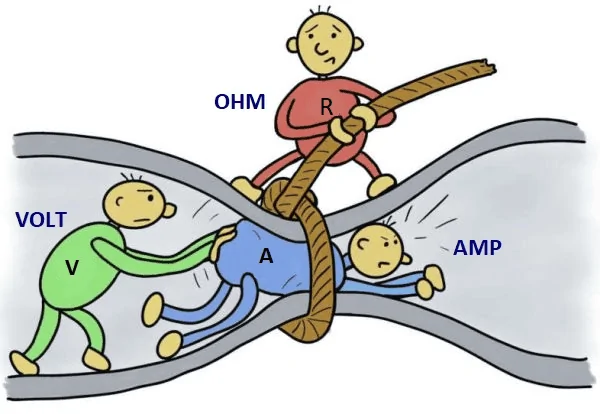
That's not how this works. That's not how this works at all. Think of voltage as a pipe of a certain size, and current as flow within that pipeline. The resistance will increase because the voltage (size of the pipe) will decrease with distance. The current will demand to remain the same as the load is demanding a set of amps, building pressure (resistance and heat). The lower voltage will not allow the amount of current to flow and the wiring will overheat because the pipe is too small. The fuse will not trip because it is current sensitive, not voltage sensitive. The practical reality is that if you don't increase wire size in accordance with the distance from the source to the load, you're not doing it right. And you risk burning up your wiring, your dash, and your truck. And with a degree in Electrical engineering and 32 years as a product safety specialist, I guess you could say that I am an expert.
Same field, correct.
 

Dryfly24

Well-Known Member
First Name
George
Joined
Feb 7, 2019
Threads
47
Messages
1,426
Reaction score
4,157
Location
Las Cruces, NM
Vehicle(s)
2020 Gladiator Rubicon, 2016 Indian Springfield
Occupation
Retired and loving it
Ohm's laws state that where:
P=power. V=voltage. I=current and R=resistance.
Power (Watts) equals voltage times current.
Voltage equals current times resistance.
Therefore:
Power also equals Current squared times resistance.

If you want to bypass all the math, simply go back to page one and use the chart for proper wire sizing with a known current rating and distance from the source. If you don't like that chart, Google it and you will fond that they're all calculated using the some SAE Standard wiring methods.
We are getting into a semantic dick measuring contest. I can play if you want.

We both know that we both understand the issues here.

P=IR = Ohms law. Potential (or voltage) = Amps (current) x Ohms (resistance) The P for potential is often swapped for a V for voltage since it means the same thing and avoids the confusion with P meaning power.

To avoid any more dick measuring, I'll be sure to express Ohm's law as V=IR from this point forward.

Good?
Girls! Girls! You’re both pretty! Can we get back to the fire now please?
 

Imbuere

Well-Known Member
Joined
May 9, 2020
Threads
9
Messages
182
Reaction score
148
Location
Colorado
Vehicle(s)
2020 JLUR
It can't draw more amps because the resistance of the whole wire/load system is fixed.
When they stall resistance goes to near zero drawing huge currents and wreaking havoc.
So which is it?

With the one substantial caveat around inductive loads. If low voltage (caused by a voltage drop from a long wire run) is applied to an electric motor, its resistance can plummet which will result in more current which creates a lot of heat.
What?? I feel like you know some terms, but don't have your cause and effect correct. Resistance is a fixed physical property of a system, it doesn't change. If you push more amps, you get more heat. Too much amps creates too much heat creates fire.
 

LostWoods

Well-Known Member
Joined
Mar 13, 2020
Threads
15
Messages
2,027
Reaction score
2,420
Location
Gilbert, AZ
Vehicle(s)
2024 4Runner / 1995 YJ
It can't draw more amps because the resistance of the whole wire/load system is fixed.

If you have a fixed resistance (R) and a fixed voltage (V) then the current draw is fixed (I)

Of course what you have described is EXACTLY how an electrical motor that is driving something like a refrigerator or air compressor will behave. When they stall resistance goes to near zero drawing huge currents and wreaking havoc.

Which is why early on I said that what I was describing was how things worked with a normal resistive load representative of electronics, lights. But not an inductive load like a DC electric motor.
Supply voltage is fixed and resistance is fixed (...roughly.) but the draw is not. Loads draw exactly what wattage is required to drive them so a 120W bulb receiving 12V will draw 10A while at 13.8V it will draw 8.7A. This is why voltage matters in calculators for wire gauge spec and why 24V loads draw less current than their 12V equivalent (aside from innate efficiencies).

Given a fixed supply voltage, wiring gauge, and two runs of wiring, the longer run will generate more heat. If you have a 10ft and a 20ft length of similar gauge wiring, the resistance is roughly double in a perfect system. If supply voltage is fixed and you doubled resistance, you now have to double amperage to achieve the same wattage at the end of the wire for whatever load is there.


Top