OP
OP
Lowcaljeepin
Well-Known Member
- First Name
- Josh
- Joined
- Mar 16, 2024
- Threads
- 13
- Messages
- 77
- Reaction score
- 63
- Location
- California
- Vehicle(s)
- 2020 Jeep gladiator rubicon
- Occupation
- Fabricator
- Thread starter
- #16
I was simply asking if anyone had the same problemOne of the best parts or things about forums is all the fun of playing 20 questions.
It gets really exciting, like a really good murder mystery, when pertinent clues come out on page 2 or even 3. Then it's a real adrenalin rush.
Some of these remind me of an Ellery Queen or Agatha Christie, or even Isaac Asimov murder mystery, clues are scattered in every chapter and it's often late in the book where things really come together.
We and the OP really have no idea how much oil was in there. 7 quarts? I strongly doubt they'd put 7 quarts of new oil in if it's a warranty thing. They'd lose money, and they can't claim 7 quarts on the "paperwork". They get paid for 5. If the dispenser is off that darned much - says 5 quarts but puts out 7, think of the money lost on every 55 gallon drum.
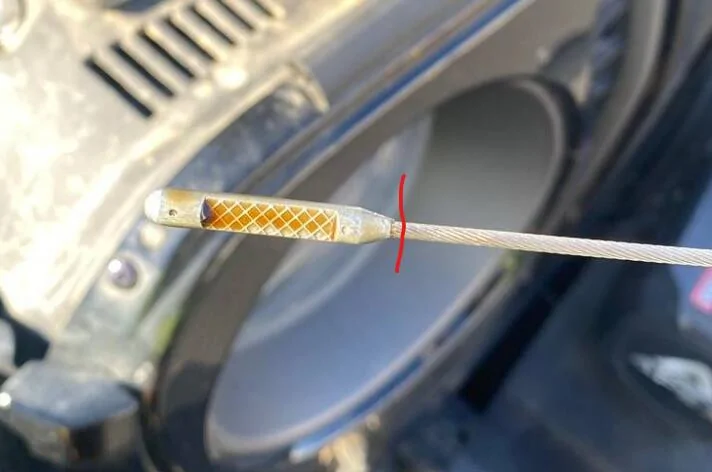
I've yet to see anyone brag about the accuracy of their 3.6 dipstick. I've not seen every single one and not every member posts their dipstick accuracy, but so far, what I've witnessed says they are more of a go/no-go gauge. Most read above that casting on the end when full.
Ideally, you let these sit a lot longer than 30 minutes if you want REAL accuracy, but 30 minutes will get you close enough to know if it's low enough to add or not.
Why longer?
Because 5 quarts is assumed with the oil filter dry, and the oil filter housing empty.
When you remove the cap and release the pressure on the filter, the remaining oil in the filter housing drains down to the sump (not fast, but it'll get there)

So the only real way to know exactly how your dipstick reads with the correct oil put in is to drain it all, change the filter - and for me, I check the oil level engine cold, in the morning before it's even started. Since I won't be driving mine today, I'll probably wait until this afternoon since I drove it yesterday afternoon.
Mine absolutely does read above that casting, onto the "wire", when the correct amount is put in.
No oil on the stick isn't necessarily low enough to cause a light to come on. Depending on your driving at the time, speed, curves/corners, braking and so on, there's likely still enough oil for the pump to create the volume needed for the oil pressure to be acceptable. Nothing on the stick doesn't mean empty - but is a red flag.
Assuming a perfectly accurate dipstick where those hashmarks indicate full/1 quart low, in a perfect world, full/5 quarts is the very top edge of the hash marks, 1 quart low is the bottom of the hash marks, that means that the dipstick has a range of around 1.5 to 2 quarts, tops. That means there's still 3 to 3.5 quarts in it. And if it was checked shortly after the drive, some of the oil is still up in the galleries, tops of the heads, oil filter housing and so on. So, no, not on the stick is very unlikely to trigger a low oil light.
As far as "over-filled", because these aren't a straight-up container where every inch rise in fluid level is exactly 1 quart, you can't know there was 7 quarts - that's a guess. The sump and crankcase itself is an odd shape for sure. If you measured how much you drained out, then you can get a close estimate, but you can't tell from the stick. Only by draining and measuring can you know what was in it - ideally pulling the filter to let the filter and filter housing drain, waiting a few minutes, then pulling the oil drain plug, and measuring.
You drained down to below full for sure - how low was it as far as quantity when you drained then used the dipstick, no way to know for sure because those dipsticks aren't calibrated.
Back to the "oil consumption" thing - a quart in 1,000 miles is a lot of oil. If it's a leak, it's going to smoke on exhaust, likely drip. A drop of oil spreads out to look like a hell of a lot more oil. (I've owned and dealt with leaking vehicles for decades). Take even a teaspoon of oil and pour it onto something - you can spread that out over a square foot or more. It's going to burn and drip and make a mess.
Burning that much oil - it will destroy the catalytic converters, it will contaminate and mess up O2 sensors, and you may well see blue out the exhaust (with the cats, it might not come out like pre-cat systems). But you'll know it - possibly even some black oily residue at the tail pipe after enough miles of that.
There's roughly 3 ways for oil to get into the chambers to be burned -
Really nasty faulty PCV - you can check that out easily enough.
Rings - compression test or leak-down test can indicate that issue.
Valve guides - extremely unlikely with these.
Oil consumption via the combustion chamber may lead to carbon fouled spark plugs, detonation, poor performance (because of the impact on O2 sensors, as well as fouled plugs and valves)
Oil consumption via leaks - it can't hide for very long! It will show itself.
If it's the oil cooler or filter housing, for example, it may get into the valley and accumulate for a while then come down the back of the engine and appear like a rear main seal.
Now, before we hit page 2 or 3 - any other details we really should know to at least TRY to help?


Sponsored