Sponsored

Torquing control arms

jjdustr340

Well-Known Member
First Name
Jason
Joined
Nov 5, 2020
Threads
9
Messages
458
Reaction score
825
Location
Ohio
Vehicle(s)
2023 Gladiator Mojave
Build Thread
Link
Occupation
Crime fighter.
I’ve seen several who have installed their own lift or leveling kits. I have the Teraflex 1.5 level and I’m thinking of installing myself. I’d classify myself as a decent shade tree mechanic for the last 30+ years, but one thing I’ve never messed with is suspension.
Looking at directions and watching various videos, it doesn’t seem to difficult at all. Well within my comfort zone.
My question for those of you who have done this yourself, how in the heck are you torquing the upper and lower control arms at the end of the install?
The vehicle need to be on the ground when torquing the bolts, and I really don’t see a way to get in there and manipulate the wrench to the required torque. Any one have some pointers? Thanks.
Sponsored
 

ColoFreeJeeper

Well-Known Member
First Name
Jason
Joined
May 28, 2021
Threads
2
Messages
120
Reaction score
352
Location
Colorado Springs
Vehicle(s)
2021 Gladiator Willys, 2005 Wrangler Sport
Occupation
Mechanical Engineer
Vehicle Showcase
2
It doesn't have to be on the ground. You can have the front diff supported by jack stands and not by the frame with the wheels off. This will be at the correct ride height and you can torque the arms.
 
OP
OP
jjdustr340

jjdustr340

Well-Known Member
First Name
Jason
Joined
Nov 5, 2020
Threads
9
Messages
458
Reaction score
825
Location
Ohio
Vehicle(s)
2023 Gladiator Mojave
Build Thread
Link
Occupation
Crime fighter.
It doesn't have to be on the ground. You can have the front diff supported by jack stands and not by the frame with the wheels off. This will be at the correct ride height and you can torque the arms.
So you’re saying support the entire vehicle by jack stands on the front diff?

What about ramps front and rear? This should still have the vehicle at normal ride level but allow an additional 8 inches or so underneath to work.
 

j.o.y.ride

Well-Known Member
Joined
May 26, 2020
Threads
96
Messages
2,937
Reaction score
3,915
Location
Foster City
Vehicle(s)
20 Gladiator Overland
Blast the hell out of it with a good impact wrench and finish it off with as long a torque wrench as you can. My M18 gets it to around 150lbs I think, haven't measured it, just a guess. It's still a serious PITA but it's doable on the ground esp when it's been lifted.

I usually jam a 24mm box wrench on the nut and wedge it against some other structural metal like the axle to be sure the nut isn't turning, then hammer the box wrench off.
 

ColoFreeJeeper

Well-Known Member
First Name
Jason
Joined
May 28, 2021
Threads
2
Messages
120
Reaction score
352
Location
Colorado Springs
Vehicle(s)
2021 Gladiator Willys, 2005 Wrangler Sport
Occupation
Mechanical Engineer
Vehicle Showcase
2
So you’re saying support the entire vehicle by jack stands on the front diff?

What about ramps front and rear? This should still have the vehicle at normal ride level but allow an additional 8 inches or so underneath to work.
If that’s how you can accomplish it, then so be it. I was only thinking to have the wheels off for better access. And yes, you can support the weight of the vehicle by the diff.
 

Sponsored

OP
OP
jjdustr340

jjdustr340

Well-Known Member
First Name
Jason
Joined
Nov 5, 2020
Threads
9
Messages
458
Reaction score
825
Location
Ohio
Vehicle(s)
2023 Gladiator Mojave
Build Thread
Link
Occupation
Crime fighter.
If that’s how you can accomplish it, then so be it. I was only thinking to have the wheels off for better access. And yes, you can support the weight of the vehicle by the diff.
Yep didn’t think about wheels, you are correct.
Im the type that thinks every project to death before I try and tackle it. Sometimes I forget the simple things while overthinking the process.
 
OP
OP
jjdustr340

jjdustr340

Well-Known Member
First Name
Jason
Joined
Nov 5, 2020
Threads
9
Messages
458
Reaction score
825
Location
Ohio
Vehicle(s)
2023 Gladiator Mojave
Build Thread
Link
Occupation
Crime fighter.
You can indeed torque the bolts while the Jeep is on the ground.
I know most every lift and leveling kit says to torque them while on the ground, my question is more of how are people doing it.
I’m not a big man, 5’8” and 210, and there’s not a whole lot of room under there, especially for moving around a torque wrench. Looking at the control arms, my mind struggled to visualize how the heck to torque the bolts as much as 190 ft-lbs on the lowers and how little room to swing a wrench on the uppers.
 

ShadowsPapa

Well-Known Member
First Name
Bill
Joined
Oct 12, 2019
Threads
247
Messages
40,442
Reaction score
53,859
Location
Runnells, Iowa
Vehicle(s)
'25 JTMX, '23 JLU 4xe, '82 SX4, '73 Javelin
Occupation
Retired auto mechanic, frmr gov't ntwrk security admin
Vehicle Showcase
3
On the ground is great, but just so the springs are compressed to the same point as if it was on the ground. Sitting on stands supporting the differential like others have said is cool.

Just so you don't do it with things hanging down. That's all.
 

Trauma PA

Well-Known Member
First Name
Robert
Joined
Jul 2, 2018
Threads
43
Messages
1,506
Reaction score
1,643
Location
Southwest Florida
Vehicle(s)
24 JT Willys, 20 JL Wrangler, 23 Bronco Wildtrak
Build Thread
Link
Occupation
Trauma Surgery Physician Assistant
I’ve seen several who have installed their own lift or leveling kits. I have the Teraflex 1.5 level and I’m thinking of installing myself. I’d classify myself as a decent shade tree mechanic for the last 30+ years, but one thing I’ve never messed with is suspension.
Looking at directions and watching various videos, it doesn’t seem to difficult at all. Well within my comfort zone.
My question for those of you who have done this yourself, how in the heck are you torquing the upper and lower control arms at the end of the install?
The vehicle need to be on the ground when torquing the bolts, and I really don’t see a way to get in there and manipulate the wrench to the required torque. Any one have some pointers? Thanks.
I wouldn’t rely on jack stands and then crawl under 5-6,000 lbs. and torque on control arm bolts. But then again look at my username/profession.
I’ve had no problem crawling under the Jeep with the wheels and tires on and accessing all the control arm bolts to tighten. Once the vehicle is lifted, there is more room than you’d think. For reference I’m a bulky 5’10” 215 lbs.
I mount the wheels and tires and then I stand on both sides of the vehicle and rock the vehicle back and forth, up and down. Then I crawl under and use a torque wrench to tighten all the control arm bolts and front and rear track bars. This is just what has worked for me and I’ve done 5 Jeep lift installs over the past 3 years.
 

Sponsored

Rockabillyroy

Well-Known Member
Joined
Nov 8, 2020
Threads
15
Messages
948
Reaction score
1,010
Location
CA
Vehicle(s)
JT
I lay on my back and just muscle through it with my arms until I can't any more. Then I get legs in there for the last few ft lbs.
 

cb4017

Well-Known Member
First Name
Cliff
Joined
Feb 15, 2021
Threads
36
Messages
518
Reaction score
984
Location
Northern Nevada
Vehicle(s)
2025 Gladiator Mohave, 2005 Jeep TJ Wrangler Sport
Occupation
USN Retired, FPD Retired, CHSO Retired
I got a 250 lb ft torque wrench from Lowes.
I discovered that trying to get 185 to 200 pounds of torque on a control arm bolt while laying on the ground was almost impossible for me. So one end at a time I put the truck on ramps. It gave me plenty of room to get the torque I needed while keeping the weight of the truck on the suspension.

Here is a link to my thread on the installation of the Mopar kit.
https://www.jeepgladiatorforum.com/...-mopar-2-lift-kind-of-long.43897/#post-707193
 

ShadowsPapa

Well-Known Member
First Name
Bill
Joined
Oct 12, 2019
Threads
247
Messages
40,442
Reaction score
53,859
Location
Runnells, Iowa
Vehicle(s)
'25 JTMX, '23 JLU 4xe, '82 SX4, '73 Javelin
Occupation
Retired auto mechanic, frmr gov't ntwrk security admin
Vehicle Showcase
3
I wouldn’t rely on jack stands and then crawl under 5-6,000 lbs. and torque on control arm bolts. But then again look at my username/profession.
I’ve had no problem crawling under the Jeep with the wheels and tires on and accessing all the control arm bolts to tighten. Once the vehicle is lifted, there is more room than you’d think. For reference I’m a bulky 5’10” 215 lbs.
I mount the wheels and tires and then I stand on both sides of the vehicle and rock the vehicle back and forth, up and down. Then I crawl under and use a torque wrench to tighten all the control arm bolts and front and rear track bars. This is just what has worked for me and I’ve done 5 Jeep lift installs over the past 3 years.
IT's not so easy to swing a long torque wrench on some of those bolts and nuts under there and get the sort of torque required. Easier for younger people, not so easy for older people. 150, 180, even more pound/ft - it's a lot of torque and you are really pulling or pushing to get there.
Setting the crush sleeve and setting pinion preload on a freshly changed pinion seal takes a lot of room to swing that long wrench and use the pinion flange holding tool.
I found it difficult to get the sort of torque leverage needed with only the little space under the truck. Not everyone is lifting 3+ inches so there's not always a lot more room under the truck. Mine - swapping spring, 1" gain - really? Do it with the truck on the ground with only 1" gain? So what about those who are not doing a big lift? What if it's a basic spring swap, parts replacement, etc.?

Jack stands are totally safe IF properly used and of the proper weight range. It's those that rely on a JACK that are idiots. My wife has a friend who was married years ago, had a little daughter about 3 years old. Mommy sent daughter to go out and get daddy for dinner. Little girl goes back to mommy - daddy won't talk to me. Yeah, working under car supported by a jack.
If properly on stands it would take another vehicle hitting it to ever move it or knock it off the stands. Using enough stands, in the CORRECT places and of the right weight rating is totally safe.
If the stands are each rated for 6,000 pounds, two of them will support 12,000 pounds (and more really, that's just the "rated" strength)
Been using them for 45 years. I have 8 stands, two of them I made and used them to support what was at that time Case's largest 2 wheel drive tractor while I removed the front axle and steering and extended the frame out forward. I don't recall how many TONS they were supporting, but me being me and paranoid, I still stacked timbers under the belly of that tractor to be sure.

The problem isn't jack stands, the problem is people who do NOT use them, or who use them improperly (not under FRAME or jack points or they don't have the differential's axle tubes nestled properly into the cradle on the top of the stand.
Concrete blocks, jacks, etc. - what the heck are people thinking? OR are they?
I've seen jacks slip, I've seen concrete blocks break.

I do not doubt for a minute what you may have seen or did see - but if there was a problem, it wasn't the use of jack stands, it was the dummy who didn't use them or didn't know HOW to use them.
I've been a mechanic working under cars on hoists and jack stands for over 40 years and frankly I'll trust my jack stands over a lot of hoists - I've seen hoists suddenly DROP! I've seen safeties fail to catch. I went into work one morning and saw my fellow employees and the manager all standing around a car that a guy had been working on the day before. He was doing exhaust but ran out of time. So he left it on the twin-post lift over night to finish the next day. He also left a tall stand under the car holding up the front pipe so he could clamp it.
The hoist settled over night, the safeties didn't catch and that stand was poking up through the floor, past the face of the dash, partially crushing it on the way past, and was sticking out the windshield.
I watched as a hoist with a hidden leak suddenly dropped a foot and the guy under it dove for cover - had he been standing under something sharp under that car........ I saw another hoist come down a couple of feet fairly quickly too and scared all of us in that shop. The boss quickly tore it down for repairs - it could have been a disaster.
My stands can't do that! Once a car is on them, no one here could easily knock it off the stands.

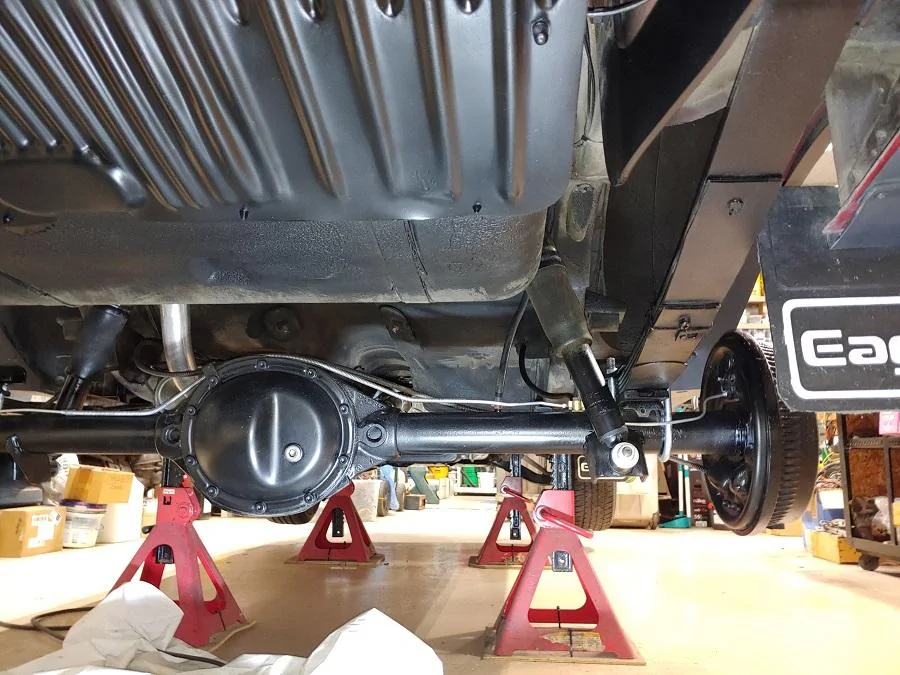
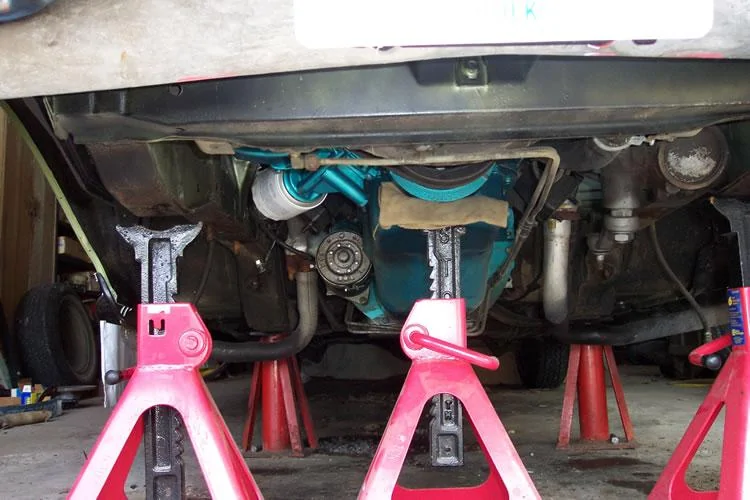
Fully supported on stands while I detail things for show.............

Jeep Gladiator Torquing control arms sx4-rear-diff


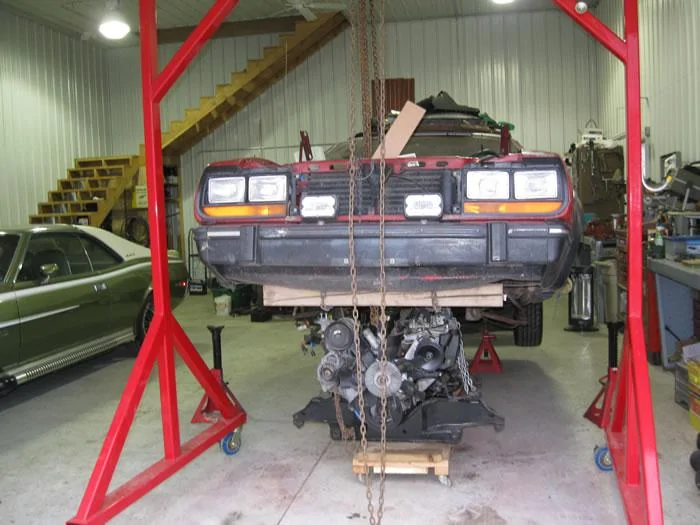
Rear on stands, front on gantry crane, stands ready to the side.

Jeep Gladiator Torquing control arms sx4-engine-insert-002


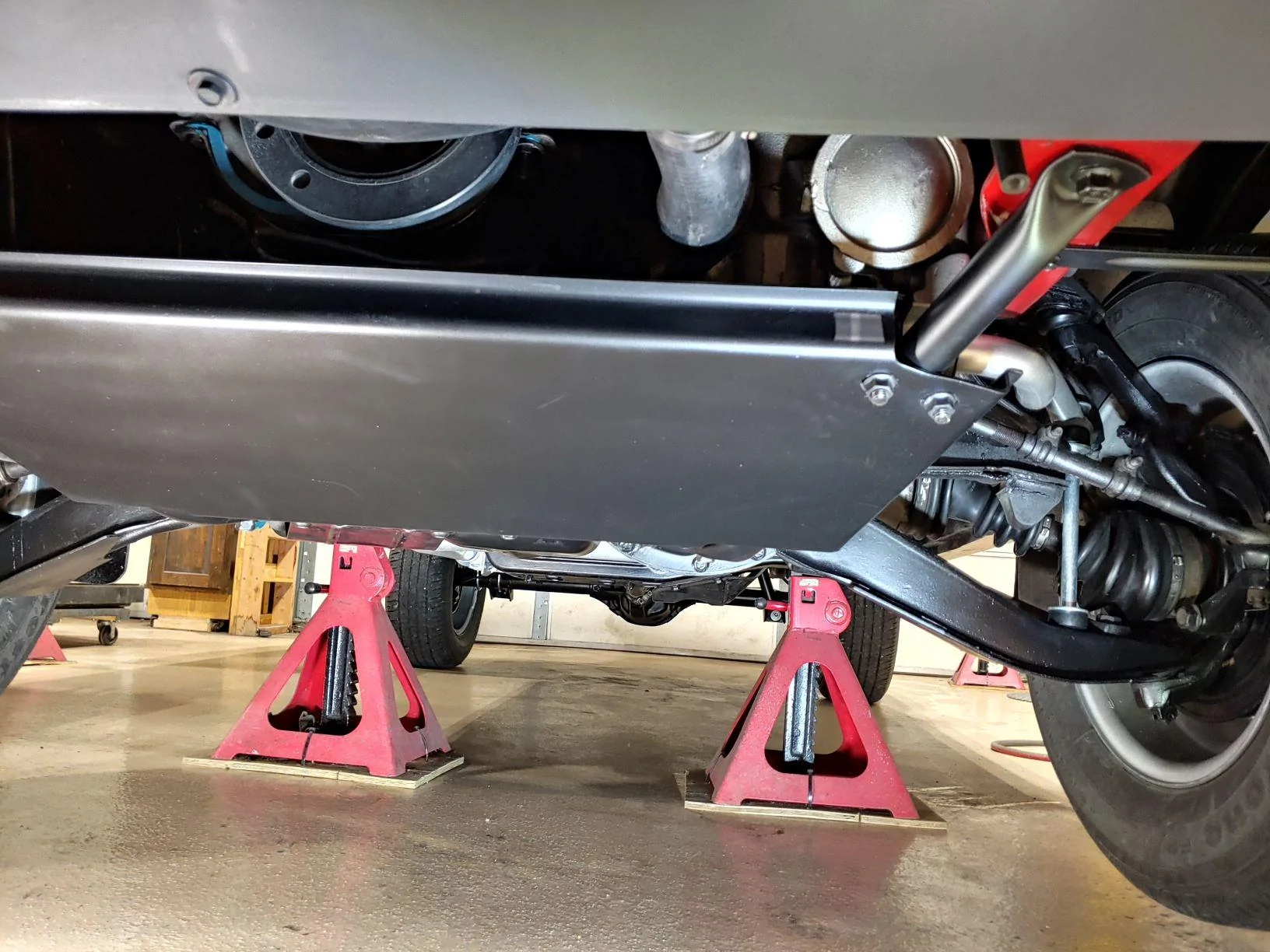
Stands under frame rails while I detail the exhaust and other parts -

Jeep Gladiator Torquing control arms sx4-front-end


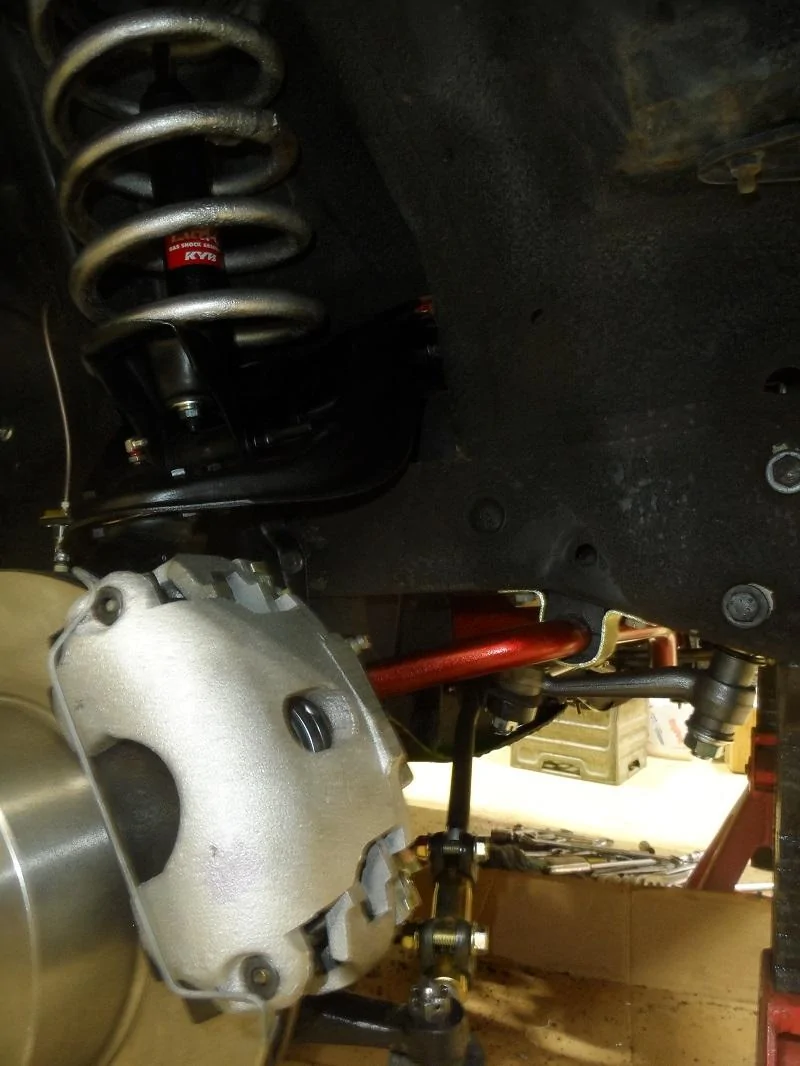
Car on jack stands while I have entire suspension and steering removed for restoration, and cross member out for cleaning and powder coating. Engine supported by 4x4 between fender mounting flanges, eye hook and chain. Padded stand under dampener because I'm paranoid.

Jeep Gladiator Torquing control arms jav-suspension-removed-11


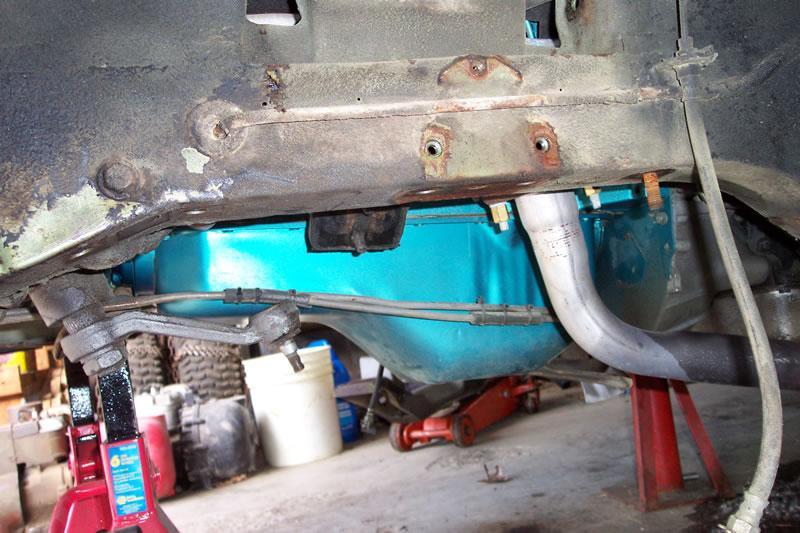
yes, I have FOUR jack stands under the front of this car - it would take a heck of a hit to knock it off, can't possibly fall. No way.

Jeep Gladiator Torquing control arms jav-susension-removed-8


73 Javelin on stands while I rebuild the steering, suspension and upgrade to HD Kelsey-Hayes disk brakes.

Jeep Gladiator Torquing control arms 73-Jav-suspension-2
 

LostWoods

Well-Known Member
Joined
Mar 13, 2020
Threads
15
Messages
2,027
Reaction score
2,420
Location
Gilbert, AZ
Vehicle(s)
2024 4Runner / 1995 YJ
I wouldn’t rely on jack stands and then crawl under 5-6,000 lbs. and torque on control arm bolts. But then again look at my username/profession.
I’ve had no problem crawling under the Jeep with the wheels and tires on and accessing all the control arm bolts to tighten. Once the vehicle is lifted, there is more room than you’d think. For reference I’m a bulky 5’10” 215 lbs.
I mount the wheels and tires and then I stand on both sides of the vehicle and rock the vehicle back and forth, up and down. Then I crawl under and use a torque wrench to tighten all the control arm bolts and front and rear track bars. This is just what has worked for me and I’ve done 5 Jeep lift installs over the past 3 years.
I can assure you that you're not knocking a properly supported truck with a 2ft torque wrench unless you're doing it wrong. Good jackstands make a difference (e.g. pin instead of ratchet and overrated for your vehicle) and bonus points for some with axle cradles if you're supporting something round.

A 90lb one-arm press is well beyond the average person so most aren't going to be able to hit the correct torque values without the clearance.
 

ShadowsPapa

Well-Known Member
First Name
Bill
Joined
Oct 12, 2019
Threads
247
Messages
40,442
Reaction score
53,859
Location
Runnells, Iowa
Vehicle(s)
'25 JTMX, '23 JLU 4xe, '82 SX4, '73 Javelin
Occupation
Retired auto mechanic, frmr gov't ntwrk security admin
Vehicle Showcase
3
My stands are capable of 4 times the weight of the truck. I have a set of 4 of NAPA's best from 25 years ago. Yes, they are ratchet but they are built like tanks. As long as you ensure the dog is in the rack properly, it can't go anywhere. The frame of the stand is heavy gauge steel and welded properly. I've had then that long and there's still no rust to speak of - the finish is good, the welds are great and I've had straight trucks supported on them.
I had a pair of them under the rear axle of my car while I lifted the front end with a gantry crane - that meant that more than just the weight of the rear of the car was on them - the car for a while was over 30 degrees in the air. The stands have a nice curve to the top and hold an axle tube securely. The axle tubes rotated nicely in the stand cradles, never climbing out.
I use those stands when I need to put 250 pound/ft of torque on the rear axle to hub nuts as that axle can't move, it has to be on something solid. .

The stands I made sit on a steel plate, are heave gauge pipe (not water pipe) and I use a 3/4" pin through holes in the inner pipe to set the height. The outer pipe is braced to the steel plate with heavy angle iron running from the top of the outer pipe to the outer corners of the plate. Those are what my tractor sat on - I made them for that purpose. My bet is that they'd each hold up 10,000 pounds.

I am claustrophobic and have a fear of being crushed and/or suffocation. Not a lot bothers me otherwise but those two things freak me out. If I even imagined something could keep me from breathing, or might crush me, I'm outta there.
Sponsored


Top