
Sponsored

Your battery voltage - truck off and at rest

OP
OP
ShadowsPapa

ShadowsPapa

Well-Known Member
First Name
Bill
Joined
Oct 12, 2019
Threads
247
Messages
40,440
Reaction score
53,853
Location
Runnells, Iowa
Vehicle(s)
'25 JTMX, '23 JLU 4xe, '82 SX4, '73 Javelin
Occupation
Retired auto mechanic, frmr gov't ntwrk security admin
Vehicle Showcase
3
Just checked the charging on the main battery. Earlier, switching up the power to 10A, the battery went from 4V to 5 then has now dropped to 4V again. It’s done.

I’ve put the leads over to the accs battery and set the charge to 2A, battery reads 0V. When I switch to 10A, it reads 1.7V. I left it on 2A charge and will leave it for a while.
That doesn't look like a charger for AGM batteries. Some conventional chargers will work, others require a load from the battery to actually put out like normal and the AGM doesn't appear as a load like a conventional battery.
For example - when I use electrolysis to de-rust ferrous parts, I have to use an old charger that is on when I flip the switch because the solution in the electrolysis bucket doesn't present a load so most battery chargers that are newer will never actually charge.
My guess is that the charger doesn't handle the 3 phases of charging these go through.
And yes, like said earlier, once these reach 0 volts the chances of resurrecting them isn't good.
AGM batteries are apparently used in the racks for solar power systems and the tech stuff I've read on those say to set the system up so that once the voltage drops below something like 11.xx volts, shut down the draw from the batteries. You get down into the 11.x volt range on these and you can get into trouble.
It can take voltages up in the upper 14s to get these to get through one phase of charging. Seems I read something like 14.8 volts - that's high for many chargers, way high, so there's another reason some legacy chargers without the AGM circuitry won't work on these.

Anyway, I left my inexpensive AGM battery tender on my wife's Grand Cherokee a few hours yesterday - voltage came up to 12.7 but the charger indicated it was still charging. It took about 12 hours to get the Grand Cherokee batteries up to where the tender shut down and was in maintain mode. Wow. That tells me that these batteries take hours to go from 12.2 or 12.3 up to fully charged and the truck will not normally ever get driven enough to fully charge them. But that begs the question - why do these go dead in a matter of days?
Sponsored
 

DobaMark

Well-Known Member
First Name
Mark
Joined
Aug 3, 2020
Threads
4
Messages
194
Reaction score
179
Location
30143
Vehicle(s)
20 JT Overland, 23 JL Sahara 4xe
Put the charger back on my Gladiator and let it trickle change. When complete, with the charger attached dash showed 12.6 volts. As soon as I unhooked display dropped to 12.4.
i'll run some errands today, but I suspect the battery charging message will still be displayed.
 

Maximus Gladius

Well-Known Member
First Name
Kevin
Joined
Jan 30, 2021
Threads
74
Messages
2,901
Reaction score
3,692
Location
Calgary, AB, Canada
Vehicle(s)
2021 JTR, 2023 JTR
This video explains it well!


If….(NOT IF,)…ITS SO IMPORTANT to NOT run theses AGM batteries down to 12V, why is the critically important AUX battery buried so you can’t get at it easy to keep a trickle charger on? We need a charge post kit that connects to the aux battery and runs up top side to not only check the V but to keep it charged up. But at the very least a V meter should be installed and run top side to at least watch the numbers. That would be simple to do but I’m sure there are many owners not having the critical knowledge of what type of batteries they have and how to care for them. I didn’t think it was something I needed to worry about so when the dealership had me tow my truck home dead (1.7V aux and the main not much higher) then recommended I just put a charger on the batteries, shows me the service manager didn’t know either and recommendation was Ill advised. Thanks Papa for your previous explanation that caused me to dive into it a bit!
 

bakobobby

Well-Known Member
First Name
Bobby
Joined
Jan 16, 2022
Threads
17
Messages
477
Reaction score
487
Location
Bakersfield
Vehicle(s)
2021 Gladiator California
Build Thread
Link
Occupation
Doer of things
The ESS in my Gladiator purchased in December has never worked properly. Would just randomly work never made sense. Turned it off with Tazer. Brought to shop for another issue and they took a look at it and told me the battery was “severely” discharged whatever that means. Truck is driven daily ?‍♂
 
OP
OP
ShadowsPapa

ShadowsPapa

Well-Known Member
First Name
Bill
Joined
Oct 12, 2019
Threads
247
Messages
40,440
Reaction score
53,853
Location
Runnells, Iowa
Vehicle(s)
'25 JTMX, '23 JLU 4xe, '82 SX4, '73 Javelin
Occupation
Retired auto mechanic, frmr gov't ntwrk security admin
Vehicle Showcase
3
This video explains it well!


If….(NOT IF,)…ITS SO IMPORTANT to NOT run theses AGM batteries down to 12V, why is the critically important AUX battery buried so you can’t get at it easy to keep a trickle charger on? We need a charge post kit that connects to the aux battery and runs up top side to not only check the V but to keep it charged up. But at the very least a V meter should be installed and run top side to at least watch the numbers. That would be simple to do but I’m sure there are many owners not having the critical knowledge of what type of batteries they have and how to care for them. I didn’t think it was something I needed to worry about so when the dealership had me tow my truck home dead (1.7V aux and the main not much higher) then recommended I just put a charger on the batteries, shows me the service manager didn’t know either and recommendation was Ill advised. Thanks Papa for your previous explanation that caused me to dive into it a bit!
The batteries are connected together. A charger at the top also charges the aux battery.
They are only disconnected - the circuit broken - when the ESS has stopped the engine.
Connecting a charger will charge both.

Not happy after I got my truck back today - they said batteries checked out fine but the notes said "did require charging for 38 minutes.........." Well, if all is functioning well, I drove the truck there, they drove the truck, it's not been sitting for a week, why did they have to charge the batteries before they could check them?
Then they said that "all the stuff you have connected to it likely is drawing the batteries down". All the stuff is factory - They said they "moved it to the other side and that should help"
What they moved was the winch ground cable, and where they moved it to was the body ground. That makes no difference since the body ground cable goes directly to the battery neg. So they did nothing. Besides, the winch pulls zero power when not in use, especially since there's a cutoff switch right next to the battery.
I had the winch ground connected to the battery on the SAME bolt the body ground cable connects to. They moved my cable from one end of the factory ground cable to the other.
So this time, they blew it. Said truck is fine, any issues likely related to "all the stuff" I have connected - which consists of a winch with a disconnect.
They had to charge the batteries before they could check them.
 

Sponsored

OP
OP
ShadowsPapa

ShadowsPapa

Well-Known Member
First Name
Bill
Joined
Oct 12, 2019
Threads
247
Messages
40,440
Reaction score
53,853
Location
Runnells, Iowa
Vehicle(s)
'25 JTMX, '23 JLU 4xe, '82 SX4, '73 Javelin
Occupation
Retired auto mechanic, frmr gov't ntwrk security admin
Vehicle Showcase
3
I was able to speak with a knowledgeable tech from the dealership where I bought this truck. I emailed the sales guy who contacted the tech and had him call me.

He agreed something wasn't right - and said "we've replaced a lot of batteries and things on these due to that very issue." More than once he mentioned it's a thing and they have replaced many batteries and agreed that mine weren't keeping charged for some reason.

He also said - not in these words, but the gist was "BS" to the bit about ABS not working under 35 mph.
 

jac04

Well-Known Member
First Name
Jeff
Joined
Apr 20, 2021
Threads
27
Messages
1,545
Reaction score
2,246
Location
CT
Vehicle(s)
2021 Mojave, 2014 JKRX SWB
What they moved was the winch ground cable, and where they moved it to was the body ground.
I don't know the size of that factory ground cable, but I would move that winch cable back to the battery terminal.
 
OP
OP
ShadowsPapa

ShadowsPapa

Well-Known Member
First Name
Bill
Joined
Oct 12, 2019
Threads
247
Messages
40,440
Reaction score
53,853
Location
Runnells, Iowa
Vehicle(s)
'25 JTMX, '23 JLU 4xe, '82 SX4, '73 Javelin
Occupation
Retired auto mechanic, frmr gov't ntwrk security admin
Vehicle Showcase
3
I don't know the size of that factory ground cable, but I would move that winch cable back to the battery terminal.
Yes, agreed! That thought had already had crossed my mind.
Looks like you obviously understand just what they did.
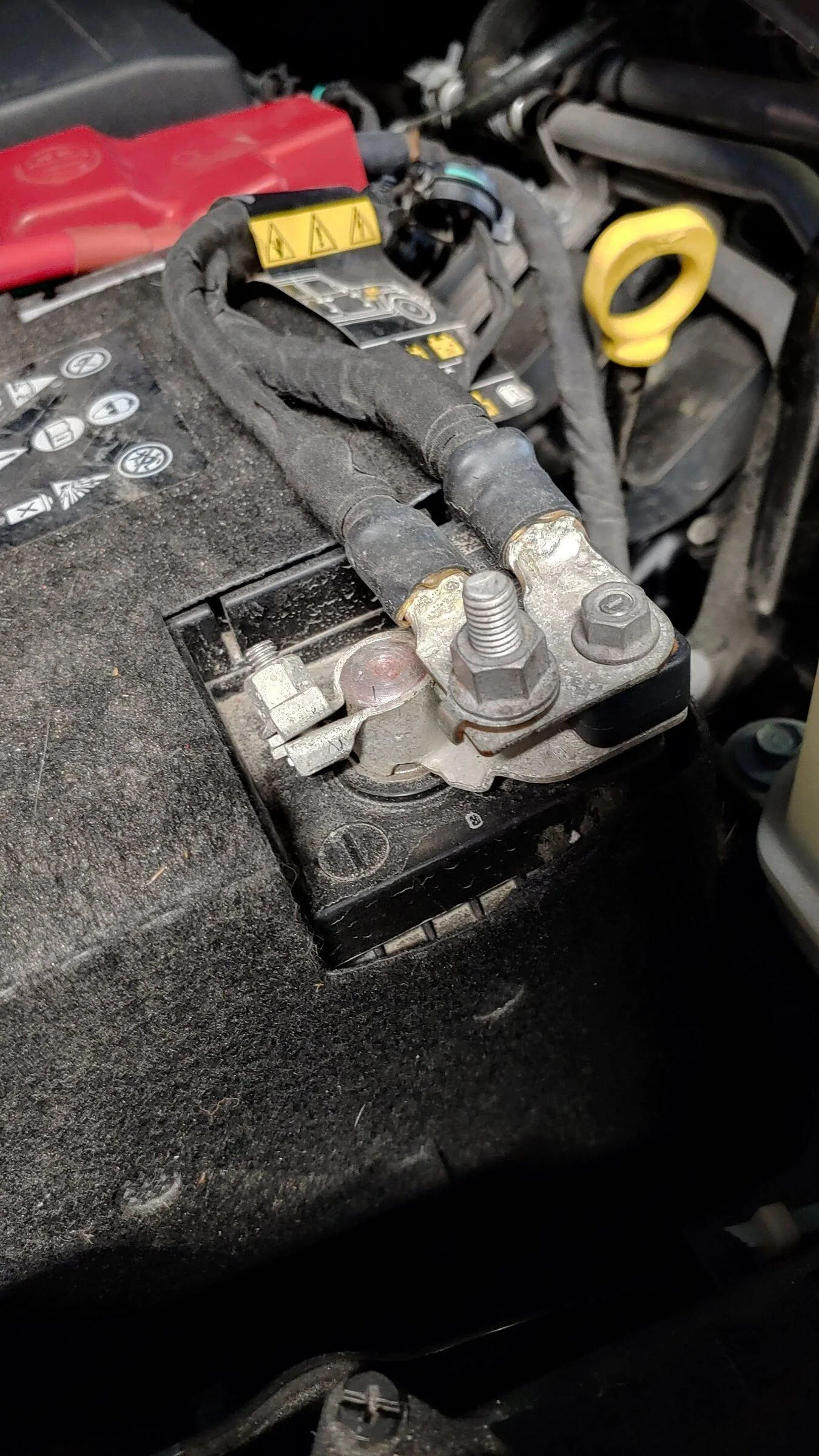
There is a cable from the negative battery connector clamp, above the IBS, that goes directly to the right fender for body ground. I was originally connected to the battery negative on the SAME stud that negative body ground cable uses - the exact same stud. I put my cable on top of the factory nut and then a nut on top of my cable, squeezing it against the factory nut that holds the body ground cable to the battery clamp. That's a tall stud, plenty of room for multiple cables and nuts.
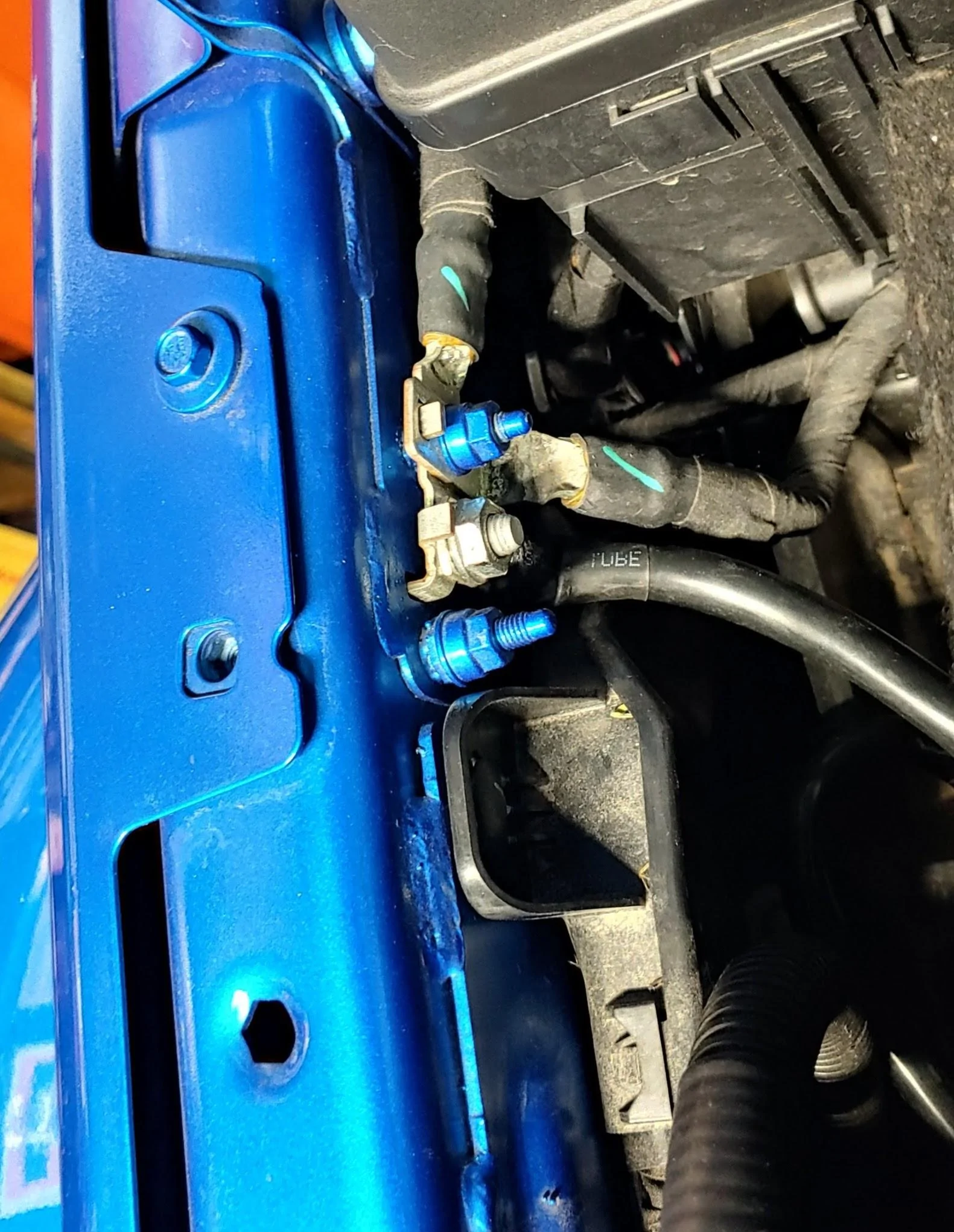
They removed my winch ground cable from that stud and connected it to the other end of the body ground cable.
So electrically speaking, all they did was add the length of the factory body ground cable to the length of my winch ground cable - increasing the number of connection points by 2 and increasing the length of the ground cable by at least 18".
So even though it could be minimal, without measuring, they added more voltage drop and 2 more connections.
But, and this is the funny part they didn't understand - they didn't electrically change anything other than adding length and connections. It's the same as if they simply bolted on 18" of cable to the end of mine and reconnected it. What silliness.


This is where it was - on the tall stud, I left that nut in place, put the cable on, then another nut ->

Jeep Gladiator Your battery voltage - truck off and at rest JT-neg-bat-post


This is where they moved it to - it's the fat black cable right next to the cable coming from the battery negative post. ->

Jeep Gladiator Your battery voltage - truck off and at rest JT-body ground
 

misplacetexan

Well-Known Member
First Name
Xavier
Joined
Jul 21, 2019
Threads
2
Messages
88
Reaction score
137
Location
Baytown, Texas
Vehicle(s)
2020 Jeep Gladiator Billet Silver Sport S/Max Tow Package
Occupation
Law enforcement
Approximately 12 hours since driven:
Fluke 77 used for measuring

Main Battery: 12.67 volts
Aux Battery: 11.20 volts (using pin 1 or pin 3 on fuse array)

Yesterday on my way to work, my ESS came on. Just curious what radio (5, 7, 8.5) are installed on the Jeep that are having this issue?
I just installed 2 new batteries this month on my JT. I just installed the 8.5” (new) radio in my JT about the same time of batteries were replaced. Never had any ESS issues with 7” radio, until the batteries needed to be replaced.

My fuse array was damaged by the tow truck driver and the fuse for charging the aux battery (pin 3) was blown. The battery voltage the gladiator displays is for the auxiliary battery at pin 3. Pin 3 is the alternator charging for the auxiliary battery.
 

jac04

Well-Known Member
First Name
Jeff
Joined
Apr 20, 2021
Threads
27
Messages
1,545
Reaction score
2,246
Location
CT
Vehicle(s)
2021 Mojave, 2014 JKRX SWB
There is a cable from the negative battery connector clamp, above the IBS, that goes directly to the right fender for body ground. I was originally connected to the battery negative on the SAME stud that negative body ground cable uses - the exact same stud. I put my cable on top of the factory nut and then a nut on top of my cable, squeezing it against the factory nut that holds the body ground cable to the battery clamp. That's a tall stud, plenty of room for multiple cables and nuts.
Wait a second. You are running your winch through the IBS? Is the IBS capable of handling the max amp draw of your winch? Sorry if this has been discussed before, but I did a quick search and didn't find anything.
 

Sponsored

OP
OP
ShadowsPapa

ShadowsPapa

Well-Known Member
First Name
Bill
Joined
Oct 12, 2019
Threads
247
Messages
40,440
Reaction score
53,853
Location
Runnells, Iowa
Vehicle(s)
'25 JTMX, '23 JLU 4xe, '82 SX4, '73 Javelin
Occupation
Retired auto mechanic, frmr gov't ntwrk security admin
Vehicle Showcase
3
Wait a second. You are running your winch through the IBS? Is the IBS capable of handling the max amp draw of your winch? Sorry if this has been discussed before, but I did a quick search and didn't find anything.
I could just as easily bolt to the battery terminal clamp bolt.........
The IBS is a low resistance shunt and the very slight voltage drop across the IBS shunt is measured along with actual battery voltage.
(It's the same as used in ammeters of cars dating back a few decades (not the full current ammeters like in the early 70s and older))

Here's what I have on the IBS -

Given that an IBS does use a resistive shunt at its core for current measurements, there is a loss associated with it being in-circuit. However, by incorporating shunts with extremely low resistance values, this loss can be negligible over most of the current range. For example, a 100 µΩ shunt only causes a loss of 1 W at 100 A of current. That is a 0.083 percent power loss if you have 100 A being sourced by a 12 V battery.

On the real-world test, the 35-inch, 4- AWG positive battery cable has a resistance of 788 µΩ. This means there is nearly eight times more power loss in just the positive battery cable than there is in the IBS. The use of such a low-value shunt should permit the IBS unit to operate at a current range of ± 600 A continuously and ± 2,000 A in pulsed applications not exceeding 900 J.

And this is what I have from another forum describing how they work -
The IBS may be the most robust sensor on the car, as its sensitive element is essentially a bar of copper capable of carrying 1,000 Amps of current. It has a tiny laser cut in it that causes the minuscule voltage drop that is used to measure current flow based on the voltage drop.
 
OP
OP
ShadowsPapa

ShadowsPapa

Well-Known Member
First Name
Bill
Joined
Oct 12, 2019
Threads
247
Messages
40,440
Reaction score
53,853
Location
Runnells, Iowa
Vehicle(s)
'25 JTMX, '23 JLU 4xe, '82 SX4, '73 Javelin
Occupation
Retired auto mechanic, frmr gov't ntwrk security admin
Vehicle Showcase
3
This is information on the actual IBS installed on the JT, or just generic information?
The first comes from a manufacturer of the technology in the IBS, a tech paper on them.
Some of the other from BMW

Since you should have the engine running when running a winch, and the idea of the IBS is to get the system to the point where all vehicle load comes from the charging system or alternator and not the battery, then if you have an alternator capable of even only 150 amps, the battery will only make up what the alternator can't supply. So if you were drawing 300 amps, that isn't going through the IBS, not the whole thing anyway, only half of that.
If you were drawing 400 amps and the alternator could kick out even only 100 amps, then 300 comes from the battery.
Of course we're talking full load, max current on the winch. In most cases that is not even close to sustained current draw - you'd heat wires.

In any case, one should not use the winch with the engine off anyway.

The system is designed so that when you are tooling down the highway, pulling a load, tunes cranked at max, lights on, nothing comes out from the battery through the IBS - it's all alternator.

I wonder if people realize that according to how these are designed, when you charge the batteries, you should not connect below the IBS to the battery but should charge through the IBS. I've found that info in multiple places, including Jeep forums.
 

jac04

Well-Known Member
First Name
Jeff
Joined
Apr 20, 2021
Threads
27
Messages
1,545
Reaction score
2,246
Location
CT
Vehicle(s)
2021 Mojave, 2014 JKRX SWB
The first comes from a manufacturer of the technology in the IBS, a tech paper on them.
Some of the other from BMW

Since you should have the engine running when running a winch, and the idea of the IBS is to get the system to the point where all vehicle load comes from the charging system or alternator and not the battery, then if you have an alternator capable of even only 150 amps, the battery will only make up what the alternator can't supply. So if you were drawing 300 amps, that isn't going through the IBS, not the whole thing anyway, only half of that.
If you were drawing 400 amps and the alternator could kick out even only 100 amps, then 300 comes from the battery.
Of course we're talking full load, max current on the winch. In most cases that is not even close to sustained current draw - you'd heat wires.

In any case, one should not use the winch with the engine off anyway.

The system is designed so that when you are tooling down the highway, pulling a load, tunes cranked at max, lights on, nothing comes out from the battery through the IBS - it's all alternator.

I wonder if people realize that according to how these are designed, when you charge the batteries, you should not connect below the IBS to the battery but should charge through the IBS. I've found that info in multiple places, including Jeep forums.
So the answer is no, that's all you needed to say.
 

jebiruph

Well-Known Member
First Name
Jerry
Joined
Dec 9, 2018
Threads
15
Messages
806
Reaction score
730
Location
IA
Vehicle(s)
2018 Wrangler JL 2024 Grand Cherokee L WL 2020 Gladiator JT
Approximately 12 hours since driven:
Fluke 77 used for measuring

Main Battery: 12.67 volts
Aux Battery: 11.20 volts (using pin 1 or pin 3 on fuse array)

Yesterday on my way to work, my ESS came on. Just curious what radio (5, 7, 8.5) are installed on the Jeep that are having this issue?
I just installed 2 new batteries this month on my JT. I just installed the 8.5” (new) radio in my JT about the same time of batteries were replaced. Never had any ESS issues with 7” radio, until the batteries needed to be replaced.

My fuse array was damaged by the tow truck driver and the fuse for charging the aux battery (pin 3) was blown. The battery voltage the gladiator displays is for the auxiliary battery at pin 3. Pin 3 is the alternator charging for the auxiliary battery.
That aux battery voltage is low, are you sure the blown fuse was repaired so the aux battery can get charged from the alternator?
Sponsored


Top