Sponsored

Driving in 2 feet of snow

Jeepasaurus_Rex

Well-Known Member
First Name
Mike🖤
Joined
Aug 21, 2020
Threads
10
Messages
460
Reaction score
659
Location
Texas
Vehicle(s)
'04 KJ -- '21 JTRD
Build Thread
Link
Nice, I had no idea there were any AT's out there in a 40"! That's cool :)

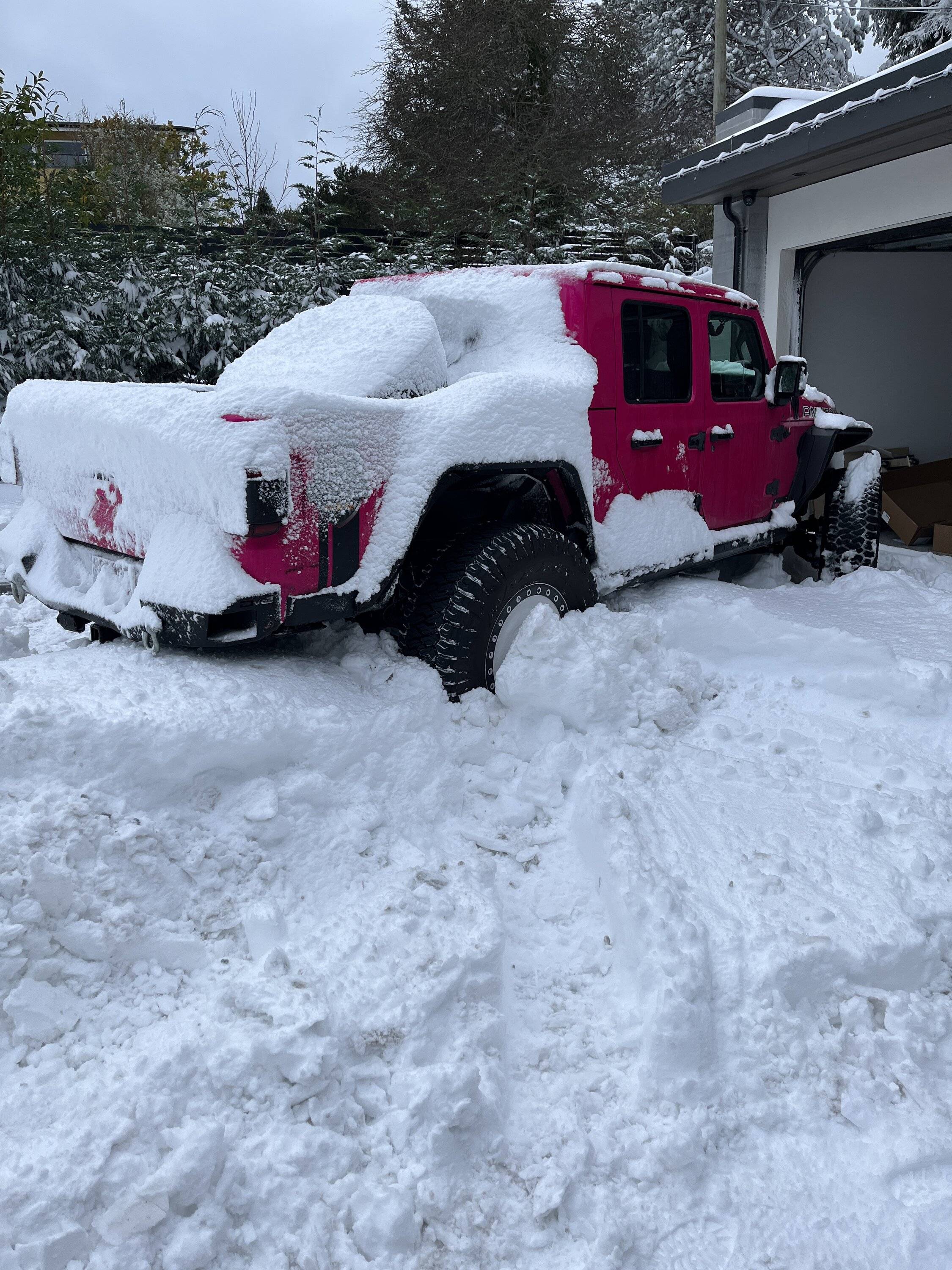
With it being on 20's you have a bit less sidewall to grab at and help clear/push past, so that could be a factor. The higher pressure is definitely the biggest factor that I can see. If you lower that pressure down to about 20-22 you should be able to "float" on top a little more, rather than just digging holes.

If nothing works, just keep spinning until the snow melts and your tires get hot lol. I used to do that all the time in an old work van I had.
Sponsored
 

Snake Eyes

Well-Known Member
Joined
Feb 10, 2022
Threads
11
Messages
659
Reaction score
1,094
Location
Las Vegas
Vehicle(s)
2022 Sport S Max Tow, 2011 Toyota FJ Cruiser
Did you turn traction control off to keep your momentum up?
I was going to say the same when I saw the word “sloped” as describing driveway.


Why would you turn off traction control?
When traveling up a steep icy hill, or when trying to get unstuck from snow/mud. When attempting to travel through deep snow or mud, reduced power may end up in the vehicle getting stuck. Reducing power or applying brakes to a spinning wheel(s) in these circumstances is counterintuitive.

These situations may require more momentum, so reducing the power is not good.”


Turning off the Traction Control on Steep Hills and Slippery Surfaces

When driving on country roads, a steep hill, or icy roads, the traction control can overreact. This is caused as these roads typically have steeper inclines than highways do, which will cause the control system to stop the car altogether. Unfortunately, this is a side-effect of its programming.

So, how will the system cause you to lose control over the car in such instances?

Well, during the drive, wheel slip is detected which causes the control module to decrease engine power. However, hills and inclines are long and slippery, which triggers the control module recurrently, which causes it to slow the vehicle down more and more.

Scientifically speaking, to overcome gravity the car will need more power. Since the control module slows the driving speed down more and more, the vehicle will not be able to climb the incline. In a worst-case scenario, this will cause the car to drift backward after stopping.

Turn the traction control off to regain the lost traction on hillsides. You will need good quality winter tires, sometimes even tire chains, to be able to conquer such winter roads. They can prove to be too much for some cars, especially when they are not plowed, drifted over, or are packed hard.”
 

Sponsored

Viper501

Well-Known Member
Joined
Oct 1, 2022
Threads
3
Messages
715
Reaction score
1,013
Location
COLASC
Vehicle(s)
2022 JT Sting Gray Mojave; 2025 Range Rover Sport, 2020 Mercedes GLE (Gone)
Occupation
Ninja
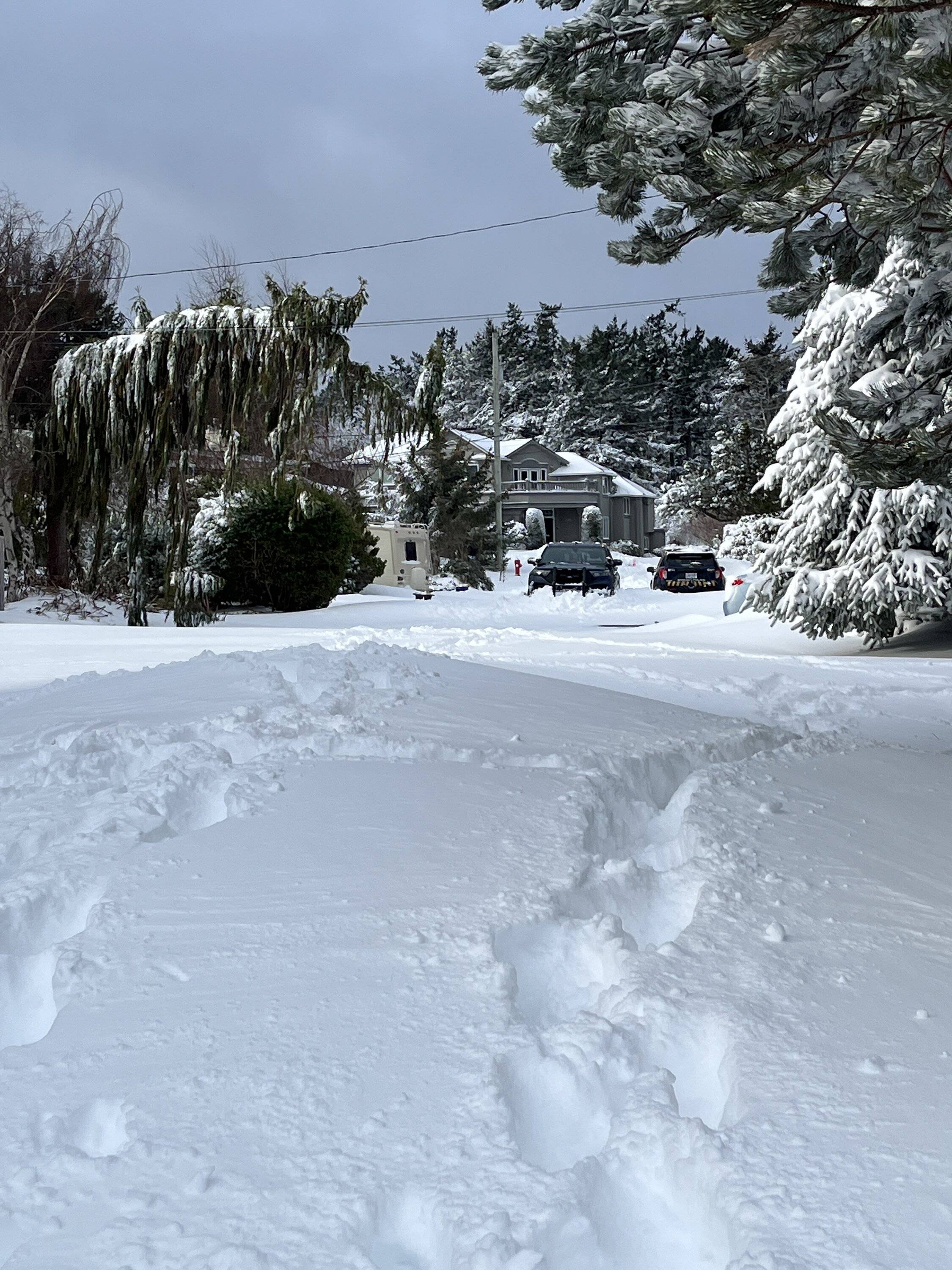
Issue with the driveway/house position is how the wind packed it in and where it put it. Photo below is 2 police SUV's getting stuck yesterday. They brought in a tow truck to get them out. Top of the hill the snow was up above my knees just due to how the wind built the drift.

IMG-4247.JPG
Why I live waaaay further south … :CWL: Stuff is beautiful to look at but no thanks. Agree on air pressure and the off-road cruise option. May be able to creep it out that way.


 

WILDHOBO

Well-Known Member
First Name
Dan
Joined
Sep 24, 2021
Threads
73
Messages
11,682
Reaction score
17,782
Location
Colorado
Vehicle(s)
2021 Gladiator Rubicon
Occupation
Network Engineer
Vehicle Showcase
1
Thank you for chiming in. Will check that out.
What load rating are the tires? Mickey Thomson recommended that I run 27psi on my D-rated 37’s from them. I have no problems at any speed, and they have amazing traction in snow and ice. And they’re wearing perfectly.
 

WILDHOBO

Well-Known Member
First Name
Dan
Joined
Sep 24, 2021
Threads
73
Messages
11,682
Reaction score
17,782
Location
Colorado
Vehicle(s)
2021 Gladiator Rubicon
Occupation
Network Engineer
Vehicle Showcase
1
To add to this. In my rubicon with 37” AT’s, if it’s deep, like 2-3ft drifts, I use 4 hi auto. It works every time. Easy on the pedal like you’re crawling. Just enough to move and it goes through virtually anything.
 

Sponsored

Jefe1018

Well-Known Member
Joined
Mar 4, 2020
Threads
48
Messages
3,123
Reaction score
5,256
Location
NV
Vehicle(s)
Sold the 21 JT Rubi Ecodiesel, now a 4.5 gen Powerwagon
Build Thread
Link
I don't think anything outside of snow tracks would be able to get you out of that first pic without any sort of engineering before hand. That's a lot of powder. Times like these, I'm glad I live in the desert - most other times I too think it is silly.
 

Labswine

Well-Known Member
First Name
Steven
Joined
Jun 18, 2020
Threads
34
Messages
1,140
Reaction score
1,736
Location
West Chester, Pennsylvania
Vehicle(s)
2020 Gladiator Overland, 2019 GC Ltd
Occupation
Retired Chemist
I had an '08 Grand Cherokee Overland (Hemi) that I added about 1.5" of lift and put larger than stock Hankook Dynapro ATMs on it. Dry road, they were whisper quiet, great aggressive tread pattern for not so nice stuff.

I took that GC through a foot and an half of heavy wet snow with another inch or so of sleet on top of it.

Put her in 4Lo and she handled it like it was nothing. Kept it low and steady on the accelerator. I think that, coupled with Quadradrive II (QD II) made all the difference.

So, IMHO that was a great combination of QD II and tires that made all the difference in goign or just sitting there wondering how to go without serious shoveling.

When my factory tires wear out, those are the tires I'm going with. Same height, just a bit wider. I have an Overland so I have the 255/70R18 tires. I'll probably go with a 275 or 285 just to hel add a little extra foot print whilst towing my travel trailer.
 

rubicon4wheeler

Well-Known Member
First Name
Geoff
Joined
Jan 1, 2022
Threads
1
Messages
228
Reaction score
373
Location
Sierra Nevada, California
Vehicle(s)
2022 Gladiator Rubicon Diesel
Occupation
Safety Supervisor
There is no one "solution" to your problem, since different snow conditions demand different strategies. But one thing you need to do is drop that air pressure. Start at 10lbs and work down from there as needed. You'd be much better off with 17 inch wheels beadlocks (preferably Icon Rebound Pro's type) rather than 20's. At least your tires meet the 3PMSF standards. But your #1 determining factor is driver experience.

From the sounds of it, you're new to 4wheeling in deep snow, so I'd recommend getting out into the snow and practice, practice, practice. Snow conditions don't just change from day to day, but from hour to hour, lower to higher elevation, wide open to tree covered, and from one side of the mountain to the other. With experience comes the ability to "read" the snow and adapt your strategy to compensate.
 

MPMB

Well-Known Member
First Name
Michael
Joined
Apr 30, 2021
Threads
12
Messages
1,820
Reaction score
2,716
Location
Utah
Vehicle(s)
'21 JTR - SG
Occupation
Check your inbox.
There comes a limit for all vehicles, no matter how well equipped.

And as a neighbor a little to your south, our snow (PNW) is one of the worst snows to drive in. It's wet and heavy. Rarely do we get light and fluffy snow. Yesterday was rain, then 'warm', then cold snow in my area, so we got wet crusties with a little bit of dry, blowing snow on top.

Flotation is the best method, so airing down is best. You'll have to rock it a bit to be able to get enough speed to float on top instead of pushing & compacting the snow.

Then as the snow starts to melt and turn slushy, you want thinner tires so you'll have to air back up.


Top