
Sponsored

New steering damper made death wobble worse

ShadowsPapa

Well-Known Member
First Name
Bill
Joined
Oct 12, 2019
Threads
247
Messages
40,463
Reaction score
53,911
Location
Runnells, Iowa
Vehicle(s)
'25 JTMX, '23 JLU 4xe, '82 SX4, '73 Javelin
Occupation
Retired auto mechanic, frmr gov't ntwrk security admin
Vehicle Showcase
3
Ball joints at 55,000 miles? I have 65,500 miles on mine and have had 35's on it And 37's now for the past 35,000 miles and my ball joints are still good. I have my stock drag link and tie rod as well. Not sure what more he should need to replace at 55,000 miles, everything should be good still. I didn't replace the ball joints on my JKU until 125,000 miles and they didn't start feeling like they needed replaced until around 120,000
It won't happen to most - but certainly can happen to some.

This dates back not only to experience, but to my college texts -
If you live and drive in an area where the roads are rough, especially along the right edge (think East University Ave. in Des Moines) the suspension is in constant motion - on the right side. This leads to the tires on the right wearing faster as well as the ball joints and bushings on the right side.

Experience has shown me that it's not uncommon to see the right side go first on SOME vehicles, depending on where the owner lives and drives, the roads around them, etc.

And then there the "stack-up of tolerances" thing. Easiest explained on a crankshaft or similar part where Joe's Ford truck engine went 200,000 miles with good oil pressure and no unusual sounds while Sam's Ford truck, same year, same engine, had trouble at 80,000 miles.
Joe was lucky - the bearings were on the good side of tolerances, the crankshaft was at the maximum spec in diameter.
Sam wasn't so lucky - his rod bearings were on the low side and the crankshaft had some journals just below the middle of the spec range.
Joe started out with things being a closer fit, Sam's engine was on the high side of clearances when new.
Not as big an issue today - things are much much more closely machined and tolerances checked by laser and machine, not micrometer and eyeball. And if they do like AMC did in the 1980s, they mechanically spin the engine while taking pressure readings from throughout the oil gallery system and can tell exactly where loose spots are, if anyway, by the pulses of oil pressure as they know where passages align and more. Today they could spot a loose bearing before that engine ever left the plant.

There's similar tolerances for steering and suspension parts. Back to AMC - they measured the force needed to press spring support bushings into the spring support. If it wasn't up to snuff, the bushing shell was tack welded to the spring support.
If a cash-strapped company could do all of that, gotta suspect any company could if they desired.

So you have tolerances - ranges of tolerances, and driving habits, road conditions, driving speed....... all playing into the life of parts. Drive fast over rough roads - it's a hammering effect. Stay along the really rough right lane on East University, you are going to need ball joints on the right side sooner than most. (try to convince my wife of that)
Sponsored
 

Jeeperjamie

Well-Known Member
First Name
Jamie
Joined
Feb 12, 2020
Threads
135
Messages
4,754
Reaction score
5,412
Location
Kannapolis nc
Vehicle(s)
2020 jeep gladiator
Occupation
Weyerhaeuser
Vehicle Showcase
1
It won't happen to most - but certainly can happen to some.

This dates back not only to experience, but to my college texts -
If you live and drive in an area where the roads are rough, especially along the right edge (think East University Ave. in Des Moines) the suspension is in constant motion - on the right side. This leads to the tires on the right wearing faster as well as the ball joints and bushings on the right side.

Experience has shown me that it's not uncommon to see the right side go first on SOME vehicles, depending on where the owner lives and drives, the roads around them, etc.

And then there the "stack-up of tolerances" thing. Easiest explained on a crankshaft or similar part where Joe's Ford truck engine went 200,000 miles with good oil pressure and no unusual sounds while Sam's Ford truck, same year, same engine, had trouble at 80,000 miles.
Joe was lucky - the bearings were on the good side of tolerances, the crankshaft was at the maximum spec in diameter.
Sam wasn't so lucky - his rod bearings were on the low side and the crankshaft had some journals just below the middle of the spec range.
Joe started out with things being a closer fit, Sam's engine was on the high side of clearances when new.
Not as big an issue today - things are much much more closely machined and tolerances checked by laser and machine, not micrometer and eyeball. And if they do like AMC did in the 1980s, they mechanically spin the engine while taking pressure readings from throughout the oil gallery system and can tell exactly where loose spots are, if anyway, by the pulses of oil pressure as they know where passages align and more. Today they could spot a loose bearing before that engine ever left the plant.

There's similar tolerances for steering and suspension parts. Back to AMC - they measured the force needed to press spring support bushings into the spring support. If it wasn't up to snuff, the bushing shell was tack welded to the spring support.
If a cash-strapped company could do all of that, gotta suspect any company could if they desired.

So you have tolerances - ranges of tolerances, and driving habits, road conditions, driving speed....... all playing into the life of parts. Drive fast over rough roads - it's a hammering effect. Stay along the really rough right lane on East University, you are going to need ball joints on the right side sooner than most. (try to convince my wife of that)
Agreed, I would imagine most would be ok especially on a mostly stock vehicle on pretty common streets. But if your beating one to death on crazy beat up roads then definitely you can have premature wear on components.
 

Jteakus

Well-Known Member
First Name
Teakus
Joined
Feb 19, 2022
Threads
19
Messages
1,811
Reaction score
3,274
Location
Oil City, LA
Vehicle(s)
2020 JLURD, 2022 JTRD, 2017 JKU, 1998 TJ, 1983 CJ-7
Build Thread
Link
Vehicle Showcase
1
@ShadowsPapa, you will probaby need ball joints and tie rod ends after your trip to Louisiana. The roads here are fairly horrible.
 

Jteakus

Well-Known Member
First Name
Teakus
Joined
Feb 19, 2022
Threads
19
Messages
1,811
Reaction score
3,274
Location
Oil City, LA
Vehicle(s)
2020 JLURD, 2022 JTRD, 2017 JKU, 1998 TJ, 1983 CJ-7
Build Thread
Link
Vehicle Showcase
1
It isn't entirely because of our inept and corrupt government here, Imagine trying to build a road base through the wetlands.
 

Sponsored

tysongladiator

Well-Known Member
First Name
Tyson
Joined
Jun 8, 2019
Threads
47
Messages
977
Reaction score
1,288
Location
Florida
Vehicle(s)
Jeep Gladiator, Jeep Wrangler
Occupation
Learner
Vehicle Showcase
1
Mostly the areas east of Lafayette, Pierre Part and other swamp areas. We started watching the old re-runs of Swamp People and thought we'd see what things were like, try the food, etc.
Wish I still had my 70. Sold it to finance my first JT. Still have the 73 and am very slowly working on getting it back on the road.
Oh Yea. Know that area very well. I usually camp somewhere (pretty much anywhere I can find) around there when I travel back and forth to Florida. When you go, stay away from the tourist areas. Visit a few small towns in the swamp areas. The restaurants that you find there will real authentic southern and cajun foods. Gotta hit those back roads. Lol

Wow! you had a 70 as well? I'm jealous. We've built and worked on a few classics in the past. We used to work on race cars, lowriders, classics, etc. Well... just about anything. And I get excited about a classic hot rod or classic bike. Haha!
 
OP
OP

JTinVA

Well-Known Member
First Name
Ray
Joined
Mar 31, 2022
Threads
14
Messages
48
Reaction score
35
Location
vA
Vehicle(s)
2020 rubicon gladiator
So dealership re torqued everything, checked ball joints and all bushings. They said they recommend tire balancing and rotation, fox steering shock, alignment, and upper drag link end. I’ve replaced steering stabilizer with brand new Oem one, got tires balanced and rotated. Still need alignment and drag link end. What’s a good drag link end?
 
OP
OP

JTinVA

Well-Known Member
First Name
Ray
Joined
Mar 31, 2022
Threads
14
Messages
48
Reaction score
35
Location
vA
Vehicle(s)
2020 rubicon gladiator
I’m trying to see if I can fix as local shop is backed up for over a month and this is my daily.
 

ShadowsPapa

Well-Known Member
First Name
Bill
Joined
Oct 12, 2019
Threads
247
Messages
40,463
Reaction score
53,911
Location
Runnells, Iowa
Vehicle(s)
'25 JTMX, '23 JLU 4xe, '82 SX4, '73 Javelin
Occupation
Retired auto mechanic, frmr gov't ntwrk security admin
Vehicle Showcase
3
It isn't entirely because of our inept and corrupt government here, Imagine trying to build a road base through the wetlands.
Yeah, I sure understand that bit. Mushy ground, not bedrock. Was thinking more of the physical properties of the roads when comparing to IL - their reasons are different.
Alaska also has serious highway issues - imagine trying to build there. Permafrost, heaving ground....
Iowa has problems with heaving pavement due to frost movement in the winter and heat in the summer. Exploding sections of highway, chunks missing from the freezing and thawing. If you don't set footings deep here, you have trouble.......

Anyway, it's good to know if we do end up "down there", there are people who know the areas, what to avoid what to go to, and so on.
Would rather take clues from those who live it than from those who make money herding people to the money spots.

So dealership re torqued everything, checked ball joints and all bushings. They said they recommend tire balancing and rotation, fox steering shock, alignment, and upper drag link end. I’ve replaced steering stabilizer with brand new Oem one, got tires balanced and rotated. Still need alignment and drag link end. What’s a good drag link end?
By upper, they are talking about the one at the pitman arm end of the drag link. If you don't want to go OEM, I'd expect any of the big names in Jeep suspension and steering parts would be good.
IMO, any time operating with a lift or bigger/heavier tires, as parts need to be replaced, move to heavier duty replacement parts.
And if it's not a warranty replacement on a stock vehicle, it never hurts to go up a notch anyway.
You could go OEM, or you could replace the whole drag link with something like this -
https://www.synergymfg.com/synergy-jeep-jl-heavy-duty-drag-link-kit.html
 

talljeeper

Well-Known Member
Joined
Mar 21, 2019
Threads
15
Messages
84
Reaction score
75
Location
Seattle
Vehicle(s)
79 J-20 97 TJ 2012 JKU 2020 JT/LE
Ill add that a dynamic balance is ideal vs a regular static balance. May cost a little more but it’s worth it, especially for larger tires.
Road Force balancing is the ONLY way to go. Always start there first, followed by verifying torque specs..
 

Sponsored

Clarkr32

Well-Known Member
First Name
Roger
Joined
Mar 14, 2021
Threads
23
Messages
134
Reaction score
84
Location
Arizona
Vehicle(s)
2023 Jeep Gladiator Rubicon
Ah, like Illinois.
That’s where I am where about are you? I’m reading this thread bc driving to Springfield from Charleston I hit a rough patch in interstate going 62ish and my wobble was intense until I slowed down to under 55. Took it to dealership and they replaced the steering dampener and it feels better but haven’t re-enacted scenario yet. I’m all stock tires suspension wise too
 

hetrab

New Member
First Name
David
Joined
Jan 10, 2021
Threads
0
Messages
3
Reaction score
8
Location
Utah
Vehicle(s)
2021 Jeep Gladiator Rubicon
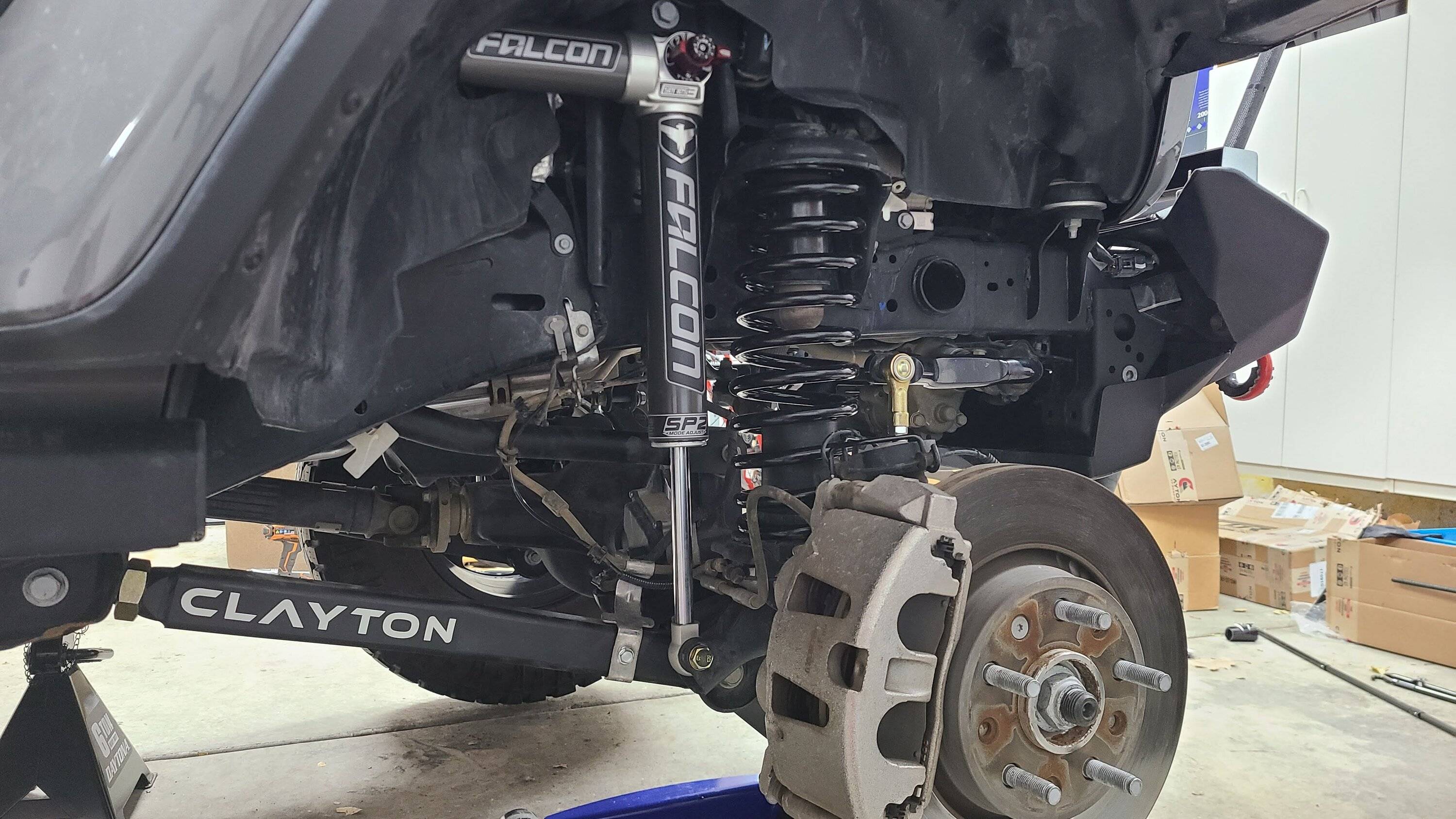
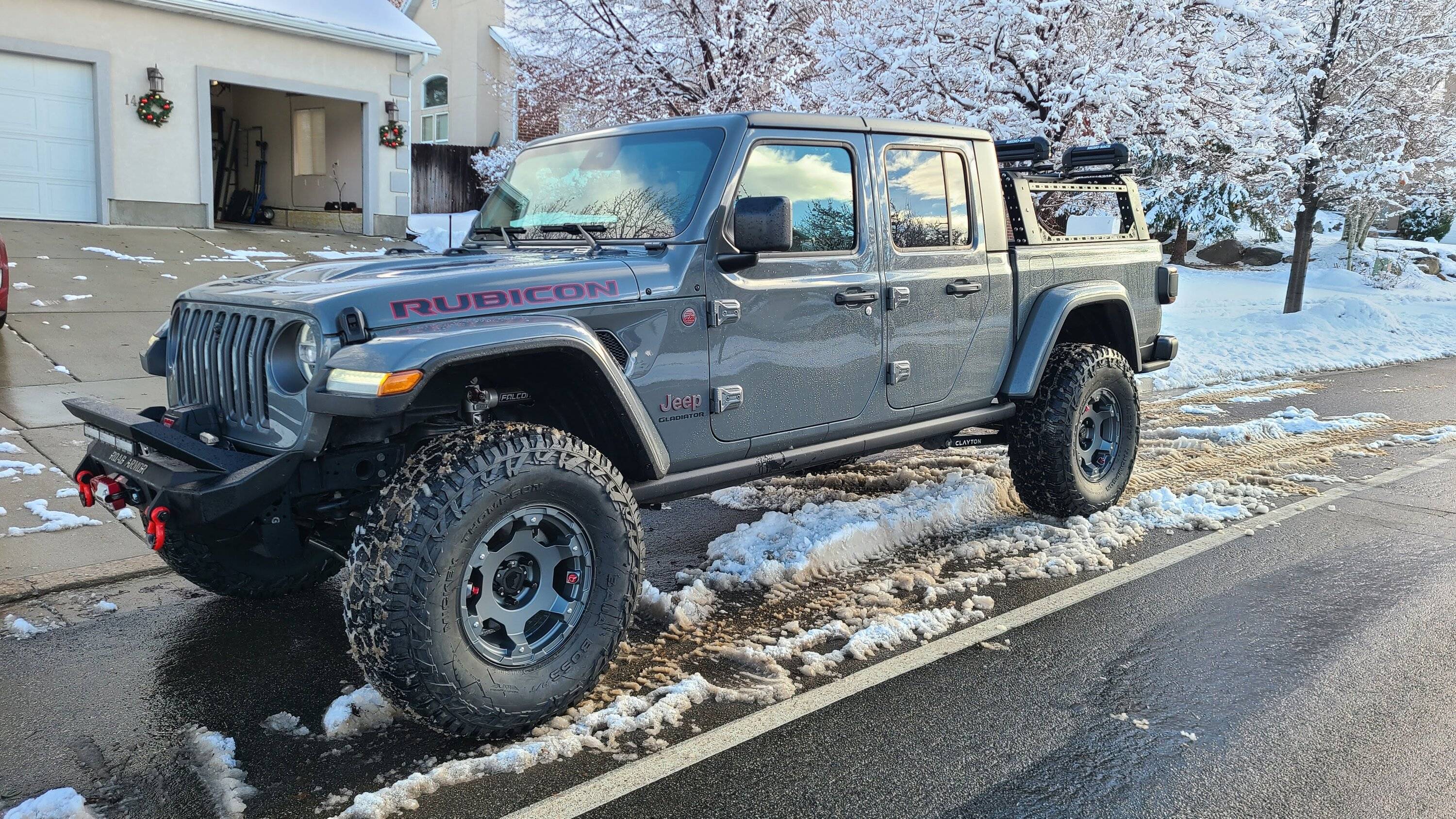
I am somewhat of a YT Engineer (technically I'm a real engineer but chemical, lol) but beyond what has already been said I may have some insight as I just fixed my death wobble. A little background: I just lifted my 20k mile JTR using a full 2.5" Clayton Overland+ kit (upper + lower front and rear control arms, F + R track bar, sway bar links, springs, Falcon SP2 3.3 shocks, Teraflex 0 offset 17" wheels with 37" tires). This information is important as all of the geometry changes and extra weight make a significant difference. Prior to the lift kit I ran 35s on stock wheels and suspension since purchase with no problems with wobble. After I installed the kit, I took it to the dealer for an alignment as it was going in for warranty stuff anyway. This was a mistake as they didn't even give me a print out and argued with me when I wanted to add more caster than 4.5 degrees but that's another story. After the alignment was done I still had DW. I took it to a reputable 4x4 shop and had it realigned with somewhere just over 7 degrees caster. Toe stayed the same around .20 total. I went for a drive and still had DW induced by uneven bumps to one wheel or the other. I took it back and we did the wiggle test (turn the steering wheel quickly side to side a few degrees and look at the joints for movement that is not normal spinning but is vertical or "clicky"). We saw a little play in the knuckle side of the draglink. I had that replaced with a nice heavy duty Steer Smarts Yeti XD. The steering felt tighter but the DW was still there. I started to think ball joints or tie rod ends. To test the ball joints I lifted one tire off the ground and stuck a prybar under the tire and pried. No vertical movement from either side. I pulled and pushed in the horizontal plane on the tire. No play in any other BJs, either. Still, I have heard cases where the wear is undetectable via these tests. I was about to pull the trigger on the tie rod but decided to experiment. According to the alignment printout, my toe was .2 which I believe is a little less than than 2.5/32nds toed in. Since I didn't have a second hand, I rudimentarily used a tape measure on the tires to estimate the toe but decided it didn't matter and that I would go by 1/4 turns of the adjuster on the tie rod end. A quarter turn appeared to be around 1-2/32nd movement in the front measurement. So I added 1/2 turn of toe in to the original setting. Took it for a test drive and the DW was much worse. I could feel that on any bump it wanted to go into an aggressive oscillation. I got back under it, set it back to the original setting and then went 1/2 turn in the toed out direction. By my guesses this would probably put the toe at zero or slightly negative. I took it out for a test drive and DW was 99% gone! Hurrah! I was elated! I brought it back and added another 1/4 turn (total of 3/4s from the original .2 setting) and it was completely gone and the steering is perfect! I did have to loosen the drag link and recenter the steering wheel with the new setting but it works great now. When checking torques on everything I did notice a loose swaybar link but that didn't have any effect on the DW.

SO, long story short, going with more negative toe (counter to many experts that suggest up to 1/8" toe in) solved my DW problem and did not make it dart into turns or make braking less stable. I agree with other posters that if the OP did not modify anything on the vehicle I would start with a torque check of control arms, TRACK BAR, drag link/pitman arm, and tie rod. The stabilizer is unlikely the cause and a new one could mask your problem but not solve. Do some basic BJ tests as above. Have the alignment checked as it can be a major portion of DW issues. In a rare case, an unbalanced wheel can cause it, too, but I feel like you might feel that regardless of hitting bumps. Hopefully this helps someone.

Jeep Gladiator New steering damper made death wobble worse 20221227_010652


Jeep Gladiator New steering damper made death wobble worse 20221228_150059
 

it_trailblzr

Well-Known Member
First Name
Driver
Joined
Oct 5, 2020
Threads
5
Messages
474
Reaction score
1,067
Location
USA
Vehicle(s)
2020 JTO
Occupation
Social Extrovert
So would the torque be a potential culprit if I have drift when going over bumps and dips in the road?
I do not have the death wobble, but the drift is annoying when I read of people who say their steering is "tight".
 

WILDHOBO

Well-Known Member
First Name
Dan
Joined
Sep 24, 2021
Threads
73
Messages
11,683
Reaction score
17,786
Location
Colorado
Vehicle(s)
2021 Gladiator Rubicon
Occupation
Network Engineer
Vehicle Showcase
1
Death wobble has nothing to do with the steering damper. If you installed a steering damper and it solved your issues, you didn't have death wobble. The steering damper is for bumpsteer.

Death wobble (as you all know) is when you vehicle shakes uncontrollably when you hit a bump and continues to do so. Bumpsteer is when you hit a bump and your wheels want to go left or right uncontrollably. Which the steering damper will help. But not Death Wobble.

If you have warranty, by all means let the dealer handle it. If not, find a reputable 4x4 shop. If you are somewhat mechanically inclined, diagnose it yourself. If you choose the latter, the first step should be to check all components that are steering and suspension related for proper torque and torque procedures. Once you start checking, you'd be surprised at what you find. Those nuts and bolts easily get out of torque. You can also inspect those parts (like balljoints) for wear and tear and decide if something needs to be replaced. And just because the dealer says everything looks good, don't trust it. Go to this video and jump to the 2:35 mark and you can see just how bad these nuts and bolts can get out of torque.

2yrs ago I had my steering box replaced. Even though I never had a problem with it, it was a free replacement so I took it. Steering then got bad. Inspected it myself and the pitman arm nut was barely finger tight. It's supposed to be 184 ft/lbs.

It could be anything. Most owners have been having balljoint issues. My balljoints were out of spec as well. But, checking everything is a good starting point. I hope this helps a little.

My apologies for it being so long!
He’s not wrong about torquing things down. But I was disappointed at the kid in the front seat. Way too short for the shoulder strap, and way too little to deal with an air bag deployment. And to top it off, he took it to interstate speeds with the front sway bar disconnected, with the kid in there. Poor at best.
 

Lunentucker

Well-Known Member
Joined
Apr 24, 2022
Threads
248
Messages
5,877
Reaction score
15,392
Location
Virginia
Vehicle(s)
2021 Jeep Gladiator Mojave
Occupation
People Work?
I am somewhat of a YT Engineer (technically I'm a real engineer but chemical, lol) but beyond what has already been said I may have some insight as I just fixed my death wobble. A little background: I just lifted my 20k mile JTR using a full 2.5" Clayton Overland+ kit (upper + lower front and rear control arms, F + R track bar, sway bar links, springs, Falcon SP2 3.3 shocks, Teraflex 0 offset 17" wheels with 37" tires). This information is important as all of the geometry changes and extra weight make a significant difference. Prior to the lift kit I ran 35s on stock wheels and suspension since purchase with no problems with wobble. After I installed the kit, I took it to the dealer for an alignment as it was going in for warranty stuff anyway. This was a mistake as they didn't even give me a print out and argued with me when I wanted to add more caster than 4.5 degrees but that's another story. After the alignment was done I still had DW. I took it to a reputable 4x4 shop and had it realigned with somewhere just over 7 degrees caster. Toe stayed the same around .20 total. I went for a drive and still had DW induced by uneven bumps to one wheel or the other. I took it back and we did the wiggle test (turn the steering wheel quickly side to side a few degrees and look at the joints for movement that is not normal spinning but is vertical or "clicky"). We saw a little play in the knuckle side of the draglink. I had that replaced with a nice heavy duty Steer Smarts Yeti XD. The steering felt tighter but the DW was still there. I started to think ball joints or tie rod ends. To test the ball joints I lifted one tire off the ground and stuck a prybar under the tire and pried. No vertical movement from either side. I pulled and pushed in the horizontal plane on the tire. No play in any other BJs, either. Still, I have heard cases where the wear is undetectable via these tests. I was about to pull the trigger on the tie rod but decided to experiment. According to the alignment printout, my toe was .2 which I believe is a little less than than 2.5/32nds toed in. Since I didn't have a second hand, I rudimentarily used a tape measure on the tires to estimate the toe but decided it didn't matter and that I would go by 1/4 turns of the adjuster on the tie rod end. A quarter turn appeared to be around 1-2/32nd movement in the front measurement. So I added 1/2 turn of toe in to the original setting. Took it for a test drive and the DW was much worse. I could feel that on any bump it wanted to go into an aggressive oscillation. I got back under it, set it back to the original setting and then went 1/2 turn in the toed out direction. By my guesses this would probably put the toe at zero or slightly negative. I took it out for a test drive and DW was 99% gone! Hurrah! I was elated! I brought it back and added another 1/4 turn (total of 3/4s from the original .2 setting) and it was completely gone and the steering is perfect! I did have to loosen the drag link and recenter the steering wheel with the new setting but it works great now. When checking torques on everything I did notice a loose swaybar link but that didn't have any effect on the DW.

SO, long story short, going with more negative toe (counter to many experts that suggest up to 1/8" toe in) solved my DW problem and did not make it dart into turns or make braking less stable. I agree with other posters that if the OP did not modify anything on the vehicle I would start with a torque check of control arms, TRACK BAR, drag link/pitman arm, and tie rod. The stabilizer is unlikely the cause and a new one could mask your problem but not solve. Do some basic BJ tests as above. Have the alignment checked as it can be a major portion of DW issues. In a rare case, an unbalanced wheel can cause it, too, but I feel like you might feel that regardless of hitting bumps. Hopefully this helps someone.

20221227_010652.jpg


20221228_150059.jpg
Welcome to the club!

Jeep Gladiator New steering damper made death wobble worse giphy (1)
Sponsored


Top