Sponsored

Let's talk bushings! (in track bars anyway)

OP
OP
chorky

chorky

Well-Known Member
First Name
Chad
Joined
Feb 26, 2022
Threads
175
Messages
3,466
Reaction score
3,801
Location
Montana
Website
www.youtube.com
Vehicle(s)
'22JTR, '06 LJ, '06 TJ GE
Build Thread
Link
Occupation
GIS Specialist
I had a nice conversation with a forum member last weekend about their JKS setup and how happy they are with it.

In the video on the link you provided they mentioned how they use the OEM style bushing. But, it's confusing because they call it a durometer bushing. Durometer is a measure of hardness (or softness?). They do talk about it being 'spongy' like the rubber clevite bushing of the OEM track bar, but a 'durometer' bushing is typically referred to in regards to a polyurethane bushing, from everything I have read thus far.

It sounds like they also make a HD version with a heim style joint on the axle side which is cool for those in more hard core stuff.

I would be interested in hearing some clarification on their OE style joints and if they really are a factory OEM style clevite joint or if it's just a softe durometer poly type joint.
 

mx5red

Well-Known Member
First Name
Paul
Joined
May 7, 2020
Threads
28
Messages
1,495
Reaction score
2,228
Location
San Diego
Vehicle(s)
2020 Firecracker JTR; 2020 DGC JLUR
Build Thread
Link
Durometer seems like it’s just thrown out as some technical jargon with all these manufacturers.
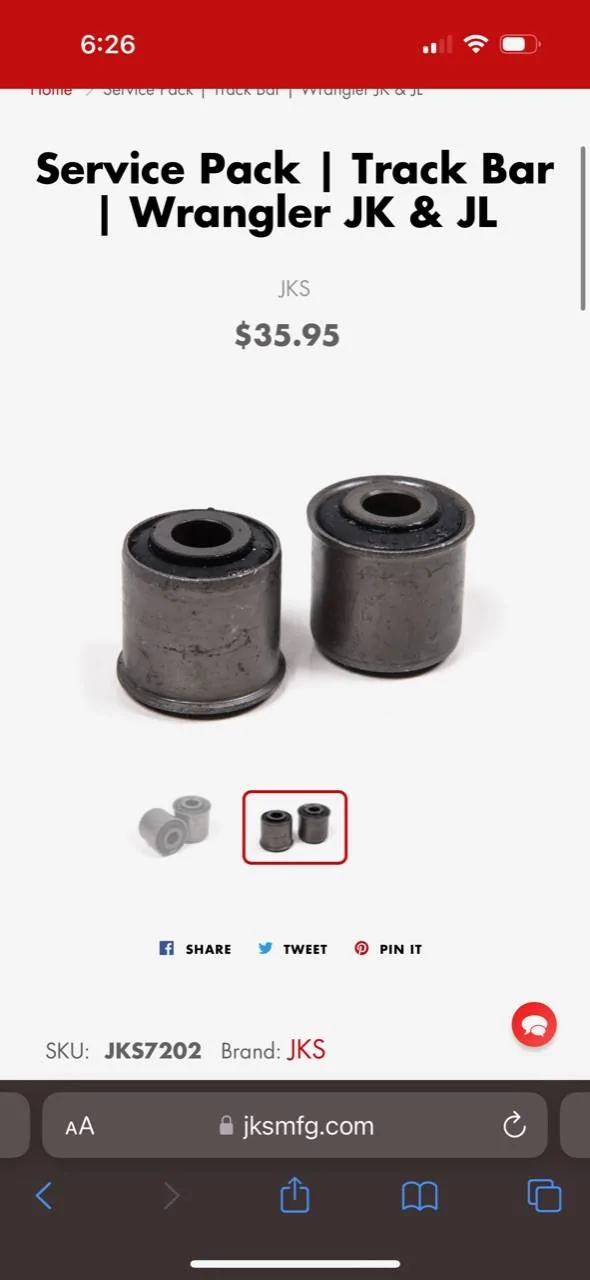
The JKS looks like a normal clevite bushing if I’m not mistaken. The bushings are replaceable, interestingly, and look to have an outer metal sleeve. So I’m not sure if this functions a little differently than a stock bushing where it’s bonded to the housing, in other words can the jks bushing rotate slightly? Probably not due to friction?
JKS seems perfectly good quality btw so no knock on them.
Jeep Gladiator Let's talk bushings! (in track bars anyway) ED0C6C6D-DED5-413E-B9D9-F6EF5B7385C7
 
OP
OP
chorky

chorky

Well-Known Member
First Name
Chad
Joined
Feb 26, 2022
Threads
175
Messages
3,466
Reaction score
3,801
Location
Montana
Website
www.youtube.com
Vehicle(s)
'22JTR, '06 LJ, '06 TJ GE
Build Thread
Link
Occupation
GIS Specialist
Durometer seems like it’s just thrown out as some technical jargon with all these manufacturers.
The JKS looks like a normal clevite bushing if I’m not mistaken. The bushings are replaceable, interestingly, and look to have an outer metal sleeve. So I’m not sure if this functions a little differently than a stock bushing where it’s bonded to the housing, in other words can the jks bushing rotate slightly? Probably not due to friction?
JKS seems perfectly good quality btw so no knock on them.
ED0C6C6D-DED5-413E-B9D9-F6EF5B7385C7.jpeg
I agree with you 100%. There is a lot of jargon out there, and very little specifications - which is why I made this thread because I am not satisfied with "just buy this it's great". I want specifics to ensure money spent is valid for my use case - and the same should go for others as well. So I tried doing some digging and kinda is the purpose of the original post to try and outline various types of joints in different manufacturer's components - hopefully it helps others also.

Which reminds me to add JKS to the original post!!

Maybe I am wrong but it's the OEM arms/track bars built with a press in clevite bushing? Or is the bushing actually bonded directly to the arm?

Seems to me JKS offers a solid product as well and kinda seems like they are overlooked some.
 

mx5red

Well-Known Member
First Name
Paul
Joined
May 7, 2020
Threads
28
Messages
1,495
Reaction score
2,228
Location
San Diego
Vehicle(s)
2020 Firecracker JTR; 2020 DGC JLUR
Build Thread
Link
I agree with you 100%. There is a lot of jargon out there, and very little specifications - which is why I made this thread because I am not satisfied with "just buy this it's great". I want specifics to ensure money spent is valid for my use case - and the same should go for others as well. So I tried doing some digging and kinda is the purpose of the original post to try and outline various types of joints in different manufacturer's components - hopefully it helps others also.

Which reminds me to add JKS to the original post!!

Maybe I am wrong but it's the OEM arms/track bars built with a press in clevite bushing? Or is the bushing actually bonded directly to the arm?

Seems to me JKS offers a solid product as well and kinda seems like they are overlooked some.
I like how you do your homework!
The OEM arms have the bushings bonded to the housing, they are not replaceable. So as your suspension cycles the rubber twists and limits flex. Which makes me wonder if there would be any rotation of the JKS bushing (and more flex), or if it’s pretty immobile once pressed in like OEM. Doesn’t look like that’s a designed-in feature though so I’m guessing it doesn’t really rotate.

All the freely rotating aftermarket bushings like teraflex IR, Clayton giiro, metalcloak, etc. flex more than the OEM because they don’t have that torsion build up, and they market it as such.

As someone said, does that matter for the track bar??‍♂
 

Sponsored

21RG

Well-Known Member
First Name
Daniel
Joined
Dec 28, 2020
Threads
1
Messages
74
Reaction score
114
Location
PA
Vehicle(s)
Gladiator Rubicon
Occupation
4Wheeling
yeah for me JJ’s are a no go this time. I also have a rock jock 4” with JJ’s on my 06 TJ with fox 2.0 reservoir adjustables and it rode great the first 5 years. Now the shocks need a rebuild and so do the JJ’s and nobody around here really knows how to do that or would charge excessive amounts. So I personally want to go with a more OeM style that is easy to understand and common. But JJ’s do work very well for their intended use. Greasing them every month is also a pita especially in winter.
JJ are great for off-road or specific uses. As a daily driver they are not the best. Rebuilding them is easy, but takes a little time as you have to remove them from the vehicle, rebuild and replace. I have an 06 LJ that I do this with.

The harder the durometer rating the more likely it will wear out. Too soft and it will wear out and have too much give.

Durometer seems like it’s just thrown out as some technical jargon with all these manufacturers.
Durometer is similar to "billet" and used as a selling/market ploy. Nothing special about billet, it is just a simple chunk of material that is machined into a part. But it sells. Durometer as already explained is how they measure the hardness level. Marketing....


A few issues that are not fully discussed.
- Bolt size and hole size. This is a pain, as any movement increases wear on the metal parts. Movement will occur and the bolt will wear out the metal hangers, take a look and see if holes are oblong on your TJ. It may be minimal, but it is probably there. The harder the durometer the more likely the bolts will move. That may be the cause of some of the banging you hear.

- Polyurethane bushings were first used with leaf springs. They increased articulation somewhat and added life but came with noise. Part of the reason is that PU bushings are a slip fit into the suspension part and allows for movement/rotation, this is for ease of installation and prevents damage when installed. Dirt and grime work their way in between the bushing and metal housing. OEM bushings are pressed in and do not allow movement, this provides longevity.

- The more parts you have, no matter how sexy, the more points of failure you have. Bushings are simple.

-Clayton proudly mentions they use 1/4" mounting brackets. This is an issue, remember the bolt size and hole size. 1/4" metal is not sufficient to withstand the use and abuse we put on the vehicles. I drill out the brackets a few drill sizes larger and make a metal insert that needs a little force to put in. The metal insert is 1/4" for the bracket and then extends out (at a larger OD diameter like a big washer) another 1/4" which amounts to a total of 1/2" surface area for the bolt on each side. The insert is installed and welded onto the 1/4" bracket. By increasing the surface area you reduce wear, but not eliminate it. Remember the bolt is harder than the bracket and any movement wears the bracket.

- With JJ, the grease fitting greases the outside of the rubber bushing. The rubber bushing is compressed and held by the washer and snap ring. So when you grease, it only greases the outside, grease cannot get in between the two halves of the rubber bushing. When rebuilding them, install the first bushing where the raised portion is inline with the grease hole and remove the grease fitting, take a drill and drill a hole through the bushing. Make sure you don't screw up the threads for the grease fitting. Clean it out. Complete the installation of the ball and top half bushing/washer and snap ring and grease. You will see grease come out between the metal ball and bushing, this is what you want. This will increase longevity. I need to rebuild one on my LJ, I will get pics and post for clarification.

- Track bars. For the rear it is not as important. But the front needs to be rigid. The front has a lot of movement due to steering. Have someone get into the vehicle and you at the front, looking at the all front steering components. Have the individual, with engine off, turn the steering wheel left to right until they feel force. As they do this, look at all the steering components to include the front track bar. If a compnent is worn you will see the excessive movement.
 
OP
OP
chorky

chorky

Well-Known Member
First Name
Chad
Joined
Feb 26, 2022
Threads
175
Messages
3,466
Reaction score
3,801
Location
Montana
Website
www.youtube.com
Vehicle(s)
'22JTR, '06 LJ, '06 TJ GE
Build Thread
Link
Occupation
GIS Specialist
I like how you do your homework!
The OEM arms have the bushings bonded to the housing, they are not replaceable. So as your suspension cycles the rubber twists and limits flex. Which makes me wonder if there would be any rotation of the JKS bushing (and more flex), or if it’s pretty immobile once pressed in like OEM. Doesn’t look like that’s a designed-in feature though so I’m guessing it doesn’t really rotate.

All the freely rotating aftermarket bushings like teraflex IR, Clayton giiro, metalcloak, etc. flex more than the OEM because they don’t have that torsion build up, and they market it as such.

As someone said, does that matter for the track bar??‍♂
Interesting I haven't looked at the OE arms close enough to see if the bushings are removable or not. But still seems to me it would be easier to find a OE part to replace a worn OE part in 10 years than something else. Maybe not but just my assumption.

I think rotational force for a track bar is actually there. The track bar will move up and down as the suspension cycles, so the bushings will need to pivot. I certainly see how having OEM style bushings, with having restrictions there, will prevent maximum movement as the bushings won't want to rotate as the suspension droops or compresses. But that's a compromise in order to have low NVH I think. The only way to truly know would be to have two vehicles outfitted side by side and do a functional test. But like you said - maybe it's not even that big of a factor? I guess it depends on how much rotation of the bushing is even necessary and if the OEM bushing rotates enough to allow the suspension to fully cycle.


JJ are great for off-road or specific uses. As a daily driver they are not the best. Rebuilding them is easy, but takes a little time as you have to remove them from the vehicle, rebuild and replace. I have an 06 LJ that I do this with.

The harder the durometer rating the more likely it will wear out. Too soft and it will wear out and have too much give.


Durometer is similar to "billet" and used as a selling/market ploy. Nothing special about billet, it is just a simple chunk of material that is machined into a part. But it sells. Durometer as already explained is how they measure the hardness level. Marketing....


A few issues that are not fully discussed.
- Bolt size and hole size. This is a pain, as any movement increases wear on the metal parts. Movement will occur and the bolt will wear out the metal hangers, take a look and see if holes are oblong on your TJ. It may be minimal, but it is probably there. The harder the durometer the more likely the bolts will move. That may be the cause of some of the banging you hear.

- Polyurethane bushings were first used with leaf springs. They increased articulation somewhat and added life but came with noise. Part of the reason is that PU bushings are a slip fit into the suspension part and allows for movement/rotation, this is for ease of installation and prevents damage when installed. Dirt and grime work their way in between the bushing and metal housing. OEM bushings are pressed in and do not allow movement, this provides longevity.

- The more parts you have, no matter how sexy, the more points of failure you have. Bushings are simple.

-Clayton proudly mentions they use 1/4" mounting brackets. This is an issue, remember the bolt size and hole size. 1/4" metal is not sufficient to withstand the use and abuse we put on the vehicles. I drill out the brackets a few drill sizes larger and make a metal insert that needs a little force to put in. The metal insert is 1/4" for the bracket and then extends out (at a larger OD diameter like a big washer) another 1/4" which amounts to a total of 1/2" surface area for the bolt on each side. The insert is installed and welded onto the 1/4" bracket. By increasing the surface area you reduce wear, but not eliminate it. Remember the bolt is harder than the bracket and any movement wears the bracket.

- With JJ, the grease fitting greases the outside of the rubber bushing. The rubber bushing is compressed and held by the washer and snap ring. So when you grease, it only greases the outside, grease cannot get in between the two halves of the rubber bushing. When rebuilding them, install the first bushing where the raised portion is inline with the grease hole and remove the grease fitting, take a drill and drill a hole through the bushing. Make sure you don't screw up the threads for the grease fitting. Clean it out. Complete the installation of the ball and top half bushing/washer and snap ring and grease. You will see grease come out between the metal ball and bushing, this is what you want. This will increase longevity. I need to rebuild one on my LJ, I will get pics and post for clarification.

- Track bars. For the rear it is not as important. But the front needs to be rigid. The front has a lot of movement due to steering. Have someone get into the vehicle and you at the front, looking at the all front steering components. Have the individual, with engine off, turn the steering wheel left to right until they feel force. As they do this, look at all the steering components to include the front track bar. If a compnent is worn you will see the excessive movement.
Good points made here. Interesting point about the oblong holes - I didn't think of that much because I figured components would be made to not have that sort of issue, then again I am reminded of some folks complaining about a particular company that does have larger internal sleeves for the bolt than the bolt is thick - providing for clunking. The JJ's on my TJ are nice in terms of flex. But now they have been there for 10 years I want them off. Because my use case just does not warrant their necessity - and because I dont have the place to rebuild them... And paying someone thousands of bucks to do so....no thanks. It is nice they are rebuildable - but thats more maintenance than I personally want to deal with at this point in life. I would be interested in seeing some pics when you rebuild yours though!
 

ShadowsPapa

Well-Known Member
First Name
Bill
Joined
Oct 12, 2019
Threads
247
Messages
40,449
Reaction score
53,884
Location
Runnells, Iowa
Vehicle(s)
'25 JTMX, '23 JLU 4xe, '82 SX4, '73 Javelin
Occupation
Retired auto mechanic, frmr gov't ntwrk security admin
Vehicle Showcase
3
good point. In my experience powder coat itself is tough but once it cracks and chips the metal under it rusts immediately. I dislike powder coat.
Any coating will do that. Paint, powder, whatever. Once the steel is bare - what do you really expect LOL. It's steel - it's gonna rust.
e-coating is a bigger joke - it's freaking paint, folks! So it's applied electrostatically! That only means it wastes less and gets into nooks and crannies a bit better. It's a marketing buzz-word for paint that's applied using electric charges. Once it gets scratched or penetrated or flakes off - the steel will rust!
Powder is tougher. At least GOOD powder is tougher and less likely to come off.
PREP is the issue, not the coating - PREP.
For powder, there are different powders. Some better than others. Cheap powder isn't as tough as a good quality powder.
So many people are likely seeing cheap powder applied on unprepared steel like many vendors use and blaming "powder coating" in general.
 
OP
OP
chorky

chorky

Well-Known Member
First Name
Chad
Joined
Feb 26, 2022
Threads
175
Messages
3,466
Reaction score
3,801
Location
Montana
Website
www.youtube.com
Vehicle(s)
'22JTR, '06 LJ, '06 TJ GE
Build Thread
Link
Occupation
GIS Specialist
Any coating will do that. Paint, powder, whatever. Once the steel is bare - what do you really expect LOL. It's steel - it's gonna rust.
e-coating is a bigger joke - it's freaking paint, folks! So it's applied electrostatically! That only means it wastes less and gets into nooks and crannies a bit better. It's a marketing buzz-word for paint that's applied using electric charges. Once it gets scratched or penetrated or flakes off - the steel will rust!
Powder is tougher. At least GOOD powder is tougher and less likely to come off.
PREP is the issue, not the coating - PREP.
For powder, there are different powders. Some better than others. Cheap powder isn't as tough as a good quality powder.
So many people are likely seeing cheap powder applied on unprepared steel like many vendors use and blaming "powder coating" in general.
maybe it is ‘tougher’. But I can say in my 30 years of vehicle stuff I have never once seen any powder coat hold up better than electrostatic paint - at least on frame and frame component things. Maybe I just never seen a quality powder coat job. But I will trust electrostatic painting to not crack and slowly flake off of the entire product more than powder coat based on experience. Because that is what has happened to every powder coat product I have had.

I can imagine that the process of e-coating (being dipped and rinsed and dipped again) provides a better prep job than powder coating. Possibly that is why I have seen painted products look nicer longer even after taking a few rocks.
 

Lunentucker

Well-Known Member
Joined
Apr 24, 2022
Threads
247
Messages
5,875
Reaction score
15,384
Location
Virginia
Vehicle(s)
2021 Jeep Gladiator Mojave
Occupation
People Work?
Lots of good information on this thread, and very much appreciated. Great job on demystifying some of the industry voodoo on bushings.
I appreciate your research.

When companies misuse terms and say things like "durometer bushings" it makes me a little suspicious of them.
Maybe they're simply parroting what their supplier has told them, or maybe they didn't copy and paste the right things, but it's essentially like saying "grade bolts" or "viscosity oil". ??‍♂
 

Sponsored

ShadowsPapa

Well-Known Member
First Name
Bill
Joined
Oct 12, 2019
Threads
247
Messages
40,449
Reaction score
53,884
Location
Runnells, Iowa
Vehicle(s)
'25 JTMX, '23 JLU 4xe, '82 SX4, '73 Javelin
Occupation
Retired auto mechanic, frmr gov't ntwrk security admin
Vehicle Showcase
3
maybe it is ‘tougher’. But I can say in my 30 years of vehicle stuff I have never once seen any powder coat hold up better than electrostatic paint - at least on frame and frame component things. Maybe I just never seen a quality powder coat job. But I will trust electrostatic painting to not crack and slowly flake off of the entire product more than powder coat based on experience. Because that is what has happened to every powder coat product I have had.

I can imagine that the process of e-coating (being dipped and rinsed and dipped again) provides a better prep job than powder coating. Possibly that is why I have seen painted products look nicer longer even after taking a few rocks.

From a Q&A-
If your finish's primary purpose is to protect your product from wear, weathering, and ultraviolet (UV) exposure, powder coating is likely the best option. While e-coating can provide many of the same benefits, powder coating results in a thicker more durabe finish.

They are actually dipped, rinsed, then cured.
e-coating allows for a much finer control over the final finish thickness and on imperfect surfaces such as areas of welds where there are recesses, pits, holes and so on, it's a better choice as it will get into the irregularities where powder can't due to the electric fields on irregular surfaces.

The problem with powder is the pits and recesses and it can't get "inside" the parts.
And - they are seldom properly prepped. Industrial e-coating usually is preceded by an acid bath and phosphate coating. Powder coating is cheaper, quicker, and as such, is often used where corners are cut.
I have often used a metal prep that leaves a zinc phosphate coating before powder. That will ensure corrosion resistance. So it's not just the difference in the final coat - it's the differences in prep that matter - your powder coated parts are likely just made and coated, little to no prep, no phosphate coating.

This is the PPG processes -


In the first step – pretreatment – metal is cleaned and a phosphate is applied to prepare the surface for application of the e-coat. This process is essential to achieving the performance requirements desired by product end users. PPG Coatings Services analyzes the metals to be processed and chooses the most appropriate chemicals for cleaning and phosphating. In our facilities, the most common pretreatment regimen for steel and iron parts is immersion in a high-quality zinc-phosphate system.
During the next step, coatings are applied to the pretreated metal in an electrocoat bath using precisely calibrated process control equipment. The e-coat bath consists of 80-90% deionized water and 10-20% paint solids. The deionized water acts as a carrier for the paint solids, which are under constant agitation. The solids consist of resin – the backbone of the final paint film, which provides corrosion protection, durability and toughness – and pigments, which contribute color and gloss.
Post-rinsing, which occurs next, enhances the quality of the coating and enables the recovery of excess paint. During the e-coat process, paint is applied to a part using a regulated amount of voltage to achieve the desired film thickness. Once the coating reaches the prescribed thickness, the part “insulates” and the coating process slows down. As the part exits the bath, paint solids that cling to the surface are rinsed off to maintain application efficiency and aesthetics. This residue material, which is called “drag out” or “cream coat,” is returned to the tank, enabling the e-coat process to achieve application efficiency rates above 95%.
After the coated part exits the post-rinse phase, it is placed in a bake oven that cures and cross-links the paint film to maximize its performance properties. The minimum bake time is 20 minutes with a part temperature at 375°F for most e-coat technologies. PPG Coatings Services can also apply a supplemental “low temperature cure” e-coat material depended on volume.


Prep, clean, zinc phosphate, e-coat, rinse, cure.
No double dipping. Why would you?

Too often the quality of the part itself determines the quality of the finish. How many companies really invest in doing powder correctly or doing a prep that includes such cleaning and phosphating? Make part, wipe it off, powder coat it.
The company that spends money will have the better finish.
e-coating is expensive. But even that can be done "crappily" with piss-poor prep and thin coats.
If the e-coated part is gouged or scratched, it will rust - there's steel under there. Phosphating can delay that greatly unless even that is compromised.
Do the phosphate treatment before powder - the powder coating can be scratched or compromised and the steel not immediately rust.
Some do phosphating, e-coating, then powder coating to add UV protection since powder generally has superior UV protection. But again - there's good powder, cheap power, good e-coat, cheap e-coat, good prep, crappy prep.
 

ShadowsPapa

Well-Known Member
First Name
Bill
Joined
Oct 12, 2019
Threads
247
Messages
40,449
Reaction score
53,884
Location
Runnells, Iowa
Vehicle(s)
'25 JTMX, '23 JLU 4xe, '82 SX4, '73 Javelin
Occupation
Retired auto mechanic, frmr gov't ntwrk security admin
Vehicle Showcase
3
Anyway... Nice thread on bushing construction ?
Shocked that one is needed. Info on bushing types are everywhere as long as you avoid youtube experts.
You could hit the AMC forum from 10 years ago and find all the info you want on bushings, types, uses, pros and cons.
 

Lunentucker

Well-Known Member
Joined
Apr 24, 2022
Threads
247
Messages
5,875
Reaction score
15,384
Location
Virginia
Vehicle(s)
2021 Jeep Gladiator Mojave
Occupation
People Work?
Shocked that one is needed. Info on bushing types are everywhere as long as you avoid youtube experts.
You could hit the AMC forum from 10 years ago and find all the info you want on bushings, types, uses, pros and cons.
Me on the AMC forums ten years ago.
Now that's an imagination!

Jeep Gladiator Let's talk bushings! (in track bars anyway) giphy
 

Rusty PW

Well-Known Member
First Name
Russ
Joined
Jan 10, 2022
Threads
37
Messages
11,378
Reaction score
30,359
Location
Fayette Nam, Pennsyltucky
Website
www.youtube.com
Vehicle(s)
'22 JTRD, '11 370Z Nismo, '07 Honda VFR
Build Thread
Link
Occupation
Muff Diver
Because of my experience with track bars on my Power Wagon. I will be going with a track bar with Johnny Joints on both ends. Looking at the Core 4x4 track bar, and their control arms.

First track bar on the PW.
Carli bar Gen 1 with a JJ on the axle, and bushing on the frame. On the frame side bushing. The metal piece that holds the bushing, got egg shaped. Allowing the bushing to move with in it.

Second track bar.
Thuren bar. A JJ on the axle and bushing on the frame. About every 9,000 miles. I had to change the bushing. It was shot.

Third track bar.
Back to a Carli 2 Gen bar with JJ's on both ends. Put 30,000 miles on that bar with no issues. It was still on the PW when I traded it in. As for NVH. Couldn't tell the difference. I also had JJ's on both ends of the control arms and metal bushings in the leaf springs. Couldn't tell the difference in NVH with MT tires.
Sponsored


Top