
Sponsored

30K mile JT oil analysis

ShadowsPapa

Well-Known Member
First Name
Bill
Joined
Oct 12, 2019
Threads
247
Messages
40,442
Reaction score
53,859
Location
Runnells, Iowa
Vehicle(s)
'25 JTMX, '23 JLU 4xe, '82 SX4, '73 Javelin
Occupation
Retired auto mechanic, frmr gov't ntwrk security admin
Vehicle Showcase
3
That’s the acid test and the base additives to keep the acids from building up. 2.5 and the additives abilities to keep the acids at bay are done.
I need to post some photos of acid-etched bearings and the pinholes in a couple of oil pans I have......... acids, moisture. Short drives and too long oil change intervals.

I don't care what Amsoil says - we're not typical consumers, and they aren't replacing a toasted engine if I exceed what the engine maker says. I don't like giving them excuses.

The bit about tin, babbet and so on assumes old-school bearings. These bearings are very different with a different surface so there should be little to no tin from crankshaft bearings. (can't speak to the cam bearings, however.......)
Sponsored

 
Last edited:
Nuclear_Inc

Active Member
Joined
Sep 8, 2021
Threads
3
Messages
27
Reaction score
27
Location
USA
Vehicle(s)
Jeep Gladiator
From a data standpoint, I would not argue against an extend drain interval. From a warranty standpoint, I would not exceed the 1 year or 10K mile max limit they state in the owners manual. That gives them one less niggle to keep from honoring any warranty claim on the engine should it arise.

Also, the Pentastar is not a "Direct Injection" engine.
I've tried to correct the lab as far as the DI labeling. I keep my receipts and always reset the OLM. Real hard to prove an oil related failure.
 

Nuclear_Inc

Active Member
Joined
Sep 8, 2021
Threads
3
Messages
27
Reaction score
27
Location
USA
Vehicle(s)
Jeep Gladiator
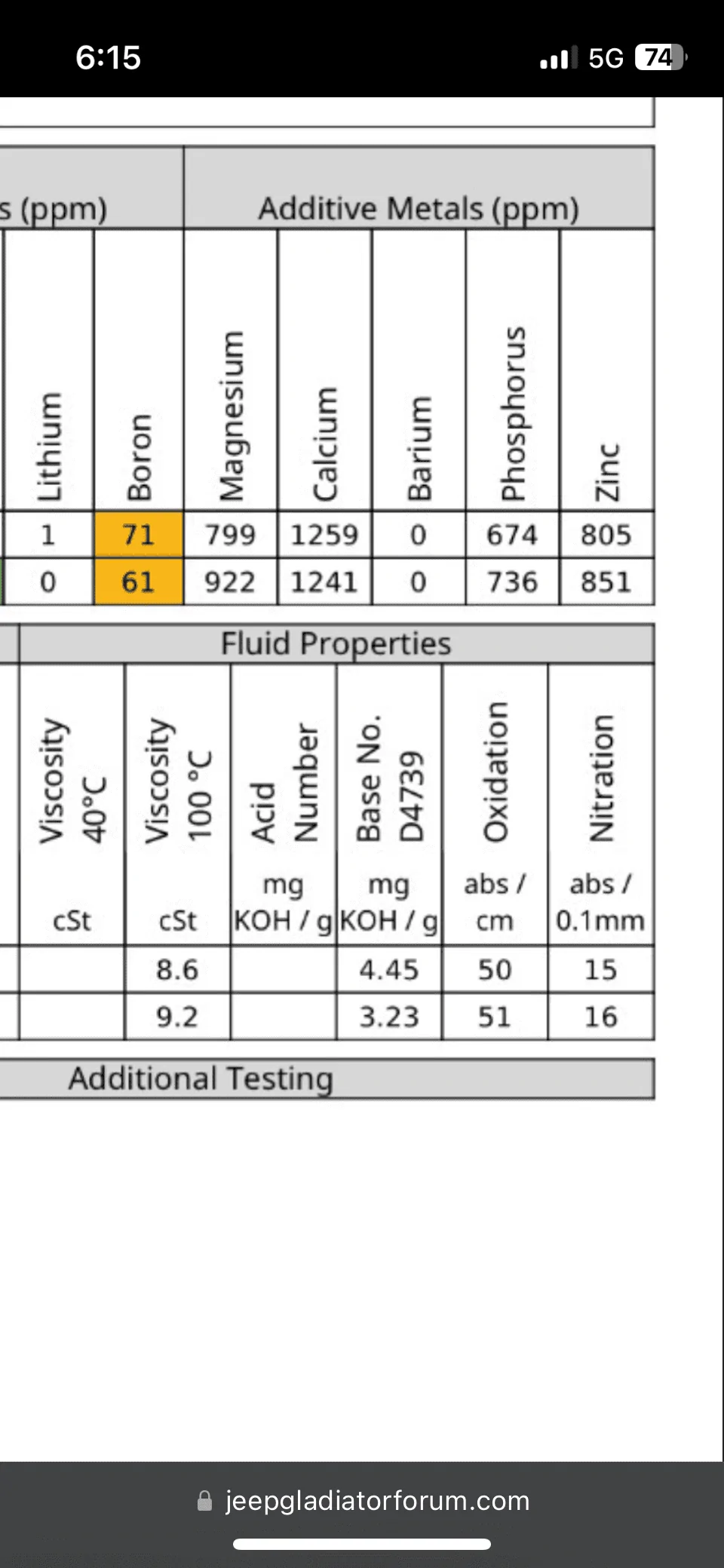
I would also second what @Hootbro said. I’ve seen engine warranties denied for going over the manufacturer recommended change interval. But…if you’re the risky type and want to see how far you can go before the lab tells you it’s time to change, look at the Base # D4789 column. Your first oil change number shows 4.45 and then the number drops to 3.23 for your extended second oil change….if you do the math estimation on that you can go roughly 1000-1500 more miles. Do not let that base # drop below 2.5, that’s your cut off point. That’s the acid test and the base additives to keep the acids from building up. 2.5 and the additives abilities to keep the acids at bay are done.

IMG_1716.webp
I wouldn't hesitate it to 15k miles. High TBN isn't really much of focus point with a lot of new oil. I have no issues pushing it to 1-1.5 TBN. There's plenty of off the shelf oils at Walmart that will have less than 3 TBN with as little as 4-5k miles. As long as the wear numbers are good and the TBN is above 1 I'm not to worried.
 

ShadowsPapa

Well-Known Member
First Name
Bill
Joined
Oct 12, 2019
Threads
247
Messages
40,442
Reaction score
53,859
Location
Runnells, Iowa
Vehicle(s)
'25 JTMX, '23 JLU 4xe, '82 SX4, '73 Javelin
Occupation
Retired auto mechanic, frmr gov't ntwrk security admin
Vehicle Showcase
3
I usually try and go by the saying "Change the oil at half the intervals the engineers recommend, and your vehicle will last twice as long."
That's funny in a way, and yet it's really hard to find anything wrong in it.
 

Sponsored

Maximus Gladius

Well-Known Member
First Name
Kevin
Joined
Jan 30, 2021
Threads
74
Messages
2,901
Reaction score
3,692
Location
Calgary, AB, Canada
Vehicle(s)
2021 JTR, 2023 JTR
I need to post some photos of acid-etched bearings and the pinholes in a couple of oil pans I have......... acids, moisture. Short drives and too long oil change intervals.

I don't care what Amsoil says - we're not typical consumers, and they aren't replacing a toasted engine if I exceed what the engine maker says. I don't like giving them excuses.

The bit about tin, babbet and so on assumes old-school bearings. These bearings are very different with a different surface so there should be little to no tin from crankshaft bearings. (can't speak to the cam bearings, however.......)
One number we don’t have, according to the oil analysis lab I use, is the acid base numbers for the Mopar 8/9 Speed ATF.

The lab tech told me the acid data points is not known for ATF unless they’ve done it prior or the customer wants to know and the lab performs extra tests. The acid data is known for engine and gear oils but the manufacturer for the Mopar ATF is not published. But the acid point of changing the oil, whether engine, gear, hydraulic or transmission is when it drops to 2.5. That’s a data point I’d love to see for this amazing “good forever” supernatural petroleum product.

Wouldn't it be interesting if the change intervals set by ZF and Mopar actual has to change if we knew when that oil’s acid level reaches 2.5 and maybe, just maybe the intervals are correct and this ATF never gets acidic.
 

Hootbro

Well-Known Member
First Name
Don
Joined
Apr 13, 2019
Threads
57
Messages
10,176
Reaction score
19,943
Location
Delaware
Vehicle(s)
2025 Gladiator Sport
One number we don’t have, according to the oil analysis lab I use, is the acid base numbers for the Mopar 8/9 Speed ATF.

The lab tech told me the acid data points is not known for ATF unless they’ve done it prior or the customer wants to know and the lab performs extra tests. The acid data is known for engine and gear oils but the manufacturer for the Mopar ATF is not published. But the acid point of changing the oil, whether engine, gear, hydraulic or transmission is when it drops to 2.5. That’s a data point I’d love to see for this amazing “good forever” supernatural petroleum product.

Wouldn't it be interesting if the change intervals set by ZF and Mopar actual has to change if we knew when that oil’s acid level reaches 2.5 and maybe, just maybe the intervals are correct and this ATF never gets acidic.
I read this and went down a pretty deep rabbit hole looking for pH levels of ATF. I checked probably 30+ MSDS reports of various ATF brands and types to include MOPAR 8/9 Speed ATF and ZF 8/9 Speed ATF and other brands like AMSOIL, Pennzoil, Mobil, Motul and even Warren Distribution. None of them listed any values for pH on the MSDS. All listed something for pH as some variable of "Not Applicable", "Not Available" and "Not Required".

Found one technical reference that stated ATF fluids are pH neutral in their base oil form before additives are put in but does not expand beyond that.

I get the impression that ATF makers do not considered pH an issue with their product themselves and that any acidic levels when found are external to their product when in use
 

Maximus Gladius

Well-Known Member
First Name
Kevin
Joined
Jan 30, 2021
Threads
74
Messages
2,901
Reaction score
3,692
Location
Calgary, AB, Canada
Vehicle(s)
2021 JTR, 2023 JTR
I read this and went down a pretty deep rabbit hole looking for pH levels of ATF. I checked probably 30+ MSDS reports of various ATF brands and types to include MOPAR 8/9 Speed ATF and ZF 8/9 Speed ATF and other brands like AMSOIL, Pennzoil, Mobil, Motul and even Warren Distribution. None of them listed any values for pH on the MSDS. All listed something for pH as some variable of "Not Applicable", "Not Available" and "Not Required".

Found one technical reference that stated ATF fluids are pH neutral in their base oil form before additives are put in but does not expand beyond that.

I get the impression that ATF makers do not considered pH an issue with their product themselves and that any acidic levels when found are external to their product when in use
Interesting. I’m going to go to the lab later and question the tech a bit more on this
 

Maximus Gladius

Well-Known Member
First Name
Kevin
Joined
Jan 30, 2021
Threads
74
Messages
2,901
Reaction score
3,692
Location
Calgary, AB, Canada
Vehicle(s)
2021 JTR, 2023 JTR
What had me question just last week on the long standing purported qualities of this oil is that I was having my 4th transmission installed and though it is just me in hundreds of thousands of gladiators that we know of, I just asked the tech if we were to deep dive into this oil what would the lab look for. The tech answered and said “we’d do an acid test, but we don’t have any base numbers and we’d have to go in and find it, along with a fresh sample too.

When I went in to talk with the service manager as I picked up the truck he mentioned that the second transmission that was replaced at just 500 kms was warrantied after the engineers tore into it and granted the warranty. The third transmission was made at the same time and appears to have had the same quality issues and in tranny #1 through 3 this was during the start and into Covid and he’s had a hell of a time with manufacturing quality issues. So for the 4th tranny is amazing.
 

Sponsored

ShadowsPapa

Well-Known Member
First Name
Bill
Joined
Oct 12, 2019
Threads
247
Messages
40,442
Reaction score
53,859
Location
Runnells, Iowa
Vehicle(s)
'25 JTMX, '23 JLU 4xe, '82 SX4, '73 Javelin
Occupation
Retired auto mechanic, frmr gov't ntwrk security admin
Vehicle Showcase
3
I read this and went down a pretty deep rabbit hole looking for pH levels of ATF. I checked probably 30+ MSDS reports of various ATF brands and types to include MOPAR 8/9 Speed ATF and ZF 8/9 Speed ATF and other brands like AMSOIL, Pennzoil, Mobil, Motul and even Warren Distribution. None of them listed any values for pH on the MSDS. All listed something for pH as some variable of "Not Applicable", "Not Available" and "Not Required".

Found one technical reference that stated ATF fluids are pH neutral in their base oil form before additives are put in but does not expand beyond that.

I get the impression that ATF makers do not considered pH an issue with their product themselves and that any acidic levels when found are external to their product when in use
I suspect because their products are fairly neutral - they must be to be safe for aluminum, so aren't considered a problem for human skin contact.
In college, every time the solvent tank was renewed in the transmission lab and class area, the instructor poured a quart of ATF in the tank - said it made it at least a bit better for the skin if you didn't use gloves or had leaky gloves (of course the rule was GLOVE UP)

I'd bet ATFs (not talking alcohol, tobacco or firearms) need to be fairly neutral as low pH of course is obvious and almost everyone knows what happens with aluminum or zinc alloys in acid....... but the other direction can be bad for especially aluminum and certain alloys as well.
Below about 4 and above 9 it's a drastic corrosive change to aluminum. I can ruin aluminum parts in seconds by soaking them in the same cleaner I put steel parts in. In fact, the data sheets for the cleaners I use don't even list it as being compatible with aluminum.
I guess in short, aluminum is very sensitive to high or low pH and will corrode at an accelerated level, even pitting badly.
Distilled water is pH 7 - think about it - just 2 points above that and you destroy aluminum pretty quickly. Get much below it - same thing.
I have to check parts I deal with for plating - is it zinc? Is it aluminum? Is it some alloy of either?
 

Hootbro

Well-Known Member
First Name
Don
Joined
Apr 13, 2019
Threads
57
Messages
10,176
Reaction score
19,943
Location
Delaware
Vehicle(s)
2025 Gladiator Sport
Interesting. I’m going to go to the lab later and question the tech a bit more on this
My understanding is that pH and acidity is mainly a issue for motor oils to deal with because of the combustion process byproducts mixing with the motor oil and elevating acidity.

With ATF that is just basically Hydraulic fluid, that form of contamination is really not there over time like it is with motor oil.
 

ShadowsPapa

Well-Known Member
First Name
Bill
Joined
Oct 12, 2019
Threads
247
Messages
40,442
Reaction score
53,859
Location
Runnells, Iowa
Vehicle(s)
'25 JTMX, '23 JLU 4xe, '82 SX4, '73 Javelin
Occupation
Retired auto mechanic, frmr gov't ntwrk security admin
Vehicle Showcase
3
What had me question just last week on the long standing purported qualities of this oil is that I was having my 4th transmission installed and though it is just me in hundreds of thousands of gladiators that we know of, I just asked the tech if we were to deep dive into this oil what would the lab look for. The tech answered and said “we’d do an acid test, but we don’t have any base numbers and we’d have to go in and find it, along with a fresh sample too.

When I went in to talk with the service manager as I picked up the truck he mentioned that the second transmission that was replaced at just 500 kms was warrantied after the engineers tore into it and granted the warranty. The third transmission was made at the same time and appears to have had the same quality issues and in tranny #1 through 3 this was during the start and into Covid and he’s had a hell of a time with manufacturing quality issues. So for the 4th tranny is amazing.
It's not unreasonable to suspect that a range of transmissions, even a very small range of a few dozen, had some issues at a given point in time, or that the issues only reared their ugly heads in combination with some other factor so some people would not have problems, others would.
We're running into this with the 4xe transmission - it's unproven and so far just a Jeep person posting what they heard or read, but it's believed the leak issue that appears in almost all cases to be a pan gasket leak is actually porous aluminum casting in an area adjacent to the pan seal area.
Some have not had a problem, many have. Some have seen it even on new just delivered to the dealership Wranglers, some say it goes back to 2022.
I've yet to check my wife's JLU again for that leak - been in twice, last time was a pan replacement where they said the pan gasket flange was "wavy".
So why some - and not others, if there's a problem with casting or manufacturing?
 

ShadowsPapa

Well-Known Member
First Name
Bill
Joined
Oct 12, 2019
Threads
247
Messages
40,442
Reaction score
53,859
Location
Runnells, Iowa
Vehicle(s)
'25 JTMX, '23 JLU 4xe, '82 SX4, '73 Javelin
Occupation
Retired auto mechanic, frmr gov't ntwrk security admin
Vehicle Showcase
3
My understanding is that pH and acidity is mainly a issue for motor oils to deal with because of the combustion process byproducts mixing with the motor oil and elevating acidity.

With ATF that is just basically Hydraulic fluid, that form of contamination is really not there over time like it is with motor oil.
Exactly. Combustion gases do get into the crankcase - combined with the moisture, it forms acids. Don't have that in a transmission, especially one that has limited access from outside contamination.
If they start out pretty close to pH neutral in the ATF, there's really nothing that should cause a fall, or rise, of pH to any danger level over the life of the fluid.
Engines always have combustion byproducts in the crankcase to deal with. Short drives make that even worse.
Sponsored


Top