Sponsored

Any empirical data on engine life if running the 3.6L at >2800RPM for long periods of time?

Badunit

Well-Known Member
Joined
Jan 31, 2023
Threads
20
Messages
817
Reaction score
1,346
Location
USA
Vehicle(s)
2023 JT Rubicon, 1997 TJ
Does anyone have empirical or official technical data on the effect of running the 3.6L at >2800rpm for long periods of time? I ask because I am looking at re-gearing and am wondering how low I can go before significantly reducing the life of the engine or the valve train if on the highway at "high" speeds for hours at a time. I have read the high valve lift kicks in it 2800rpm (or maybe 2700) and the oil pump increases pressure at 3000rpm. I see that the high lift is not a roller, it appears to be sliding contact so maybe it is something to avoid for long periods at a time. Or maybe it can hold up as good or better than the low-lift rollers. I don't know. This is not a question about the "best" differential ratio to choose, it is a question about running the engine at >2800rpm for hours at a time. Is there any real-life data or info from Jeep about it?
Sponsored
 

Escape.idiocracy

Well-Known Member
First Name
Rich
Joined
Jan 23, 2022
Threads
37
Messages
1,569
Reaction score
1,823
Location
PNW
Vehicle(s)
Jt
Occupation
Hitchhiker
I can’t answer your question, I’m just curious- manual or auto, what ratio are you looking at? Or what speeds do you intend to roll at for long periods of time at?

Jeep Gladiator Any empirical data on engine life if running the 3.6L at >2800RPM for long periods of time? IMG_1751
 

bleda2002

Well-Known Member
Joined
May 11, 2021
Threads
24
Messages
2,759
Reaction score
4,500
Location
34655
Vehicle(s)
2021 JTR Firecracker Red
OP
OP
Badunit

Badunit

Well-Known Member
Joined
Jan 31, 2023
Threads
20
Messages
817
Reaction score
1,346
Location
USA
Vehicle(s)
2023 JT Rubicon, 1997 TJ
I've read through so many posts my eyes are bleeding and seen people who think 5.13 on 33's is perfect and others say 3.73 on 37's works great. I lean toward the "overgearing" side to compensate for the low torque. I figure if I truly "overgear" it, I can buy larger tires. If I undergear it, I'm stuck. I don't want to change my tires at all. though.

Automatic Transmission.

The speeds I intend to roll at are 0-85mph but top speed will typically be 75-80. My ideal 50-60mph rpms are 1800-2100, which is what I get in 7th gear currently. My goal is to get sufficient rpm at 50-60mph in 8th without overdoing it above that. They will be lower than my "ideal", but hopefully not by too much. If "manual" mode on the auto would simply lock out 8th and let 1-7 shift normally, I would likely just do that until I got above 60 and leave the gearing alone for now, though it could use some more RPMs (power) above that.

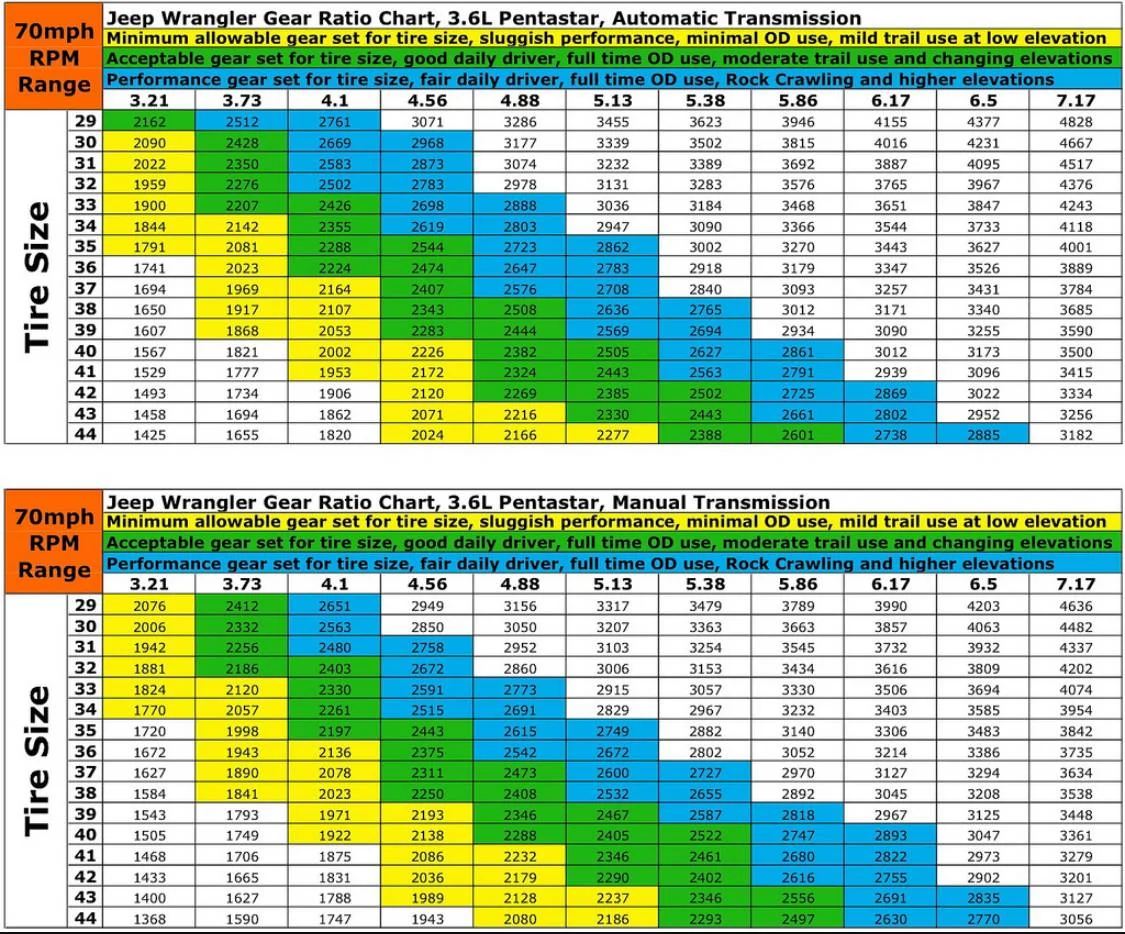
I have my own spreadsheet to calculate rpm vs mph and I measured my actual rpm at a few mph to get the "tire size" correct (versus the ideal numbers used in the calculators and those provided by the tire mfgs).
 

ShadowsPapa

Well-Known Member
First Name
Bill
Joined
Oct 12, 2019
Threads
247
Messages
40,514
Reaction score
54,050
Location
Runnells, Iowa
Vehicle(s)
'25 JTMX, '23 JLU 4xe, '82 SX4, '73 Javelin
Occupation
Retired auto mechanic, frmr gov't ntwrk security admin
Vehicle Showcase
3
Does anyone have empirical or official technical data on the effect of running the 3.6L at >2800rpm for long periods of time? I ask because I am looking at re-gearing and am wondering how low I can go before significantly reducing the life of the engine or the valve train if on the highway at "high" speeds for hours at a time. I have read the high valve lift kicks in it 2800rpm (or maybe 2700) and the oil pump increases pressure at 3000rpm. I see that the high lift is not a roller, it appears to be sliding contact so maybe it is something to avoid for long periods at a time. Or maybe it can hold up as good or better than the low-lift rollers. I don't know. This is not a question about the "best" differential ratio to choose, it is a question about running the engine at >2800rpm for hours at a time. Is there any real-life data or info from Jeep about it?
Most of the damage I've seen has been to the high lift portion of the follower and intake cam. Not sure I'd run in that range "for hours". I'm not afraid to hit over 3,000 RPM while towing for periods of time, even hit into the 4,000s but do drive constantly in that high RPM area? There's a reason they put the normal operating range of the engine on rollers.

Manual mode doesn't lock out any gear - it's still going to hit 8th unless you have that lever over and are shifting it manually. Even then, there are limits to what gears it allows. See the book for more details. No gears are "locked out".

Seems to me maybe the data you seek is right there in front of us - damage is typically to the high lift components, and, there's reasons they keep it in the low lift mode unless extra power is necessary.
Could be wrong, but that's how I view it from here.
I wonder how many JT owners are running their JTs in that RPM range for hours at a time.
And do watch the charts and info you see online - most of it is way out of date.
 

Sponsored

Hootbro

Well-Known Member
First Name
Don
Joined
Apr 13, 2019
Threads
57
Messages
10,220
Reaction score
20,049
Location
Delaware
Vehicle(s)
2025 Gladiator Sport
The only comparable info I know of and will just be empirical, is the engine in fleet use.

I know the Pentastar in Police use has a less than stellar reputation of longevity and is about as close to frequent high RPM use I can think of.
 

sharpsicle

Well-Known Member
Joined
Apr 29, 2021
Threads
22
Messages
2,776
Reaction score
6,272
Location
Tampa, FL / Milwaukee, WI
Vehicle(s)
2020 Gladiator Overland, 2002 VTX1800
I would gear it to maintain the factory speed<>rpm relationships when possible. That being said, if you aren't going to be hitting high freeway speeds, you've got more room to mess around as the 8 speed will be able to maintain the match up to a point. You can get the same speed<>rpm in another gear. But if you are going 80mph+, like you state, now you're more limited by that 8th gear's ratio. You can move it a bit, but you don't want to deviate too much. I feel if you gear it to consistently run at over 2800, you've got a mismatch going on and are going to want to fix that.

Also consider that most applications go the other way when gearing for freeway cruising; they want to reduce cruising RPMs as that's more beneficial in a lot of ways, especially for engine longevity and efficiency. It's where overdrive gears came from. It's also why we have developed gearboxes with more and more gears. Modern transmissions are made to cover that spread more effectively while maintaining the starting 1st gear needs and the final OD low-rpm cruising needs.

Is there some other change you're doing that's prompting the re-gear? Or some specific result or use case you're after? Is it just about trying to get more low-speed torque? To be honest it sounds like your re-gearing plan is essentially just going to make the intermediate gears shorter and ultimately less useful and make your engine work harder on the freeway just to keep up with itself. That is, unless something else is changing with it (like tires/wheels).
 
Last edited:
OP
OP
Badunit

Badunit

Well-Known Member
Joined
Jan 31, 2023
Threads
20
Messages
817
Reaction score
1,346
Location
USA
Vehicle(s)
2023 JT Rubicon, 1997 TJ
Is there some other change you're doing that's prompting the re-gear? Or some specific result or use case you're after? Is it just about trying to get more low-speed torque? To be honest it sounds like your re-gearing plan is essentially just going to make the intermediate gears shorter and ultimately less useful and make your engine work harder on the freeway just to keep up with itself.
My goal is to stop it gear hunting 7th-8th at 50mph and higher. Yes, re-gearing will make the intermediate gears shorter and I don't need or want that. If the shift from 8th to 7th was more seamless, I would be okay with it downshifting like an automatic is meant to do. But, unlike all the other downshifts, 8 to 7 is not seamless. I'll be on the gas pretty hard trying to maintain speed in 8th. When it finally downshifts to 7th, that much pedal makes it accelerate vs maintaining the same speed. If I could reprogram the transmission, I'd do that instead (but I still think it could use 4.56 vs the factory 4.10).
 

ShadowsPapa

Well-Known Member
First Name
Bill
Joined
Oct 12, 2019
Threads
247
Messages
40,514
Reaction score
54,050
Location
Runnells, Iowa
Vehicle(s)
'25 JTMX, '23 JLU 4xe, '82 SX4, '73 Javelin
Occupation
Retired auto mechanic, frmr gov't ntwrk security admin
Vehicle Showcase
3
The only comparable info I know of and will just be empirical, is the engine in fleet use.

I know the Pentastar in Police use has a less than stellar reputation of longevity and is about as close to frequent high RPM use I can think of.
Frequent, in bursts, yeah, but not constant for 30 minutes or more.
I used to work on IHP cars - they were sprinters most of the time, not very often needed to maintain 120 mph+ for a length of time. They could if they had to with the big block MOPARs and around here some chases last a good 20-30 minutes or so, crossing multiple counties but most of the time it's foot to the floor for limited lengths of time.

. If the shift from 8th to 7th was more seamless, I would be okay with it downshifting like an automatic is meant to do. But, unlike all the other downshifts, 8 to 7 is not seamless.
Odd you say that because mine is pretty calm about the 7>8 or 8>7 shifting. Don't really feel it. When it drops 2 gears, that's noticeable but not bad at all. It's better than most I've had.
With our hills here, the winds that are almost daily, and my 3.73 ratio, I don't see 8th a lot and I'm more often in 7th but when conditions are right, it's between 8 and 7, 7 and 8 fairly frequently. Not a big deal, it's just how it is with that many speeds and the hills and such.
 

sharpsicle

Well-Known Member
Joined
Apr 29, 2021
Threads
22
Messages
2,776
Reaction score
6,272
Location
Tampa, FL / Milwaukee, WI
Vehicle(s)
2020 Gladiator Overland, 2002 VTX1800
I've been thinking about this more, and it sounds like you simply don't like 8th gear. Is that fair to say? And because of that, you're looking to re-gear the whole truck to make 8th act like 7th?

And also, I'm a little confused here:
I'll be on the gas pretty hard trying to maintain speed in 8th. When it finally downshifts to 7th, that much pedal makes it accelerate vs maintaining the same speed.
Isn't that expected? If I hit the gas hard in any gear, I'd expect the transmission to shift and accelerate. It's odd you describe it the way you do, because you're admitting that it is having trouble getting to or maintaining a speed in 8th, but then get upset it goes to 7th and actually accelerates?

I suppose if you wanted to stay in 7th, you could just flip it to manual mode on the freeway and keep it in that gear. It shouldn't kick you out unless you decelerate too far. You'll just be missing out on all the benefits of having an 8th gear.

Forgive me if any of this sounds harsh or anything. I'm legit trying to get on the same train of thought as you to better understand your situation.
 

Sponsored

Stan H

Well-Known Member
First Name
Stanley
Joined
Oct 26, 2022
Threads
10
Messages
5,521
Reaction score
5,500
Location
WV
Vehicle(s)
Gladiator Rubicon 2021
Occupation
Safety Consultant
My goal is to stop it gear hunting 7th-8th at 50mph and higher
I live in a very hilly state even the highways are steep and I aint never seen but one vehicle I ever owned that would pull every hill with out shifting . That was a 2015 6.7 turbo diesel truck with a 6 spd. Standard shift. Now with that said my Rubicon will hit 8th constantly then drop to 7th half way up a long grade and top it out in 6th then go right back into 7th and almost immediately to 8th. It will also cruise 8th on flat ground between 45 and 50 mph. I have 4.10's with 34" tires. I feel like it has plenty of power. I am going to put 35"s on it . What is the base rear-end ratio on your jeep?
I often while driving leisurely between 35-50 can garner 19-20 mpg.
I aint an expert and there are some on here.
If it was me I would go between 4.10-4.63's nothing higher.
By the time you get to 5.13's that pinion is so small it put it at much greater risk of breakage..IMHO.
 
OP
OP
Badunit

Badunit

Well-Known Member
Joined
Jan 31, 2023
Threads
20
Messages
817
Reaction score
1,346
Location
USA
Vehicle(s)
2023 JT Rubicon, 1997 TJ
Not that this was a question about gearing and the transmission but...

I expect the transmission to shift seamlessly to maintain roughly the same speed, not accelerate abruptly, at a given throttle position. I'm trying to maintain a steady speed on the highway, not speed up and slow down. The perfect shift would be imperceptible.

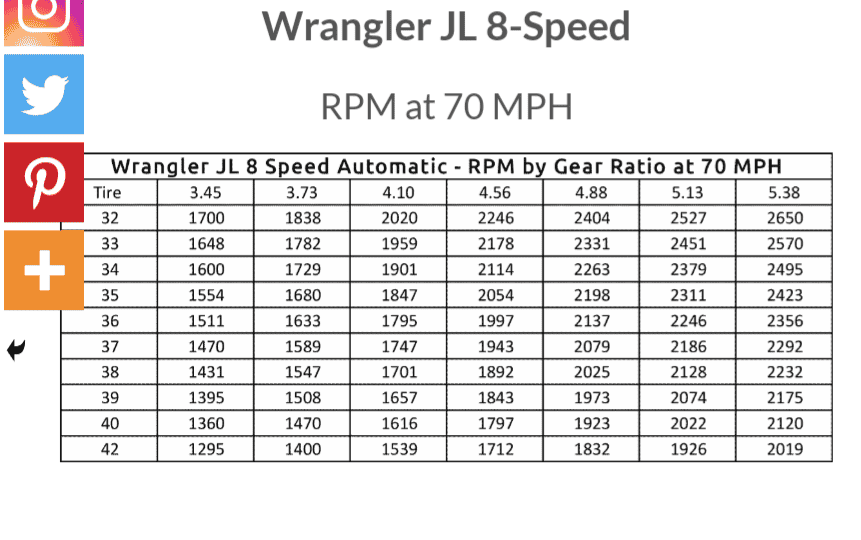
Making 8th into 7th is not my goal. 7th is too low for 70+ mph and is useless for interstate cruising. I'm looking for something between 7th and 8th. It is geared 4.10 now. 4.56 is 1/3 of the way between 7th and 8th. 4.88 is 2/3 of the way.

Shifting into manual mode and putting it in 7th is great for cruising 50-60 except when a larger hill comes along and it needs to downshift. I will often end up pressing the gas hard enough that it downshifts several gears, revs the engine to the moon, and stays in that low gear until I upshift it a few times. If I was driving a manual it would be second nature to downshift manually but this is an automatic and It is neither a manual nor an automatic in this "manual" mode. As I said before, if "manual mode" set on 7th would shift normally between 1-7 and never go into 8th, that would be great. That's how "manual mode" works on my Ram.

For the price of re-gearing, it bothers me to go only one step deeper to 4.56 but going one more step to 4.88 kills my top speed if I'm trying to avoid exceeding 2700rpm for long periods of time. Plus that is higher rpm than it usually needs anyway. It sounds like 4.56 is the best compromise. I think that has been verified here. I either leave it at 4.10 (at no cost) or gear it 4.56 to get some relief.

Thanks for the all the input.
 

IanNubbit

Well-Known Member
First Name
Ian
Joined
Jul 5, 2020
Threads
5
Messages
552
Reaction score
606
Location
New Jersey
Vehicle(s)
2023 JL 2 Door Sport 6MT & 2022 JT 6MT Sport
Occupation
Mopar Dealer Tech
Does anyone have empirical or official technical data on the effect of running the 3.6L at >2800rpm for long periods of time? I ask because I am looking at re-gearing and am wondering how low I can go before significantly reducing the life of the engine or the valve train if on the highway at "high" speeds for hours at a time. I have read the high valve lift kicks in it 2800rpm (or maybe 2700) and the oil pump increases pressure at 3000rpm. I see that the high lift is not a roller, it appears to be sliding contact so maybe it is something to avoid for long periods at a time. Or maybe it can hold up as good or better than the low-lift rollers. I don't know. This is not a question about the "best" differential ratio to choose, it is a question about running the engine at >2800rpm for hours at a time. Is there any real-life data or info from Jeep about it?
Factual data I don’t have. But as mush as I hate it, Jeep considers extended drives under 3k rpms at sustained speed severe use, yes, you read that right, not the other way around. In my experience, the added oil pressure is a good thing and does more good then harm, also the valve lift and timing is more efficient at that state (from a performance point of view) and theroretically better for all components. So most likely its better then running it under 3k, but all jist hypothetical.
 

ShadowsPapa

Well-Known Member
First Name
Bill
Joined
Oct 12, 2019
Threads
247
Messages
40,514
Reaction score
54,050
Location
Runnells, Iowa
Vehicle(s)
'25 JTMX, '23 JLU 4xe, '82 SX4, '73 Javelin
Occupation
Retired auto mechanic, frmr gov't ntwrk security admin
Vehicle Showcase
3
Factual data I don’t have. But as mush as I hate it, Jeep considers extended drives under 3k rpms at sustained speed severe use, yes, you read that right, not the other way around. In my experience, the added oil pressure is a good thing and does more good then harm, also the valve lift and timing is more efficient at that state (from a performance point of view) and theroretically better for all components. So most likely its better then running it under 3k, but all jist hypothetical.
How can extended drives under 3,000 RPM be severe use?
Heck, that's how engines have been since the 1980s - teens, then upper 2,000s to lower 3,000s for when needed. But almost all driving has been under 3,000 RPM.

The added oil pressure doesn't do anything as far as lubrication other than it's needed for the lash adjusters and VVL followers as speed increases, more oil is lost through the moving parts, but that OP is only there due to the extra speed.
What I'm saying is that the extra pressure won't help anything at all at lower RPM and is only there for higher RPM so it's not aiding anything.
If something is moving faster and leaking out faster, then you have to feed it faster - it's the volume not the pressure. So what you are saying doesn't really make sense.
Oil pressure doesn't result in increased lubrication. Think hydraulic circuits.
As long as the bearings have their film of oil to pad, and there's adequate oil on all rubbing and moving parts - pressure does nothing. In fact, general rule of thumb has been 10 psi per 1,000 RPM. That's from engineers and those who test oils, and race engine builders.
Pressure does not lubricate. Pressure is the result of a volume against a resistance. The two stage pump simple opens up and pushes more volume against that same resistance. But it doesn't lubricate things better because it's the film not the pressure that protects.
If oil pressure protected and more was better, then we'd have been running 80 psi even at only 1,000 RPM. It's a matter of hydraulics and losses happening faster through the more quickly moving parts.

For performance, the higher lift is better, but if you don't need it, it's a waste.

Please show where Jeep says extended drives under 3,000 RPM is severe use.
You do realize the oil life clock ticks down more quickly the more often the engine is run at higher RPMs for extended periods. That tells me that is sees higher RPM as more severe use.

As a long time engine builder - and person who has studied oils and lube systems for years, I'm going to disagree with pretty much all of that.
If you can show evidence from Jeep to the contrary..........
 

IanNubbit

Well-Known Member
First Name
Ian
Joined
Jul 5, 2020
Threads
5
Messages
552
Reaction score
606
Location
New Jersey
Vehicle(s)
2023 JL 2 Door Sport 6MT & 2022 JT 6MT Sport
Occupation
Mopar Dealer Tech
F
How can extended drives under 3,000 RPM be severe use?
Heck, that's how engines have been since the 1980s - teens, then upper 2,000s to lower 3,000s for when needed. But almost all driving has been under 3,000 RPM.

The added oil pressure doesn't do anything as far as lubrication other than it's needed for the lash adjusters and VVL followers as speed increases, more oil is lost through the moving parts, but that OP is only there due to the extra speed.
What I'm saying is that the extra pressure won't help anything at all at lower RPM and is only there for higher RPM so it's not aiding anything.
If something is moving faster and leaking out faster, then you have to feed it faster - it's the volume not the pressure. So what you are saying doesn't really make sense.
Oil pressure doesn't result in increased lubrication. Think hydraulic circuits.
As long as the bearings have their film of oil to pad, and there's adequate oil on all rubbing and moving parts - pressure does nothing. In fact, general rule of thumb has been 10 psi per 1,000 RPM. That's from engineers and those who test oils, and race engine builders.
Pressure does not lubricate. Pressure is the result of a volume against a resistance. The two stage pump simple opens up and pushes more volume against that same resistance. But it doesn't lubricate things better because it's the film not the pressure that protects.
If oil pressure protected and more was better, then we'd have been running 80 psi even at only 1,000 RPM. It's a matter of hydraulics and losses happening faster through the more quickly moving parts.

For performance, the higher lift is better, but if you don't need it, it's a waste.

Please show where Jeep says extended drives under 3,000 RPM is severe use.
You do realize the oil life clock ticks down more quickly the more often the engine is run at higher RPMs for extended periods. That tells me that is sees higher RPM as more severe use.

As a long time engine builder - and person who has studied oils and lube systems for years, I'm going to disagree with pretty much all of that.
If you can show evidence from Jeep to the contrary..........
First quick check this isnt the 3k rpm I orginally saw, but “low RPM” is extremely vague in every way as factory can have people using 8th going 55 and that gonna be at ~1,500rpm, is that low?


  • Change Engine Oil at 4,000 miles (6,500 km) or 350 hours of engine run time if the vehicle is operated in a dusty and off-road environment, or is operated predominately at idle or only very low engine RPM’s. This type of vehicle use is considered Severe Duty
I dont like that they say it, but its mentioned, also the reason we have a two stage pump is for one reason and one reason only, efficiency. Less pressure, less effort, small fuel economy gain. Same story with low oil viscosity (and yes of course, the engine is designed to run on said lower oil viscosities, but thats not the reason the oil viscosity was initially lowered). Ill have to keep looking for the 3k rpm mention though. Ill also add thats a 2020, 21 rewords it but same message, 22-23 omits the statement alltogether, what that means??‍♂
Sponsored


Top