Sponsored

Aux Battery Died, Weird Results When Doing Fuse 42 / Aux Battery Disconnection

jebiruph

Well-Known Member
First Name
Jerry
Joined
Dec 9, 2018
Threads
15
Messages
806
Reaction score
731
Location
IA
Vehicle(s)
2018 Wrangler JL 2024 Grand Cherokee L WL 2020 Gladiator JT
Actually, moving the aux ground off of the IBS (Intelligent Battery Sensor) takes the charge level of the auxiliary battery out of the PCMs charging strategy. The PCM not seeing the charge level of both batteries together affects the charging of both batteries, since they are in a parallel circuit. Both charge together, discharge together, except for the very brief time when the Engine Stop Start system is restarting the engine. This is when the PCR relay separates the batteries, allowing the vehicle electrical system to be isolated from voltage spikes caused by the restart.
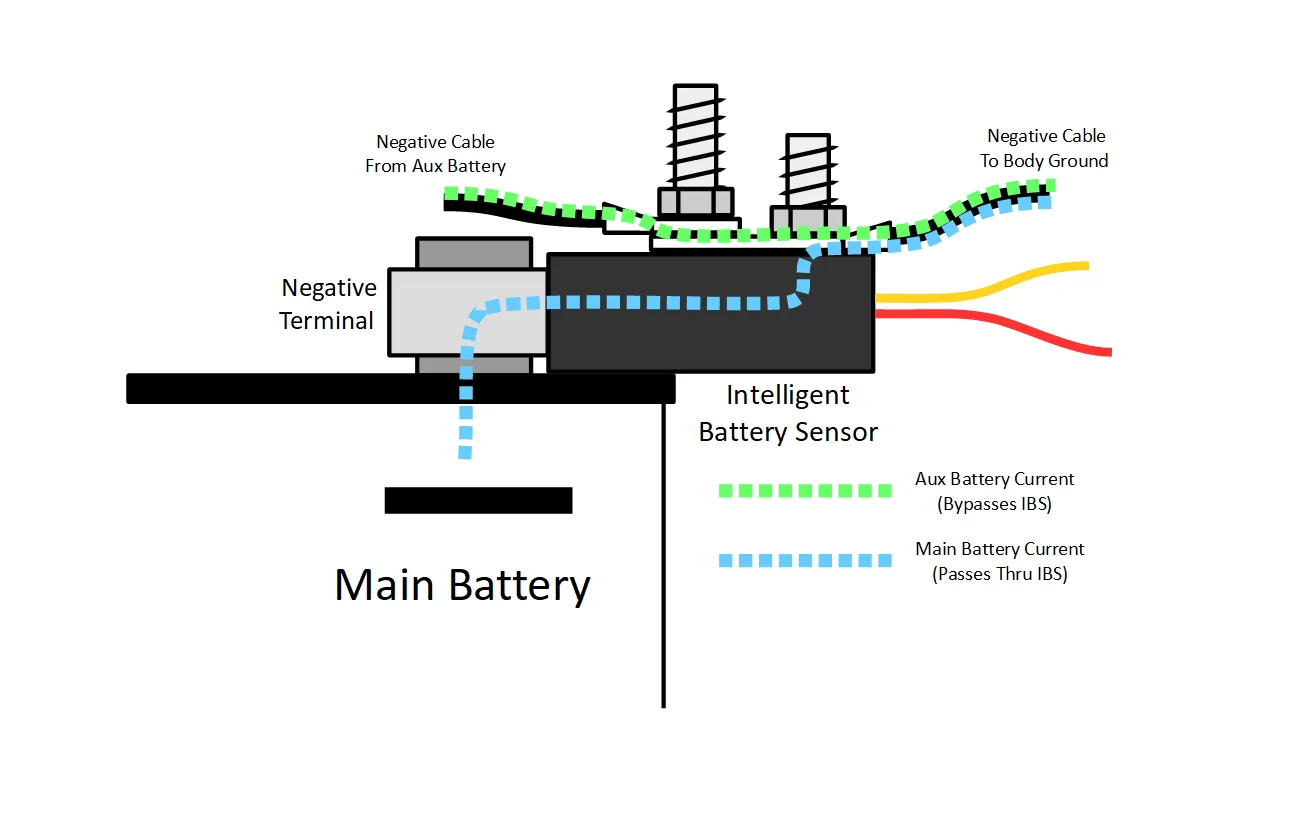
The IBS does not monitor the aux battery charge level when the aux ground is connected to the main battery negative terminal because the aux battery current does not go through the IBS.
Jeep Gladiator Aux Battery Died, Weird Results When Doing Fuse 42 / Aux Battery Disconnection IBS operation


Also based on the anecdotal evidence I've seen posted, it looks to me like the PCR reconnects the batteries before the restart, so no isolation from voltage spikes caused by the restart. I am interested in any information anyone has to the contrary.
Sponsored


 

jebiruph

Well-Known Member
First Name
Jerry
Joined
Dec 9, 2018
Threads
15
Messages
806
Reaction score
731
Location
IA
Vehicle(s)
2018 Wrangler JL 2024 Grand Cherokee L WL 2020 Gladiator JT
Thanks for this. It is quite odd, I wonder what their reasoning was for changing it. Maybe to desuade people from disabling the aux battery? It seems weird to hook the smaller cable up to the smaller bolt.
The only reason I see for changing the cables is that the new setup lets you disconnect both batteries from the body ground by disconnecting one cable. With the old cables you have to disconnect two cables to separate both batteries from the body ground.
 

ShadowsPapa

Well-Known Member
First Name
Bill
Joined
Oct 12, 2019
Threads
247
Messages
40,514
Reaction score
54,044
Location
Runnells, Iowa
Vehicle(s)
'25 JTMX, '23 JLU 4xe, '82 SX4, '73 Javelin
Occupation
Retired auto mechanic, frmr gov't ntwrk security admin
Vehicle Showcase
3
Also based on the anecdotal evidence I've seen posted, it looks to me like the PCR reconnects the batteries before the restart, so no isolation from voltage spikes caused by the restart.
How would someone be monitoring or knowing that?
Someone would have to be watching the relay for the PCR to see when it's energized and be pretty darned quick to catch that thing closing at the right instant.

I'm really curious as to how they are knowing or monitoring that (and why, of course LOL)
 

PsyRN

Well-Known Member
First Name
Eric
Joined
May 13, 2019
Threads
28
Messages
515
Reaction score
623
Location
Santa Rosa
Vehicle(s)
2020 StingGray JTR, 2016 Bonneville T120 Black
Ideal is 30 minutes per day. Every two to three days is okay. If no power is available, look at one of the Solar Chargers that connects to the OBD port.
I wonder if this is my issue. I've been riding my moto to work instead of driving the last couple of months because the weather is nicer and I save about $150/mo on gas. Commute is about 15miles or 25minutes each way. I drive the JT maybe once or twice a week for a couple of errands, and the occasional long trip.

That said, when I've tested both batteries they come up as 12.6v each, alternator reading says 14.6v. I put them on the charger just in case, reset IBS when disconnected, and when I put it all back together, I still get the error though. I checked the fuse array and that was good. Just not sure what else could be the problem. Like @ShadowsPapa has mentioned, I don't want to jump straight to "it must be the aux... disable it".
 

Lost1wing

Well-Known Member
First Name
Tim
Joined
Dec 22, 2020
Threads
24
Messages
2,614
Reaction score
2,881
Location
West Georgia
Vehicle(s)
2020 Jeep Gladiator Rubicon
Occupation
Retired AMT
That said, when I've tested both batteries they come up as 12.6v each, alternator reading says 14.6v. I put them on the charger just in case, reset IBS when disconnected, and when I put it all back together, I still get the error though.

You did separate the ground cables to test the aux and main batteries? Just checking!
 
Last edited:

Sponsored

OP
OP
foxwalkhq

foxwalkhq

Banned
Banned
First Name
Alex
Joined
Jan 17, 2021
Threads
6
Messages
95
Reaction score
32
Location
Texas
Vehicle(s)
2022 Jeep Gladiator Rubicon, 2014 Ford Mustang
Occupation
Software Engineer
You did separate the ground cables to test the aux and main batteries? Just checking!
Of course.

BTW I can't find the post but someone said something about "I assume that you are going to keep the core from the old battery" ... I wanted to ask about that: huh???

I don't really care about the core unless this is needed somehow for swapping the batteries???

I am a little confused about that.. I only have to take out the old battery, disconnect the IBS, then put in the new battery and reconnect the IBS, is that correct?

I assume that disconnecting the IBS will wipe the memory on it or reset it or something... and that I just have to wait until I have removed all batteries from it before doing it.

That it doesn't matter what order I plug it back in AFTERWARDS...

Like I can plug it back in to the network and then connect it to the new battery.. Or do I have to connect it to the new battery and get everything back together and THEN reconnect the IBS to the network?
 

Lost1wing

Well-Known Member
First Name
Tim
Joined
Dec 22, 2020
Threads
24
Messages
2,614
Reaction score
2,881
Location
West Georgia
Vehicle(s)
2020 Jeep Gladiator Rubicon
Occupation
Retired AMT
Of course.

BTW I can't find the post but someone said something about "I assume that you are going to keep the core from the old battery" ... I wanted to ask about that: huh???

I don't really care about the core unless this is needed somehow for swapping the batteries???

I am a little confused about that.. I only have to take out the old battery, disconnect the IBS, then put in the new battery and reconnect the IBS, is that correct?

I assume that disconnecting the IBS will wipe the memory on it or reset it or something... and that I just have to wait until I have removed all batteries from it before doing it.

That it doesn't matter what order I plug it back in AFTERWARDS...

Like I can plug it back in to the network and then connect it to the new battery.. Or do I have to connect it to the new battery and get everything back together and THEN reconnect the IBS to the network?
Sorry, the comment for separating the grounds for charging was aimed at the post just prior. The quote was erased when I tried to edit.

I would disconnect the batteries and the IBS (just the plug). Make sure both batteries are fully charged with an AGM charger. That should be sufficient time for the IBS to reset. Connect both batteries and then the IBS.

Another step could be added if you have a VOM (Meter). Let the fully charged batteries to sit disconnected for 30 minutes. After 30 minutes, test the voltage of each battery. Hopefully you will see 12.8v or better. Your aux battery may have suffered some with a depleted main battery.

The core battery is not needed. Some people rather save a few dollars and trade it in. It doesn't need to go in the trash either.
 

Mr._Bill

Well-Known Member
First Name
Bill
Joined
Jul 22, 2019
Threads
38
Messages
6,658
Reaction score
7,775
Location
North Las Vegas, NV
Vehicle(s)
2023 Gladiator High Altitude - 2013 Nissan Leaf SV
Vehicle Showcase
1
The Auto Parts and similar stores charge a 'core' fee that they refund when the old battery is returned. If you take the old battery in when you buy the new one, the core charge is not involved. Places that sell and ship, like Amazon, expect you to just be responsible and recycle the old battery.
 

Sponsored

ShadowsPapa

Well-Known Member
First Name
Bill
Joined
Oct 12, 2019
Threads
247
Messages
40,514
Reaction score
54,044
Location
Runnells, Iowa
Vehicle(s)
'25 JTMX, '23 JLU 4xe, '82 SX4, '73 Javelin
Occupation
Retired auto mechanic, frmr gov't ntwrk security admin
Vehicle Showcase
3
The Auto Parts and similar stores charge a 'core' fee that they refund when the old battery is returned. If you take the old battery in when you buy the new one, the core charge is not involved. Places that sell and ship, like Amazon, expect you to just be responsible and recycle the old battery.
Around here, the core batteries are worth anywhere from 7 to 10 bucks.
 

jebiruph

Well-Known Member
First Name
Jerry
Joined
Dec 9, 2018
Threads
15
Messages
806
Reaction score
731
Location
IA
Vehicle(s)
2018 Wrangler JL 2024 Grand Cherokee L WL 2020 Gladiator JT
How would someone be monitoring or knowing that?
Someone would have to be watching the relay for the PCR to see when it's energized and be pretty darned quick to catch that thing closing at the right instant.

I'm really curious as to how they are knowing or monitoring that (and why, of course LOL)
Not monitoring, but a conclusion after this thread.
https://www.jlwranglerforums.com/fo...lown-replaced-blown-again.117638/post-2449773
I wondering what evidence there is that the batteries are connected after an ESS restart?
 

ShadowsPapa

Well-Known Member
First Name
Bill
Joined
Oct 12, 2019
Threads
247
Messages
40,514
Reaction score
54,044
Location
Runnells, Iowa
Vehicle(s)
'25 JTMX, '23 JLU 4xe, '82 SX4, '73 Javelin
Occupation
Retired auto mechanic, frmr gov't ntwrk security admin
Vehicle Showcase
3
Not monitoring, but a conclusion after this thread.
https://www.jlwranglerforums.com/fo...lown-replaced-blown-again.117638/post-2449773
I wondering what evidence there is that the batteries are connected after an ESS restart?
it may point that direction if one assumes that there's a huge imbalance between the two batteries while it's stopped for ESS because there's draw from both batteries, and since the battery itself is always connected to the fuse, what else changes? The PCR?
It's a huge thread with a lot of back and forth (and conjecture of course as always follows - and that site is down right now)

One question I'd have for the engineers is - why connect it before - or after - the ESS start - what would be the purpose for doing one vs. the other?

Having dual batteries alone can absorb spikes from restarting. The aux battery acts like a buffer protecting the electronics. So if the PCR closed first, you still have that small second battery taking the brunt of spikes ahead of the electronics.
It's one reason to never disconnect a battery on a running engine - that battery is a buffer, in a way, sort of a capacitor, for the alternator, a load and it needs that.

It's obvious he had a bad battery and this quote here tells me he's not dealt with very many automotive batteries - this isn't that uncommon. He assumes a bad battery means a bad cell. Wrong assumption.
>>While I was at the local parts store we load tested it. At around 50A, consistently, the battery fell flat and acted like it shorted itself out. Drop the load and bounced right back to 12.8. Never seen that before, especially with a solid resting voltage and the ability to power a light bar with no issue. Usually they'll be around 10.8 when they lose a cell. This one only lost a cell under load, apparently.<<

The battery in my Eagle charged up nicely, 12.6 like a wet battery should, but put a load on it and it would puke, take the load off, voltage climbed back up.
It's loss of capacity.

I try to stay out of the electrical stuff over there - too much bull and bad info so I've not read much of that sort of thing on that side of things.
 

jebiruph

Well-Known Member
First Name
Jerry
Joined
Dec 9, 2018
Threads
15
Messages
806
Reaction score
731
Location
IA
Vehicle(s)
2018 Wrangler JL 2024 Grand Cherokee L WL 2020 Gladiator JT
it may point that direction if one assumes that there's a huge imbalance between the two batteries while it's stopped for ESS because there's draw from both batteries, and since the battery itself is always connected to the fuse, what else changes? The PCR?
It's a huge thread with a lot of back and forth (and conjecture of course as always follows - and that site is down right now)

One question I'd have for the engineers is - why connect it before - or after - the ESS start - what would be the purpose for doing one vs. the other?

Having dual batteries alone can absorb spikes from restarting. The aux battery acts like a buffer protecting the electronics. So if the PCR closed first, you still have that small second battery taking the brunt of spikes ahead of the electronics.
It's one reason to never disconnect a battery on a running engine - that battery is a buffer, in a way, sort of a capacitor, for the alternator, a load and it needs that.

It's obvious he had a bad battery and this quote here tells me he's not dealt with very many automotive batteries - this isn't that uncommon. He assumes a bad battery means a bad cell. Wrong assumption.
>>While I was at the local parts store we load tested it. At around 50A, consistently, the battery fell flat and acted like it shorted itself out. Drop the load and bounced right back to 12.8. Never seen that before, especially with a solid resting voltage and the ability to power a light bar with no issue. Usually they'll be around 10.8 when they lose a cell. This one only lost a cell under load, apparently.<<

The battery in my Eagle charged up nicely, 12.6 like a wet battery should, but put a load on it and it would puke, take the load off, voltage climbed back up.
It's loss of capacity.

I try to stay out of the electrical stuff over there - too much bull and bad info so I've not read much of that sort of thing on that side of things.
It is an involved thread, but it's the best evidence I seen determining when the batteries get reconnected.

I haven't heard of any ESS restart spike related issues with any single battery systems regardless of if it's because the aux was removed or the system was designed that way. What's your experience with the restart spikes?
 

ShadowsPapa

Well-Known Member
First Name
Bill
Joined
Oct 12, 2019
Threads
247
Messages
40,514
Reaction score
54,044
Location
Runnells, Iowa
Vehicle(s)
'25 JTMX, '23 JLU 4xe, '82 SX4, '73 Javelin
Occupation
Retired auto mechanic, frmr gov't ntwrk security admin
Vehicle Showcase
3
It is an involved thread, but it's the best evidence I seen determining when the batteries get reconnected.

I haven't heard of any ESS restart spike related issues with any single battery systems regardless of if it's because the aux was removed or the system was designed that way. What's your experience with the restart spikes?
The bit about it not starting after an ESS stop because of a blown N3 makes absolutely no sense to me.

Why? Because the aux battery is still connected to the electronics.
That aux battery is still powering the electronics. So that never changes no matter what.
Then -
All that the N3 fuse does is allow the aux to charge directly off the bus, and all the PCR does is take the aux off the bus so that only the main battery is running certain things.
For it to not start with a blown N3 - but moving that cable over to N4 and it starts?
No, doesn't make sense.
Think of those who replace batteries and blow the N3 leg of the high current fuse and drive not realizing it - until later. They are driving around, some even with a working ESS for a while until that aux battery goes down.

the only way it could maybe make a tiny bit is with a dead - very bad, main battery.
And then if the PCR closed and it tried to start - it might blow the N3 fuse. Cranking power would be coming from the aux battery through the N3 across the bus to the crank battery and starter.

But if that's the case, then moving the aux battery wire to N4 should blow the fuse again - because it's still trying to crank it to start through that fuse - but in that case, a restart, or cold start, which is much more power needy than an ESS restart.
Because the PCM has tracked things and kept all on the ready for that restart, it takes very little to start after an ESS stop compared to a big button start.
So if it's going to blow a fuse trying to start from an ESS stop, it's going to blow a fuse during a cold start when the starter is drawing more power for longer.

So to me, it still makes no sense.
ESS tries to restart, blows N3.
Move the wire over to N4, still only 150 amps, and use the big button to start it and it starts - not blowing the fuse this time?
Same set of circumstances except it takes more to start from the big button than an ESS start.
Sponsored

 
Last edited:


Top