
ShadowsPapa
Well-Known Member
- First Name
- Bill
- Joined
- Oct 12, 2019
- Threads
- 247
- Messages
- 40,463
- Reaction score
- 53,912
- Location
- Runnells, Iowa
- Vehicle(s)
- '25 JTMX, '23 JLU 4xe, '82 SX4, '73 Javelin
- Occupation
- Retired auto mechanic, frmr gov't ntwrk security admin
- Vehicle Showcase
- 3
The voice of logic. It's not viscosity that protects. All that's necessary is for oil to reach the end of the line internally - the last part of the oil flow process. Viscosity is what ensures it gets there. Viscosity does not lubricate. Strength of the oil film does.Withou my reading the back and forth I’m sure is happening here. 1.) engineers are smarter then someone who questions oil weight for regular vehicle use. 2.) yes, engines are exponentially built with tighter tolerances and manufacturing perfection every year. 3.) the one that matters the most, VVL. Oil does wayyyy more then lubricate engines components. It. Opens valves, it’s ability to hold the same vesocity under immense pressures, rotate VVT phasers and more. 0w20 and even 0w16 for Toyotas is ideal for these requirements when your running an NA engine. In boosted applications you’ll see those 5w40 and 5w30 weights still since they will experience increased temperatures comparatively.
As long as there's adequate flow and pressure to get to the last parts - viscosity is ok.
These have a lot tighter tolerances than what people want to compare to from years ago. The oil doesn't "leak out" of the bearing clearances and so on as quick as it did in 1980.
Too high viscosity and there's resistance to flow - it won't get there quickly or enough of it.
Too thin and if the clearances are great, it isn't going to make it to the end of the line.
Thick oil flows more slowly through the bearings, generating more heat, oil gets hotter, doesn't dissipate the heat as well or quickly. The sheer forces of thicker oil also generate heat themselves.
Thinner oil moves more quickly, generates less heat from sheer, and keeps moving cooling the oi more quickly, carrying more heat away from the bearing areas.
The higher flow rate of thinner oil, supplies more oil volume to the main and rod bearings, helping to maintain the wedge of oil formed between the crank journal and bearings.
Heat can be generated just from an oil’s internal shearing action taking place within the oil.
If this matters to anyone - This is from FCA -
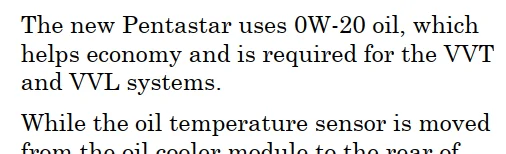
It's not oil pressure or viscosity that lubricates, it's the strength of the oil film on parts like followers, etc. and the incompressible liquid oil between the crank journals and bearings - thick or thin, that liquid oil is there, it can't be compressed, it protects.
QUALITY oil will handle higher pressures - more PSI, more load. That's nothing to do with viscosity, that's the base oil quality with the quality of the additive package that determines that.
Sponsored
 I am a bit cynical, but if I were the manufacturer, this is a legit strategy.