Sponsored

Not impressed with Gladiator performance in snow

chorky

Well-Known Member
First Name
Chad
Joined
Feb 26, 2022
Threads
175
Messages
3,466
Reaction score
3,801
Location
Montana
Website
www.youtube.com
Vehicle(s)
'22JTR, '06 LJ, '06 TJ GE
Build Thread
Link
Occupation
GIS Specialist
If my measuring is correct, the wheelbase centerline is something like where I drew the red line.
For it to be 50/50, everything ahead of that line would need to weigh the same, not more than, everything behind that line.
Engine, transmission, transfer case - I'll have to look to see just where the rear of that assembly sits compared to the red line.
You have the weight of the windshield assembly (frame and glass), figure in roll cage, front axle assembly will be a lot heavier than the rear axle assembly.

One thing the Gladiator has going for it over more conventional pickups is the front axle is clear out front leaving much engine weight to the rear of the front axle, and the rear axle is quite forward in the bed, leaving bed hanging out behind the rear axle.

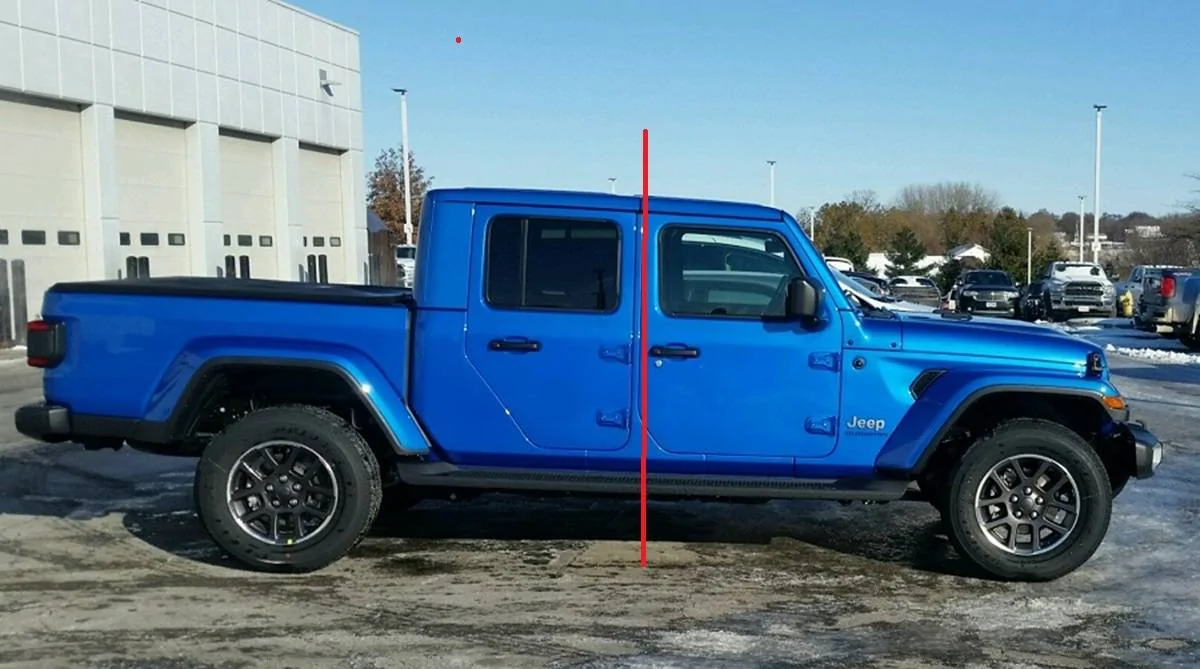
Gladiator-center.jpg
That's the wheelbase centerline, but it is not the balance point . You have to consider the space behind the rear axle. So to consider the entire truck as a whole, the balance point is probably closer to the middle of the rear doors.
Sponsored


chorky

Well-Known Member
First Name
Chad
Joined
Feb 26, 2022
Threads
175
Messages
3,466
Reaction score
3,801
Location
Montana
Website
www.youtube.com
Vehicle(s)
'22JTR, '06 LJ, '06 TJ GE
Build Thread
Link
Occupation
GIS Specialist
Actually the balance point might even be a little further back, because as you add weight to the very rear, it removes weight off of the front tires ever so slightly. I noticed this in real function as I weighed my Gladiator (and past F350) as I was slowly adding things to it.
 

Almost

Well-Known Member
First Name
Shawn
Joined
Nov 11, 2021
Threads
4
Messages
368
Reaction score
485
Location
New Jersey
Vehicle(s)
2022 JTRD & 09 JKU
Balanced is one thing and axle weight is another... Gladiators are much lighter over the rear axle vs the front. It also matters where the balance point is... probably somewhere near the the front seats... which still gives you an extremely light rear-end... which is why on oversized tires like 37's you would run atleast 5 psi or so less in the rear tire vs the front.... just my logic...anyway.
I’m referencing axle weight. Any way you put it it’s not light in the rear.

https://www.jeepgladiatorforum.com/forum/threads/diesel-lift-options-axle-weights.36045/
 

chorky

Well-Known Member
First Name
Chad
Joined
Feb 26, 2022
Threads
175
Messages
3,466
Reaction score
3,801
Location
Montana
Website
www.youtube.com
Vehicle(s)
'22JTR, '06 LJ, '06 TJ GE
Build Thread
Link
Occupation
GIS Specialist
I’m referencing axle weight. Any way you put it it’s not light in the rear.

https://www.jeepgladiatorforum.com/forum/threads/diesel-lift-options-axle-weights.36045/
I think you mean to say the axle weight capacity? So RAWR vs FAWR which, combined is often times way over GVWR. On the rubi (wide axles) the rear axle weight capacity is something like 700 pounds over a 50/50 split of the GVWR - which funny enough is in line with the weight rating of the HD springs for AEV.

But, 'axle weight' is a different meaning. It could be the weight of the axle itself, or the weight being placed on that axle as a vehicle is loaded, unloaded, etc.. But in that regard it is variable - because as you put 5 sandbags at the very rear of the bed, behind the rear axle, it will actually lessen the weight being placed on the front axle - however the axle weight capacity remains the same.
 

SargeDiesel

Well-Known Member
First Name
michael
Joined
Aug 22, 2021
Threads
25
Messages
1,887
Reaction score
1,449
Location
35173
Vehicle(s)
Jeep Gladiator Rubicon Diesel
Occupation
Retired Military
I’m referencing axle weight. Any way you put it it’s not light in the rear.

https://www.jeepgladiatorforum.com/forum/threads/diesel-lift-options-axle-weights.36045/
I hear you....
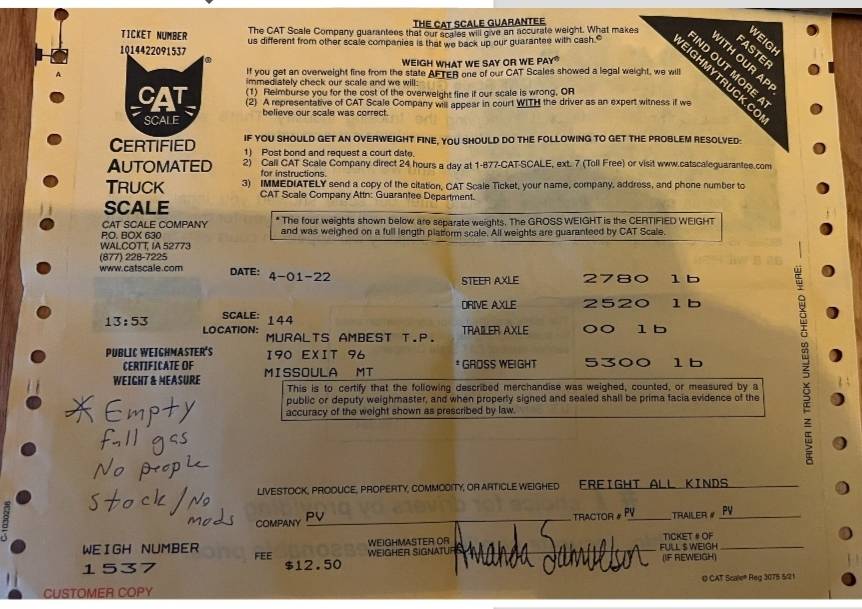
There has been a lot of debate about this. So its nice to see facts. I just got this from another member:

Jeep Gladiator Not impressed with Gladiator performance in snow Screenshot_20231124_124809_Chrome


I have a diesel, so it will obviously be a little different, I have mine setup to get weighed at my local CAT Scale at the beginning of December....

Now , I need to figure out the best place to center it over the scale. Seems best to seperate the jeep evenly... maybe measure bumper to bumper and divide in half or axle to axle and divide in half... ? Tring to find facts over opinions so I get it right.

Seems this is a case of appearances can be deceiving.
 

Sponsored

Ryan...

Well-Known Member
Joined
Feb 7, 2019
Threads
5
Messages
199
Reaction score
429
Location
WI
Vehicle(s)
Gladiator Willys
I like reading these kinds of conversations, you learn a lot, and you get to see how wildly different people experience similar things (snowy conditions).

Coming from my younger days of driving RWD '80s BMWs, and a RWD Ford Ranger (4cyl, manual trans) with all seasons here in our Wisconsin winters, it always interesting seeing how people talk about how the Gladiator handles snowy conditions.

If you have good tires and you have a basic/good understanding of weight distribution/speed/road conditions, it seems the Gladiator should be able to get you anywhere a non-snowmobile should go.

1) Buy good AT tires.
2) Know and drive within your capabilities.
3) Throw some weight in the back if you want a little extra grip off the line
 

ShadowsPapa

Well-Known Member
First Name
Bill
Joined
Oct 12, 2019
Threads
247
Messages
40,442
Reaction score
53,860
Location
Runnells, Iowa
Vehicle(s)
'25 JTMX, '23 JLU 4xe, '82 SX4, '73 Javelin
Occupation
Retired auto mechanic, frmr gov't ntwrk security admin
Vehicle Showcase
3
That's the wheelbase centerline, but it is not the balance point . You have to consider the space behind the rear axle. So to consider the entire truck as a whole, the balance point is probably closer to the middle of the rear doors.
I know - that was my whole point. That's the WHEELBASE centerline - now figure the weight on either side of that (over-simplifying, of course).
It's heavier in the front so the balance point will be forward, not rearward.

Actually the balance point might even be a little further back, because as you add weight to the very rear, it removes weight off of the front tires ever so slightly. I noticed this in real function as I weighed my Gladiator (and past F350) as I was slowly adding things to it.
Now you are talking leverage, not where weight would be placed to balance the truck so that there's the same weight on each axle.
If you were to lift the truck by the top somehow, with the rope going through the truck right smack in the middle of the wheelbase front to rear, the front will be downward because it will be heavier on the front half of the wheelbase than the rear half of the wheelbase.
Sure if you put weight in the very back it's going to lift the front because now you are using the rear axle as a fulcrum.
 

chorky

Well-Known Member
First Name
Chad
Joined
Feb 26, 2022
Threads
175
Messages
3,466
Reaction score
3,801
Location
Montana
Website
www.youtube.com
Vehicle(s)
'22JTR, '06 LJ, '06 TJ GE
Build Thread
Link
Occupation
GIS Specialist
I know - that was my whole point. That's the WHEELBASE centerline - now figure the weight on either side of that (over-simplifying, of course).
It's heavier in the front so the balance point will be forward, not rearward.


Now you are talking leverage, not where weight would be placed to balance the truck so that there's the same weight on each axle.
If you were to lift the truck by the top somehow, with the rope going through the truck right smack in the middle of the wheelbase front to rear, the front will be downward because it will be heavier on the front half of the wheelbase than the rear half of the wheelbase.
Sure if you put weight in the very back it's going to lift the front because now you are using the rear axle as a fulcrum.
I dont think you're understanding what I'm saying though. Your point is, stock, the front is heavier. Yes, we know this - it's a truck.... trucks are designed to carry more weight in the rear, cause they're a truck. Most SUV's still have more weight up front for cargo space in the back. But, if the overall goal is to figure how to get a 50/50 split, or even to understand why it is not 50/50 stock, and what dynamics change that - you have to consider the overall midpoint of the truck as well as the amount of overhang of weighted items (like sandbags) or other stuff behind the rear axle, as well as anywhere else on the vehicle. Simply taking the midpoint of the wheelbase is fine to understand where weight is when stock, but it doesn't show or discuss the dynamics of varying amount of weight throughout the truck. Similarly, a standard pickup with the front axles not so far forward, and having a heavy winch/bumper would reduce the amount of weight planted on the rear axle. And that dynamic changes, sometimes drastically, depending on where other weight is placed in the vehicle. This is an important aspect to consider especially if trying to determine where to place additional load to provide more 'weighted' traction to the rear axle. So maybe 'balance' was the wrong term to use since the balance point can change depending on where weight is place. Center point of the vehicle would be a better term. And center point of the vehicle, various weight locations and amounts, and wheelbase center are all equally important things to know if the goal is getting a balanced vehicle, or at least understanding why it is not balanced and by how much.
 

ShadowsPapa

Well-Known Member
First Name
Bill
Joined
Oct 12, 2019
Threads
247
Messages
40,442
Reaction score
53,860
Location
Runnells, Iowa
Vehicle(s)
'25 JTMX, '23 JLU 4xe, '82 SX4, '73 Javelin
Occupation
Retired auto mechanic, frmr gov't ntwrk security admin
Vehicle Showcase
3
I dont think you're understanding what I'm saying though. Your point is, stock, the front is heavier. Yes, we know this - it's a truck.... trucks are designed to carry more weight in the rear, cause they're a truck. Most SUV's still have more weight up front for cargo space in the back. But, if the overall goal is to figure how to get a 50/50 split, or even to understand why it is not 50/50 stock, and what dynamics change that - you have to consider the overall midpoint of the truck as well as the amount of overhang of weighted items (like sandbags) or other stuff behind the rear axle, as well as anywhere else on the vehicle. Simply taking the midpoint of the wheelbase is fine to understand where weight is when stock, but it doesn't show or discuss the dynamics of varying amount of weight throughout the truck. Similarly, a standard pickup with the front axles not so far forward, and having a heavy winch/bumper would reduce the amount of weight planted on the rear axle. And that dynamic changes, sometimes drastically, depending on where other weight is placed in the vehicle. This is an important aspect to consider especially if trying to determine where to place additional load to provide more 'weighted' traction to the rear axle. So maybe 'balance' was the wrong term to use since the balance point can change depending on where weight is place. Center point of the vehicle would be a better term. And center point of the vehicle, various weight locations and amounts, and wheelbase center are all equally important things to know if the goal is getting a balanced vehicle, or at least understanding why it is not balanced and by how much.
I know all of that - because each axle is a fulcrum. Been down this path so many many times. Remember, I haul cars and am pretty well tuned to the weight of each car and how much of that total is where, wheel bases vs. weight distribution and so on.
And from hauling with trucks - one I literally lengthened the frame on, repositioned the grain box and more. And a tractor I had - similar, I lengthened the frame and move the steering axle on it. (man, that was some serious work)
I really understand fully about the weight distribution, axle location and so on.

I figure that 280 pounds placed over the rear axle balances mine out fine for a good 50/50 split as far as weight on each axle, making the center of the wheelbase the center of gravity.

However, when the plow is on since the weight of the plow is probably roughly 3 feet ahead of the front axle, literally lifting the rear of the truck because the front axle then is a fulcrum, the truck is a lever. That's when the weight goes clear to the rear of the bed, basically offsetting the 300 pounds of plow up front.
The 280 pounds over the axle isn't even close to helping offset the plow out ahead of the front axle.
The evidence is my rear hub to fender measurement.
 

chorky

Well-Known Member
First Name
Chad
Joined
Feb 26, 2022
Threads
175
Messages
3,466
Reaction score
3,801
Location
Montana
Website
www.youtube.com
Vehicle(s)
'22JTR, '06 LJ, '06 TJ GE
Build Thread
Link
Occupation
GIS Specialist
I know all of that - because each axle is a fulcrum. Been down this path so many many times. Remember, I haul cars and am pretty well tuned to the weight of each car and how much of that total is where, wheel bases vs. weight distribution and so on.
And from hauling with trucks - one I literally lengthened the frame on, repositioned the grain box and more. And a tractor I had - similar, I lengthened the frame and move the steering axle on it. (man, that was some serious work)
I really understand fully about the weight distribution, axle location and so on.

I figure that 280 pounds placed over the rear axle balances mine out fine for a good 50/50 split as far as weight on each axle, making the center of the wheelbase the center of gravity.

However, when the plow is on since the weight of the plow is probably roughly 3 feet ahead of the front axle, literally lifting the rear of the truck because the front axle then is a fulcrum, the truck is a lever. That's when the weight goes clear to the rear of the bed, basically offsetting the 300 pounds of plow up front.
The 280 pounds over the axle isn't even close to helping offset the plow out ahead of the front axle.
The evidence is my rear hub to fender measurement.

Oh I know you get it, no doubts about that at all. But I mentioned it since others here might not have that level of experience. It's actually kinda astonishing how many people, even those who tow trailers frequently, dont know or understand the implications of various types of weight loadings and their effects.
 

Sponsored

Alpine Warthog

Well-Known Member
First Name
Eric
Joined
Nov 15, 2022
Threads
72
Messages
1,053
Reaction score
1,301
Location
Allegheny National Forest, PA
Website
www.instagram.com
Vehicle(s)
21 Gladiator, 98 XJ
Occupation
Retired USAF Police Officer
Vehicle Showcase
1
Are the Gladiators just very light in the back end and prone to sliding around and losing traction? Or is it the oversized tires on the Jeep acting as floats rather than digging in? The Jeep tires are also load range E in this size, but I'm only running about 35 psi, similar to the Rover tires. Thoughts?
Nail meet hammer. It seems to me you've not driven pickups in the snow before. The Rover benefits from a narrower tire and more weight over the drive wheels. The all wheel drive system your Rover has (If I remember correctly, I'm sure someone will correct me if I'm wrong) nearly the same operation as a Volvos, where 80% of the drive power goes to the front and 20% to the rear. It shifts power front to back as needed.
Jeeps are pretty much all power to all wheels that then gets split up by the differentials and somewhat controlled by the traction control applying brakes to slipping wheels.

The gladiator, just like all other traditionally powered pick-ups needs weight in the back to be any good in the snow.

Also, tires are 80% of your traction.
 

Rusty PW

Well-Known Member
First Name
Russ
Joined
Jan 10, 2022
Threads
37
Messages
11,354
Reaction score
30,296
Location
Fayette Nam, Pennsyltucky
Website
www.youtube.com
Vehicle(s)
'22 JTRD, '11 370Z Nismo, '07 Honda VFR
Build Thread
Link
Occupation
Muff Diver
I grew up driving big V8 rwd cars with sawdust recapped winter tires. That's where you learn to drive in the snow.
 

Alpine Warthog

Well-Known Member
First Name
Eric
Joined
Nov 15, 2022
Threads
72
Messages
1,053
Reaction score
1,301
Location
Allegheny National Forest, PA
Website
www.instagram.com
Vehicle(s)
21 Gladiator, 98 XJ
Occupation
Retired USAF Police Officer
Vehicle Showcase
1
I grew up driving big V8 rwd cars with sawdust recapped winter tires. That's where you learn to drive in the snow.
Same here! AN 88 Coupe De Ville with a 1970 Caddy 500 stuffed under the hood. Too much power for a 17 year old. LOL
 

Rusty PW

Well-Known Member
First Name
Russ
Joined
Jan 10, 2022
Threads
37
Messages
11,354
Reaction score
30,296
Location
Fayette Nam, Pennsyltucky
Website
www.youtube.com
Vehicle(s)
'22 JTRD, '11 370Z Nismo, '07 Honda VFR
Build Thread
Link
Occupation
Muff Diver
Same here! AN 88 Coupe De Ville with a 1970 Caddy 500 stuffed under the hood. Too much power for a 17 year old. LOL
I took my drivers test in my brother's '70 Dodge SuperBee 440 6 Pack.
 

RMAG

Member
Joined
Nov 17, 2023
Threads
3
Messages
17
Reaction score
2
Location
PA
Vehicle(s)
2008 JK, 2019 JL, 2023 JT
So trucks that have select track and command track, it’s better to run Select Track In the snow?

snow or no snow,
in what scenarios is it better to run select track?
in what scenarios is it better to run command track 4H?
Sponsored


Top