Sponsored

DavenFla

Well-Known Member
First Name
Davy
Joined
Mar 26, 2025
Threads
3
Messages
46
Reaction score
73
Location
Florida
Vehicle(s)
2002 Ford Excursion, 2019 Lincoln MKC, 2022 Jeep Gladiator
Occupation
Retired (electric utilities)
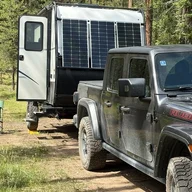
2022 JT Rubicon, stock tire size, 4:10 gears, 3.6 gas engine. 3 months, 20K miles, Florida to Grand Canyon then north to Grande Prairie, Alberta and back to Florida. 4 oil changes, towing a 4100 lb Winnebago Hike 100 travel trailer from April to July. Last oil change interval/mileage was almost 6K with 5% oil life indicated. This was my 'test' run for the oil analysis. I 'generally' changed the oil at 25% oil life previously. I used https://www.speediagnostix.com/ to do the testing. Everything came back 'good'. Oil life monitor was spot on according to the data and review by the engineer. I used 0W-20 initially and monitored oil temps. As the engine load (mountains) and temps rose I changed to 5W-30 and last oil change was 5W-40 (Schaeffer) 'cause it was hot. I'm back to 5W-30 (Pennzoil Platinum) since I'm not towing every day. Never had to add oil/top off during my entire trip. When I checked the oil viscosity chart based on the engine type and oil temps ... (0W or 5W) 40W oil was suggested.

Towing oil temps were as high as 240*F While towing up hill (steep grade) running about 4500 + or - rpm. 80% of the time the engine rpm's were around 3K + or - 500 rpm.

All values were good. 5.2 total metals per 1000 miles. Oil life was close to ending with 23.7 Oxidation, oil viscosity was still good @ 12.6.

No fuel dilution or water noted in the sample. I'm happy with the results and the engine is in very good operating condition after the 20K miles of 'hard use'. Used only synthetic oils, tried to use 100% pure gas, changed my air filter once before my last oil changed and added Techtron fuel treatment at each oil change.

I can share values:

ron 19 - - -
Chromium 2 - - -
Copper 2 - - -
Tin 2 - - -
Lead 1 - - -
Aluminum 3 - - -
Manganese 2 - - -
Nickel 1 - - -
Titanium 0 - - -
Total Metals: 30 - - -
Wear per 1000 Miles: 5.2 - - -

6000 miles
Sponsored
 

BearFootSam

Well-Known Member
First Name
Jim
Joined
Oct 12, 2022
Threads
9
Messages
674
Reaction score
949
Location
PNW
Vehicle(s)
22' Gladiator Rubicon
Occupation
Fed
How were your oil temps other than the steep grades? High temperatures significantly impact oil life but fortunately I’ve observed the gladiator cooling system does a great job. The only time I’ve ever hit 230 on the oil gauge has been very short stints into headwinds towing or at the top of steep passes towing and they drop back to a normal range of 190-205.

I’ve been generally impressed with how cool the engine and transmission run in this truck. Much, much more consistent temperatures than I observed in my former Subaru which would fluctuate wildly between 195 and 250. It would run hot just with a big roof basket from wind resistance. The jeep tends to stay between 190 and 205° regardless except for those brief high demand situations.

AT temps tend to run even lower, 170-190° on average, only occasionally breaking 205°.

All that bodes well for longevity and oil life.
 

Stan H

Well-Known Member
First Name
Stanley
Joined
Oct 26, 2022
Threads
10
Messages
5,481
Reaction score
5,461
Location
WV
Vehicle(s)
Gladiator Rubicon 2021
Occupation
Safety Consultant
2022 JT Rubicon, stock tire size, 4:10 gears, 3.6 gas engine. 3 months, 20K miles, Florida to Grand Canyon then north to Grande Prairie, Alberta and back to Florida. 4 oil changes, towing a 4100 lb Winnebago Hike 100 travel trailer from April to July. Last oil change interval/mileage was almost 6K with 5% oil life indicated. This was my 'test' run for the oil analysis. I 'generally' changed the oil at 25% oil life previously. I used https://www.speediagnostix.com/ to do the testing. Everything came back 'good'. Oil life monitor was spot on according to the data and review by the engineer. I used 0W-20 initially and monitored oil temps. As the engine load (mountains) and temps rose I changed to 5W-30 and last oil change was 5W-40 (Schaeffer) 'cause it was hot. I'm back to 5W-30 (Pennzoil Platinum) since I'm not towing every day. Never had to add oil/top off during my entire trip. When I checked the oil viscosity chart based on the engine type and oil temps ... (0W or 5W) 40W oil was suggested.

Towing oil temps were as high as 240*F While towing up hill (steep grade) running about 4500 + or - rpm. 80% of the time the engine rpm's were around 3K + or - 500 rpm.

All values were good. 5.2 total metals per 1000 miles. Oil life was close to ending with 23.7 Oxidation, oil viscosity was still good @ 12.6.

No fuel dilution or water noted in the sample. I'm happy with the results and the engine is in very good operating condition after the 20K miles of 'hard use'. Used only synthetic oils, tried to use 100% pure gas, changed my air filter once before my last oil changed and added Techtron fuel treatment at each oil change.

I can share values if you want.
Stock tires size would IMHO play a significant part in your heat not getting out of control while 0ulling those hills.
I really curious as to what gear yours pulled the grades in., 3rd, 4th or 5th,
 
OP
OP
DavenFla

DavenFla

Well-Known Member
First Name
Davy
Joined
Mar 26, 2025
Threads
3
Messages
46
Reaction score
73
Location
Florida
Vehicle(s)
2002 Ford Excursion, 2019 Lincoln MKC, 2022 Jeep Gladiator
Occupation
Retired (electric utilities)
On flat ground running at speed (65mph) 215*F was about normal towing. Non towing numbers less... but didn't really observe. For a warm/hot environments 5W-30 is now my go to oil. However If I tow any distance on a regular basis, 5W-40 would still be my choice. I would go 0W-40 in a cooler environment towing.
 
OP
OP
DavenFla

DavenFla

Well-Known Member
First Name
Davy
Joined
Mar 26, 2025
Threads
3
Messages
46
Reaction score
73
Location
Florida
Vehicle(s)
2002 Ford Excursion, 2019 Lincoln MKC, 2022 Jeep Gladiator
Occupation
Retired (electric utilities)
4th gear up to 65MPH on steep grade. 4500 + rpm maybe a bit higher, but always kept it under 5K rpm. I did manual shifting while towing, Used "D" when driving local. However 2nd gear holds too long. The Winnebago Hike has a high profile, so lots of wind resistance. I average 10.5 MPG for the whole trip. Some mountain driving, mpg's were as low as 8. The 3.6 is barely adequate for towing. Pure gas vs gas with 10% alcohol makes a difference on gas mileage, so when available I filled up with pure gas. I hate the 20 gal gas tank and always carried 10 gals of gas with me.

The sweet spot is 50-55 MPH
 

Sponsored

ShadowsPapa

Well-Known Member
First Name
Bill
Joined
Oct 12, 2019
Threads
247
Messages
40,442
Reaction score
53,859
Location
Runnells, Iowa
Vehicle(s)
'25 JTMX, '23 JLU 4xe, '82 SX4, '73 Javelin
Occupation
Retired auto mechanic, frmr gov't ntwrk security admin
Vehicle Showcase
3
On flat ground running at speed (65mph) 215*F was about normal towing. Non towing numbers less... but didn't really observe. For a warm/hot environments 5W-30 is now my go to oil. However If I tow any distance on a regular basis, 5W-40 would still be my choice. I would go 0W-40 in a cooler environment towing.
Weather or climate are zip, nothing to do with the 2nd number. Only the oil temperatures, clearances and requirements of the engine affect the 2nd number.
I don't understand why people say "I live where it's hot so i need thicker oil".
No, you don't.
Only the load on the engine and engine temperatures matter - not the fact it's 100 degrees outside.
Going that high could cause trouble with the operation of the phasers and the multi-mode followers.
The winter number, the first number, yes - in hot climates, no need for 0.

Non-mechanics and non-engineers are trying to out-engineer the pros who designed the OIL for that specific engine and worked directly with the engine designers in creating the oils.

Doesn't matter if your outside temp is 110, as long as you are seeing engine temperatures where you posted - 215 - 230, etc. - it's fine.

When I checked the oil viscosity chart based on the engine type and oil temps ... (0W or 5W) 40W oil was suggested.
One should ignore such generic charts - they don't take into account the design of all of the internals and other details. Very dangerous to use a chart vs real engineering. In fact, I find such a chart laughable and risky.

Won't help engine life, and could be a big negative.
I can "understand" going to a 5w30 for example, it's hardly a jump at all, but 40?

I'm really curious as heck -
What exactly is the goal?
 
Last edited:
OP
OP
DavenFla

DavenFla

Well-Known Member
First Name
Davy
Joined
Mar 26, 2025
Threads
3
Messages
46
Reaction score
73
Location
Florida
Vehicle(s)
2002 Ford Excursion, 2019 Lincoln MKC, 2022 Jeep Gladiator
Occupation
Retired (electric utilities)
Iron 19 - - -
Chromium 2 - - -
Copper 2 - - -
Tin 2 - - -
Lead 1 - - -
Aluminum 3 - - -
Manganese 2 - - -
Nickel 1 - - -
Titanium 0 - - -
Total Metals: 30 - - -
Wear per 1000 Miles: 5.2 - - -

6000 miles
 

Maximus Gladius

Well-Known Member
First Name
Kevin
Joined
Jan 30, 2021
Threads
74
Messages
2,901
Reaction score
3,692
Location
Calgary, AB, Canada
Vehicle(s)
2021 JTR, 2023 JTR
I'm really curious as heck -
What exactly is the goal?
I’m going to guess what this angle of thought and action is about is an honest attempt to obtain longevity. Good, bad or indifferent, and against the ‘never be humble better learned judgement’ the thicker viscosity using folks are trying to do “good” for their engine. Others here have gone down the 40 weight with absolute passion and conviction and as far as I’m aware, no one’s engine has blown up…unless some have and don’t want to come back on here and get spanked or the “I told you so” waving finger.


Chromium 2
This is the only number I wouldn’t want to see this high. “1” is very normal and typically expected,…2 , I would watch this and change oil earlier than 6k miles. 2 indicates (to me, wear on the high side I don’t want to see).

So, as @ShadowsPapa has indicated in his “as a mater of fact” way because he’s earned his lifetime of knowledge and educates us all with it, I would seriously consider it.

My speculative opinion on the 40 weight doesn’t come from being a schooled engineer, I’m not a chemist but “critically think” about the difference of thin viscosity like a 0/20 (8 viscosity) and thicker viscosity 0/40. (12 viscosity) Thinner viscosity will remove heat and wear metals out faster than a thicker viscosity.

Like I said, the only number of concern for me is your chromium @2. How do you bring down the number? Change the oil sooner, use a thinner viscosity, maybe settle for 0/30 or 5/30 if you don’t want to run 0/20. Third way to get the scratchy stuff like iron out of you oil is to get a magnetic drain plug or slap on a fishing magnet to your oil pan. I think trying one or all three things here will lower numbers.
 

KevinC

Well-Known Member
First Name
Kevin
Joined
Feb 6, 2021
Threads
17
Messages
840
Reaction score
1,596
Location
Central Florida
Vehicle(s)
2023 JT Mojave Sarge
Occupation
Hard Labor
A very detailed trip, thank you for the review on the oil.

I never thought the Winnebago Hike was 4100lbs. I'm assuming that was loaded with your gear?
 

Sponsored

ShadowsPapa

Well-Known Member
First Name
Bill
Joined
Oct 12, 2019
Threads
247
Messages
40,442
Reaction score
53,859
Location
Runnells, Iowa
Vehicle(s)
'25 JTMX, '23 JLU 4xe, '82 SX4, '73 Javelin
Occupation
Retired auto mechanic, frmr gov't ntwrk security admin
Vehicle Showcase
3
A very detailed trip, thank you for the review on the oil.

I never thought the Winnebago Hike was 4100lbs. I'm assuming that was loaded with your gear?
Frontage is also part of town ratings, so, that's probably one reason he's not thrilled.
 

g2020

Well-Known Member
First Name
David
Joined
Oct 30, 2024
Threads
22
Messages
214
Reaction score
272
Location
Texas USA
Vehicle(s)
2020 Jeep Gladiator Sport
I use 0W-20 because it is specified in the owner's manual.

From the online version of the 2020 Jeep Gladiator owner's manual (P138339_20_JT_OM_EN_USC_DIGITAL.pdf):

Page 251:
"The engine oil filler cap also shows the recommended engine oil viscosity for your engine....Lubricants which do not have both the engine oil certification mark and the correct SAE viscosity grade number should not be used."

Page 287:
"We recommend you use API Certified SAE 0W-20 Engine Oil, meeting the requirements of FCA Material Standard MS-6395....Refer to your engine oil filler cap for correct SAE grade."
Specs: API Certified, SAE 0W-20, and MS-6395

These are the specs for three Mobil 1 EP engine oils that are compliant with MS-6395:

Meets all manufacturer specifications:
- SAE 0W-20, API Certified, Chrysler/FCA MS-6395, and GM dexos 1 Gen 3 (meets all manufacturer specs and more stringent GM standard)

Others:
- SAE 5W-20, API Certified, and Chrysler/FCA MS-6395 (meets API and MS-6395; thicker at cold startup)
- SAE 5W-30, API Certified, Chrysler/FCA MS-6395, and GM dexos 1 Gen 3 (meets API, MS-6395, and more stringent GM standard; thicker at both cold startup and operating temperature)


On a related note, high-mileage motor oils tend not to meet GM dexos 1 Gen 3 likely because they contain a higher concentration of seal conditioning additives.
- Mobil 1 EP High Mileage 0W-20, 5W-20, and 5W-30 meet API and MS-6395, but do not meet GM dexos 1 Gen 3
 
Last edited:

Hootbro

Well-Known Member
First Name
Don
Joined
Apr 13, 2019
Threads
57
Messages
10,176
Reaction score
19,943
Location
Delaware
Vehicle(s)
2025 Gladiator Sport
Any way to share the actual report either by PDF or JPG? It is easier to digest in the original format than written out with blocks of information here or there.
 

ShadowsPapa

Well-Known Member
First Name
Bill
Joined
Oct 12, 2019
Threads
247
Messages
40,442
Reaction score
53,859
Location
Runnells, Iowa
Vehicle(s)
'25 JTMX, '23 JLU 4xe, '82 SX4, '73 Javelin
Occupation
Retired auto mechanic, frmr gov't ntwrk security admin
Vehicle Showcase
3
I’m not a chemist but “critically think” about the difference of thin viscosity like a 0/20 (8 viscosity) and thicker viscosity 0/40. (12 viscosity) Thinner viscosity will remove heat and wear metals out faster than a thicker viscosity.
Your critical thinking will get you into trouble - oh, wait, you are correct..

Yes. Tests show that that large of a jump especially will increase the oil temperatures in the sump. How does it get that much hotter in there? Because the oil returning is more hot.
It heats due to the shear in the bearing areas, it moves a lot slower so can't be cooled as well by any oil coolers, and in our cases, may also lead to issues with cam phasers and more. They are designed with REALLY tight tolerances. Thick oil will hinder proper, quick operation.
But....but...but why isn't my oil temperature on the screen higher?
Because we have an oil cooler that's working and because the temp sensor is above, not at the sump, so it's not really showing the whole picture.
The parts like pistons (cooled by oil, oil slowed by being thicker), piston pins and other parts.
Thicker oil is also harder to shoot out the spray nozzles at the bottoms of the pistons, and likely also not doing as well at the cam followers which are lubricated by oil shooting from the exhaust lash adjusters, through the holes in the exhaust followers.

People can do what they want, but I'd burn any chart that said to use 40 weight oil based on temperatures and "engine type". It's likely based on stuff from the 1970s.

BTW - the owners manuals for the new cars I bought in 1977 and 1984 said - "10w30" oil.
So, why is it suddenly in vogue to run heavier oil than some recommended 40-45 years ago?
Sponsored


Top