Sponsored

Switching from Hamburgers to Magnuson

DAVECS1

Well-Known Member
First Name
David
Joined
Jan 24, 2020
Threads
56
Messages
1,861
Reaction score
2,538
Location
Peoria, IL
Vehicle(s)
2020 Gladiator Sport S Max Tow
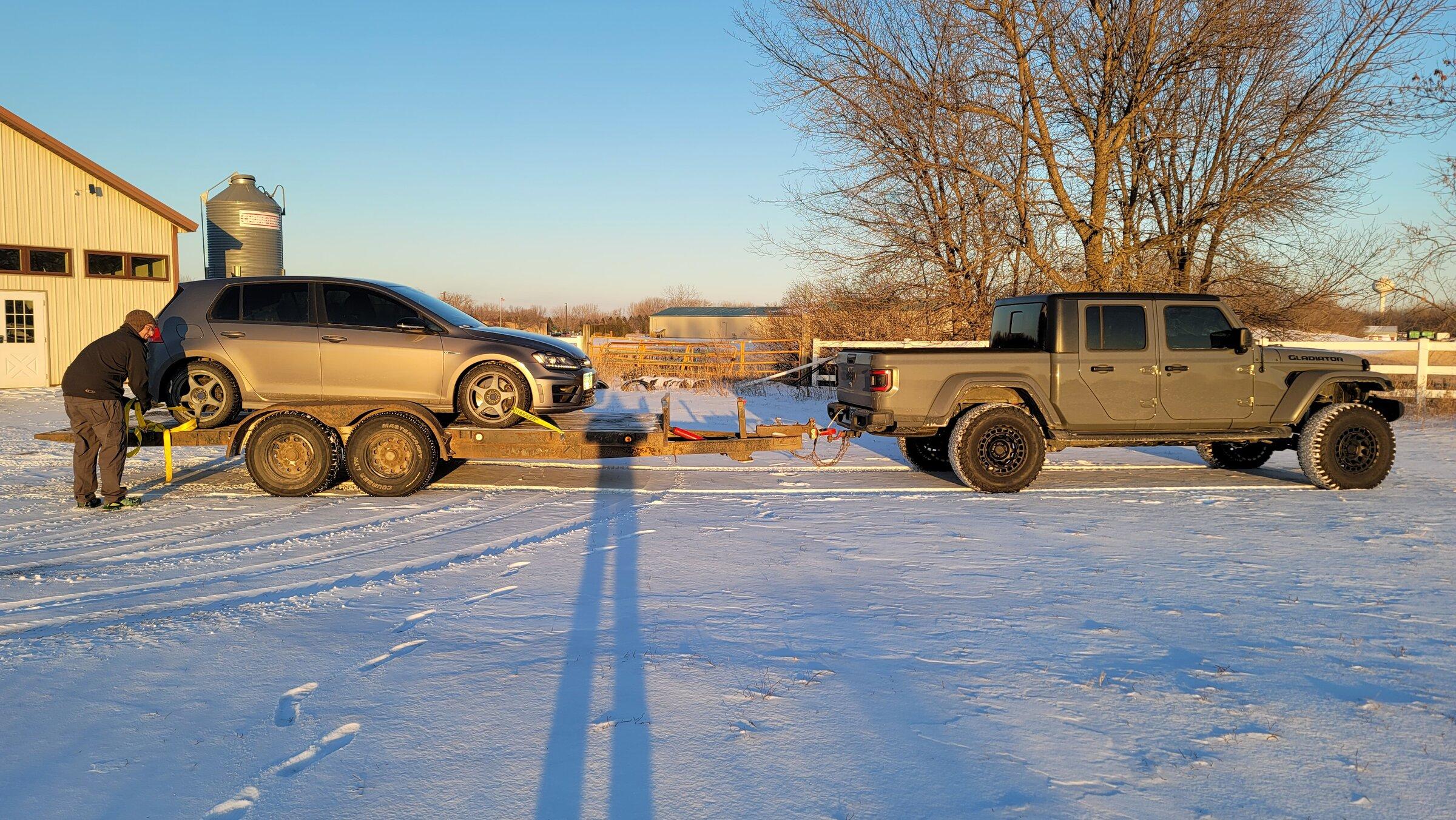
I had the serendipitous opportunity to do a short haul, and not having to dig deep into the RPMs was sure nice, much to Kurt's points above. I am loving the Gladiator more and more!

I will be doing a more comprehensive comparison by the end of the week.


2021-12-21 16.08.49.jpg
Which tune where you on ?. You should tell these guys what gears your packing and towing like that.

Guys I am not advertising this as the saviour of motors. It MORE POWER and who doesn't like that.

And as a 45 year old father of two with a family, I know the importance, of not cashing out a 50K plus investment used as a daily driver. I have made my calibration as safe as I know how. There are anomolies and the download process is not as straight forward as I would like it. With that said I try to offer everyone as much assistance as possible as I am not in this to make money at this point.

If you want to move faster, tow better, and generally play offroad with more torque. I believe, I have a very viable alternative. Thats all.
Sponsored

 
OP
OP
DC3

DC3

Well-Known Member
First Name
Carl
Joined
Jul 14, 2020
Threads
47
Messages
367
Reaction score
938
Location
Willmar, MN
Website
dilabs.cc
Vehicle(s)
'21 JT GDE Ecodiesel, 22 Polestar 2
Occupation
engineer
Which tune where you on ?. You should tell these guys what gears your packing and towing like that.

Guys I am not advertising this as the saviour of motors. It MORE POWER and who doesn't like that.

And as a 45 year old father of two with a family, I know the importance, of not cashing out a 50K plus investment used as a daily driver. I have made my calibration as safe as I know how. There are anomolies and the download process is not as straight forward as I would like it. With that said I try to offer everyone as much assistance as possible as I am not in this to make money at this point.

If you want to move faster, tow better, and generally play offroad with more torque. I believe, I have a very viable alternative. Thats all.
I was running your latest P2 tune and I am running 3.73 gears with 35" tires. I had previously towed similar loads on the other kit with 33" tires, it had power but always felt like
Jeep Gladiator Switching from Hamburgers to Magnuson 1640195578408
.

Having partial throttle boost at low RPM with the Magnuson was really nice, an improvement even with the 35s. I imagine this has some to do with Dave's trans tune which isn't as quick to drop gears to raise RPMs. Rubitrux forgot to include the stock Magnuson tune so I am not able to compare that to Dave's tune but at this point as good as it runs, there is no reason to fiddle with another tune.

None of this is to say the other kit was bad, but for my use I am happy with the swap. While I am not disatisfied with the 3.73 I will probably regear before too long. I have had the 35s only a few weeks.
 

ShadowsPapa

Well-Known Member
First Name
Bill
Joined
Oct 12, 2019
Threads
247
Messages
40,465
Reaction score
53,924
Location
Runnells, Iowa
Vehicle(s)
'25 JTMX, '23 JLU 4xe, '82 SX4, '73 Javelin
Occupation
Retired auto mechanic, frmr gov't ntwrk security admin
Vehicle Showcase
3
I was running your latest P2 tune and I am running 3.73 gears with 35" tires. I had previously towed similar loads on the other kit with 33" tires, it had power but always felt like
1640195578408.png
.

Having partial throttle boost at low RPM with the Magnuson was really nice, an improvement even with the 35s. I imagine this has some to do with Dave's trans tune which isn't as quick to drop gears to raise RPMs. Rubitrux forgot to include the stock Magnuson tune so I am not able to compare that to Dave's tune but at this point as good as it runs, there is no reason to fiddle with another tune.

None of this is to say the other kit was bad, but for my use I am happy with the swap. While I am not disatisfied with the 3.73 I will probably regear before too long. I have had the 35s only a few weeks.
3.73s and 35s? Now I'm really impressed.


Guys I am not advertising this as the saviour of motors. It MORE POWER and who doesn't like that.
Could be a wash - if you can keep RPM down, reduce shifting you save some wear there. No one can say anything more than that really.
Yes increased pressures do put a bit more on the rings but then you aren't sliding the rings up and down as much (and saving that automatic transmission some effort.
What it will or won't do for wear and life can't be said until we get these trucks - hundreds of them, with and without superchargers, up to the 100,000 mile mark or better and even at that - you can't fully compare. I've seen truck engines with the original factory cylinder hatch marks still very visible with no ridge, at 100,000 miles and then I've seen the same engine in need of going through with the same miles.

My OPINION based on experience otherwise and what I know and see so far without a lot of technical digging - you do introduce higher pressures, you do increase a certain amount of load here and there - but - you are reducing RPM and shifting needs. Could be a wash.
My hopes would be that it last as long as any other engine used and maintained in the exact same fashion.
That's my opinion.

As far as a prior comment -

but when was the last time you heard of a modern engine actually wearing out?
That's extremely subjective! What is meant by "wearing out" and at what miles? Where do you draw the line on modern?
In the 80s and 90s I saw engines going 200,000 miles and some reports of 300,000 miles - on the 258 and 4.0. I put 160,000 on one and with a couple simple fixes could have gone more. My WJ had 128,000 and was going strong.
So we have to define "worn out", at what miles, and where's the line on "modern engines".
As long as the combustion process is stable, timing controlled, detonation controlled, there's a boundary layer on the top of the piston that protects it from the heat of combustion. If you can run any ethanol at all you also help cool the combustion process. You can melt pistons or blow parts off them on a NA engine if the tune is bad.

Rumor (likely true) was that FCA was aiming to see some future turbo on the 3.6 and thus the changes back around 2015 or whatever the exact year was. Discussions with Dave otherwise and reading his stuff has me less concerned about "breaking things". He's a level-headed guy wanting power without parts flying.

Anyway, I am contaminating the thread with this other stuff. My apologies to the OP - my main questions were, to get back on track for the OP -
What gears (we see they are 3.73), what tires, (size - we see 35s now) and WHAT was the trailer load in pounds....... 6,000? More?
And what were the RPMs typically seen and the max RPMs.
 
Last edited:

KurtP

Well-Known Member
First Name
Kurt
Joined
Oct 9, 2020
Threads
68
Messages
2,310
Reaction score
3,020
Location
VA
Vehicle(s)
S/C Mojave
Occupation
Only Fans Content Creator
I also yearn for forced induction. There is nothing like the swell of torque at 3000 rpm that builds as a turbo spools up.

I've owned and played with turbocharged cars since the 1970s. (My dad had an ex-Saab rally car with alcohol injection driven by a windshield washer pump. primitive)

And I also agree that higher RPM = more wear.

But, and this is a big but, when was the last time you actually saw a modern engine worn out.

Back in the 90s Subaru, Saab and some others did tests where they ran their cars flat out at redline at full throttle round and round and round a huge oval for 30,000 to 60,000 miles. None of the cars broke. Modern engines suffer more from a cold weather start than they do from 50 trips to redline.

Its all theory, but when was the last time you heard of a modern engine actually wearing out?

RPM are not to be feared.

One other thing. I you need to make X amount of power and you aren't revving, then you are making more torque with more manifold pressure. This adds its own kinds of stresses.

They aren't the kinds of stresses that impact pistons and wrist pins and valves from moving quickly. Rather its increased ring tension from the combustion pressure working its magic behind the rings. Its more stress on the crank. Its more thermal stress on the aluminum pistons.

You get my point. I think that within reason neither of these kinds of stresses. (high rpm vs high manifold pressure) are going to cause a problem on a practical level. So the motor wears out at 300,000 miles instead of 400,000 miles.

Thoughts?
remember manifold pressure and cylinder pressure are different. Two cars with equal peak manifold pressure can have vastly different cylinder pressures.

the only kit on the market that concerns me on any of the wear items is the Ripp, but they may have sorted their issues out.

imo, with the kits out today it largely depends on how you want your truck to drive/what kind of tq profile you prefer.
 

shrinkhead

Well-Known Member
Joined
Dec 21, 2019
Threads
62
Messages
751
Reaction score
729
Location
Massachusetts
Vehicle(s)
Gladiator Launch Edition
how many hours your think you can hang out in boost before something gives ? what’s the weak link with the pentastar? anyone making forged pistons yet ?
 

Sponsored

KurtP

Well-Known Member
First Name
Kurt
Joined
Oct 9, 2020
Threads
68
Messages
2,310
Reaction score
3,020
Location
VA
Vehicle(s)
S/C Mojave
Occupation
Only Fans Content Creator
how many hours your think you can hang out in boost before something gives ? what’s the weak link with the pentastar? anyone making forged pistons yet ?
weak link is the shallow piston crown, which means the ringland is easy to crack. as long as you dont have a detonation event, or run too much cyl pressure (like it seems Ripp did) and they have been holding up pretty well.

people Ive talked to have run them reliably up to 13psi, and then broke it at 15psi. They were non specific on the failure.

it seems mostly accepted that <=12psi on a good tune with cyl pressures in check is long term reliable For all the components, but few people are pushing the limits. Fwiw, i think you could run Dave’s tune, Edelbrock’s factory tune, Hamburger’s tune and barring abuse the motor would last the life of the vehicle.

forged pistons have been developed from someone on this forum spearheading the project.
 

DAVECS1

Well-Known Member
First Name
David
Joined
Jan 24, 2020
Threads
56
Messages
1,861
Reaction score
2,538
Location
Peoria, IL
Vehicle(s)
2020 Gladiator Sport S Max Tow
My truck spends most of its time in boost. Boost is not bad and it is not always more force, infact in many instances is reduces work the engine needs to do. In many part throttle operations a NA engine does a fair bit of work to pull air in. There are suction forces on the rings.
With Forced induction at part throttle the air is fed in under light pressure reducing the pressure on the rings and the pull the engine needs to supply to get the needed air. My tune utilizes this phenomenon to hold high gears during cruise, at light throttle. The engine does less work pulling air and is able to easier hold speed, not necessarily using boost power. This is why you can achieve better fuel milage at cruise with this setup. High use cycle begins with moderate to WOT acceleration, this is when your creating forces beyond what the engine would normally see. Even then there is a portion of that work that is still normal duty cycle as ring forces are still similar between the negative and postive forces that are generated. The only time your really stressing the engine is when your generating power beyond what the engine has been tested to generate safely. I am curious about what it means to generate more power in lower RPMs. My first guess is, it should be ok to put the forces on the components at lower speeds. In all the max forces seen should be less. My concern pressure frequency at the head gasket cylinder interface. Again lower engine speeds should mean lower vibration and force on the cylinder, but who knows what a bigger explosion means to the head gasket. If the material is right and things are not shifting. I would guess it is ok. My two oil analysis showed no abnormal coolant in the oil. It is definitely a discussion. As far as damage from agressive and misunderstood tuning. I am not worried about that on my calibration. I have a triple redundant system that jumps in when temps and ignition anomolies are seen. Basically I look for ignition anomolies at high load, when this is scene there is a quick ramp timing cut, and then the cylinders are taken to an acceleration fueling level to cool things down, and the exhast valves are ramped open to cool and release pressure. This is why I ask for data right away when people bring issues to my attention. If I see these happening, I know there is a problem that needs addressed now and quickly. I have been able to advise a number of users to not drive on a tune or to drive with caution until we can determine root cause.

Of course there is no perfect mouse trap and people will blow through all the safetys.
 

Wrathis79

Active Member
First Name
Dustin
Joined
Dec 3, 2021
Threads
3
Messages
35
Reaction score
28
Location
Dallas
Vehicle(s)
2021 Gladiator Mojave, 2003 Grand Cherokee
Occupation
Aerospace/Defense
I have a question or two since I dream of SC - and likely it will stay just that but then who knows.....
People talk about "digging into the RPMs" as if they really have to wrap these up tight.
Mine did hit ~4300 or so once in a while on a large long hill, but otherwise most of the time it was 2300-3300 unless the hill was longer or steeper (talking I80 east half of Iowa where even OTR guys have trouble keeping speed at times if fully loaded)

I don't see 2300 RPM as digging deep at all. In fact I wish these would run about 200-300 rpm higher as a norm. Mine spent a lot of time around 2,000-2300 rpm (trying to keep the speed about 65 mph)

Your pic looks like a heavier load than mine - I was hauling about 5,000 pounds (car hauler with car) and I was shocked/surprised that my Overland kept the RPM well below what my Chevy with V8 LS had to do to make those exact same hills. My JT actually wound up less than my Chevy had to.

No question that RPM = wear. As a long-time mechanic I get that. Non-issue there. But I don't consider the 2,000s as high rpm when my Chevy wrapped up into the 5s and was often into the 4s and this truck doesn't seem to need to do that.

Maybe it's because you were pulling a lot more than I was at only 5,000 pounds.
I used my Mojave to tow my 19' E-Pro camper (approx 4,000lbs) from Austin to Dallas. Running at 60-65mph it stayed in 5th gear and about 3200-3500 rpm. Truth be told, I would have much preferred to stay in the 2800 range, but found it took more pedal in 6th to maintain speed than it did in 5th. This got me about 11mpg and maybe that's acceptable, but I'm already thinking about downsizing my camper so the truck won't have to work so hard to tow. Granted, I like the idea of downsizing anyway but this tow experience got me thinking about it even more now...
 

DAVECS1

Well-Known Member
First Name
David
Joined
Jan 24, 2020
Threads
56
Messages
1,861
Reaction score
2,538
Location
Peoria, IL
Vehicle(s)
2020 Gladiator Sport S Max Tow
I was running your latest P2 tune and I am running 3.73 gears with 35" tires. I had previously towed similar loads on the other kit with 33" tires, it had power but always felt like
1640195578408.png
.

Having partial throttle boost at low RPM with the Magnuson was really nice, an improvement even with the 35s. I imagine this has some to do with Dave's trans tune which isn't as quick to drop gears to raise RPMs. Rubitrux forgot to include the stock Magnuson tune so I am not able to compare that to Dave's tune but at this point as good as it runs, there is no reason to fiddle with another tune.

None of this is to say the other kit was bad, but for my use I am happy with the swap. While I am not disatisfied with the 3.73 I will probably regear before too long. I have had the 35s only a few weeks.
Did you get the update I sent the other night? Should smooth some things out.
 
OP
OP
DC3

DC3

Well-Known Member
First Name
Carl
Joined
Jul 14, 2020
Threads
47
Messages
367
Reaction score
938
Location
Willmar, MN
Website
dilabs.cc
Vehicle(s)
'21 JT GDE Ecodiesel, 22 Polestar 2
Occupation
engineer
Did you get the update I sent the other night? Should smooth some things out.
I did. I have put about 120 miles on it since the flash. I will send some feedback and run some logs, probably tomorrow

I also decided to regear.... 4.56s coming in next week.

I just wish the damn pulley would ship, the belt is staring at me and teasing me. ?? the addiction has set in.
 

Sponsored

19Delta

Well-Known Member
Joined
Oct 8, 2021
Threads
37
Messages
415
Reaction score
413
Location
Indiana
Vehicle(s)
Built JKUR to an F150 FX4, to my 2022 Mojave!
I used my Mojave to tow my 19' E-Pro camper (approx 4,000lbs) from Austin to Dallas. Running at 60-65mph it stayed in 5th gear and about 3200-3500 rpm. Truth be told, I would have much preferred to stay in the 2800 range, but found it took more pedal in 6th to maintain speed than it did in 5th. This got me about 11mpg and maybe that's acceptable, but I'm already thinking about downsizing my camper so the truck won't have to work so hard to tow. Granted, I like the idea of downsizing anyway but this tow experience got me thinking about it even more now...
I assume you are supercharged? Brand?
 
OP
OP
DC3

DC3

Well-Known Member
First Name
Carl
Joined
Jul 14, 2020
Threads
47
Messages
367
Reaction score
938
Location
Willmar, MN
Website
dilabs.cc
Vehicle(s)
'21 JT GDE Ecodiesel, 22 Polestar 2
Occupation
engineer
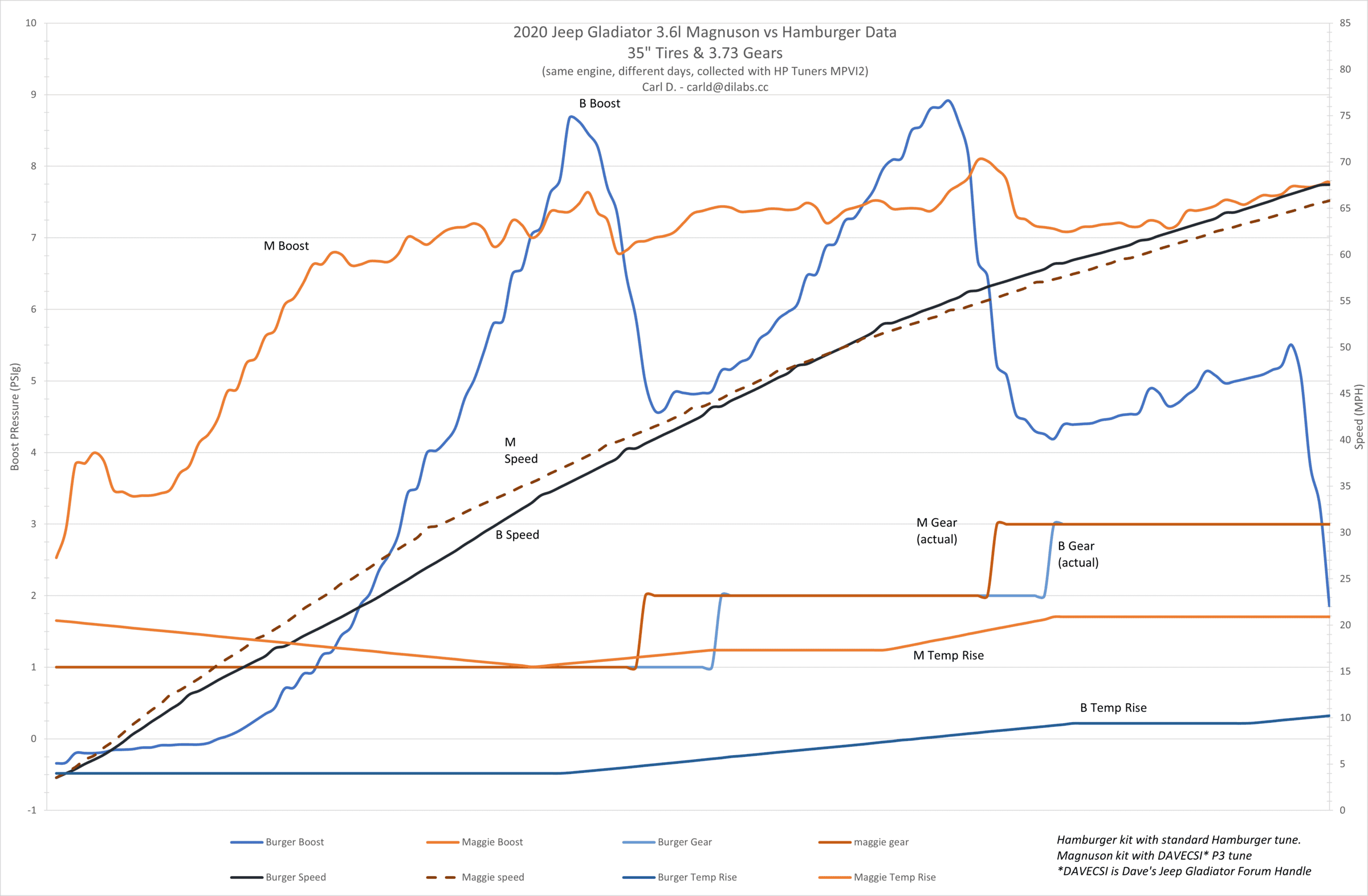
I am still working on my comparison but I wanted to share a graph comparison of both kits. I wish I had a dyno but in lieu of that, I logged some parameters I thought might be of value. The attached graph shows a comparison of the Magnuson to the Hamburger kit for boost pressure, speed, temperature rise, and gear. I wish I had been more thoughtful and methodical in my data logging for the burger kit, but as they say, hindsight is 20:20.

I had to align the two graphs as best I could. I haven't analyzed the data beyond creating the matchup, I am sure folks smarter and more experienced than I will spot obvious findings, beyond the differences in boost profile.

Our trucks aren't meant for WOT acceleration but this chart is still helpful IMHO. I recorded a 0-60 time of about 6.7s with the Magnuson, 35s, and 3.73 gears. Pretty surprising to me.

By the way, the X-axis is time, "B" references Hamburger and "M" is Magnuson.

Jeep Gladiator Switching from Hamburgers to Magnuson Burger vs Magnuson compariso
 

dcmdon

Well-Known Member
First Name
Don
Joined
Mar 31, 2021
Threads
60
Messages
3,656
Reaction score
4,427
Location
Boston Metro-West, Northern NH
Vehicle(s)
.
remember manifold pressure and cylinder pressure are different. Two cars with equal peak manifold pressure can have vastly different cylinder pressures.

the only kit on the market that concerns me on any of the wear items is the Ripp, but they may have sorted their issues out.

imo, with the kits out today it largely depends on how you want your truck to drive/what kind of tq profile you prefer.
As long as you stay out of detonation, it is my understanding that cylinder pressure and manifold pressure track together. It makes more sense. More A and F = more cylinder pressure = more torque.

And yes, more manifold pressure does equal more torque. In a rather linear way actually.

I suspect you are referencing the possibility of detonation. But if not, I'd like to hear an explanation.

Merry Christmas.
 
OP
OP
DC3

DC3

Well-Known Member
First Name
Carl
Joined
Jul 14, 2020
Threads
47
Messages
367
Reaction score
938
Location
Willmar, MN
Website
dilabs.cc
Vehicle(s)
'21 JT GDE Ecodiesel, 22 Polestar 2
Occupation
engineer
Jeep Gladiator Supercharger Comparison

Hamburger Centrifugal vs Magnuson TVS


Context/Background


It’s important to understand where I am coming from to help put my perspective in context. I bought the Gladiator in May of 2020 because I needed the utility and tow capability of a pickup. I really liked the Gladiator. My daily driver was a high hp Audi S6 and I really liked the idea of having a vehicle under warranty. I bought the Overland because I don’t rock crawl and didn’t need the panache or utility of the Rubicon or Mojave.

With the exception of a 2500 Duramax and a few Jeeps, most of my vehicles have been either Audi or VW. None of them remained stock. From engine builds to transmission swaps to turbos, everything eventually gets modified. Having a few bad experiences with OEM and independent shops, I do all the work myself, except tuning, because the work done by others typically needs to be redone. The closest I have gotten to tuning was recoding an Audi S8 ECU for a manual trans. It was a mind-bending and time-consuming effort. I learned tuning is not my gift.

The initial selection

After a few thousand miles on the Gladiator, I found the power delivery to be uninspiring at best. I felt I needed to wind it out to accelerate, pass, and tow. On top of that, the engine sounded terrible at higher RPMs. I wanted a power adder and a warranty, so I narrowed options down to the Hamburger and Magnuson kits. I decided on Hamburger in June 2020 because they agreed to honor the warranty with a self-install, Magnuson didn’t and there were reported drivability issues with the Maggie.

The repower

After a year of the Hamburger kit, I decided I wanted a better power delivery (low rpm power). I kinda considered trading for a diesel and seriously considered a Hemi swap both as a DIY and having it done. I did a ton of research and nearly called to make an appointment and came across Dave’s Magnuson crib notes with the updated tunes and smaller pulley details. So I decided to try the Maggie.

The Hamburger Install

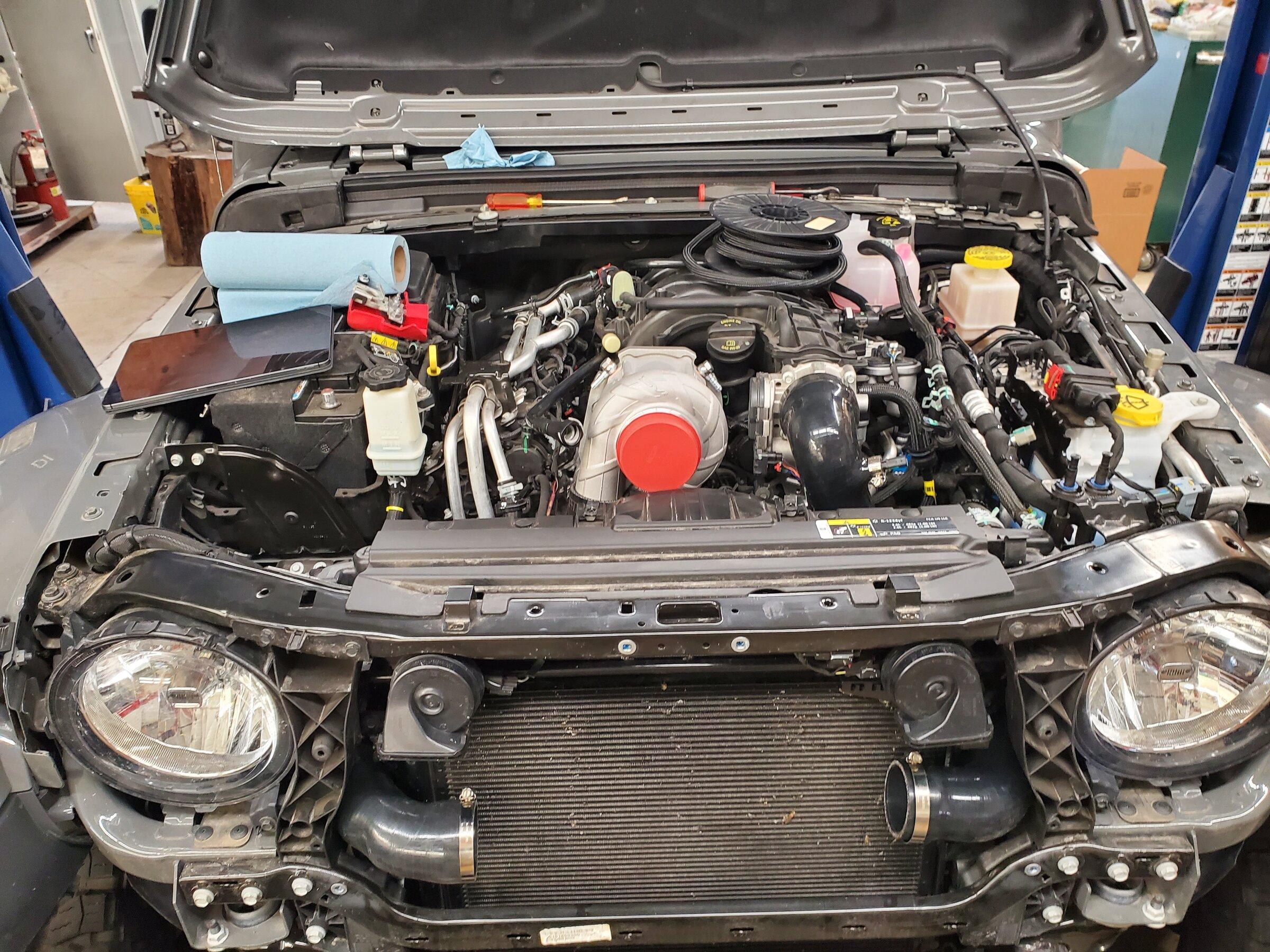
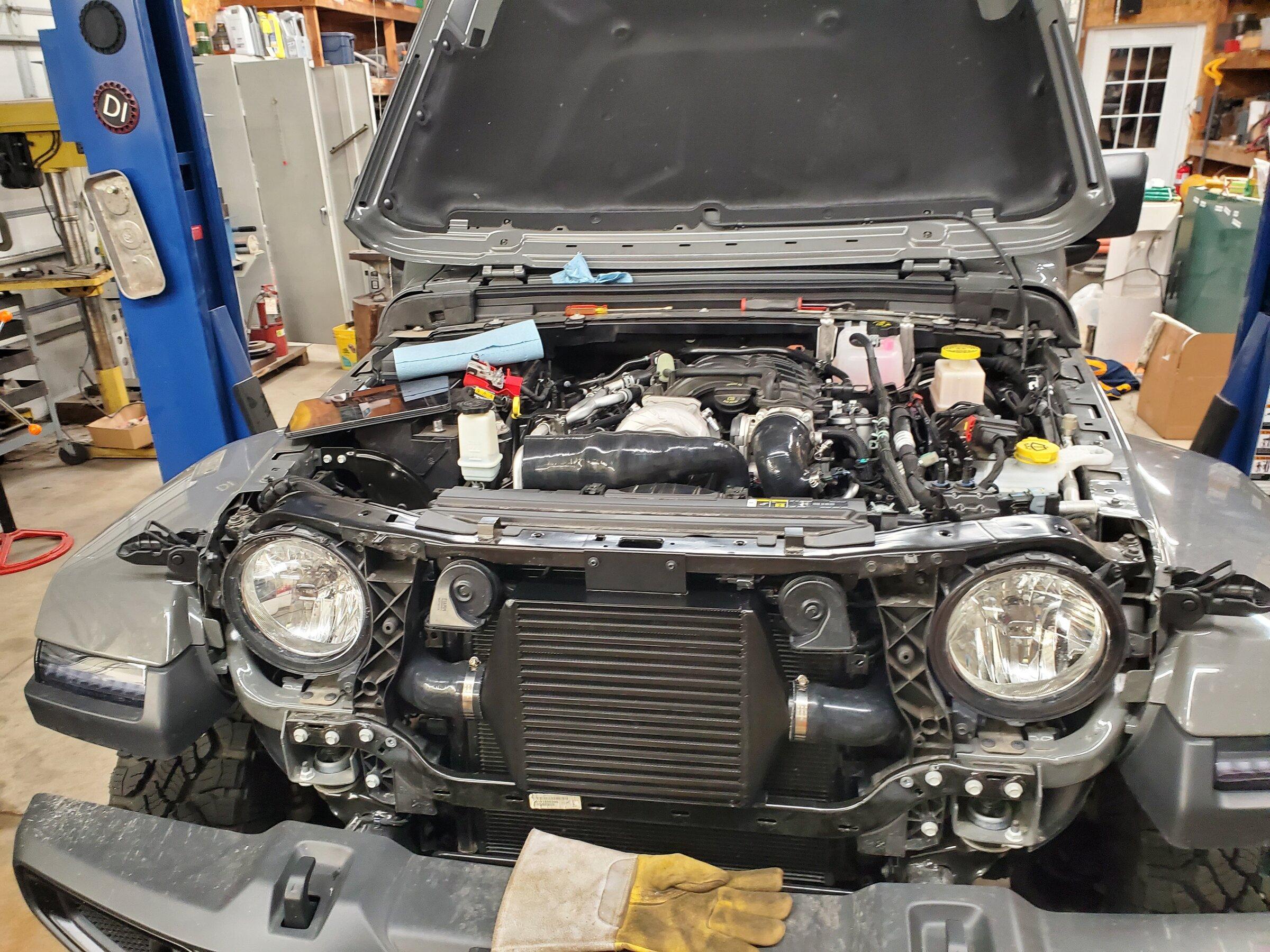
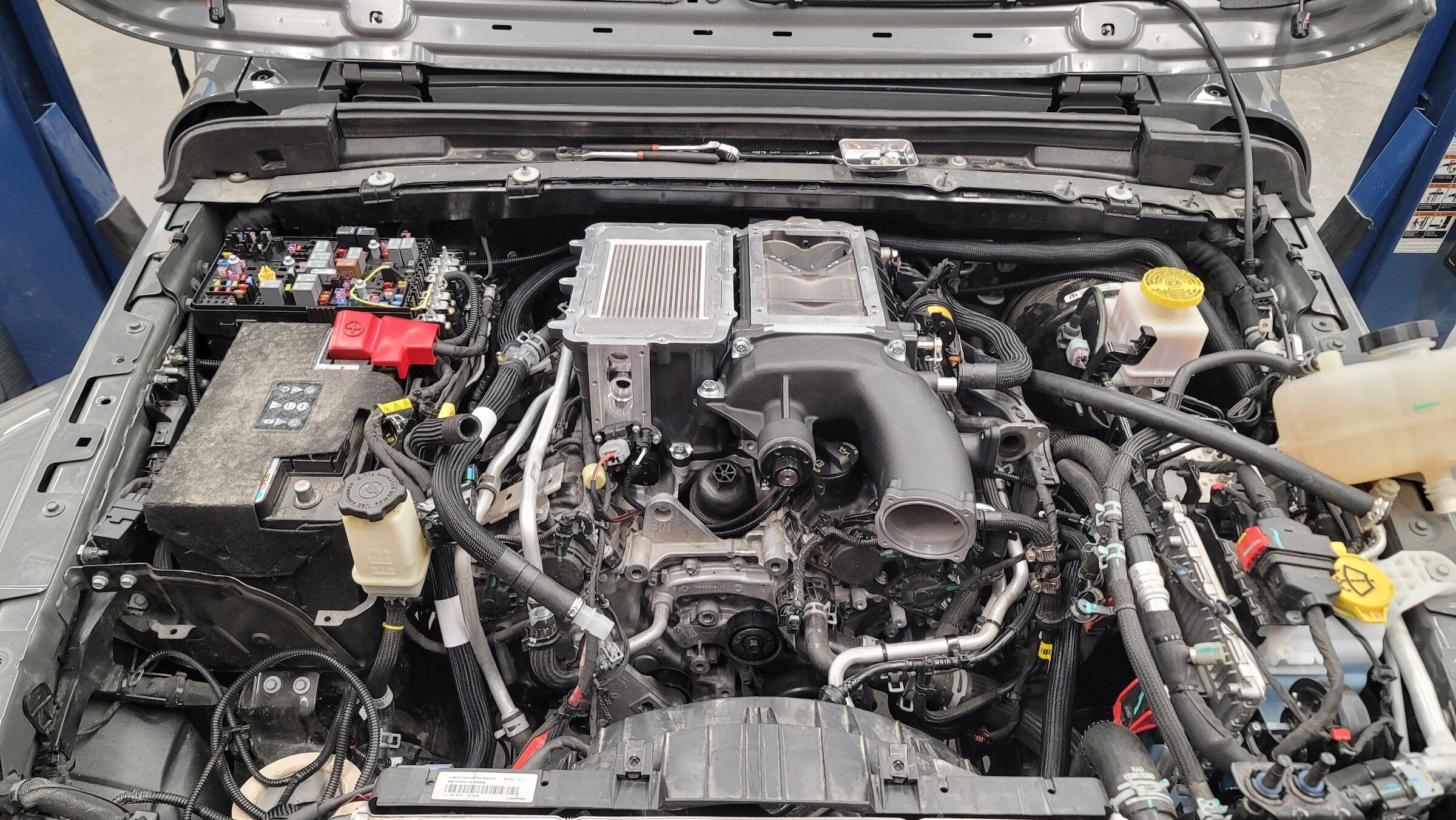
The installation of the Hamburger kit is straightforward. There is some trimming of factory parts (airbox, radiator support, fan shroud), and while this sucks it’s not that big a deal. There are fewer components to the Hamburger kit and it is easier to install than the Magnuson. However, the installed product is not as OEM feeling as the Magnuson. Everything can be removed and the Jeep returned to stock but there are birthmarks left. The alternator wiring harness is modified for the relocation, I am replacing the modified wiring with a stock harness.

The instructions are okay but there are some unclear aspects and in a few cases I thought there were better ways to approach certain activities. All of the individual hardware and components were bagged and lettered, the included packing list was a great reference.

Jeep Gladiator Switching from Hamburgers to Magnuson Picture1


Jeep Gladiator Switching from Hamburgers to Magnuson 2020-07-18 10.17.10


Jeep Gladiator Switching from Hamburgers to Magnuson 2020-07-18 20.15.03


Jeep Gladiator Switching from Hamburgers to Magnuson 2020-07-18 21.38.42


The Magnuson Install

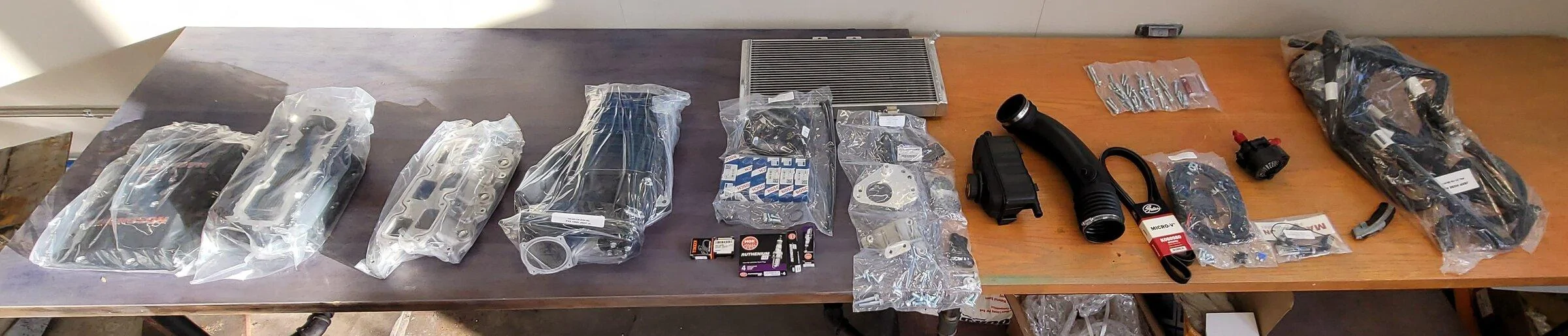
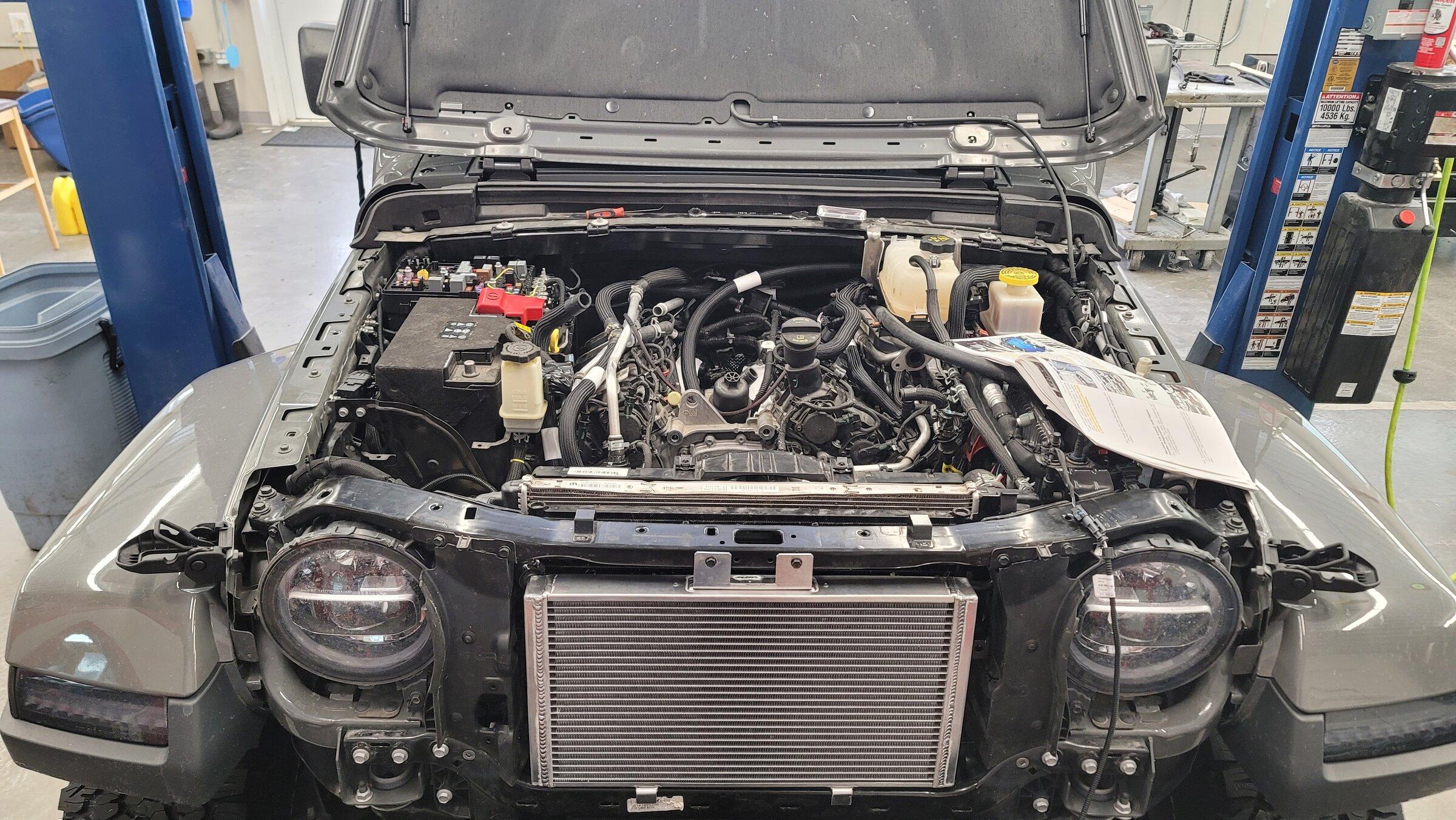
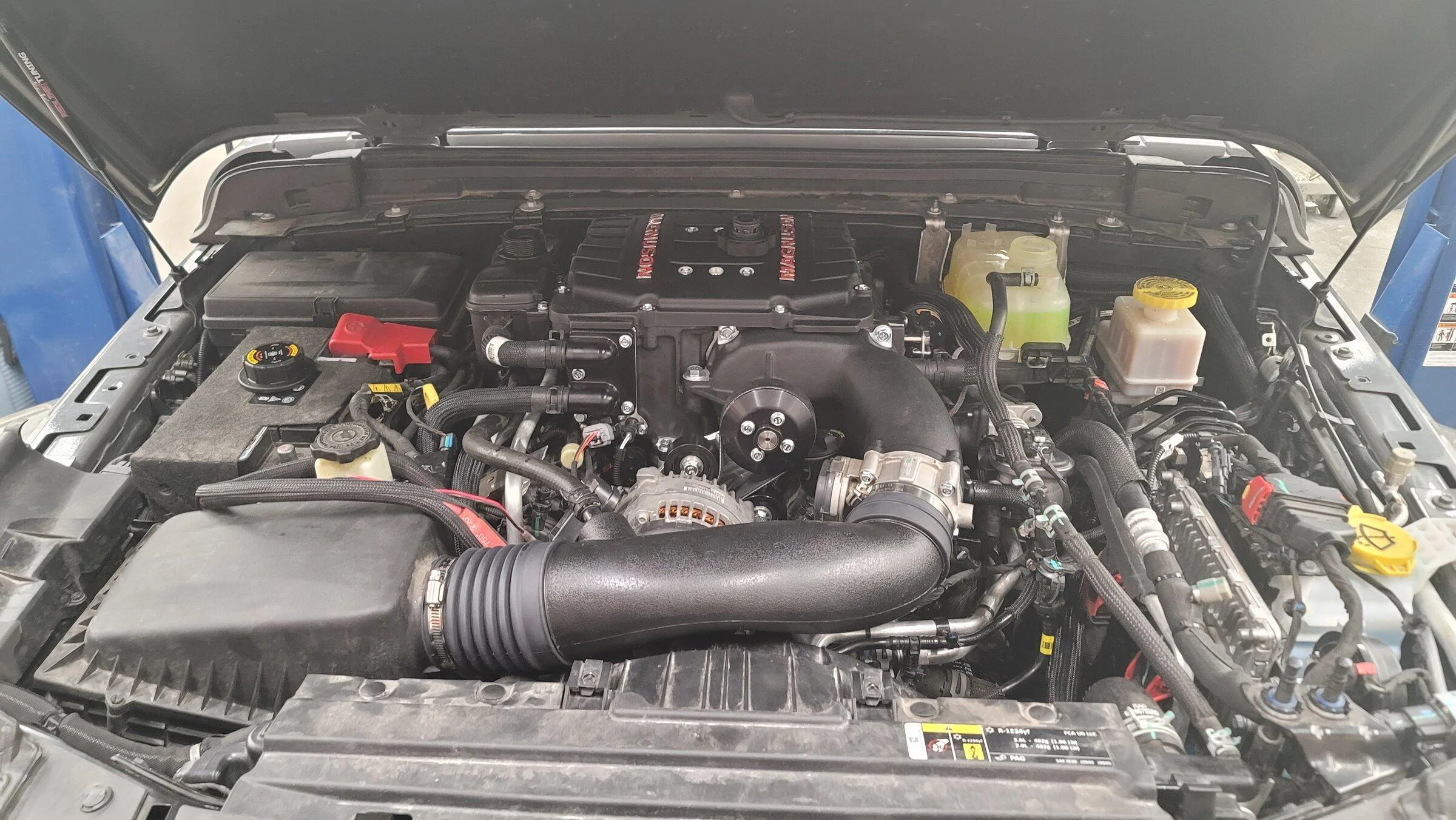
The Magnuson kit was packaged extremely well, all of the hardware was segmented in heat-sealed bags. The Magnuson components just look amazing, it all felt like it came from the factory (or better). The installation was straightforward but time-consuming, I got the install done in a day. The removal of the Hamburger kit was about 6 hours. Removal and installation were both done in a methodical and comfortable pace. Dave’s crib notes were very helpful for early upgrades of the pulley bearings, plugs, and sensor positioning. My only gripe would be that the hardware (nuts & bolts) packaging wasn’t labeled. This is a simple but meaningful thing that Magnuson should do.

I found the instructions to be well-constructed and thorough. A couple of the photos in the instructions were at weird angles or perspectives which required a little creative orientation.

Jeep Gladiator Switching from Hamburgers to Magnuson Maggie Parts cropped


Jeep Gladiator Switching from Hamburgers to Magnuson 2021-12-19 14.36.26


Jeep Gladiator Switching from Hamburgers to Magnuson 2021-12-19 16.22.17


Jeep Gladiator Switching from Hamburgers to Magnuson 2021-12-19 19.37.36


Install Comparison:

Either kit can be installed by a competent or experienced shade tree mechanic in my opinion. However, this is not a job for a minimalist tool collection. Having a proper set of mechanics tools and accessories is important. The Hamburger is “easier” to install but the Magnuson looks more polished.


Driving Comparison:

This comes down to preference and usage. I felt the Hamburger kit was powerful but always required a gear change to get boost. It was nearly always in vacuum unless I was WOT or pushing it. The Magnuson is pushing boost most of the time (for my driving style). I love that going up an incline or accelerating with the Magnuson results in boost pressure then shift, if necessary. I have seen a couple of lbs of boost all the way down below 1,500 RPM (of course this is the nature of the beast). I towed a ~6,000 lb load with the Magnuson this week and I appreciated the ability to modulate boost pressure with the right foot without requiring a shift and high RPM. It made for a more docile experience, which is exactly what I wanted.

It is too early to make an mpg claim, but it seems the Magnuson setup is thirstier. However, it might just be my ears prefer the whine and shift sound more ?. I suspect there won’t be a major difference in gas mileage between the two in the long run.

I was happy with the Hamburger but I am happier with the Magnuson. As shown in the graphs in the previous post, the WOT acceleration nets about the same result between the two kits. There are pros and cons of each configuration.


Top