Sponsored

Who is running Falcon 3.3 shocks

JTPatriot

Well-Known Member
Joined
May 22, 2020
Threads
59
Messages
668
Reaction score
870
Location
Kansas
Vehicle(s)
2020 Jeep JT Rubicon
Occupation
Proto Shop Technician
Thinking of getting a set of the Falcon 3.3's to replace my RK 2.25 RRD's. Anybody run these shocks with an RK 3" lift? How do you like them regardless of lift make.

Seems to be a wide range from like to dislike but not seeing to many Gladiator responses.
Sponsored
 

Teserak

Member
First Name
Scott
Joined
Apr 6, 2023
Threads
6
Messages
24
Reaction score
41
Location
Camarillo ca
Vehicle(s)
2022 gladiator eco diesel
you wont regret them if you do , I run them with a teraflex 4.5 long arm lift & love them
the adjustability its very easy & awesome ...
 

@californiajeeping

Well-Known Member
Joined
Apr 1, 2020
Threads
16
Messages
953
Reaction score
1,002
Location
California
Vehicle(s)
2022 Jeep Gladiator diesel, 1977 cj5 LS swapped
I have them and love them on the diesel with metal cloak lift.

Mine are diesel specific and valves stiffer which makes them work perfect with a softer set of springs.

In the softest setting they are firmer than the stock shocks or metal cloak rocksport shocks but have significantly more control. Walk around the truck and flip it to stiff and it handles drastically better on the road! Hugs the corners very well.
 

Jeepmonster

Well-Known Member
Joined
Jun 1, 2020
Threads
8
Messages
479
Reaction score
1,468
Location
Socal
Vehicle(s)
2020 JTR, 1968 Chevy C10
I went with the Falcon SP2 3.3 adjustables. I really like them. I put those on instead of the Fox shocks on my Mopar 2 inch lift. I went with 35 inch BFG KO2s. The soft setting is perfect for long highway drives, and the medium is perfect for everyday commuting. I feel like they stay planted very well. At initial installation, I went with the soft setting (where you twist the shaft, not knob settings). I too was somewhat concerned when I saw some of the negative reviews (too stiff), but I really like them. Way better than the soft factory Fox shocks.

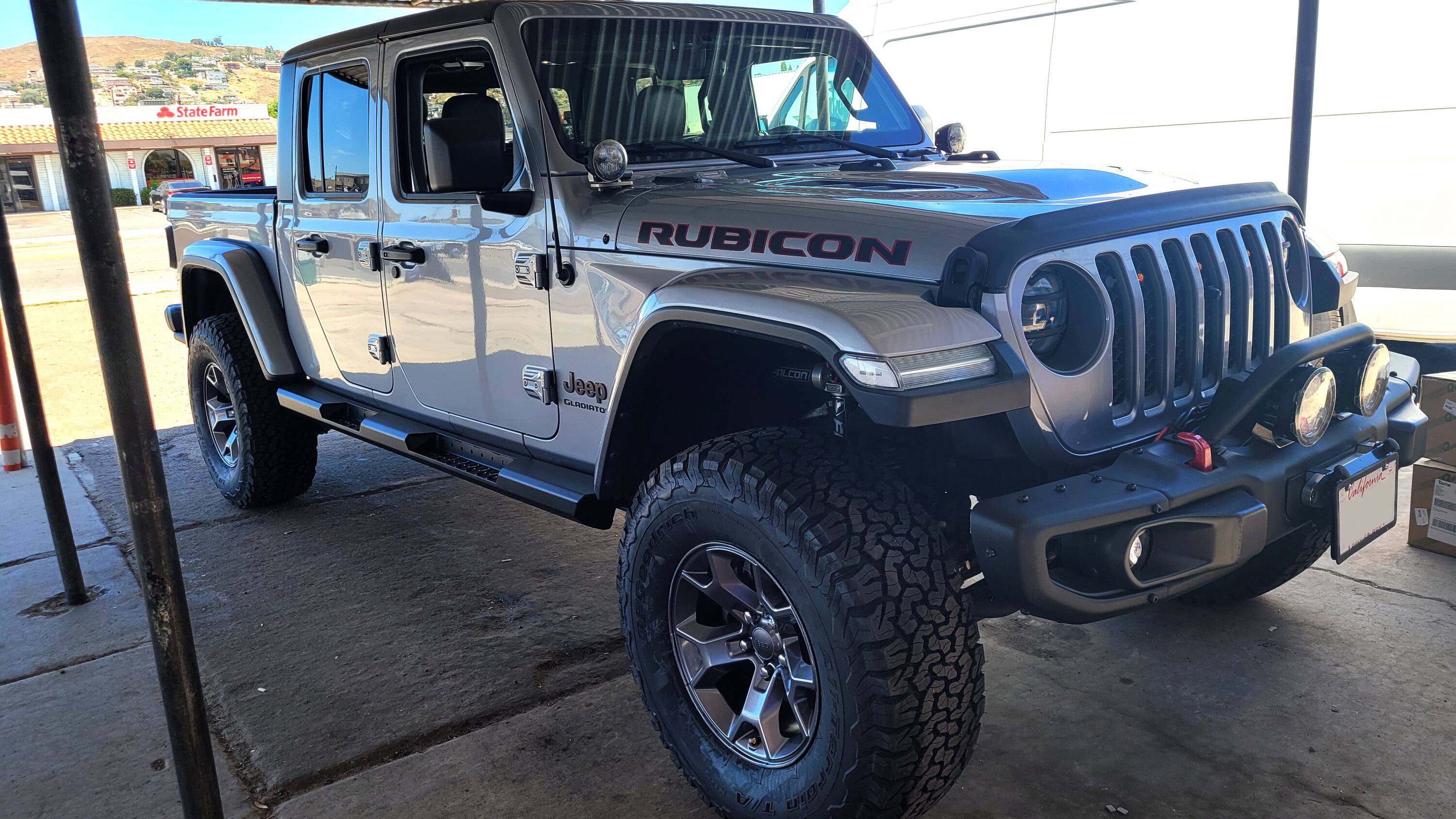
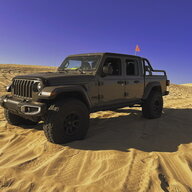
Jeep Gladiator Who is running Falcon 3.3 shocks 20230712_144155


Jeep Gladiator Who is running Falcon 3.3 shocks 20230712_153117
 

Forum Crawler

Well-Known Member
Joined
May 14, 2020
Threads
2
Messages
335
Reaction score
545
Location
USA
Vehicle(s)
2020 Gladiator
Occupation
Working for the man every night and day
Falcon 3.3 here. Absolute game changer. No regrets.
 

Sponsored

OP
OP
JTPatriot

JTPatriot

Well-Known Member
Joined
May 22, 2020
Threads
59
Messages
668
Reaction score
870
Location
Kansas
Vehicle(s)
2020 Jeep JT Rubicon
Occupation
Proto Shop Technician
Thank for the replies. Sounds as these just might be the next purchase.
 

Steven_B

Well-Known Member
First Name
Steven
Joined
Dec 20, 2020
Threads
8
Messages
480
Reaction score
749
Location
Federal Way, WA
Website
aroundthenw.com
Vehicle(s)
2018 WK2, 2001 XJ, 1993 YJ, 2021 JT EcoDiesel
Occupation
Digital Marketing Manager
I'm also looking into them. Who's running them on a heavy overland-style build? My JT is a diesel and is built a bit heavy (camper system). Currently running the Bilstein 5100s that came withe AEV kit.
 

fourfa

Well-Known Member
Joined
Dec 12, 2021
Threads
14
Messages
1,103
Reaction score
1,398
Location
CA
Vehicle(s)
22 JTRD + ACCC
Build Thread
Link
I'm also looking into them. Who's running them on a heavy overland-style build? My JT is a diesel and is built a bit heavy (camper system). Currently running the Bilstein 5100s that came withe AEV kit.
Heavy build with Alu-Cab Canopy Camper here, JTRD, 37s, usually loaded with supplies for two people and two big dogs for a week or more. Running with the heaviest Clayton spring rates (diesel front rate, heavy-duty rear rate) and the diesel-specific 3.3 SP2 shocks.. With this much weight and spring rate, it's underdamped for low shock speeds (ie body sway, big whoops, broad gutters etc) and takes almost two bounces to fully settle from big hits. All the adjustments (both the SP2 shaft twist, and the 3.3 quick-adjust knob) mainly adjust high-speed damping that you feel on square edges, rough surfaces, quick handling transitions.

I run the front shocks in the soft shaft-twist position. I tried the hard position for curiosity, and it was needlessly harsh with no real benefit in low-speed damping. I run the rear shocks in the hard twist position though - I didn't notice any change in harshness, and with so much rear weight up high, everything helps.

On the quick adjust knob, here's my experience:
Position 1: full open. I run this on high speed washboards and very rocky desert trails. Minimum harshness on high-shaft-speed events. It does reduce low-speed damping somewhat, and the body can be very floaty. Certain repeated whoops at just the right spacing can drive the body to top out and bottom out; gotta watch for those and slow down. Tires are usually at 16-20psi when I need position #1.
Position 2: medium. This is my general off-road setting. Not overly harsh on rough stuff, not as much float as position 1. Do note: the micro-adjust knob (rotary dial with positions 1-8) is only active in Position 2, and you can fine-adjust the front vs rear balance. I've found mine pretty good at 4 on both. I'm usually at 18-23psi here.
Position 3: closed. I run this on pavement, and there's better handling in quick transitions, feels more confident, with little cost in paved harshness IMHO. (But if I forget and drive pavement in #2, it's still fine, just a bit looser. #1 is uncomfortably floaty on pavement.). Usually 30-32psi for pavement.

If I could get these revalved for more low-speed damping, I'd think they were about perfect. I almost always want more low-speed damping. But the adjustments are very useful for high-speed damping, and the range available (#1 for the worst washboard, #3 for pavement) covers the range of conditions very usefully for me.

Please note, this is a heavy truck and these notes only apply to this heavy loaded truck with heavy spring rates. Stock or softer springs and less load will react completely different. It's hard to convey how much difference this makes. I hope people actually read this far into this post...
 

Steven_B

Well-Known Member
First Name
Steven
Joined
Dec 20, 2020
Threads
8
Messages
480
Reaction score
749
Location
Federal Way, WA
Website
aroundthenw.com
Vehicle(s)
2018 WK2, 2001 XJ, 1993 YJ, 2021 JT EcoDiesel
Occupation
Digital Marketing Manager
Heavy build with Alu-Cab Canopy Camper here, JTRD, 37s, usually loaded with supplies for two people and two big dogs for a week or more. Running with the heaviest Clayton spring rates (diesel front rate, heavy-duty rear rate) and the diesel-specific 3.3 SP2 shocks.. With this much weight and spring rate, it's underdamped for low shock speeds (ie body sway, big whoops, broad gutters etc) and takes almost two bounces to fully settle from big hits. All the adjustments (both the SP2 shaft twist, and the 3.3 quick-adjust knob) mainly adjust high-speed damping that you feel on square edges, rough surfaces, quick handling transitions.

I run the front shocks in the soft shaft-twist position. I tried the hard position for curiosity, and it was needlessly harsh with no real benefit in low-speed damping. I run the rear shocks in the hard twist position though - I didn't notice any change in harshness, and with so much rear weight up high, everything helps.

On the quick adjust knob, here's my experience:
Position 1: full open. I run this on high speed washboards and very rocky desert trails. Minimum harshness on high-shaft-speed events. It does reduce low-speed damping somewhat, and the body can be very floaty. Certain repeated whoops at just the right spacing can drive the body to top out and bottom out; gotta watch for those and slow down. Tires are usually at 16-20psi when I need position #1.
Position 2: medium. This is my general off-road setting. Not overly harsh on rough stuff, not as much float as position 1. Do note: the micro-adjust knob (rotary dial with positions 1-8) is only active in Position 2, and you can fine-adjust the front vs rear balance. I've found mine pretty good at 4 on both. I'm usually at 18-23psi here.
Position 3: closed. I run this on pavement, and there's better handling in quick transitions, feels more confident, with little cost in paved harshness IMHO. (But if I forget and drive pavement in #2, it's still fine, just a bit looser. #1 is uncomfortably floaty on pavement.). Usually 30-32psi for pavement.

If I could get these revalved for more low-speed damping, I'd think they were about perfect. I almost always want more low-speed damping. But the adjustments are very useful for high-speed damping, and the range available (#1 for the worst washboard, #3 for pavement) covers the range of conditions very usefully for me.

Please note, this is a heavy truck and these notes only apply to this heavy loaded truck with heavy spring rates. Stock or softer springs and less load will react completely different. It's hard to convey how much difference this makes. I hope people actually read this far into this post...

Awesome, thanks for the super in-depth reply. Sounds like our Gladiators are very similar in setup. The low-speed sway back and forth on the trail is what I want to tame the most. Are you running an aftermarket rear anti-sway bar? I am running the Helwig on the heaviest setting currently.

Thanks again for your honest and in-depth informational reply.
 

fourfa

Well-Known Member
Joined
Dec 12, 2021
Threads
14
Messages
1,103
Reaction score
1,398
Location
CA
Vehicle(s)
22 JTRD + ACCC
Build Thread
Link
Are you running an aftermarket rear anti-sway bar? I am running the Helwig on the heaviest setting currently.
Yes - I put in the Teraflex extended rear travel kit which includes a RockJock-style sway bar replacement with a straight bar over the frame rails, with forward-facing arms and downlinks almost right over the axle. So it fixes the dangling stock downlinks, and the weak stock upper mounts. But the sway bar rate is similar to stock. Helwig has multiple holes for adjusting rate, RockJock has a HD bar diameter available for more rate. Teraflex is fixed rate.

I did an entire suspension swap at once, so I didn't get to compare stock vs Teraflex sway bar system, or new Clayton springs with stock vs Teraflex sway bar etc. So overall it's much better than stock, because of better shocks and higher coil spring rates. But as a guess the sway bar is stock-like (Teraflex says "providing the same stability as the factory sway bar").

I was drawn in by the extended travel ability. I have not been able to hit Teraflex's advertised 16" of travel - the Clayton springs are strong and don't have quite enough free length to allow 16" (and this system includes top and bottom spring retainers, which restrict droop that might unseat the springs otherwise). I assume the Teraflex springs do flex to 16", but they also appear to be softer and wouldn't be as well suited to my heavy build. Oh well, I get ~13" of rear travel which is still quite good IMHO for such a heavy system, and I haven't found a situation yet where that's not enough. I need to flex it out more with the retainers removed, and see if there are any easy gains there. Maybe with a rubber cone instead of the hard retainer to make sure it reseats straight?
 

Stan H

Well-Known Member
First Name
Stanley
Joined
Oct 26, 2022
Threads
10
Messages
5,476
Reaction score
5,456
Location
WV
Vehicle(s)
Gladiator Rubicon 2021
Occupation
Safety Consultant
Awesome, thanks for the super in-depth reply. Sounds like our Gladiators are very similar in setup. The low-speed sway back and forth on the trail is what I want to tame the most. Are you running an aftermarket rear anti-sway bar? I am running the Helwig on the heaviest setting currently.

Thanks again for your honest and in-depth information and reply.
I went with Falcons 2.1 ,I run them on Performance setting because the Roads here are constant curves dips and swoops and etc. I was flopping around in my Jeep like a bobblehead. The Falcons stopped it ALL.
They made me a believer.
Sponsored


Top