
Sponsored

Aux. Battery: When did yours die (or how old is it now if it hasn't)?

When did your aux. battery die (or how old is it now if it hasn't)?


  • Total voters
    320

Jeeperjamie

Well-Known Member
First Name
Jamie
Joined
Feb 12, 2020
Threads
135
Messages
4,754
Reaction score
5,412
Location
Kannapolis nc
Vehicle(s)
2020 jeep gladiator
Occupation
Weyerhaeuser
Vehicle Showcase
1
Had to have both replaced at about 33k miles. They were replaced under warranty. The Jeep OEM batteries are no different from other manufacturer's batteries in that most don't make it to 36 months. Yes there are exceptions, but the rest of us have to keep AutoZone busy. :LOL:
Mostly true, except a battery in a BMW. I've owned 6 BMWs and the Factory Battery in everyone of them last at least 60,000 miles. Our 2017 X5 50i still has the original battery in it and it's 6 yrs old and has 74,000 miles on it.
Sponsored


tysongladiator

Well-Known Member
First Name
Tyson
Joined
Jun 8, 2019
Threads
47
Messages
976
Reaction score
1,287
Location
Florida
Vehicle(s)
Jeep Gladiator, Jeep Wrangler
Occupation
Learner
Vehicle Showcase
1
Mostly true, except a battery in a BMW. I've owned 6 BMWs and the Factory Battery in everyone of them last at least 60,000 miles. Our 2017 X5 50i still has the original battery in it and it's 6 yrs old and has 74,000 miles on it.
My second factory battery lasted 82,000 miles.
 

Lunentucker

Well-Known Member
Joined
Apr 24, 2022
Threads
247
Messages
5,873
Reaction score
15,379
Location
Virginia
Vehicle(s)
2021 Jeep Gladiator Mojave
Occupation
People Work?
I don't. That is why I own a diesel and I'm not deleting the AUX battery. Neither one is a real issue. I would consider a battery not lasting 3 plus years a minor issue, but that is not a design issue. It's a poor manufacturing issue. That was why I asked who makes the OEM battery.

There are 3 main battery makers. Clarios (JCI), East Penn Manufacturing and Exide. Look into these further and you will find out 2 of the 3 are junk. I only buy East Penn batteries and they always last 5+ years.
Clarios came from a rebranding of Johnson Controls after being purchased by Brookfield Business Partners in 2019.
Some say that Johnson made MOPAR batteries prior to that transaction, so they may well still be Clarios now.
 
OP
OP
Raven65

Raven65

Well-Known Member
Joined
Oct 25, 2022
Threads
12
Messages
275
Reaction score
427
Location
SC
Vehicle(s)
2022 Jeep Gladiator Sport S
<snip>
And yes, asking on a forum like this about problems is like going to a hospital looking for sick people (my favorite addage). Of course it's going to look worse there than it does in the real world. The same happens here, and in fact gets magnified here.

The unfortunate truth is that it's not just an echo chamber here, it's a highly magnified negatively-skewed echo chamber. If we used this forum as a measuring stick for Jeep reliability and quality, you'd expect our trucks to be stuck dead on the road half the time.
I don't buy that the majority of the people on this forum only come here to complain. It IS true that you'll see a lot of posts made by people who having a problem and are in search of a solution (and you'll certainly see posts about the more common problems over and over again because they're... well... common), but there are also TONS of people on here who just like reading about Gladiators and seeing how other people modify theirs and where they go with theirs, etc. This place is definitely not a negatively-skewed echo chamber. I don't perceive it as such anyway.

As for this aux. battery situation, batteries die over time... that's just a fact of physics... especially small motorcycle batteries - which the aux. battery basically is. I've owned many motorcycles since the early 80's (have four right now), so I'm no stranger to dealing with motorcycle batteries. My biggest gripe with the aux battery setup on the JL/JT is that the Jeep engineers in their infinite wisdom - knowing full well that these small batteries have a relatively short life - BURIED them down where they are - so that you have to spend a couple of freaking HOURS to replace one - when it would have taken just a few MINUTES if they had located it somewhere easily accessible. Its infuriating where they put it. It's an absolute afterthought.

All that said, I'm really glad to see that the vast majority of people responding to this poll so far are NOT having to replace their aux battery before its designed 36-month lifespan is up. It would be interesting to get more data on the ones that HAVE failed prematurely, but as someone already mentioned, doing that that properly would be a fairly involved, time-consuming process.
 

ShadowsPapa

Well-Known Member
First Name
Bill
Joined
Oct 12, 2019
Threads
247
Messages
40,445
Reaction score
53,879
Location
Runnells, Iowa
Vehicle(s)
'25 JTMX, '23 JLU 4xe, '82 SX4, '73 Javelin
Occupation
Retired auto mechanic, frmr gov't ntwrk security admin
Vehicle Showcase
3
Yeah, data is data and with almost 100 people reporting that is a pretty good sample. You have anything else to look at? Even if it is lower around 8% that is still bad. I wouldn't say 1 of 10 Jeep drivers being stranded of a dead battery in the 1st 2 years of ownership good no matter how you look at it.


I think you and I have widely different views on what we would define as success.
Can't go by forum polls. You are not polling the general population of Jeep owners. You are polling only those who join forums or who have a problem/issue/complaint, or those looking for solutions to either perceived or real issues.
Contrary to the belief of many people ON forums, they do not represent the majority or even the general feeling of typical vehicle owners.
If 8% of those in a poll say X, that's ONLY 8% of those who will respond to polls on this forum - or who even SAW that it exists (they may not even know about it) and of those that do respond, they are not likely to be even 10% of the vehicle owner population.
Do the math - you are looking at a pretty small number - not anywhere even close to 8% of the real world. Just not even close.

I only buy East Penn batteries and they always last 5+ years.
4 years here, and NAPA customers say about 4 years (same company makes 'em)
 

Sponsored

ShadowsPapa

Well-Known Member
First Name
Bill
Joined
Oct 12, 2019
Threads
247
Messages
40,445
Reaction score
53,879
Location
Runnells, Iowa
Vehicle(s)
'25 JTMX, '23 JLU 4xe, '82 SX4, '73 Javelin
Occupation
Retired auto mechanic, frmr gov't ntwrk security admin
Vehicle Showcase
3
I don't buy that the majority of the people on this forum only come here to complain. It IS true that you'll see a lot of posts made by people who having a problem and are in search of a solution (and you'll certainly see posts about the more common problems over and over again because they're... well... common), but there are also TONS of people on here who just like reading about Gladiators and seeing how other people modify theirs and where they go with theirs, etc. This place is definitely not a negatively-skewed echo chamber. I don't perceive it as such anyway.

As for this aux. battery situation, batteries die over time... that's just a fact of physics... especially small motorcycle batteries - which the aux. battery basically is. I've owned many motorcycles since the early 80's (have four right now), so I'm no stranger to dealing with motorcycle batteries. My biggest gripe with the aux battery setup on the JL/JT is that the Jeep engineers in their infinite wisdom - knowing full well that these small batteries have a relatively short life - BURIED them down where they are - so that you have to spend a couple of freaking HOURS to replace one - when it would have taken just a few MINUTES if they had located it somewhere easily accessible. Its infuriating where they put it. It's an absolute afterthought.

All that said, I'm really glad to see that the vast majority of people responding to this poll so far are NOT having to replace their aux battery before its designed 36-month lifespan is up. It would be interesting to get more data on the ones that HAVE failed prematurely, but as someone already mentioned, doing that that properly would be a fairly involved, time-consuming process.
Gee, the batteries in my bikes, my last one being a Yamaha Maxim 750 shaft drive years ago, lasted a good 4 to 5 years with ease. But then again - I kept them charged.
These aux batteries are more like lawn tractor batteries, IMO. But even then, my lawn tractor battery is currently well over 5 years old and that is even with a lot of sitting between uses. Granted, there's NO DRAIN on the battery as it sits. None. Pull the cable and there will be no spark and use a meter or light and there's NOTHING. That matters, too.
 

Gezer

Well-Known Member
First Name
Tom
Joined
Oct 8, 2019
Threads
2
Messages
48
Reaction score
37
Location
North Carolina
Vehicle(s)
2020 gladiator overland
End of this August will be 4 years. Like others I turn off the start stop when I remember and it is always in the driveway.
 

@californiajeeping

Well-Known Member
Joined
Apr 1, 2020
Threads
16
Messages
953
Reaction score
1,006
Location
California
Vehicle(s)
2022 Jeep Gladiator diesel, 1977 cj5 LS swapped
I have essentially resolved the defective factory setup by removing the aux.

Yes the alternator turns off at times. Yes it still does this. The difference is my agm battery can hold the float voltage higher. Is that straining the alternator. It’s spending less time under a large load because it’s not constantly charging batteries that are either dead or low Soc.

Now when the alternator decides to do it’s eco shit it still holds vehicle voltage above 13v. The battery is AGM and will live fine under a 13-14v float voltage. Even says so on the box.

Even the start stop functions better if you want to use it. The larger main battery holds voltage much better without a motorcycle battery leeching power constantly.
 

ShadowsPapa

Well-Known Member
First Name
Bill
Joined
Oct 12, 2019
Threads
247
Messages
40,445
Reaction score
53,879
Location
Runnells, Iowa
Vehicle(s)
'25 JTMX, '23 JLU 4xe, '82 SX4, '73 Javelin
Occupation
Retired auto mechanic, frmr gov't ntwrk security admin
Vehicle Showcase
3
The larger main battery holds voltage much better without a motorcycle battery leeching power constantly.
Mistake right there - the smaller battery doesn't "leech" anything.
They are both charged to the same voltage as they are in parallel. when the alternator is at a voltage high enough to charge, it's being seen as one big battery and nothing leeches anything.
The stock Jeep batteries are AGM. It's laid out in the control systems as AGM - type and size are plugged in.
Yes the alternator turns off at times. Yes it still does this. The difference is my agm battery can hold the float voltage higher.
It’s spending less time under a large load because it’s not constantly charging batteries that are either dead or low Soc.
That makes no sense. Hold the float voltage higher? That's not what's happening at all.
AGM batteries are typically "fully charged" or "100% SoC" at anywhere from 12.7 to 12.8, some a bit off those numbers but it matters not because it makes no difference to anything other than the owner realizing their particular batteries are 100% or not. So really no one should care if theirs are fully charged at 12.7 or 12.9 - but it makes people feel better to see a higher number.
Float voltage is whatever the float charger determines to keep a battery at the same state of charge. Again, who cares what it really is. Some will take a bit more to keep at their current level, some a bit less. The IBS works with the BCM and PCM to determine what that's going to be for the batteries in the truck.
There would be no difference - two in parallel or one large battery. Same thing electrically, same thing charging. (as long as both are the same type and same AGE - so it's best to keep them within a short time period of each other)
You haven't changed anything as far as "the alternator" because these are smart systems with output adjusted by the PCM based on the IBS historical and current information.
The only thing you have done different is to put in better AGM battery than the factory supplied. The alternator is never under a large load as far as "charging batteries". The task for the alternator is to provide operating power for the vehicle. Charging the batteries would be a drop in the bucket for a 180+ amp alternator. Only 20-30 amps of that is going to be for charging batteries and only then if they are really low. So you've done nothing to take the load off the alternator. I could drop a 37 amp 10Si on there and keep the batteries up.

There's a whole lot of bad information, misunderstanding of how batteries work, of how these alternators work, of the way the "charging system" functions and more.
I hope no one is seeing that as educational as it's not really even close.
 
Last edited:

Jeeperjamie

Well-Known Member
First Name
Jamie
Joined
Feb 12, 2020
Threads
135
Messages
4,754
Reaction score
5,412
Location
Kannapolis nc
Vehicle(s)
2020 jeep gladiator
Occupation
Weyerhaeuser
Vehicle Showcase
1
I have essentially resolved the defective factory setup by removing the aux.

Yes the alternator turns off at times. Yes it still does this. The difference is my agm battery can hold the float voltage higher. Is that straining the alternator. It’s spending less time under a large load because it’s not constantly charging batteries that are either dead or low Soc.

Now when the alternator decides to do it’s eco shit it still holds vehicle voltage above 13v. The battery is AGM and will live fine under a 13-14v float voltage. Even says so on the box.

Even the start stop functions better if you want to use it. The larger main battery holds voltage much better without a motorcycle battery leeching power constantly.
I'm no expert but this seems like a lot of bad info to me. The part that gets me about the post is the comment about the Auto Start/Stop working better. Not sure how removing the battery that functions that and adding one large battery would make it function better. A pressure switch on the brake pedal is what triggers the auto start/stop so unless you figured out a way to make that more or less sensitive then just adding one battery over two isn't going to make it function better.

I guess when you do a mod you got to figure out a way to justify it!
 

Sponsored

jmdwifi

Well-Known Member
First Name
John
Joined
Dec 23, 2019
Threads
22
Messages
654
Reaction score
785
Location
Virginia
Vehicle(s)
2025 Rubicon X
Occupation
Wireless Network engineer, Drummer of WOLF LEGION
Genesys dual battery system and everything works perfectly.
 

Mr. Wuf

Well-Known Member
First Name
Michael
Joined
Feb 9, 2020
Threads
17
Messages
182
Reaction score
262
Location
North Carolina
Vehicle(s)
2020 Jeep Gladiator Overland
Build Thread
Link
Occupation
Principal
Mine died at around the 2-year mark with probably 45,000-50,000 miles on it.
 

@californiajeeping

Well-Known Member
Joined
Apr 1, 2020
Threads
16
Messages
953
Reaction score
1,006
Location
California
Vehicle(s)
2022 Jeep Gladiator diesel, 1977 cj5 LS swapped
I'm no expert but this seems like a lot of bad info to me. The part that gets me about the post is the comment about the Auto Start/Stop working better. Not sure how removing the battery that functions that and adding one large battery would make it function better. A pressure switch on the brake pedal is what triggers the auto start/stop so unless you figured out a way to make that more or less sensitive then just adding one battery over two isn't going to make it function better.

I guess when you do a mod you got to figure out a way to justify it!
the starter turns over faster. Likely because it’s getting 13.5v instead of dropping to the low 12s when the engines off. I’ve owned two of these a 2020 gasser and the 2022 diesel. Both had ess and battery issues until now.
 

sharpsicle

Well-Known Member
Joined
Apr 29, 2021
Threads
22
Messages
2,768
Reaction score
6,257
Location
Tampa, FL / Milwaukee, WI
Vehicle(s)
2020 Gladiator Overland, 2002 VTX1800
I have essentially resolved the defective factory setup by removing the aux.

Yes the alternator turns off at times. Yes it still does this. The difference is my agm battery can hold the float voltage higher. Is that straining the alternator. It’s spending less time under a large load because it’s not constantly charging batteries that are either dead or low Soc.

Now when the alternator decides to do it’s eco shit it still holds vehicle voltage above 13v. The battery is AGM and will live fine under a 13-14v float voltage. Even says so on the box.

Even the start stop functions better if you want to use it. The larger main battery holds voltage much better without a motorcycle battery leeching power constantly.
the starter turns over faster. Likely because it’s getting 13.5v instead of dropping to the low 12s when the engines off. I’ve owned two of these a 2020 gasser and the 2022 diesel. Both had ess and battery issues until now.
I think you're confusing a lot of the characteristics of battery capacity with voltage. Voltage does not have an impact on or can be used to measure a battery's available capacity in this way without amperage. The voltage drop you're observing is a result, not an action, of using available amps. This is why you'll see it pop right back up to it's actual voltage level once it's done being used.

You put in a battery with a larger capacity. Add to that, the aux battery isn't even used for the starter, so having it there or not would not affect how the starter functions. You removed the battery that doesn't power the starter and upgraded the one that does. That's why you're seeing this with the starter. Nothing to do with the aux battery. You would get the same results if you upgraded the main and left the aux battery as it was in the system. You would see this in any vehicle, regardless of ESS being present or not, regardless of multiple batteries being present or not, regardless of the system design. While voltage and capacity are two sides of the same coin, it's important to understand their differences, and why you cannot use one to measure the effectiveness of the other. This is why I suggested you look into a capacitor rather than more battery for your high-load audio system.

This is also applicable to your statements about alternator "load". The "load" is not measured in voltage, it is measured in amperage. On larger capacity batteries, your voltage may not drop as significantly when x amps are used simply because of the capacity. That does not mean the alternator has less work to do, though. It still needs to recharge those amps. So the "load" actually doesn't change. All you've done is increase your buffer size. Voltage increases in order to push amps from A to B, in the same way air or water pressure increases force a flow. When you activate something like the starter, the drop in voltage from the battery to the starter is akin to a low-pressure system, and high will push to low.

Think of it like a swimming pool, and this year you upgraded your pool with one that has the same depth (same voltage) but is twice as big (twice the capacity). But you still fill it with the same hose from the house. That means when x amount of the water gets used or lost, your overall pool level doesn't drop as far. But to refill it, you need to run the hose for the same amount of time. That's the same as a larger capacity battery. The water level is voltage, the amount of water is amperage. In this way, monitoring your voltages doesn't tell you what you really need to know in regards to loads or usage.

Admittedly I am leaving out a lot of the science and nuances of electrical systems and batteries, but I'm also trying to keep it simple and understandable. Capacity, load, and usage is measured in amps, not volts. They are related, yes, but not substitutes in measurement. I am glad you are getting better results, but don't use those results to muddy the water on this stuff.
 
Last edited:

ShadowsPapa

Well-Known Member
First Name
Bill
Joined
Oct 12, 2019
Threads
247
Messages
40,445
Reaction score
53,879
Location
Runnells, Iowa
Vehicle(s)
'25 JTMX, '23 JLU 4xe, '82 SX4, '73 Javelin
Occupation
Retired auto mechanic, frmr gov't ntwrk security admin
Vehicle Showcase
3
Adding to sharpsicle's post -
I saw "float voltage is higher, it says so" as if that's a GOOD thing.
It's not - not in these vehicles that are programmed for specific criteria.
Float voltage is the voltage required to keep a battery at a constant state - compensating for the battery's self-discharge.
That can often be ~13.5 volts to 13.6 volts.
If a battery requires more pressure to compensate for the natural self-discharge - how is that a good thing?
When an AGM battery charger goes through all of the phases of charging an AGM battery, and you leave it in place, it may go into float mode - and that will mean it's "charging" at the float voltage. If a battery requires much more to maintain full charge - will it stay fully charged?
Float in a charger may also refer to a part of a specific phase of the charging process.
There's a couple of ways the term can be used and what it may refer to.
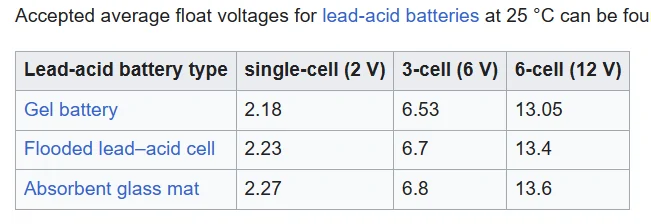
And - the float voltage varies with temperature. Typically rated at 25(c) (77(F)
A flooded lead-acid battery (12v) float voltage is lower than typical AGM batteries - another reason to use a correct charger for AGM -
13.4 vs. 13.5 to 13.6 for AGM (varies with the specific battery)

Anyway, all of that because it appeared to be mentioned as a good thing. It's a "meh, so what?" thing - unless you are trying to match the charging device or system to the battery when designing things.

Alternators in these are of very high amperage output not for the batteries but for the load of the truck's electrical system - I mean, look at the fuse ratings for the fan, EHPS pump and certain other things. The batteries themselves take a tiny fraction of that total available output to charge.
Again, if it wasn't for the fan, EHPS, vacuum pump, fuel injection, fuel pump, and all of the electronics and other stuff, you could charge the batteries with a 1960s alternator.
The voltage seen on the screen isn't all about the battery - well, it is and it isn't. It's to cover the load of the operating vehicle, prevent discharge of the batteries, and if needed, charge the batteries.
All the charging system should be doing is putting back that which was taken out when the vehicle was sitting, putting back from natural self-discharge, and putting back from cranking and starting the engine.
Once the battery is topped off (according to historical data and the IBS current information), all the "charging system" does is handle the load of the vehicle. The battery is not powering anything while the engine is running - the alternator is supposed to cover everything and nothing should be coming out of the battery.

This is why I suggested you look into a capacitor rather than more battery for your high-load audio system.
Yeah, what happens is at idle, the alternator can't cover the load - so the battery is drawn upon. That is NOT good. No load of the vehicle should come from the battery. It means the load is so heavy that the alternator isn't big enough to cover the audio at lower RPM. Bigger alternator is needed.
(and I was in the Alpine auto audio contests in the 1980s and frankly, I think there's a whole lot of bragging on the "it won't keep up with my audio system" because even back then our systems could keep up for the most part with big multiple amps and so on. someone will have profound hearing loss in short order if they REALLY have that much power in that cab. Once you reach a certain point, the rest is all meant to impress, no other function. Seriously? A 240 amp alternator not handling a stereo system? ?)

So yeah, a capacitor or a bigger alternator or if it was an older vehicle, a smaller pully on the alternator to spin it faster at idle. Not sure what the idle RPM output of these is - likely not great and the ratio (pulleys) is likely more to maximize mpg rather than output at idle.

Jeep Gladiator Aux. Battery: When did yours die (or how old is it now if it hasn't)? 1690552215801


And this? Wow, sorry, I actually smiled at that - no, your fully charged, 100% SoC is STILL under 13 volts, around 12.8.
Your starter is in no way in hell getting 13.5 volts.
Float voltage is not fully charged voltage.
Float is what it takes to maintain the 12.8 fully charged voltage once it's charged.
When cranking, that 12.8 drops down to BELOW 12.8
How far below 12.8 and how fast depends on a lot of things - draw of the starter, capacity of the battery (which depends on age and other factors) and length of time cranking. But it will drop unless it's so massive with so many plates no single plate has to do any real work to be able to supply the amperage of the starter.

If your battery maker says the float voltage is 13.5 - that's 100% absolutely totally NORMAL for an AGM battery. it's not higher.
Your new battery, fully charged, will still be ~12.8 Otherwise no charging system out there could properly and fully charge a battery that had a normal voltage of 13.5 volts.
It's only higher than a flooded cell. 13.5 is the usual float voltage for a typical AGM car battery.
And that has 0 to do with the fully charged voltage.
It's only cranking faster because of what was already explained - more capacity so more able to supply the amperage needed and not drop the pressure.
Like a water pipe - it can supply the volume without pressure loss.

So if your float voltage is 13.5 - you have a normal AGM battery.

Jeep Gladiator Aux. Battery: When did yours die (or how old is it now if it hasn't)? 1690552485011
Sponsored

 
Last edited:


Top